

It took less than 48 hours for Donald Trump to revert to form after his much-praised pivot to unity following an apparent assassination attempt during the White House Correspondents’ Dinner on Saturday. The shift served as a reminder to anyone credulous enough to have been taken in by his performance that the leopard does not change its spots. Through attrition and capitulation, the bar has been set so low for Trump by the media that the president not blaming the people who were nearly shot was somehow praiseworthy.
On Saturday night, Trump stood before reporters in the White House’s Brady Briefing Room after an armed 31-year-old man from Torrance, California, was stopped by the Secret Service trying to storm the Washington Hilton in what appears to be an attempted attack on Trump and his gathered Cabinet. The president sounded chastened. “We have to — we have to resolve our differences,” he told the press, a group he has spent the better part of a decade labeling enemies of the people. Some in the press corps, exhausted and rattled after a gunman interrupted their dinner, were grateful for the crumbs.
“What We Learn About Trump in His Rare Moments of Self-Reflection,” read the title of Matt Viser and Jonathan Lemire’s analysis of Trump’s comments in the Atlantic.
CNN’s Brian Stelter, who wrote a book documenting the president’s war on journalism in meticulous detail, praised the president for his restraint. “Trump very easily could have blamed the media last night, but instead, he basically said “we’re all in this together,” Stelter concluded on Sunday.
But within hours, the same president whom Stelter had briefly cast as a unifier was back to doing what he has always done: demanding his perceived enemies be punished.
In taking the post-shooting moment at face value, he essentially vouched for Trump’s gesture. But within hours, the same president whom Stelter had briefly cast as a unifier was back to doing what he has always done: demanding his perceived enemies be punished.
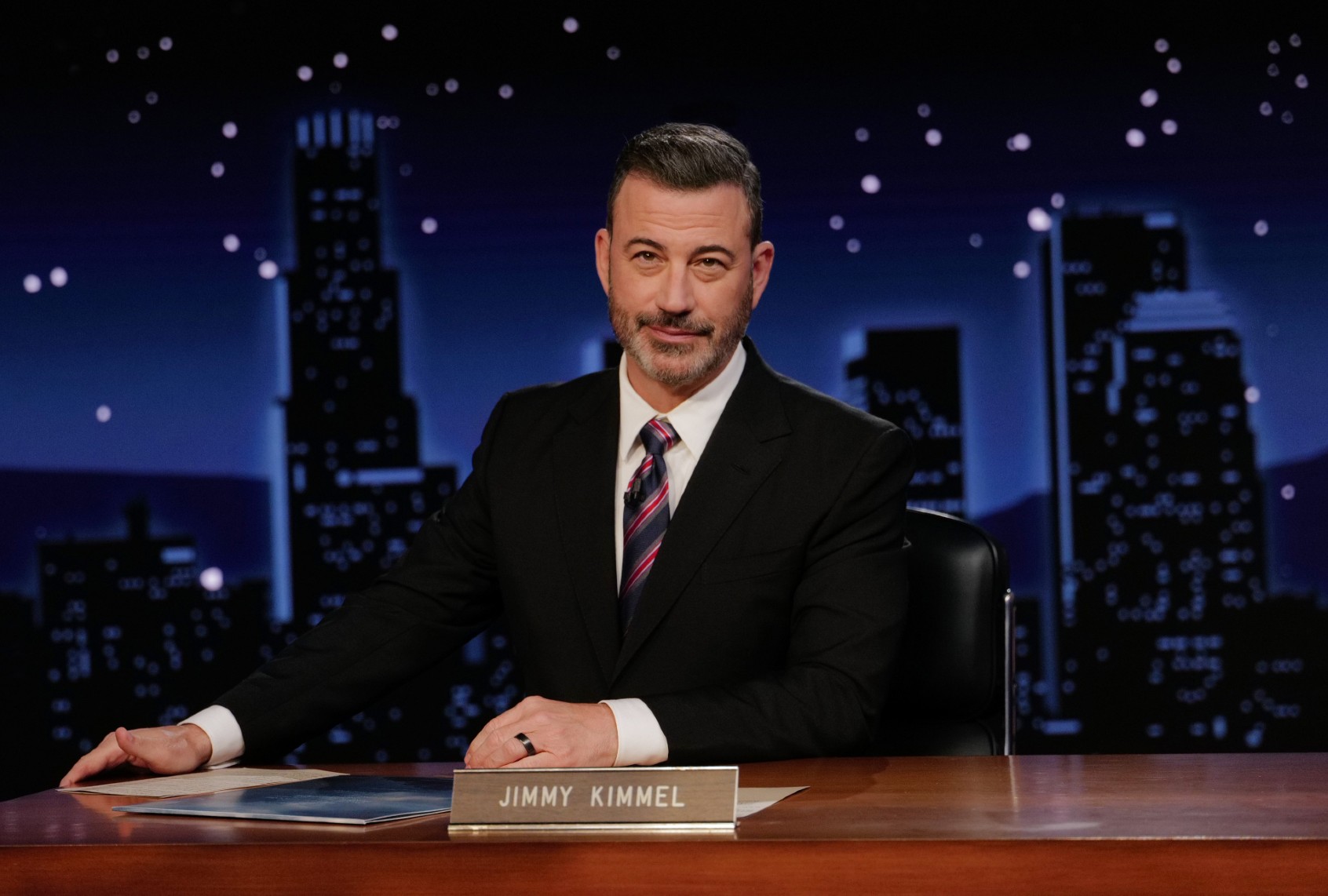
Trump, following the lead of First Lady Melania Trump, took to Truth Social on Monday afternoon to demand that Disney and ABC immediately fire Jimmy Kimmel, accusing the late-night host of making “a despicable call to violence” for a joke he made three days before the shooting. During a parody on Thursday’s show in which he pretended to give a speech at the Correspondents’ Dinner, Kimmel joked, “Our First Lady Melania is here. Look at her, so beautiful. Mrs. Trump, you have a glow like an expectant widow.”
The “expectant widow” line was a morbid, vaguely risqué gag, the kind of joke that has been standard fare at the Correspondents’ Dinner and roasts for decades. But Melania Trump, who recently demonstrated a lacking understanding of the Streisand effect with her bizarrely-timed denial of Jeffrey Epstein links, amplified Kimmel’s joke when she demanded Kimmel’s firing on Monday morning. In a formal statement to ABC, she wrote that “people like Kimmel shouldn’t have the opportunity to enter our homes each evening to spread hate.” With a straight face White House press secretary Karoline Leavitt argued that his joke constituted an incitement to assassination. Steven Cheung, the president’s communications director, called Kimmel “a shit human being.” MAGA media, having been given their marching orders, fanned out across television and social media to amplify the outrage.
“This was like déjà vu for me today,” Kimmel said in his Monday night monologue, recalling Trump’s unsuccessful campaign in September to get him yanked off air for a joke about reactions to MAGA influencer Charlie Kirk’s killing.
By Tuesday afternoon, the Federal Communications Commission had issued an order directing Disney’s eight ABC-owned television stations to file their broadcast license renewals within 30 days — years ahead of schedule. Chairman Brendan Carr was sitting in the room for the Correspondents’ Dinner, an event explicitly dedicated to celebrating the First Amendment. He attended a tribute to press freedom on Saturday and by Tuesday had weaponized a federal regulatory agency against a broadcaster for airing a comedian’s joke. The rationale offered, officially, is an ongoing investigation into Disney’s diversity, equity and inclusion policies. But Anna Gomez, the lone Democratic commissioner on the FCC, made clear the timing is no coincidence: “This is unprecedented, unlawful, and going nowhere. It is a political stunt and it won’t stick.”
Then, as if to remove any remaining doubt about the week’s theme, the Justice Department announced late Tuesday afternoon it had secured a second indictment against former FBI Director James Comey on two felony counts tied to a social media post that officials claimed constituted a threat against the president. The case revolves around a picture Comey posted on social media in May 2025 that showed shells on a beach forming the numbers “86 47.” (The number 86 can often refer to getting rid of something, while 47 corresponds to Trump’s current term as the 47th president.) Each count carries a maximum sentence of 10 years in prison. A warrant for Comey was also issued.
Want more sharp takes on politics? Sign up for our free newsletter, Standing Room Only, written by Amanda Marcotte, now also a weekly show on YouTube or wherever you get your podcasts.
So in the span of 72 hours, the Trump administration has demanded a television network fire a late-night host for a morbid joke, weaponized a federal regulatory agency to threaten that network’s broadcast licenses and indicted a former FBI director for posting a picture of seashells. All of this in the immediate wake of a shooting the administration has characterized as the product of dangerous anti-Trump rhetoric. The message being sent is not subtle: Threatening language is an outrage when it comes from Trump’s critics, and a protected expression of presidential authority when it comes from Trump himself, or from his aides. Karoline Leavitt, let us remember, told Fox News before the dinner that “there will be some shots fired tonight in the room.” No arrest warrant has been issued for her.
This asymmetry is what makes the media’s earlier willingness to credit Trump for a moment of unity so damaging. It creates the illusion of good faith where none exists, and it suggests that the president’s rhetoric can be evaluated in isolation, as a series of discrete moments, rather than as part of a coherent pattern of behavior.
We need your help to stay independent.
In reality, Trump has said the chairman of the joint chiefs of staff should be executed for treason. He has suggested, in terms not subtle enough to be called metaphors, that Liz Cheney should face a firing squad. He has trafficked in imagery and rhetoric that has put members of Congress, judges and journalists under security protection.
Media figures who know better, who have documented the administration’s assaults on the First Amendment in real time, found themselves genuinely moved that Trump didn’t exploit a near-tragedy to score points against the people in the room on Saturday. But far from a credit to the president, it’s an indictment of how far we’ve fallen since he announced his first presidential run in 2015.
The White House Correspondents’ Dinner has always been a strange ritual, a night when journalists and politicians gather to roast one another and briefly suspend the usual rules of engagement. Trump’s appearance this year — his first ever as president — and his response to a moment of crisis, offered an opportunity to finally suggest that something had shifted. After all, a decade of escalation has made each individual retreat from baseline decency seem remarkable by contrast. But nothing has shifted.
The attack on Jimmy Kimmel makes that clear. The indictment of James Comey makes it undeniable.
Read more
about the FCC
