
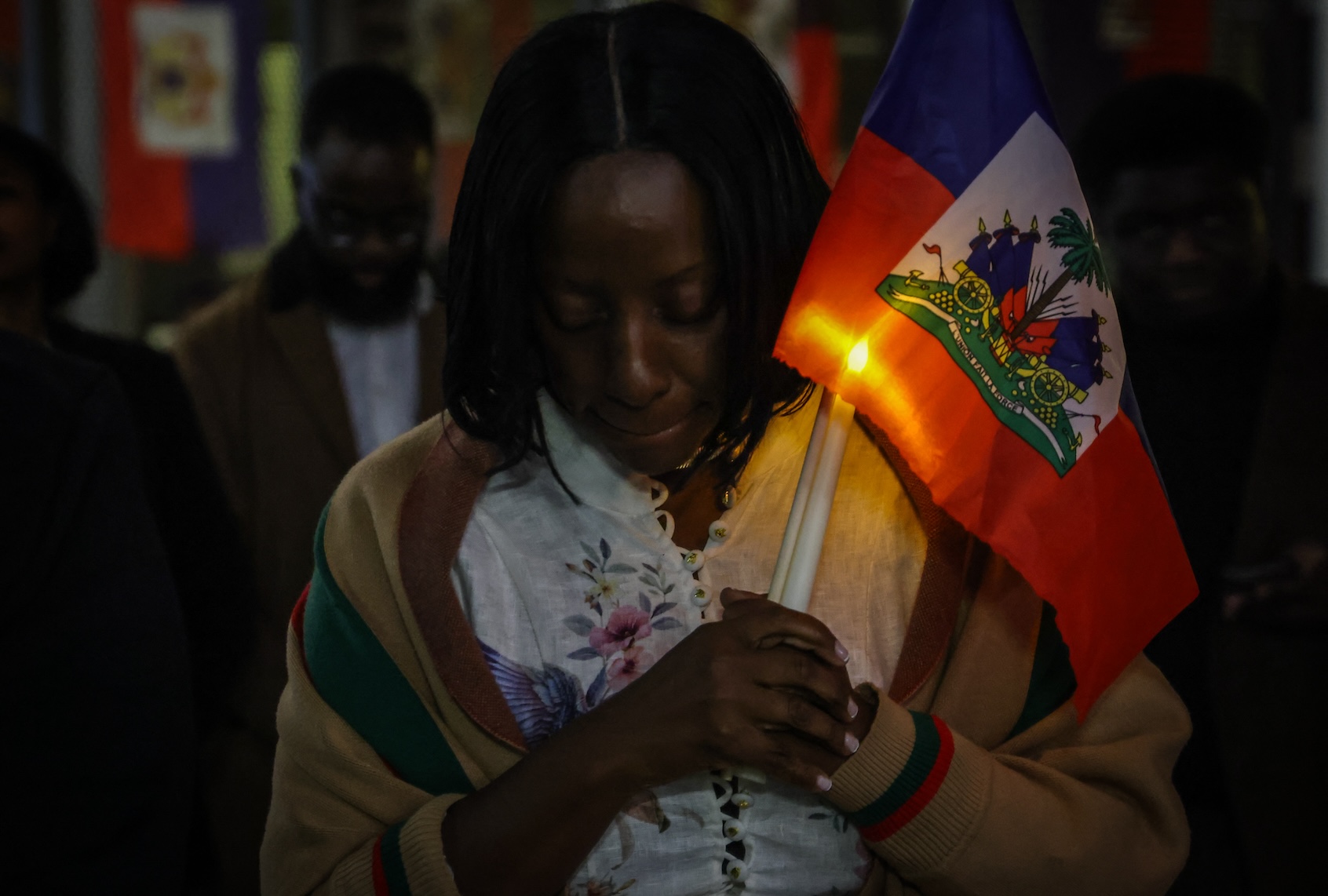

The air in Springfield, Ohio carries an unsettling quality these days. For almost two years, the post-industrial community has grappled with the potential loss of a sizeable portion of its population and workforce. That tension only grows more palpable as the Trump administration targets the status of many of the 15,000 Haitian immigrants within the city limits and the hundreds of thousands more beyond it.
In some ways, it’s become a new normal for Haitian Springfielders to anticipate the worst, and for their neighbors to fight against a government they see as threatening to rip their families apart. Viles Dorsainvil, the executive director of Haitian Community Support Center, calls it a lasting trauma that the immigrant population and their children will carry with them beyond this administration.
“Folks are still trying to deal with the fact that they do not have any stability here,” Dorsainvil told Salon. His organization helps community members pay for housing, utilities and legal fees, access transportation and receive interpretation assistance while advocating for immigration reform. “They know that they are not stable. They know that something can happen that can cause them to be removed or to be deported or to be detained. It affects not only the daily lives of folks, but also creates some type of trauma for the folks trying to cope with these unsettling circumstances.”
Some 350,000 Haitian immigrants hold temporary protected status, a legal designation for those whose home country isn’t safe for them to return to that allows them to live and work in the U.S. for renewable periods of up to 18 months. With the Supreme Court set to rule on the life of TPS for Haitians this summer, Haitian community leaders, though hopeful, remain unsure of what the future will hold while trying to keep their communities afloat in the wake of the damage the legal upheaval has already done.
“The mood right now is a mixed feeling,” Dorsainvil said. “People try to be optimistic, but at the same time, there is still that uncertainty because we cannot predict what the ruling is going to be.”
Many Haitian immigrants were first granted TPS after a devastating 2010 earthquake killed more than 300,000 people and left the island nation in ruins. As the environmental deterioration and political upheaval in Haiti continued into the 2020s with the assassination of their president in 2021 and subsequent takeover by violent gangs, the Department of Homeland Security repeatedly extended the status. Then, former South Dakota Gov. Kristi Noem became Homeland Security Secretary, with one her first moves being to terminate TPS in early 2025.
Since then, Haitian TPS recipients across the country have had their lives and futures thrust into near-constant limbo, with their only relief coming in the form of federal court rulings undoing Noem’s partial vacation of their status and placing its termination on hold — until the Trump administration inevitably appeals them.
“People try to be optimistic, but at the same time, there is still that uncertainty because we cannot predict what the ruling is going to be.”
For the thousands of TPS recipients in Springfield, the turmoil began during the 2024 election cycle when then-candidate Donald Trump repeated inflammatory and false claims about the community eating pets. The burgeoning Ohio town soon became inundated with stigma and threats of violence, forcing Haitian community members into hiding and jeopardizing their ability to work. Nearly two years later, thousands of Ohioans have organized and rallied on their behalf, but the constant back-and-forth around their legal status has made planning their day-to-day lives more difficult, Dorsainvil explained.
“What the administration says has a direct impact on folks because at the end of the day, we have to understand that when the president says something and the DHS acts based on what the president says that will create so much confusion among the employers and employees,” Dorsainvil said.
“We rely on faith, community engagement and action, or we’ll reflect on what has been happening and we take action. As long as we’re able to do that, we just would like a positive outcome of the Supreme Court hearing,” he added. “We just try to be optimistic; hope is something that keeps people going.”
In a nearly two-hour-long session on Wednesday morning, the Supreme Court heard oral argument in the consolidated cases Mullin v. Doe and Trump v. Miot, which will ultimately determine whether the Trump administration can strip status from hundreds of thousands of Syrian and Haitian immigrants. The Trump administration asked the court to intervene in the legal battle over TPS for Haitians in March after a federal judge in Washington, D.C. blocked the government from ending the program.
Specifically, the court considered whether the statute governing TPS designations prevents courts from considering whether the DHS secretary’s process leading up to terminating status was enough, or if they can only review the final determination. The court also had to mull whether the decision to terminate TPS for Haiti was racially motivated in violation of the Constitution’s guarantee of equal protection.
Start your day with essential news from Salon.
Sign up for our free morning newsletter, Crash Course.
Solicitor Gen. John Sauer argued, on behalf of the Trump administration, that the courts lack the authority to challenge the DHS secretary’s process for determining whether to terminate TPS designations for Haiti and Syria, and contended that, even if courts could, Noem did not violate the law. He also argued that Noem’s decision to end TPS for Haitian recipients was not rooted in racial bias.
Lawyers for Haitian and Syrian TPS holders rebutted, however, that federal courts have the power to review the determination process. They accused Noem of failing to adequately consider the conditions in Syria and Haiti or consult with other agencies as the statute requires, and acting on orders from the president to make her determinations. Geoffrey Pipoly, the attorney representing the Haitian challengers, further argued that Noem’s decision to end TPS for Haitians was driven by racial animus.
“The secretary herself described people from Haiti, and from 18 other, all non-white countries, as ‘killers,’ ‘leeches,’ ‘entitlement junkies,’ saying ‘We don’t want them, not one,'” Pipoly told the court, drawing a comparison with her policy providing relief to white South African refugees, which have been vastly prioritized compared to other refugees.
The justices’ questioning, at times, appeared split along ideological lines during the hearing. The conservative justices questioned the extent to which the DHS secretary’s consultation requirements are a “box-checking exercise,” and whether the recent regime change in Syria improved conditions enough for nationals to return. Meanwhile, the liberal justices referenced President Trump’s history of derogatory comments, claiming immigrants are “poisoning the blood” of America and, in particular, calling countries including Haiti “filthy, dirty, disgusting, ridden with crime.”
“In our community, we are exhausted, not only as attorneys, but also as the TPS holders. The damage has been done.”
“So the position of the United States is that we have to have an actual racial epithet, that we aren’t allowed to look at all the context to include the president’s insistence that immigrants from certain countries — largely, if not almost exclusively, countries with Black African immigrants — are not allowed and called these sorts of names and the types of things he said about Haiti,” Justice Ketanji Brown Jackson asked Sauer. “At the same time, that it is the policy of the United States to encourage and welcome immigrants from Norway and Denmark and white South Africans?”
The justices will likely hand down a decision at the end of the court’s 2025-26 term in late June or early July.
Though the highly anticipated ruling would determine the future for Syrian and Haitian TPS holders, as well as impact over one million others with the protection, the decision would not be the high court’s first regarding temporary legal status. In May and October 2025, the justices issued emergency docket orders allowing for the termination of TPS for the more than 600,000 Venezuelans who held it. The terminations took effect in the fall, with those who had work authorizations until October 2026 permitted to keep them.
Lana Joseph, the managing attorney of Marcius Joseph Law in Georgia, told Salon that the Supreme Court could take the ruling in three main directions. The first — and the determination Haitian TPS holders are hoping for — is to rule that courts have the authority to review Noem’s determination process and decide in favor of the challenged immigrants. Such a ruling would allow people to maintain their legal status, keep their families intact, continue to work and bolster local economies, and evade danger in their home country.
The court could also rule narrowly in the case, not determining exactly whether the government can terminate TPS, extending it briefly and requiring the government to undergo additional procedures before they issue a final decision, she said. The justices’ upholding the government’s authority to terminate TPS for Haitians, however, would undoubtedly lead to “economic and humanitarian crisis” as people lose protection from deportation, work authorization and are separated from American-born children.
“No matter what the outcome is — whether they rule in our favor, or they uphold the government’s authority to terminate TPS, or they give a short extension, or any extension at all — what is clear is, the negative impact has already reached its high,” Joseph said. “In our community, we are exhausted, not only as attorneys, but also as the TPS holders. The damage has been done.”
As they await a final ruling, her community in Georgia remains distraught. Joseph, who community members know as Avoka Pèp La (the people’s lawyer) in Creole, said many of her clients have been unable to sleep, some have suffered heart attacks and strokes from stress, and others struggle to make long-term decisions about businesses they’ve opened or whether to sell their homes or renew leases.
“Everything is at stake for the Haitian community,” Joseph said. “People are living in a constant state of anxiety, not knowing what would happen next. For the Haitian community, for the TPS holders, it’s not just a legal designation, it’s safety, it’s the stability for them, and it’s being able to stay together with their families and live in a place where they have built.”
We need your help to stay independent.
Ruth Jeannoel has seen the same distress affect Haitian people in her community in Miami, Florida, which boasts the largest Haitian population in the country. For the last year, in particular, Jeannoel, executive director of Afro-Diasporan empowerment organization Fanm Saj, has tried to help her community members cope with their emotional and physical limbo by hosting healing circles for people to connect with resources for legal battles, child care and employment, share their stories and process their fears.
“People are processing if they do have to go back, where are they going back to? People are also processing while they’re here, how they navigate who’s going to take my children, who’s not going to take my children?” Jeannoel told Salon. “That impacts their health. It impacts their ability to have mental clarity, to show up. It impacts their physical health.”
As a Haitian-American, Jeannoel said she understands firsthand how the legal battle around TPS alongside the political crisis in Haiti reverberates beyond recipients to their families. Though two of her grandparents died in Haiti in the last month, she couldn’t justify traveling to the island nation to attend their funerals out of concern for her and her family’s safety. If the turmoil affects her ability to travel to and from Haiti as an American citizen, she said, the risk is even more dire for TPS holders.
“If TPS is not extended, people have to then manage where are they going to stay, especially if they have no family in Haiti, or if all of their family is here,” she said. “So where are they going to stay? How are they going to take care of themselves? What’s the economic situation there?”
“The lifeline is so much being pulled away from us,” she added. “But I know either way that our people are going to thrive.”
Read more
about TPS for Haitians
