

When I was an undergraduate student at The George Washington University in the early 2000s, I used to take a couple of textbooks and trek down 23rd Street — past the Watergate and the Kennedy Center in the distance on my right, and the State Department complex on my left — to the Lincoln Memorial. I had a study spot I considered my own that offered a respite from university life, as well as a reminder of the weight of history surrounding me in the city I was learning to call home. Reaching the memorial’s terrace after climbing the small mountain of steps, I would bypass the temple housing Daniel Chester French’s famous statue of the 16th president and walk along the colonnade until I reached the quiet rear, where most Washington tourists never think to venture. There, I’d sling my backpack to the ground and, reclining into one of the large grooves in the monument’s columns, I’d read and study for hours, with the Potomac River and Memorial Bridge as my personal vista. In the distance, across the river in Virginia, was Arlington National Cemetery, and when the gloaming fell, I could see the flicker of the eternal flame marking the graves of John and Jacqueline Kennedy, with Arlington House illuminated by floodlights on the slope above.
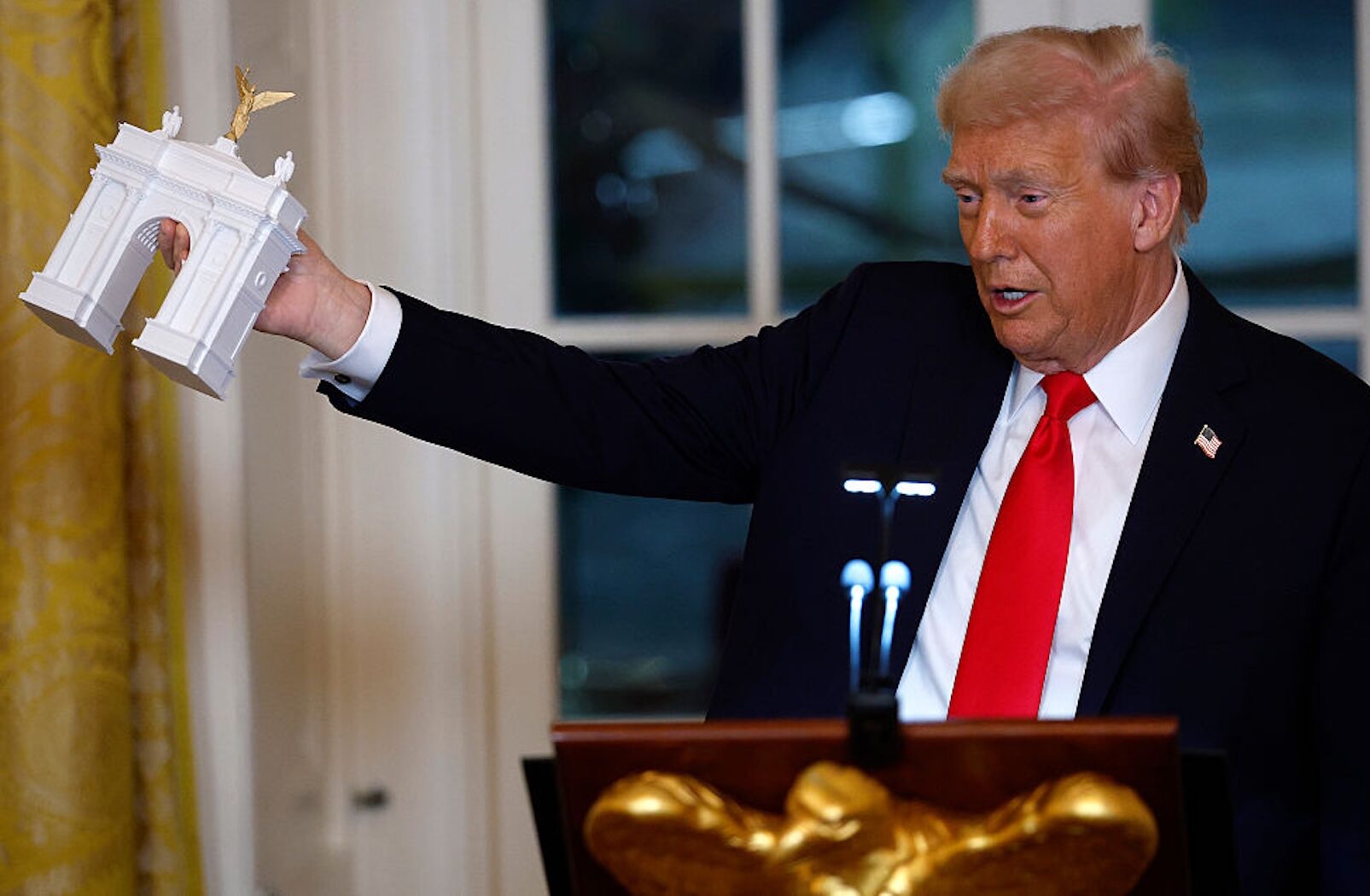
Now, each time I read about or see plans for the president’s proposed triumphal arch, which would stand in a traffic circle that marks the end of the bridge and the beginning of the cemetery’s formal entrance, I think of that view and how it could soon be no more. Plans for the arch were preliminarily approved in mid-April by Trump devotees who sit on the Commission of Fine Arts. The graves of America’s fallen soldiers will be obstructed, the eternal flame blocked — and from the cemetery, the majestic view of the Lincoln Memorial obscured — by a 250-feet monument. To Donald Trump.
Last year, when he was asked whom the arch would honor, the president was, perhaps admirably, honest: “Me,” he replied. According to reporting from the Atlantic’s Ashley Parker and Michael Scherer, Trump “has privately started talking about himself as being on par with great, norm-defying, historical figures [like] Alexander the Great, Julius Caesar and Napoleon Bonaparte.” By including himself in such company, he believes he should be memorialized in stone. And so, in his second term, he has turned his attention to leaving his mark on the nation’s capital.
But there is something else beyond self-memorialization that undergirds Trump’s plans not just for the arch but also for his remake of Washington itself — an architecture of erasure.
Knowing his history of branding and licensing his surname, this shouldn’t come as a surprise. But there is something else beyond self-memorialization that undergirds Trump’s plans not just for the arch but also for his remake of Washington itself — an architecture of erasure that seeks to undermine the living history of Black and brown Americans, women and the LGBTQ+ community, and to paper over the legacy of the post-World War II liberal order.
At the center of that impulse is the arch, which will destroy a poignant visual reminder of Kennedy, who is perhaps more symbolic of that consensus than any other American.
In the days between Kennedy’s assassination and burial, the artist William Walton, a friend of the first family who headed the Commission of Fine Arts, accompanied the president’s widow and other family members to Arlington to consider a gravesite for the president. One stood out as the clear winner. With sweeping views of Washington, the spot at the bottom of the slope beneath Arlington House “met a classic architectural definition,” historian William Manchester wrote in “The Death of a President” — it was on the “invisible axis” connecting the house with the Lincoln Memorial on the other side of the Potomac. Once Jacqueline Kennedy nodded her assent, Walton eyed the ground and indicated the place to be staked. As Manchester recounted, “The artist’s eye was uncanny; next morning a team of surveyors found he had been less than six inches off the axis.”
Short of extinguishing the eternal flame altogether, there is nothing worse that Trump could have done to erase the presence of Kennedy and the era he represents. His presidency, while short and largely unrealized, nonetheless seeded much of the transformative legislation and social programs that defined the 1960s and the rest of the American century — and continue to be felt today. The Civil Rights Act of 1964, which ended legal segregation in public accommodations; the Voting Rights Act of 1965, which outlawed discriminatory tests and, at least until the Supreme Court’s April 29 decision in Louisiana v. Callais, provided for fair representation of Black voters; the War on Poverty, which sought to eliminate poverty through job training, community development and education — all of these initiatives and more had roots in the Kennedy presidency and were fully brought to life under his successor, Lyndon Johnson.
Whether by design or incident, Trump’s arch will interrupt the axis connecting Kennedy’s legacy to that of Lincoln 100 years prior — and more importantly, the symbolic reminder that securing civil rights, particularly for Black Americans, remains an ongoing, unfinished work. But Trump’s attempts at historical interference are not just confined to the arch.
On the other side of the Lincoln Memorial is its famous plaza and reflecting pool, a rectangular pond constructed in 1922 and 1923, just after the monument opened, that measures 2,030 feet long by 167 feet wide. Immortalized on screen in “Forrest Gump,” the plaza and pool have provided the backdrop to some of the most consequential protests for equal rights in American history. In 1939, the Black contralto Marian Anderson famously faced the reflecting pool to sing “My Country, ‘Tis of Thee” after she was denied permission by the Daughters of the American Revolution to perform at DAR Constitution Hall nearby. Twenty-four years later saw the March on Washington and the Rev. Dr. Martin Luther King Jr.’s “I Have a Dream” speech. Over 100,000 gathered there in October 1967 to protest the Vietnam War as part of the March on the Pentagon. The following year, Black Americans and their allies convened in solidarity with the Poor People’s Campaign. LGBTQ+ Americans have gathered there to advocate for equality, most recently in June 2025, when thousands marched from the memorial to the Capitol during World Pride celebrations to protest the Trump administration’s rollback of queer rights and equality.
The plaza has become sacred ground, America’s cathedral of protest, and any change, however minor, should be made with care and respect both for that space and the identities of the millions of Americans who have gathered there.
With these events and so many others, the plaza has become sacred ground, America’s cathedral of protest, and any change, however minor, should be made with care and respect both for that space and the identities of the millions of Americans who have gathered there to prod the country into fully recognizing their rights.
On April 23, Trump announced plans to renovate the “filthy” reflecting pool “using a contractor,” according to the New York Times, “he knows from his years in real estate.” Speaking to reporters in the Oval Office, the president bragged of his experience building “more than 100 pools,” explaining, “I have some really good pool builders.”
After the pool was drained and its stone surface “scrubbed,” Trump ordered the contractors to cover it with “an industrial grade swimming pool topping” in “American flag blue.” Photos now show it looking like the world’s largest lap pool.
Beyond the garish aesthetic and how it changes a sacrosanct American site is that the paint job was unnecessary. The reflecting pool underwent major renovations in 2010 under the Obama administration, a project that took two years and cost $34 million in economic stimulus money. By that point, the pool had serious issues. In the 90 years since its construction, it had sunk by a foot and faced lengthy bouts of stagnant water and algal blooms, so contractors made the pool shallower and addressed the issue of water quality.
Want more sharp takes on politics? Sign up for our free newsletter, Standing Room Only, written by Amanda Marcotte, now also a weekly show on YouTube or wherever you get your podcasts.
While there are continued issues apparently stemming from the size of water pipes, the drama over the hue of the water is, according to Trump himself, an intentional attack on Obama. On April 25 the president posted side-by-side versions of the same image on his Truth Social platform that appeared to be digitally altered. One showing a green-tinged, stagnant pool was labeled “Hussein Obama.” The other depicted a tranquil, navy blue surface; it was captioned “Trump.” Just like the president’s withdrawal from the Paris Agreement and the 2015 Iran nuclear deal, or his rollback of Obama-era initiatives including Deferred Action for Childhood Arrivals (DACA), LGBTQ+ protections and reset of relations with Cuba, Trump is now seeking to erase yet another vestige, though small, of the first Black president’s legacy.
His project has also reached the White House grounds and mansion. Trump’s demolition of the East Wing to make room for a ballroom that will engulf the Executive Mansion is not just an attack on an historic building. It destroyed a century of women’s history. As the traditional location of the first ladies’ offices, the East Wing was the birthplace of important initiatives that enhanced women’s visibility and changed the physical and spiritual landscape of the country. As Errin Haines and Amanda Becker wrote in The 19th, Eleanor Roosevelt commandeered the space “as a base of operations for her activism,” which included advocating for the welfare of unemployed Appalachian miners, speaking up for civil rights and supporting equal pay for women. Rosalynn Carter’s work on mental health was centered there. Laura Bush used it to plan her literacy initiatives. Michelle Obama launched her “Let’s Move” campaign from the East Wing. The site containing that history is now gone, with little evident regard for its importance to our national life.
We need your help to stay independent.
There are many other examples of Trump’s erasure. He has slapped his name on the John F. Kennedy Center for the Performing Arts and transformed its mission, and he has announced the facility’s closure for a two-year renovation project later this year. He has gutted the bathroom attached to the Lincoln Bedroom in the White House’s private quarters, altering its green Art Deco tile work to a sterile marble with gold fixtures.
Many writers, including me, have argued that history doesn’t matter to Trump. He has never shown any serious regard for it; he has never sought to learn lessons from it. The ongoing debacle in Iran is proof enough of this.
But now I think we have been wrong, at least to a degree. History does matter to Donald Trump, in the sense that he wants to alter it. The nation’s liberal past is yet another one of his renovation projects, something he believes he can gut and replace with paver-stones and country club chic. Trump knows that to elevate himself, he must first attempt to erase what — and who — came before. It’s now on us to not forget.
Read more
about this topic
