

In late April, President Donald Trump requested a record-breaking $1.5 trillion defense budget, which, if approved, would mark the largest ever increase in Department of Defense funding. It remains an open question whether or not the priorities outlined in the budget even make sense, especially in light of lessons from the ongoing Iran war, and whether the military spending is worth the cuts it will necessitate elsewhere in government.
The proposed budget comes in the wake of recent comments from the president indicating that he believes that military readiness, rather than the wellbeing of the American people, should be the budgetary priority of the government.
“Don’t send any money for daycare, because the United States can’t take care of daycare. That has to be up to a state. We can’t take care of daycare. We’re a big country. We have 50 states. We have all these other people. We’re fighting wars. We can’t take care of daycare. You got to let a state take care of daycare, and they should pay for it too,” Trump said in April in a video posted to YouTube that was later deleted.
The proposed military budget for the fiscal year 2027 would represent a 42% increase year over year, one of the largest increases in American history, especially considering that the country is not engaged in the sort of conflict that similar giant increases in military spending have coincided with. The last time a budget increase of this proportion was approved was in 1952 during the Korean War. The topline $1.5 trillion budget also does not include an expected supplemental funding package for the Iran war. Though the official supplemental funding request hasn’t been voted on by Congress, it could cost up to $200 billion, though recently the Pentagon has indicated that it could be significantly less. Democratic lawmakers have pushed back on the current administration’s estimates, arguing that if you account for the cost inflicted on the U.S. economy, the war has already cost the country between $630 billion and $1 trillion.
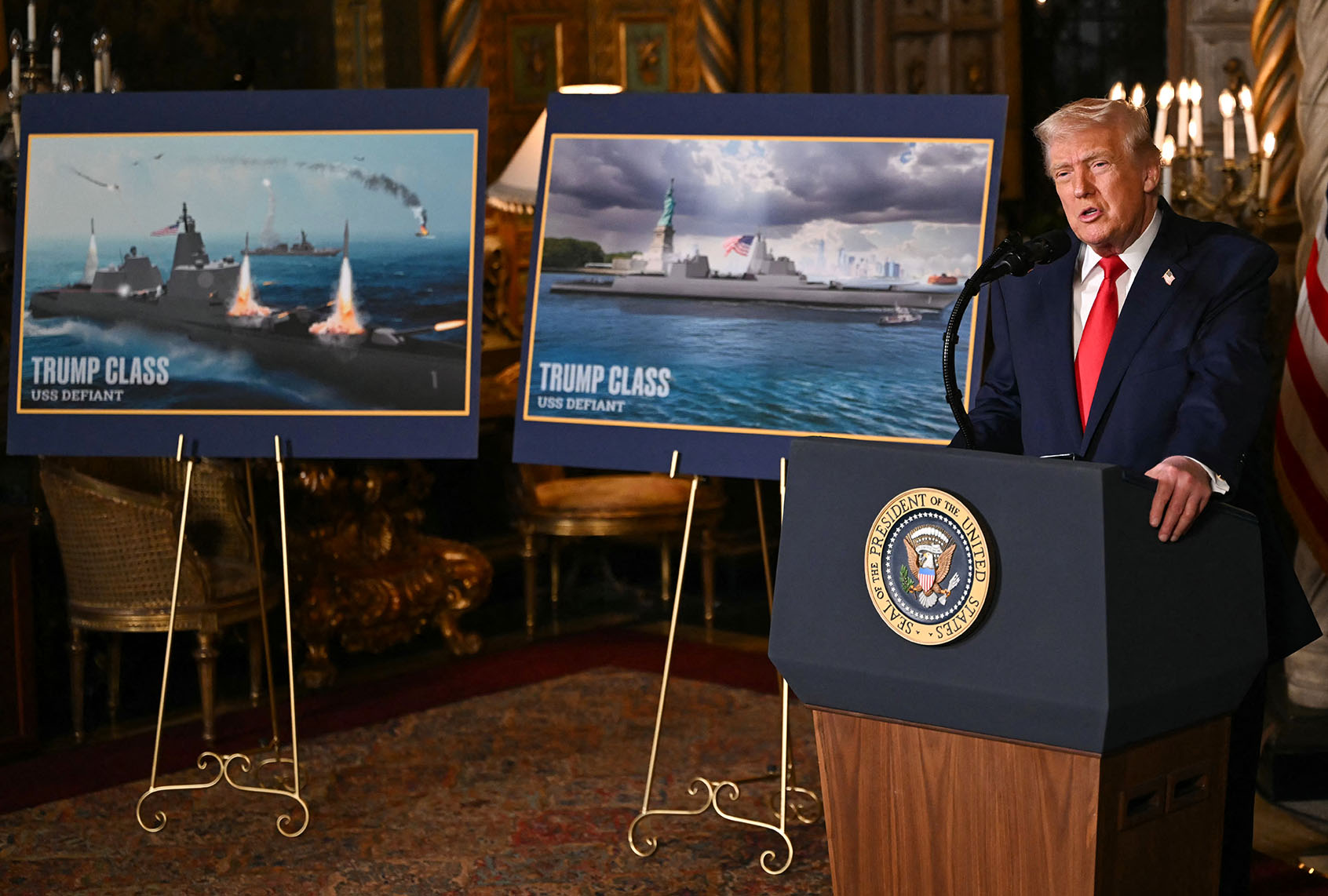
Furthermore, the proposed budget has been panned in the press for the inclusion of projects like the Trump class battleship, a $20 billion project that would revive a World War II era project with a Trumpian spin. The problem is that the U.S. Navy decommissioned its last battleship in 1992, after the military recognized that battleships had become sitting ducks, vulnerable to modern military munitions that could pick off the vessel from the sky.
While projects like the Trump class battleship have drawn attention, Jerry McGinn, the director of the Center for the Industrial Base at the Center for Strategic and International Studies, a think tank closely aligned with the Pentagon, told Salon that the proposed budget isn’t all akin to the battleship project.
The U.S. Navy decommissioned its last battleship in 1992, after the military recognized that battleships had become sitting ducks, vulnerable to modern military munitions that could pick off the vessel from the sky.
Breaking down the budget in an interview, McGinn said that although the proposed budget increase is much larger than in recent years, the actual content of it is largely a continuation of trends that have persisted since well before Trump took office in 2016.
“The scale of assuming they get the $1.5 trillion, that is a step function change,” McGinn explained. “But as far as the emphases within it, there’s a lot more continuity in terms of stuff like the collaborative combat aircraft, which was a program started under [President Joe] Biden. They’re continuing it and they’re accelerating.”
The collaborative combat aircraft is a project revealed in 2023 as part of the Next Generation Air Dominance program, a classified Air Force modernization plan, which aims to produce, among other things, unmanned aerial weapons that can accompany F-35 stealth fighters on their missions.
This isn’t the only continuity either. The proposed budget also aims to address what McGinn calls magazine breadth as well as magazine depth. Magazine depth refers to the munitions stockpiles the U.S. maintains, which have been a staple in headlines since the Russian invasion of Ukraine in 2022. The issue of magazine depth became more acute since the U.S. and Israel’s joint war against Iran began in February, as both countries quickly depleted significant portions of their weapon stockpiles in response to Iranian drone a missile attacks.
Magazine breadth, however, references the number of options American forces have for responding to strikes, as well as their own offensive options.McGinn said that the proposed budget does include measures to expand magazine breadth. For example, the Pentagon has been working on its own program to produce the same sort of relatively inexpensive drone swarms that the Iranian military has used during the war to great effect.
There are also provisions to continue programs to help address both magazine depth and breadth in the budget, with McGinn pointing to programs in which the U.S. partners with allies to produce munitions in other countries. These are also a continuation of existing U.S. policy. For example, in 2024 the Polish government agreed to produce 48 Patriot system launchers.
McGinn said that, speaking from a strict military preparedness perspective, there can never be enough depth and that the only way to achieve more depth is to invest in more breadth. He said, however, that as a military industrial base analyst, it wasn’t his place to opine on whether this sort of intense military investment should be the budget priority of the American government.
This problem is particularly acute given that $350 billion of the total $1.5 trillion request is expected to be pushed through the budget reconciliation process, which would necessitate cuts to other parts of the government. These cuts will be on top of the cuts that came in fiscal year 2026’s tax and spending bill, which saw the Trump admin cut healthcare spending by more than $1 trillion, while slashing taxes for the wealthiest Americans.
We need your help to stay independent.
Steven Kosiak, a senior fellow at the Center for American Progress working on national security and budgeting, told Salon that he sees no need for the sort of dramatic increase in military spending that the administration is pushing for and also no rationale.
“It’s not like all of a sudden the U.S. was at war, and so we went from spending $930 billion on national defense in 2025 to $1.5 trillion in 2027 and we were deploying troops all over. That’s not what happened,” Kosiak said. “It’s all of a sudden somebody came up with the idea that, hey, let’s spend $1.5 trillion even though a lot of the policies we’re looking at don’t seem to point in the direction of needing more. Some point in the direction of needing less money for the military.”
Kosiak provided the example of spending on the U.S. Army, which has $253 billion allocated to it in the proposed budget as an area in which the U.S. could probably spend less rather than more. That’s because the U.S. is not preparing to deploy ground troops anywhere and it’s not even clear in what theater the U.S. would need to deploy ground troops at a scale that would warrant such a large increase in the budget.
“If you’re not going to defend Europe and you’re not likely to ever use major ground forces again in an Iraq or Afghanistan kind of operation, let alone an invasion of Iran, then why do we have to spend this much? Because you’re not going to use them in the Pacific,” Kosiak said. “The China theater is not a theater where large ground forces are needed.”
Kosiak also addressed the notion that the increase in U.S. military spending is a way to pressure other NATO countries to increase their spending. Last year, NATO increased its target spending levels for member nations from 3.5% to 5% and the proposed budget would move the U.S. in the direction of meeting that spending goal. Kosiak said, however, that historically large American military spending has not incentivized NATO countries to increase their defense spending.
Start your day with essential news from Salon.
Sign up for our free morning newsletter, Crash Course.
“Arguably the biggest reason that NATO has not spent more in the last several decades is because the U.S. [already] spends so much,” Kosiak said. “If the U.S. said ‘We’re not adding $500 billion to the defense budget, we’re cutting it by $100 billion,’ that would be more of an incentive. That would more put a fire under their whatever and get them to spend more money. But spending loads more than past administrations, that’s kind of a mixed message.”
Kosiak also pointed out that, as much as Republicans have historically positioned themselves as hawks when it comes to the deficit and national debt, this proposed budget would potentially dramatically increase the national debt over the next ten years. Incidentally, Kosiak noted, such defense spending isn’t likely to decrease and that we already spend far more on the military than other countries like Russia, China and Iran. Currently, the U.S. military budget is just shy of $1 trillion at $968 billion. China, for comparison, spends roughly $317 billion, while Russia spends around $150 billion and Iran was estimated to spend about $7.4 billion on their military in 2025.
In terms of the national debt, an analysis from the Committee for a Responsible Federal Budget, for instance, found that approval of Trump’s proposed budget would add around $6.9 trillion extra, when accounting for increased interest costs.
All in all, Kosiak characterized the $1.5 trillion budget as a sort of solution in search of a problem, and one that would make it harder for the government to spend on any other priorities in the future.
“One of the reasons that they’re pushing for it is that it pushes up the deficit more, which pushes up the debt more, and it makes it harder to spend on anything else,” Kosiak said. “It’s the one area you’re okay with ballooning, because one of the nice side effects is that it makes it even harder to do things like restore healthcare.”
Read more
about the military
