
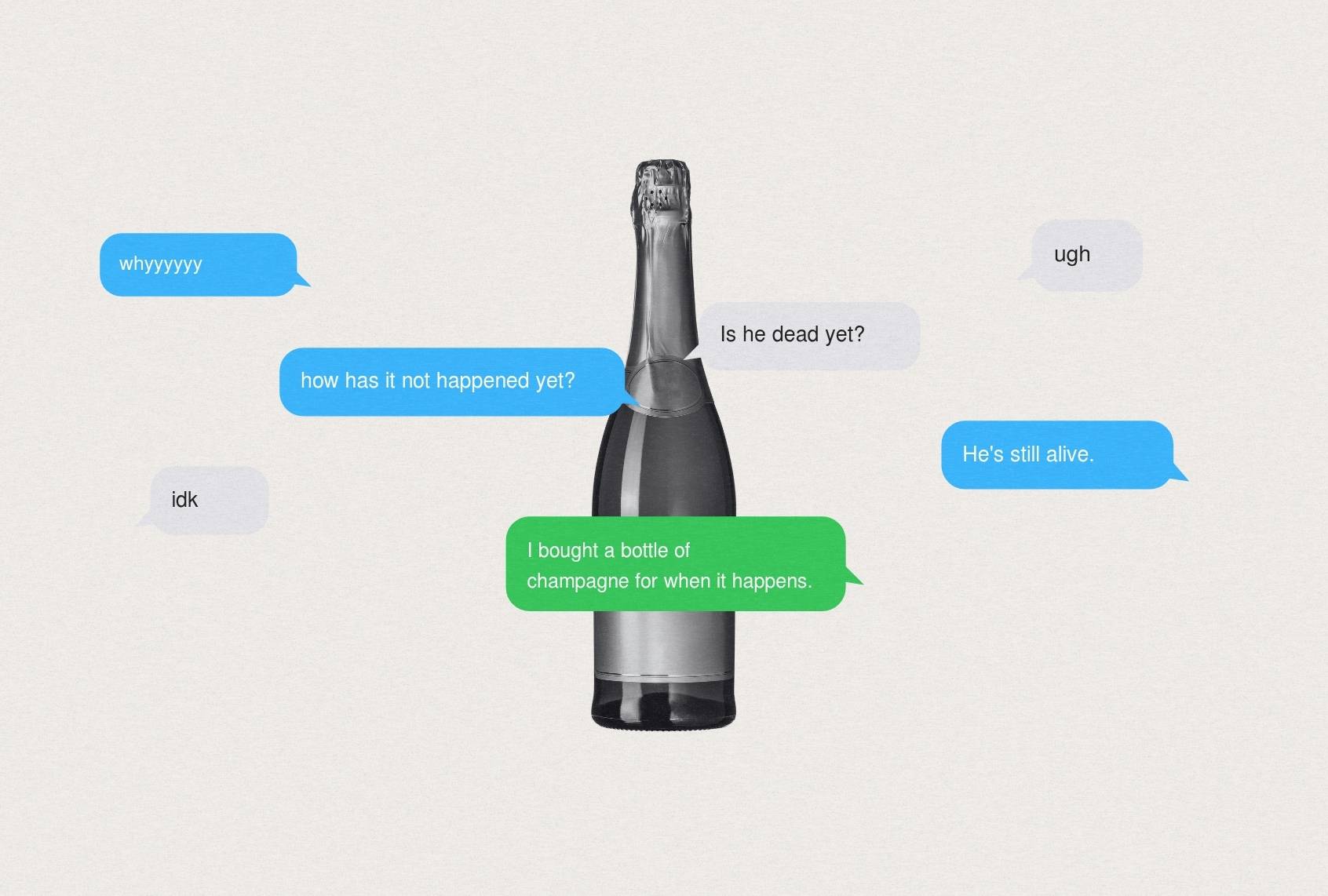

Every so often, the internet becomes abuzz with vague statements that everyone instantly understands. “Is he dead yet?” or “When it happens” flood the feeds, with nearly everyone exactly aware of who “he” is and what “it” is. Webcomics have made “he’s still alive” a punchline, with similar humor embedded in long-winded McSweeney’s essays. This makes for good business, too. A Wisconsin brewery went viral recently for promising free beer “all day long, the day he dies” without mentioning anyone by name.
It is no coincidence these phrases and memes pop up every time President Donald Trump makes an unexpected trip to Walter Reed National Military Medical Center, among other surprise medical exams that have been occurring since his first term.
Yes, the death of Trump, who will turn 80 this June, has been a popular topic for some time, not solely due to the torrent of alleged health concerns surrounding the president, whose swollen ankles, discolored skin, spontaneous naps and incoherent rambling has sparked online rumors that he is seriously ailing. Whether you agree or not, it is unlikely that ever in history have so many people been eagerly awaiting the death of a single person. Even if Genghis Khan or Joseph Stalin or, yes, even Adolf Hitler were less popular than Trump, which is impossible to measure and not really relevant, no one had 24/7 news coverage or social media at the height of other tyrants’ power. People share photos of unopened wine bottles they can’t wait to pop off as soon as the news hits — yet Trump’s name is rarely, if ever, directly mentioned.
It is interesting how this euphemism in particular has gained such widespread use, though of course the practice of wordplay is really anything but new. But that’s precisely what interests me: the coded way in which people are talking about this may betray something darker about our culture.
“Euphemistic speech is the highest form of thinking, human intelligence, an elegant, ‘veiled,’ neutralized, softened figurative expression of reality,” Xilola Inomovna Ismailova, an English teacher at Kokand State University, wrote last year. “Euphemistic speech is as ancient as language, and goes back to the primitive system, to the languages of clans and tribes. The practice of prohibiting and using euphemisms is manifested in its own way at all stages of language development, among all peoples, in the speech of all social classes and groups.”
That’s great, but do we really need so much euphemism? All of this is tied to the use of “algospeak” — an invented word for the form of online self-censorship used to circumvent social media algorithms by using terms like “unalive” and “PDF file” to signify “kill” or “pedophile.” I hoped I would never age into someone who complains about new slang the way every older generation tends to, but still: Have we forgotten how to talk normally? Normality, of course, is relative. English is always evolving, but where is it taking us?
The coded way in which people are talking about this may betray something darker about our culture.
“When the algorithm prevents people from saying ‘sex’ or ‘suicide’ or any other sensitive word, it becomes a proxy for human behavior. Instead of people turning a word negative over time, the platform labels it as undesirable for social media, causing the treadmill to move faster rather than actually preventing discussion of forbidden topics,” pop linguist Adam Aleksic explains in his book “Algospeak: How Social Media Is Transforming the Future of Language.”
He continues, “Our colorful potpourri of euphemisms, bowdlerizations and circular language is more than a collection of individual strategies to defeat content moderation tools. It’s an entirely new style of communication serving a distinct social purpose. What we’re actually doing on social media is building up a common vocabulary to reflect our shared experiences.”
Leaning so heavily on euphemism may be part of the new normal, but lest we forget, euphemisms are also being weaponized in the Trump era. The second indictment of former FBI Director James Comey centers on a photo he posted of seashells on a beach arranged to read “86 47,” which federal prosecutors allege was a threat to kill the president. To “86” someone is to eject or ban someone, especially from a bar or restaurant. It has never really been used as a euphemism for murder. As Salon columnist Heather Digby Parton puts it, “No sentient person of either party saw those wielding this phrase as making a literal, credible death threat. But the right has jumped on it in another of their coordinated hissy fits conducted on the taxpayers’ dime. There has never been a case so silly.”
There are several lines of reasoning as to why people don’t say who they’re talking about when they hint at “it” happening. One is a desire not to give Trump any additional clout, given how he thrives on any positive, negative or neutral mention of his name, stamping it on literally anything he can, from the buildings he owns to, apparently, U.S. passports and currency. Another more obvious explanation is that it seems funny or amusing to used coded language, a sort of throwback to a certain transphobic British YA fantasy author who popularized a character known as “He-Who-Must-Not-Be-Named.”
Start your day with essential news from Salon.
Sign up for our free morning newsletter, Crash Course.
The darker thread to all this is that many Americans feel they can’t speak freely anymore. There are obvious parallels to the assassination of right-wing podcaster Charlie Kirk, a mouthpiece for smarmy bigotry if there ever was one. Kirk’s death was a shocking and inexcusable act of violence, in spite of the hate he advocated, but it was precisely his bile-spewing that prompted so many to shrug, express zero condolences or even celebrate his death, perhaps because they felt that at least it meant an end to his ceaseless disparagement of anyone not a straight white male.
That wasn’t the same thing as wishing or encouraging violence, obviously, and it should go without saying that killing people for holding right-wing beliefs, no matter how abhorrent, is unacceptable. Wanting Charlie Kirk to shut up wasn’t the same as wanting him dead. In a better world, perhaps he’d have had a change of heart and repented of his increasingly intolerant tirades. But I’m not aware of a single occasion when someone grew a conscience and turned away from the outrage machine and the money and fame it can bring. The only thing people like Andrew Tate and Ben Shapiro grow is more tiresome.
But there was a concentrated effort to attack and punish anyone who dared question Kirk’s hagiography, with folks like MAGA acolyte Steve Bannon calling for mass arrests and crackdowns on universities. Others described Kirk’s death as a literal declaration of civil war, which some eight months later has (thankfully) yet to materialize. Meanwhile, attempts to turn Kirk into some sort of patron saint of anti-wokeness have mostly stalled, although Trump has enshrined Oct. 14 as a National Day of Remembrance, for someone who was not a war hero, an activist hero or an elected official but a political firebrand who reveled in trolling the right’s perceived enemies. We’ll have to wait to see if anyone bothers to celebrate this October.
Lest anyone assume this euphemistic tendency is only coming from the left, that’s mostly the case because MAGA thought-leaders, if you can call them that, are often more overt about calls for violence. In September, Geoffrey Ingersoll, editor-at-large of the Daily Caller, wrote a column that pretty much says it all: “Today, I choose violence. Literally. I know calls for violence are generally frowned upon. The issue is … I simply don’t care.” While that op-ed was later amended with an editor’s note claiming that it only advocated “hypothetical instances of self-defense,” it’s easy to find dozens of other examples of not-at-all-subtle calls for violence, especially coming from Trump.
If you want to talk egregious euphemisms, let’s discuss the president’s tweeted threat to Iran on April 7 that “A whole civilization will die tonight, never to be brought back again,” which was widely interpreted to imply pending nuclear holocaust. Thank whatever god responsible that never happened, because the devastation of dropping just one nuke would be so horrendous that we can barely comprehend it.
Maybe hinting that you can’t wait to celebrate the death of a world leader isn’t exactly loving kindness, but it’s not the same as actively salivating for bloodshed. At any rate, moralizing about this tendency won’t change how people really feel. Euphemisms aren’t just trivial ways of communicating online. They’re reflections of our overall culture, which is coded to navigate around violence and depravity, as well as all the ways freedom of expression is being constricted. People are tired of the Trump tantrums, the bullying, the threats to massacre entire civilizations, the needless war, the funding of genocide, and all the other verbal and physical violence relished by the MAGA world, which is eager to turn around and play the victim any time there’s the least bit of blowback.
We need your help to stay independent.
It’s not as if Trump hasn’t made a long-time habit of disparaging any of his dead enemies, whether it’s Robert Mueller, Rob Reiner, Rep. John Dingell, U.S. military veterans and a staggering list of others. So what happens when “it” finally does happen? No one lives forever, not even centenarian Henry Kissinger. As much as Silicon Valley hucksters are vying to invent a cure for death, I doubt we’ll see that in the near future. So Trump will probably meet the same fate as all of us, which may indeed trigger parties, fireworks and popped champagne.
Frankly, that worries me. I recently came across a protest sign that said “If Kamala were president, we’d be napping”, painted with little martini glasses. There has been a recent effort to rehabilitate “Sleepy Joe,” Trump’s insult for Joe Biden, which was both oddly appropriate (given the former president’s tendency to exhibit senile behavior) and wildly hypocritical (given Trump’s overwhelming tendency to do exactly the same thing.) Some liberals now want to insist that “Sleepy Joe” meant people could sleep at night while he was in the White House. So much for being “woke,” I guess, but there’s a label that has really run its course.
If Trump suddenly leaves the stage and the left goes back to sleep, that would be a disaster. It would once again mean shirking the work it will take to undo the damage of the MAGA movement, from its setbacks in public health to its evisceration of the environment, its enrichment of scam artists and the way it has unleashed Silicon Valley to spy on citizens while federal agents kick down doors, arrest people for blog posts and attack immigrants, to say nothing of U.S. atrocities abroad. Semantics are more important than they may seem; it’s not just about quibbling over language. What words we choose, or avoid, dictate our thoughts and therefore our actions. Wordplay and schadenfreude aren’t the real issues here. It’s about understanding that that the removal of a single despised figurehead isn’t enough. Ahead of the country’s 250th birthday, we need to more discussion of what America is and what we want it to look like — without mincing words.
Read more
from Troy Farah
