
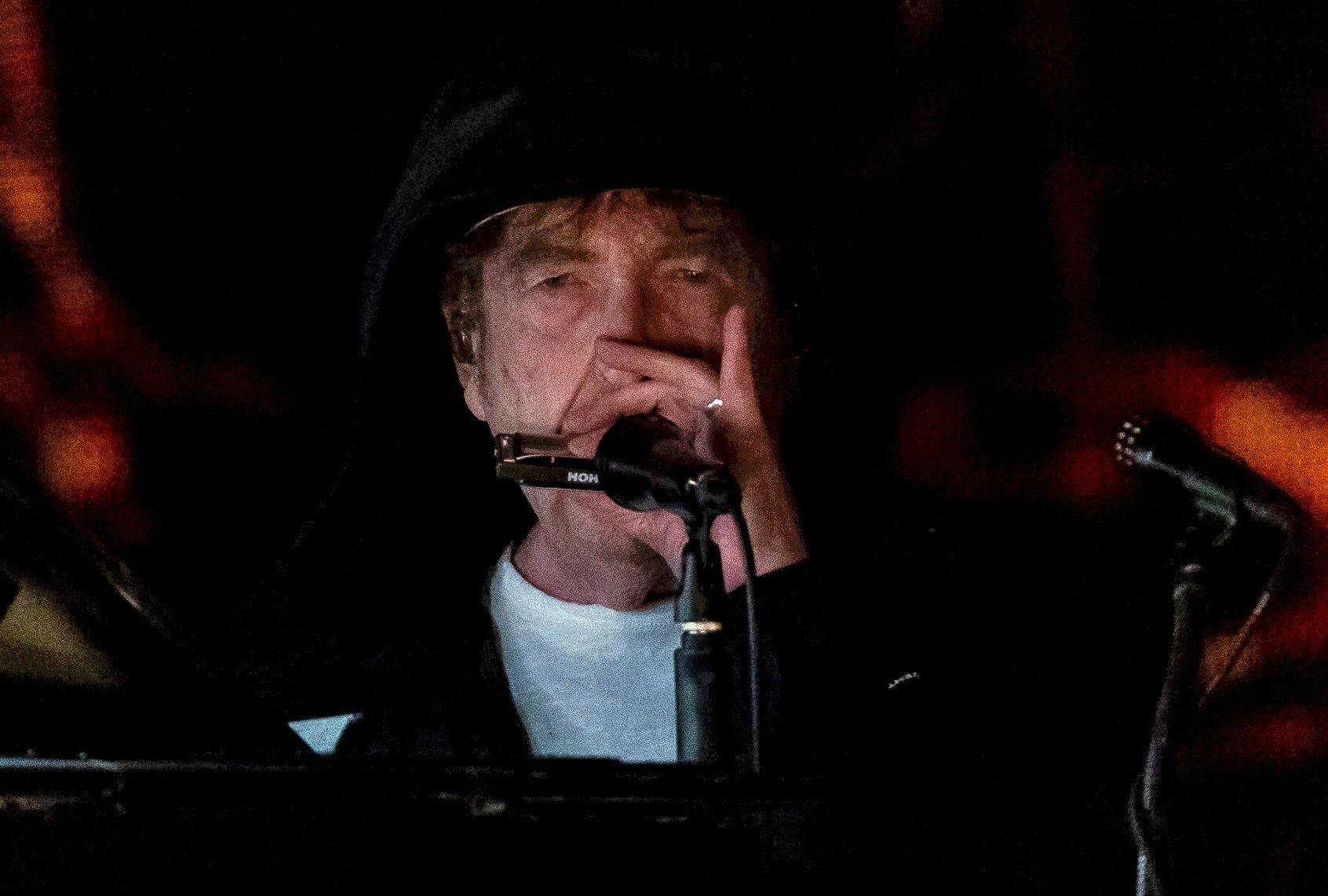

Bob Dylan’s Instagram account used to feature the type of bland, standard content you’d expect from a legacy artist: “On this date” historical posts, tour announcements, box set advertisements. That was how things were until January 25, 2025, when the account uploaded a grainy video of Les Paul and Eddie Van Halen, taken from a 1988 special called “Les Paul & Friends.”
But to know that, you’d have to know that, do a web search, or read the comments, because there was no caption on the post. Was this an error on the part of whoever manages Dylan’s social media? Was it a hint? Some kind of clue? No idea, but shortly thereafter another post appeared: A clip of Ricky Nelson singing and playing guitar, taken from an episode of “Ozzie & Harriet.” Eagle-eyed observers would note that the great James Burton, probably best known for his work with Elvis Presley, Emmylou Harris, and as part of the Wrecking Crew, was in the band. Once again, the clip appeared with no context or caption, and it was left to the commentariat to provide the details.
Two more clips would be posted to the account that day: An excerpt of the 1952 film “Clash By Night,” which features Marilyn Monroe, and film footage of legendary jazz guitarist Django Reinhardt and his band performing a tune called “J’attendrai.” Once again, the details were supplied by random commenters, who were beginning to work themselves into a fever pitch: Were these clues? Was Dylan hinting at future work? Was he making a statement about influences? WHAT DID IT ALL MEAN???!! You could write a dissertation exploring all of the possibilities of why Dylan posted each item, and some people probably did.
This seemed like it could have been an interesting experiment, or Dylan trying to direct people in a certain direction, but when you break it down into its component parts, one by one, it isn’t any more complex than your uncle or your older sister who likes to send you interesting things they find on the internet.
A few days later, there were more posts: Guitarist Tony Rice, taken from an instructional DVD. A clip from the classic John Wayne Western, “The Searchers.” A clip of The Band in their configuration without Robbie Robertson, taken from a broadcast in Japan. A song clip from Native American author and poet John Trudell. Mae West in 1933’s “She Done Him Wrong.” The classic “Twilight Zone” episode “To Serve Man” (“It’s . . . it’s a cookbook!”). These were the first 10 posts, and there was nothing here that was particularly obscure, nor was there any kind of thread of continuity that seemed obvious.
Of course, Dylan’s Instagram posts instantly became fodder for the various flavors of Dylan appreciators (guilty as charged), whether newsletters or podcasts or just folks holding it down in their particular corner of the internet. The comment sections became a maze of people trying to be helpful by identifying the subject of the post, while other folks offered their theories as to why Dylan was posting this particular content. Of course, you also had people saying “Hi” to Bob (“You are exceptionally thought-provoking and sexy. All My love to you, Robert <3”) and even the occasional whackjob who is sure Bob Dylan is communicating in code with them directly, as well as multiple folks asking various versions of: “Is this Bob posting???!”
Want more from culture than just the latest trend? The Swell highlights art made to last.
Sign up here
It’s absolutely fascinating, because no one is exempt from the siren song of responding to the Bob Dylan account just in case it might be Bob — or, similarly, because there’s no way that it’s Dylan. Dave Davies of The Kinks was a regular commenter! And then there’s a group of folks on the outskirts that are just hanging out because their pals are there, and so someone’s going to come in with an in-joke or a snappy line. Just another normal day on the social internet, hanging out on Bob Dylan’s Insta!
It’s worth noting that none of this Content with a capital “C” was obscure. If you were to execute a basic web search using the name of anyone in a clip and any modifier (e.g., “Mae West & Cary Grant movie”), the segment that was uploaded to Instagram would be one of the first search results. This seemed like it could have been an interesting experiment, or Dylan trying to direct people in a certain direction, but when you break it down into its component parts, one by one, it isn’t any more complex than your uncle or your older sister who likes to send you interesting things they find on the internet. I put it all into a spreadsheet, one by one, and then waited to see if there would be some kind of grand, larger message. But sometimes a movie clip is just a movie clip.
Everyone’s right, except that at the end of all of this, we still don’t know and probably never will.
The discovery — or rediscovery — of these cultural artifacts isn’t trivial. Someone is going to learn about Lowell George, the Osborne Brothers, or Hoagy Carmichael through these posts. In some ways, you can look at this method as a more direct version of an artist doing interviews with the music press and talking about what they’re listening to these days, or what inspires them, or what they just think is cool. Social media means that there’s no intermediary, and there are positives and negatives to that scenario.
However, in an interview, the journalist could push back and ask what about each of these items particularly inspires or interests Dylan, as opposed to Dylan just walking into a room and putting a song on the stereo, which is the equivalent of what this is. The account (I’m avoiding saying “Dylan” because — as countless commenters feel the need to point out — it is true that we do not 100% know that this is actually Dylan pushing the button or providing the content, but it would be odd and weird if he didn’t have some kind of input, even if it was deputizing someone else to do it all for him) is throwing things out into the void and it’s hard to argue with that strategy because each post gets tens of thousands of likes and hundreds of comments.
That is, of course, assuming there is some kind of larger strategy in play here and this isn’t some kind of performance art.
Further into February 2025, the Dylan Instagram account introduced a new flavor of Bob Post: an Instagram Reel, featuring an audio recording labelled “Last Testament of Frank James” overlaid on top of historical, black-and-white images of Jesse James’ house and a portrait of Frank, who was the outlaw’s older brother. No one has yet found the source of the text of the recording, read in a British accent, and it could be AI, but it also might not be. A week or so later, and there was “Andrew Jackson Giving One of His Final Speeches,” followed by “Stephen Foster speaks from the grave,” “Edgar Allen Poe speaks from the grave,” a three-part series of “Al Capone in his own words,” and the most recent historical reels, “Aaron Burr On the Art of Survival.”
What they all share: The strange accents voicing the recordings, the inability for any Dylanologist to find the sources, the loud declaration that this is all AI, and the equally loud clamoring insisting that it is not. People are carefully trying to connect the dots, trying to point to places within Dylan’s work where he’s mentioned gangsters or specific moments in American history. Everyone’s right, except that at the end of all of this, we still don’t know and probably never will.
And now, Patreon, or “BobGPT”
At the end of March, Dylan launched a Patreon. That’s right, for $5 a month, you can subscribe to the Bob Dylan Patreon, just like any of the other artists or creators who are sending out graphic novels or newsletters or videos or songs. Like his Instagram account, there are contextless videos and spoken-word recitations.
The membership benefit is described as: “A living archive of lectures from the grave, letters never sent, and original short stories curated by Bob Dylan.” Please notice that nowhere does it say that Bob Dylan is the author of any of this content, and “curated by” is one of the vaguest descriptions of the last few decades.
Being Bob Dylan must be exhausting, and the fanbase kind of deserves what it gets from that standpoint.
And then came the short stories. You know they are short stories because they appear as “Bull Rider (short story)” or “Frozen Pizza (short story),” and the most infuriating thing about them is that they require you to download a PDF. It is the most Boomer thing in the world to subscribe to something only to have to download a document instead of it simply being posted within the page you paid for. This is the case even if you have the Patreon app, which I downloaded in hopes it would get around the PDF, but alas.
Unlike the other artifacts with no traceable provenance, these short stories are bad. They are terrible. And the comments that follow each one lack the humor and irreverence that highlight the Instagram posts. While the Instagram feed seems random and you wish he’d give the devotees something to hang onto that might explain or illuminate the purpose of this exercise, on Patreon, people are paying for the right to download a double-spaced PDF of the most basic and bland stories.
We need your help to stay independent.
It does not matter if we learn in a week that Bob Dylan himself is writing these. In fact, learning that would make things worse. Dylan would have to probably work hard to write such bland and pointless garbage. Greeting cards have more substance to them, and are more useful. The good news — and we’re really scraping bottom here calling it that — is that the $5 limits the audience. The likes on each post barely scrape 100, and the comment numbers are similar. On the other hand, there is zero self-awareness in these comment sections, and definitely no humor. It is full of people who think this is actually Bob Dylan (or the closest they are going to get) and so what they are purchasing is what they believe is an opportunity to commune with The Bard.
As with Instagram, there is the camp of individuals absolutely certain that all the “original content” is AI-generated, and there is another group of folks who think it’s just bad. You could say that it’s great that Dylan has prompted these larger public discussions about artificial intelligence and large language models, or you could think that Bob is trolling people simply because he can. On the one hand, being Bob Dylan must be exhausting, and the fanbase kind of deserves what it gets from that standpoint. On the other hand, it feels kinda scammy and manipulative, but there is nothing more American than that, especially right now.
In any event, nothing shared in either of these Dylan outlets has proved itself to be anything more monumental than a footnote in this man’s career and body of work. You could say something like, “I wish he’d devote this time to writing new material,” but the man is 84 and is still on the road and still releasing new music, paintings, and wrought ironwork, along with the occasional whiskey. There is something to be said for Bob Dylan’s ability to consistently do things that keep people thinking and talking about him, just as long as I don’t have to download a PDF to do it.
Read more
from music columnist Caryn Rose
