

The opening of the new documentary about the loud, hilarious and irreverent ’90’s band the Lunachicks features the same kinds of devices anyone who’s ever watched a music documentary will be familiar with: a shot of an audience, with accompanying excited murmurings, and then, voices making fearless assertions: “Everything was a challenge that needed to be conquered,” “We’re gonna, like, melt people’s fu*king faces off because they expected us to suck,” “We were literally out there with people throwing pint glasses at our heads and pulling their dicks out at us,” and then: “But we have a superpower when we’re together. And it was us against everybody. It was like us against the world.”
You see the back of a leather jacket — if you’re a fan, you know it’s Theo Kogan, the band’s formidable lead singer — and you can see her shoulders square as though she’s girding herself for battle. And then there she is, bounding onstage at New York City’s Webster Hall in 2021, for a pair of reunion concerts that were scheduled and then rescheduled multiple times because of COVID-19, raising her arms in triumph.
This is “Pretty Ugly: the Story of the Lunachicks.”
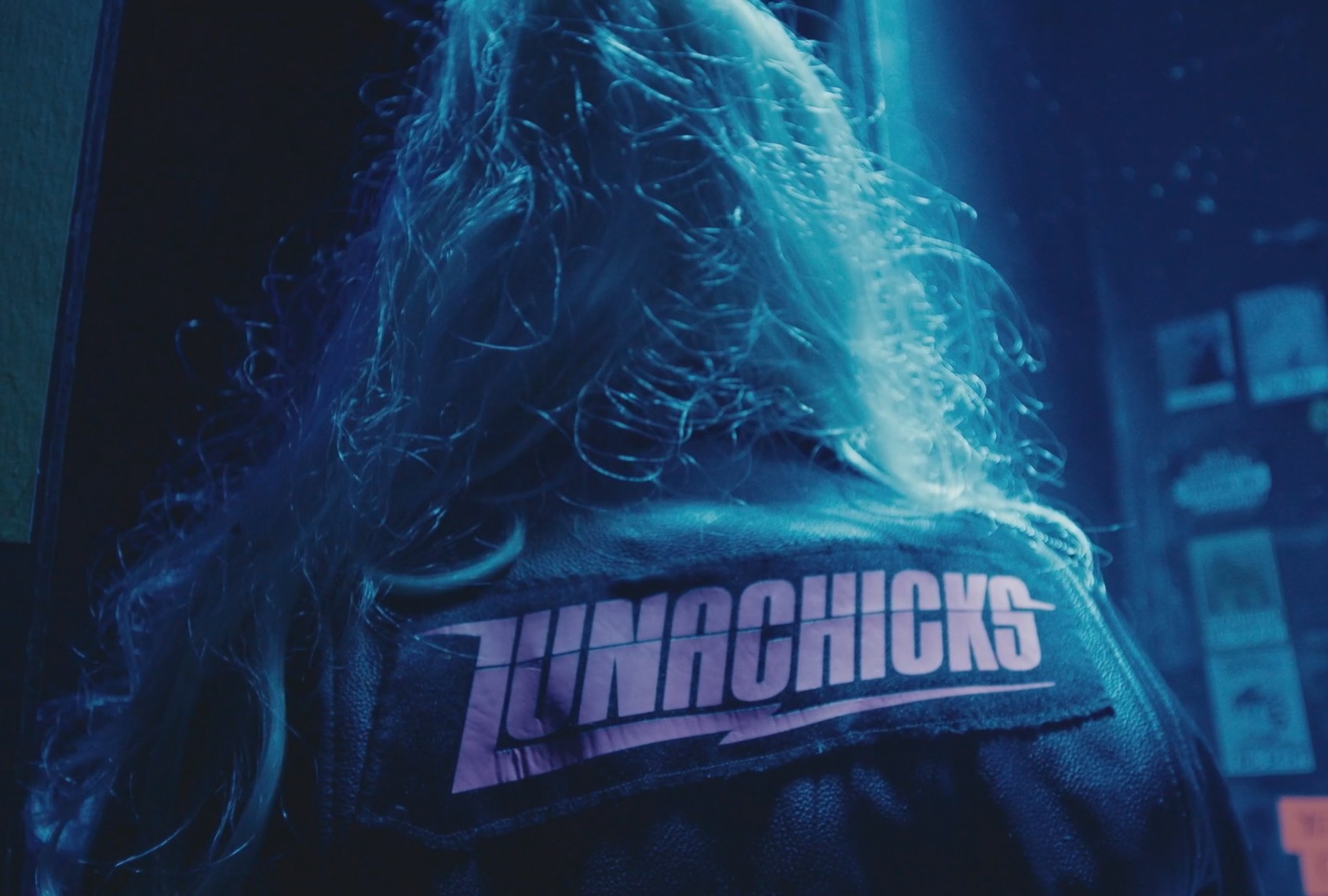
(Giant Pictures) Theo Kogan of the Lunachicks, backstage at Webster Hall
“Pretty Ugly” documents the story of the Lunachicks, from before they were a band, taking the viewer through their very early days: their childhood friendships, their formation, the triumph of early shows and the environment that created them. It also captures the band members in current times, as the core group (with a fair amount of reluctance) agrees to play some reunion shows. Both the film and the story are sad and brilliant and hilarious and infuriating, and the documentary moves with love and understanding and a deliberate and specific rhythm. This is not something you put on in the background while you scroll social media on your phone; it moves briskly, and you will find yourself getting attached to the band members and their lives, work and art.
The film lets you feel — not just see, or watch, nothing here is passive — the band and its vibe and its ethos, but you also feel the director’s eye and her vision for the story she wanted to tell, and tell correctly. It is about friendship and creativity and New York City, specifically the East Village when you didn’t walk past First Avenue alone, on the edge of gentrification and the 1988 Tompkins Square Park riots. It is about what happened when a bunch of friends decided to start a band even though no one could really play an instrument. It is about punk rock and the inevitable commercialization of it. And it is about life as a woman and as an artist in America.
The Lunachicks came of age in NYC’s East Village in the mid-’80s, with Kogan, guitarist Gina Volpe and bassist Sydney “Squid” Silver meeting as pre-teens before heading to the LaGuardia High School of Music & Art and Performing Arts (otherwise known as the “Fame” school, if you are also as old as dirt). Like many a New York City teenager in that era, they snuck into rock shows with fake IDs and when they couldn’t sneak in, they stood outside, listening.
This is not something you put on in the background while you scroll social media on your phone; it moves briskly, and you will find yourself getting attached to the band members and their lives, work and art.
One of those bands they stood outside listening to was Freaks, featuring East Village punk fairy godfather Howie Pyro, and we see the late Pyro telling the camera, with great affection, how he told the then-girls who would become the Lunachicks that they needed to start a band. The fact that none of them played instruments at this point was irrelevant, in the spirit of the CBGB’s Class of 1975. “Everything we do is fun and great,” explains guitarist Sindi Benezra Valsamis in the film, “So this will be fun and great.”
And the next thing you see is none other than Joey Ramone (RIP), standing onstage at CBGB’s, introducing the band, and then, only a few gigs later, Thurston Moore and Kim Gordon of Sonic Youth mistake the Lunachicks for a noise band and sign them to Blast First, a label that specialized in the loud and discordant. “We wanted to be this mishmash of the MC5, and the Clash, and Iggy, you know, all our favorite bands, but we did not sound like that,” says Volpe.
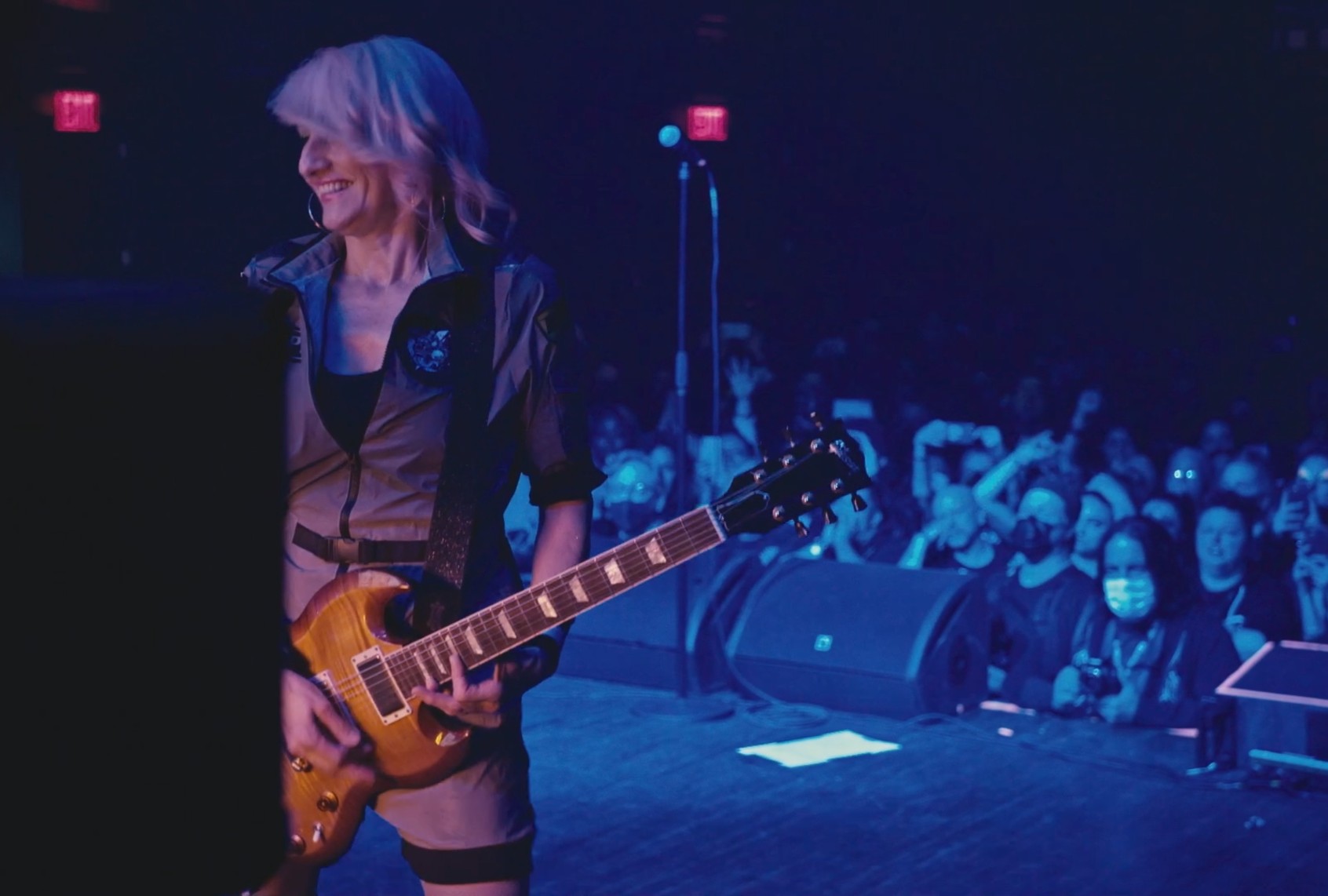
(Giant Pictures) Gina Volpe of Lunachicks, performing at Webster Hall
So the fact that ”Pretty Ugly” director Ilya Chaiken had never shot a documentary before is true to the ethos of all things Lunachicks. “It was my first time doing a doc,” Chaiken told Salon. “I’ve made narrative films in the past, but I also work as an editor, so I edit a lot of docs. I was, like, I can do this.” For her, also, this was personal: she attended college with Gina Volpe (before the band made her drop out and be a rock star) and attended the first Lunachicks show. It’s the combination of storytelling chops, genuine enthusiasm, and subject matter expertise that makes this film exponentially better than your average band documentary.
It’s also probably why the band felt comfortable letting Chaiken make the film she wanted to make. Unlike their 2021 biography “Fallopian Rhapsody,” “Pretty Ugly” wasn’t a group project. “I am notoriously private when I’m working on something,” Chaiken said. “Part of our agreement was that they were gonna get to look at stuff and weigh in on it. But they really didn’t see much until I had a rough cut. And they would give their notes, but I kept it from them for a long time.”
Want more from culture than just the latest trend? The Swell highlights art made to last.
Sign up here
Chaiken qualifies that she absolutely was willing to hear if someone said something they wished they hadn’t, or wanted kept private. “They understood that to make it a compelling story, they couldn’t bury the conflicts,” she said. “They understood that the conflicts were part of the drama and that people can tell, an audience can tell when you’re glossing something over.”
“It was my first time doing a doc,” Chaiken told Salon. “I’ve made narrative films in the past, but I also work as an editor, so I edit a lot of docs. I was, like, I can do this.”
If you don’t know the band’s history, but have watched enough music documentaries, you won’t be surprised to learn that there were a few conflicts over the years with various members of the Lunachicks, whether as a result of strong personalities, inter-band romances, or a combination of drugs and alcohol. No one died, and everyone is still around and able to talk with Chaiken about those incidents. Nothing is prurient, but what’s in the film is real and honest and messy, which is likely what it felt like if you had been in the middle of it. “I was very pleased that they all felt that they had been fairly represented,” Chaiken shares. “And there’s a lot of different points of view within the characters, but everyone felt like they were treated fairly, which I felt good about.”
Chaiken’s influences draw from everything from Scorsese to “Spinal Tap.” “We have a few references thrown in there for the die-hard fans,” she said, “but that was because that too is a story of this band and their friends from childhood, and they end up in the Where Are They Now file.” The Scorsese influence is most striking because New York City is a minor character in the film, right alongside band members and other musicians. But “Spinal Tap” and its “mockumentary” style is also relevant.
In the film, all of the Lunachicks talk about what it was like to be a teenager on the street in New York in the ’80’s, dropping references to the ’80s punk rock fantasy film “Times Square” (“That was like us!”). If you didn’t grow up in NYC, this will all sound very exotic. Still, to anyone who came of age in that particular time period, it will ring true: going to shows, lying to your parents about where you were sleeping/what you were doing and how dangerous all of that probably actually was will make sense, whether viewers ran around on the Lower East Side or just hung out at that one sketchy rock club in your hometown.
And if you didn’t actually do any of that, if you’re interested in this film, you probably wished you had, and dreamed about the day you’d have that same level of freedom. That’s the aspect of the story that makes it relatable to anyone who doesn’t quite fit in. Or if you ever were a young girl who wanted to pick the drums when it came time to choose an instrument for band, and were instead encouraged to play something like the flute. (It wasn’t just me!!)
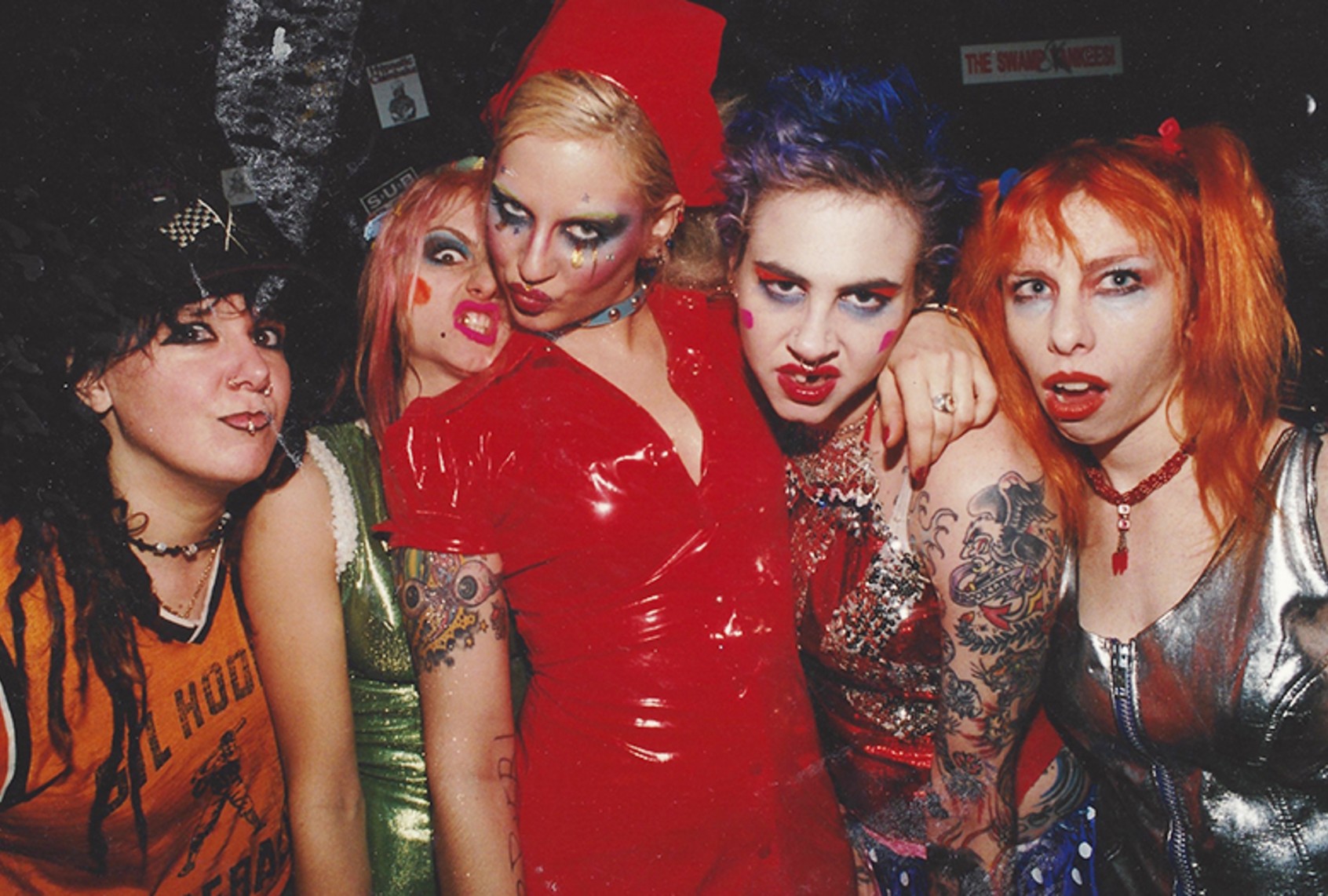
“The Lunachicks tapped into every girl’s desire to take down the patriarchy,” offers “Fallopian Rhapsody” co-author, music journalist Jeanne Fury. They were thoroughly, 100% grounded in punk rock, but executed with great humor and flamboyant onstage outfits, everything from Kogan’s vinyl bondage nurse outfit to the tutus they’d often all wear at the same time. They wrote songs like “Jan Brady” and “Babysitters On Acid” or “Plugg,” as Volpe explains (while standing in front of a gigantic photograph of the band – part of an ad campaign for Vans – in the middle of the Union Square subway station) they once tried to execute spontaneously menstruating together at the same exact moment, taping bags of fake blood to the back of their guitars or on the inside of their thighs.
The costumes were important. The attitude was important. The politics were important. Before Riot Grrrl, Theo Kogan was enforcing an early version of “girls to the front,” calling out problematic men at their shows, on mic and from the stage. There’s great footage of her reading the riot act to a man in one audience. And most people forget that the Lunachicks were there in the days of Rock For Choice, a series of benefit concerts organized by L7 beginning in 1991 that were in support of pro-abortion rights. Over the years, the benefits featured names like Pearl Jam, Nirvana, Joan Jett, Rage Against the Machine and others. Theo Kogan displays a stash of vintage T-shirts while archival footage shows Lunachicks marching in DC, Kogan wearing a tiara that reads FEMINIST KILLJOY and carrying a sign reading GET OUT OF MY WOMB.
They once tried to execute spontaneously menstruating together at the same exact moment, taping bags of fake blood to the back of their guitars or on the inside of their thighs.
It wouldn’t be a story about women trying to make art in the world without the people who tried to get in their way and the rampant, sometimes diabolical sexism, especially at the very moment punk rock suddenly became big business. Famously, the Lunachicks took the Offspring out as their opening act until “Come Out and Play” became a number one single. Then the Offspring returned the favor and had the Lunachicks open, but their reception among Offspring fans was not quite as positive as it was when things were reversed, in the form of constant, non-stop “get out your tits” chants. There was also a fairly well-publicized incident with Blink-182 when the Lunachicks got added to Warped Tour; to Blink-182, women were only there as targets. There’s footage of the boys looking dumb and bemused (“They didn’t appreciate our boob jokes,”) and of Theo exhorting the women in the crowd to not take any sh*t.
The Lunachicks had been Lunachicks for 12 years before they were able to upgrade from touring in an Econoline-style van to an RV, which feels like the height of luxury to them. But despite the high-profile opening gigs, they watched while other bands who had just arrived were suddenly making a lot of money, while they were still hearing things like a radio station explaining that they couldn’t play the band on the radio because they were already playing a band that had women in it. Or that they couldn’t get booked into that festival, because there were already female bands playing. Or that the magazine couldn’t review their record, or put them on the cover, or any number of other normal activities where no one ever says, “Wow, that lineup is all men, we can’t possibly have that.” The emphasis — which, again, came from the director’s viewpoint, so it’s not that the band said, “We don’t want to talk about this” — instead falls on all the great stories and the friendships and the fact that the Lunachicks just kept working, kept touring, kept writing and recording and playing music.
A sign of a great documentary is often the other famous (or exponentially more famous) artists who show up in the film. Sometimes it doesn’t even matter what the talking heads are saying; it’s the fact that they have chosen to lend their name, their time, and their overall imprimatur to the project. In the case of “Pretty Ugly,” there are some top-tier folks, and they are all enthusiastic without prompting. Dexter Holland and Noodles of the Offspring, who began their career opening for the Lunachicks, have nothing but good things to say, as does Mike Bishop of costumed heavy metal merchants GWAR: “The Lunachicks was more than a band. It was a gang.”
But the best cameo is from Debbie Harry and Chris Stein of Blondie:
Debbie: “I was really surprised that they didn’t go further.”
Chris: “It was too much for some people.”
Debbie: “Fu*k ‘em if they can’t take a joke.”
As noted above, it’s not that this statement is that unique or earthshattering. But it’s coming from a very famous band that also came from downtown NYC. They noticed the Lunachicks, they paid attention, and they clearly liked what they were doing. This is rock documentary gold.
The other thing about a good rock documentary is when the movie makes you viscerally not just understand but feel how good the band was. The Lunachicks are better than you remember them, even if your memories are fond ones. Theo Kogan’s voice was — and is, in the Webster Hall footage from 2021 — clear and monstrous and the perfect voice to sing these songs. Gina Volpe is a fantastic guitar player. And even with the various trials and tribulations within the rhythm section (and especially the drum throne), everything was tight as hell and absolutely rock solid. There were so many great bands in this era that happened to be all-women, and all of them should have been more famous and better paid than they were.
We need your help to stay independent.
This film is also about the band’s legacy, even if some of the band members seem a little uncomfortable hearing that word applied to the Lunachicks. There’s that adage about the Velvet Underground, how they only sold 10,000 copies of their first album, but every one of the 10,000 people who bought it went out and started their own band. There were, and are, many women for whom the very existence of the Lunachicks was life-changing, whether it meant that they picked up an instrument, wrote a song, started their own band, or simply used their example as an inspiration for a model of freedom and self-expression within their own lives.
It wouldn’t be a story about women trying to make art in the world without the people who tried to get in their way and the rampant, sometimes diabolical sexism, especially at the very moment punk rock suddenly became big business.
Chaiken touches on all of this a little bit in a short passage where the band talks about what it was like to get fan mail (and we see some of it, handwritten notes full of love and admiration and enthusiasm) and what it felt like to be a positive influence. One of the only negatives about the film is that there should have been just a little bit more of this, because it feels like they don’t want to puff themselves up too much. “When I hear things like that from fans, that makes all that suffering that we did on the side of the road and sleeping on floors and running out of gas, worth everything,” says Kogan in the film.
“Documentaries are reserved for people who are, like, super famous and, you know, everybody knows who they are,” Gina Volpe said when asked about her perspective on her band’s legacy. “Maybe I’m just downplaying us a little bit too much in that.” When it’s pointed out that Ilya Chaiken mentioned the fact that Volpe had been the caretaker of the band’s archive, handing over a box of artifacts and VHS tapes she’d taken care of over the years (and the source for much of the archival footage, photographs, fliers and other physical mementos), she’s not entirely ready to accept that aspect of it.
But it’s out of her hands. “Pretty Ugly” is out right now, showing in limited theatrical release (screenings in Philadelphia, Las Vegas, Boston, St. Louis and more happening right now) and will be available for streaming on AppleTV, Fandango At Home, and Prime Video. More information about screenings and streaming is available on the band’s website. Somewhere out there is a young person who’s going to find this film and not even know it’s what they’ve been waiting for.
Read more
from music columnist Caryn Rose
