
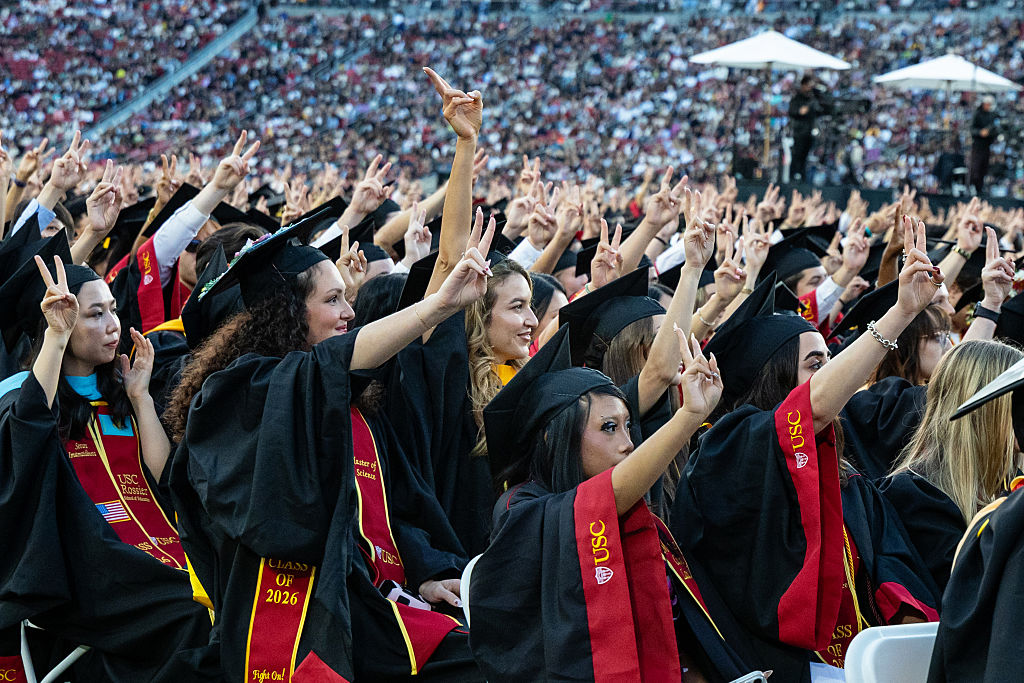

Across this year’s commencement season, the selection of speakers has become its own reflection of how institutions are trying and often struggling to speak to a graduating class entering a period of economic and cultural uncertainty.
At one end of the spectrum are celebrity and cultural figures who have leaned into humor, vulnerability, and personal storytelling. At Harvard University, comedian Conan O’Brien delivered a commencement address rooted in self-deprecation and reflection on career longevity. At Northeastern University, Hilary Duff brought a similarly nostalgic tone, speaking to reinvention and early-career uncertainty in a way that resonated with younger audiences.
Other widely circulated addresses this season came from figures like Henry Winkler at Emerson University, whose relatively brief remarks emphasized warmth, persistence and emotional honesty — qualities that have increasingly defined the speeches that gain traction beyond the ceremony itself.
“Live by two words: tenacity and gratitude. Tenacity will get you where you want to go, and gratitude will make you enjoy the journey, no matter how bumpy.” — Henry Winkler, Emerson Univeristy, May 2026
These addresses often succeed less because of institutional authority and more because they feel explicitly personal.
At the same time, political and institutional figures continue to occupy traditional commencement roles, though often in increasingly contested environments. At Howard University, Washington, D.C. Mayor Muriel Bowser faced visible student pushback during her remarks, underscoring how even ceremonial addresses can become sites of political expression and disagreement.
These tensions were echoed elsewhere. At University of Central Florida, student debate and reaction surrounded businesswoman Gloria Caulfield, whose AI-focused commencement address that drew audible pushback during the ceremony itself, reflecting growing discomfort with artificial intelligence as both a tool and a symbol inside academic spaces.
And at New York University, political scientist and NYU professor Jonathan Haidt drew criticism and protest in connection with commencement programming, highlighting ongoing generational disagreement over how institutions should engage with debates around free speech, culture and Gen Z identity.
Start your day with essential news from Salon.
Sign up for our free morning newsletter, Crash Course.
What connects these moments is not simply disagreement over individual speakers, but a broader breakdown in consensus about what a commencement address is supposed to represent. Increasingly, speakers are being chosen or challenged not only for what they say, but for what they symbolize about institutions, technology, politics and generational authority.
Read more
about graduation & commencement addresses
