
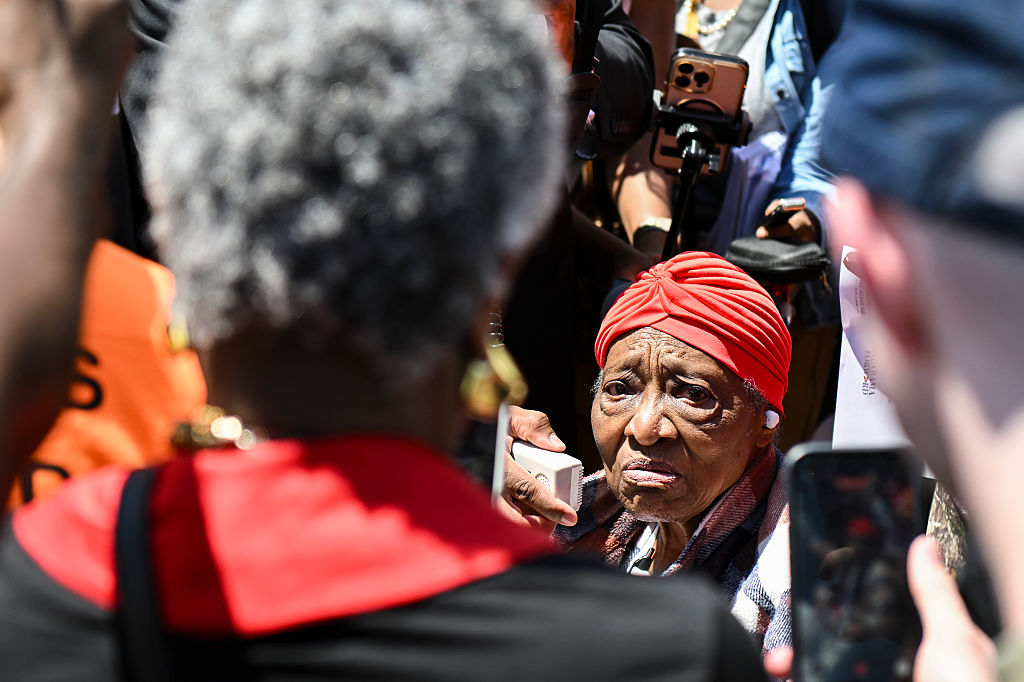

Thousands of demonstrators gathered in Selma and Montgomery, Alabama, on Saturday in one of the largest voting rights mobilizations in the South in recent years, responding to a Supreme Court decision that civil rights advocates say significantly weakens key protections of the Voting Rights Act.
The demonstrations, organized under the banner “All Roads Lead to the South,” brought activists, clergy members, students, union organizers, and elected officials to the historic sites associated with the 1965 Selma-to-Montgomery marches. Protesters crossed the Edmund Pettus Bridge in Selma before continuing events in Montgomery, where speakers framed the current political moment as a continuation, not a conclusion of the civil rights movement.
The protests followed the Supreme Court’s recent ruling in Louisiana v. Callais, a decision critics argue further weakens Section 2 of the Voting Rights Act by limiting the role race can play in redistricting challenges. Civil rights organizations warn the ruling could make it substantially harder to challenge congressional maps that dilute Black voting power across Southern states.
Several high-profile political figures joined the demonstrations, including Representative Alexandria Ocasio-Cortez, Senators Cory Booker and Dr. Rev. Raphael Warnock, and Bernice King, daughter of Martin Luther King Jr. Speakers repeatedly linked the current redistricting battles to earlier struggles against Jim Crow-era voter suppression, arguing that the rollback of federal protections has accelerated over the last decade.
The symbolism of the location itself loomed over the demonstrations. Organizers intentionally centered Selma and Montgomery because of their central role in the voting rights movement, including the events of “Bloody Sunday” in 1965, when state troopers attacked peaceful marchers crossing the Edmund Pettus Bridge, including the late Rep. John Lewis. The violence helped galvanize public support for passage of the Voting Rights Act later that year.
But speakers on Saturday made clear they do not see those victories as secure.
At the rally in Montgomery, chants of “we won’t go back” echoed through crowds gathered near the Alabama Capitol, where both Confederate and civil rights monuments stand within view of one another. Protesters described the current redistricting fights as part of a broader national struggle over democratic representation, particularly in states where Black-majority districts are once again under legal and political pressure.
Start your day with essential news from Salon.
Sign up for our free morning newsletter, Crash Course.
The demonstrations also reflected growing frustration with institutions that many activists believe have failed to preserve protections won during the civil rights era. Organizers repeatedly emphasized that the protests were not simply commemorative events tied to historical memory, but warnings about what they see as an active rollback of voting rights in real time.
For many attendees, that was the central message of the weekend: Selma is not only a site of American history. It remains a battleground over who gets political representation, whose votes carry power, and whether the promises embedded in the Voting Rights Act still hold meaningful force six decades later.
