
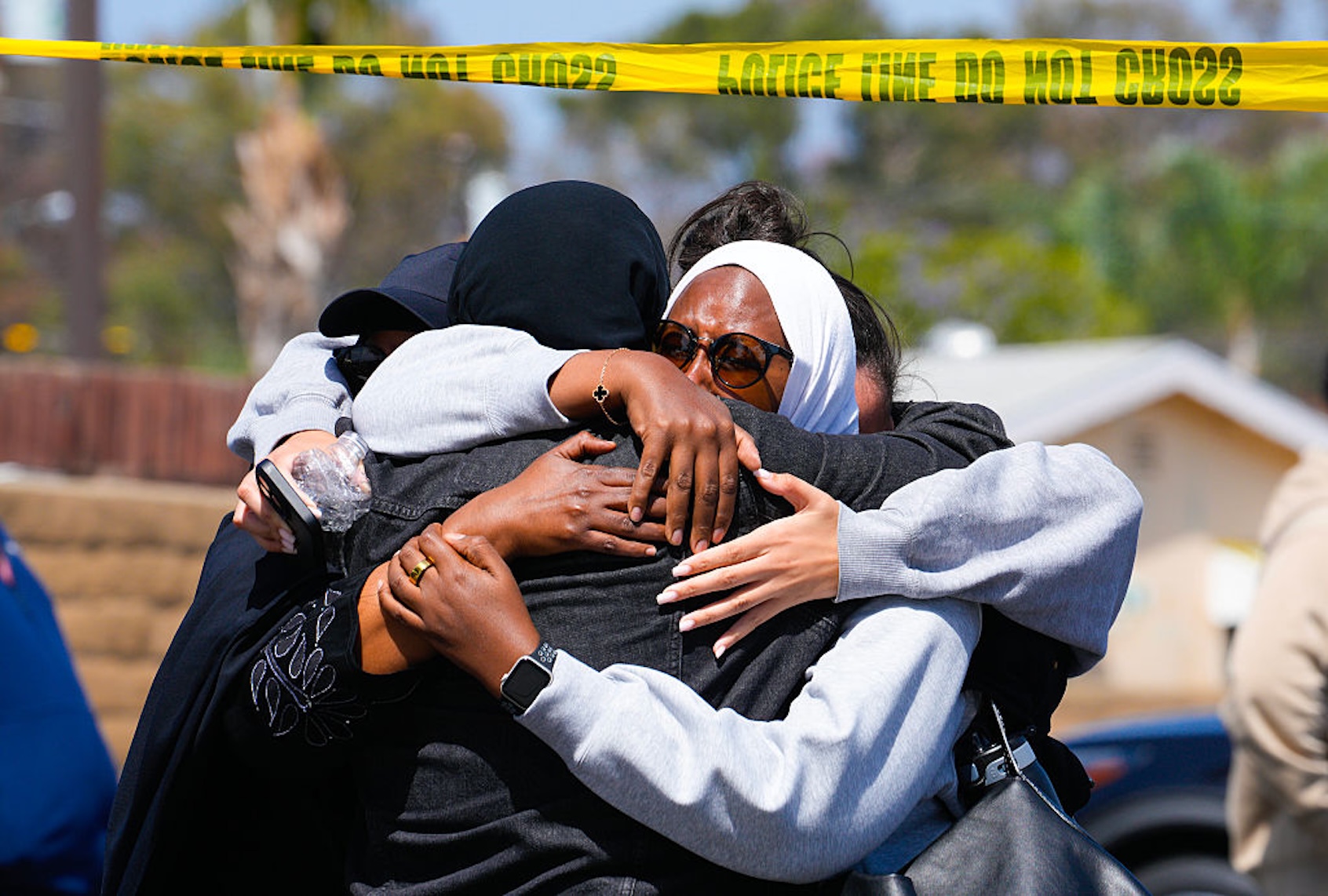

Much remains unknown about the recent shooting at the Islamic Center of San Diego that ended with three victims killed and the two teenaged suspects dead by their own hand. Initial reports from law enforcement suggest this was a hate crime. Cain Clark, 17, and Caleb Vazquez, 18, were reportedly radicalized into white supremacy online, and left behind racist writings and symbols of Nazism and the Confederacy. A fuller view of their motives will no doubt emerge from the investigation, but in the meantime, one detail has emerged that’s all too common in cases with underage killers: Clark reportedly stole the guns used in the shooting from his mother.
San Diego police are yet to determine if they will file charges, but they have confirmed the weapons involved belong to a parent and not to either shooter. (The minimum age to legally purchase guns in California is 21.) Clark’s mother called the police before the shooting, telling them he had stolen her car and her guns, and was possibly suicidal. This is typical in these cases. In a 2025 analysis of school shootings committed by juveniles, the Washington Post found that in 86% of the 180 cases they examined, the weapons used came from the homes of friends, relatives or parents.
While more evidence needs to be collected in the San Diego shooting to determine the teenagers’ motives and access to guns, the larger trend shows that more needs to be done to hold adults accountable when minors snatch their weapons. In recent years there have been two high-profile prosecutions of parents of school shooters, but such accountability remains an under-used tactic by district attorneys. It’s one that should be used more; far too many gun-owning parents are careless, leaving firearms where kids can easily get to them.
This access doesn’t just result in murder but also includes the potential for suicides and accidental gun deaths, making firearms the leading cause of death for children and teens in the U.S. Seeing other parents face legal consequences for unsecured guns might be the incentive some parents need to finally invest in a gun safe — or better yet, get rid of their weapons altogether.
In 2024, Jennifer and James Crumbley received 15-year sentences for involuntary manslaughter after their 15-year-old son Ethan murdered four people at his high school in Oxford Township, Michigan. The case was reportedly the first time parents had been charged with homicide, although a researcher at Baylor University School of Law found that most states have prosecuted parents on other charges for violent crimes committed by children.
Want more Amanda Marcotte on politics? Sign up for her free newsletter, Standing Room Only, now also on YouTube or wherever you get your podcasts.
The case against the Crumbleys worked in no small part because their behavior was so egregious. They ignored Ethan’s frightening behavior, which included animal torture, and rejected warnings from his school that their son was out of control. Instead, they bought Ethan a gun and took him to the shooting range. When a teacher caught him shopping for ammunition on his phone, his mother laughed it off, texting him, “Lol. I’m not mad at you. You have to learn not to get caught.” After he was arrested, the Crumbleys went on the run and were caught only after an extensive manhunt.
The precedent has opened up the door to similar prosecutions. In March, a Georgia jury convicted Colin Gray of second-degree murder after his 14-year-old son Colt was alleged to have killed four people in a school shooting. Prosecutors won the conviction after Gray’s estranged wife testified that he ignored his son’s erratic behavior and made it easy for him to access the assault rifle used in the shooting.
But an increasing number of legal experts are arguing that the mass shooting problem is so dire that it’s become necessary to, in some instances, prosecute the parents of the perpetrators.
Because these are homicide convictions for people who weren’t even on the scene when the victims were killed, these cases are uncomfortable. But an increasing number of legal experts are arguing that the mass shooting problem is so dire that it’s become necessary to, in some instances, prosecute the parents of the perpetrators.
“The goal of these lawsuits and prosecutions is to deter parents from being careless with their guns and put pressure on their children to stay away from firearms,” University of California, Davis law professor Nila Bala told the Guardian. Major gun safety organizations including Giffords, Brady United and Everytown have publicly backed prosecutions of parents or other adults who facilitate shootings, even unwittingly, by making guns accessible to minors.
This isn’t just about parents being thoughtless. Guns have become a major culture war issue. For many conservatives, buying firearms and displaying them openly has become a way to signal their political identity and affiliation with Donald Trump’s MAGA movement. When politicians try to pass mandatory gun safety or trigger lock laws, pro-gun groups will insist those laws are unnecessary. Posing around the Christmas tree with guns — often in the hands of children — has become something of a Republican tradition, often for the purpose of trolling liberals. Another popular social media trope on the right is the photo of an unsecured gun on the nightstand, which is such a cliché at this point that even Elon Musk, the father of at least 13 mostly minor children, has followed suit. While their political affiliation is unclear, Gray and the Crumbleys behaved similarly, treating guns not just as tools but as fashion accessories, which allowed them to be coded by most Americans as MAGA.
We need your help to stay independent.
Because it’s a matter of cultural and political identity, many on the right reject the overwhelming evidence that having firearms — and especially unsecured guns — in the home is dangerous for children. Narratives that paint gun control as a liberal effort to oppress conservatives create an excuse to dismiss the dangers as nothing more than a Democratic hoax. Perversely, this has created cultural incentives to make guns easier for kids to get; having them visible and accessible in the home is seen as a way to stick it to progressives. And since guilt doesn’t often work and facts rarely register, the next step to convince right-wing parents to be safer with guns is to create legal consequences.
Law enforcement in San Diego has been mum about the possibility of charging parents in the Islamic center shooting, but defense attorney Elmira Yousufi raised the possibility to Fox 5, a local news station. So far, the case is more ambiguous than the Michigan or Georgia cases. Both the Crumbleys and Gray had a lengthy documented history of ignoring and even arguably encouraging dangerous behavior in their children. Clark’s mother, however, called the police herself, hoping to prevent violence.
Whether such charges are justified in this particular case, prosecutors across the country should be open to indicting parents or other adults when minors commit crimes with their guns. Such cases get attention and send a message that carelessness with firearms is serious business. In a political environment that is hostile to passing meaningful gun control, it’s time to get creative about preventing mass shootings. One step: make gun-owning parents think twice before leaving their weapons unlocked.
Read more
about gun violence
