
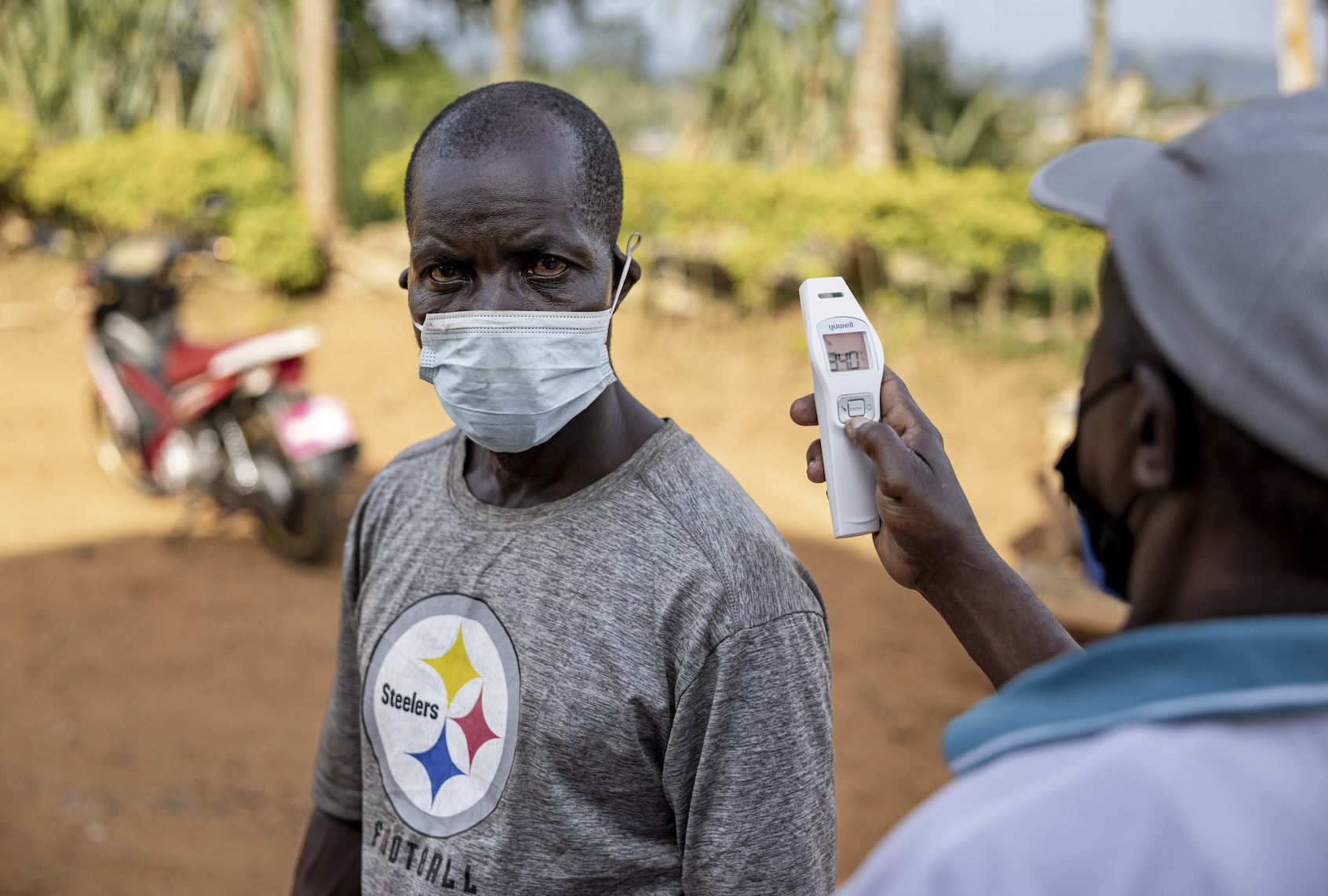

The ongoing Ebola crisis is escalating quickly, already ranked the third largest outbreak in history — and experts say erosions of U.S. health policy have fueled the crisis. When Health and Human Services pleaded for volunteers from the Centers for Disease Control and Prevention to screen for Ebola at airports, they highlighted what experts say is a growing problem. The Trump administration’s pullback from public health is rippling across the globe in ways that don’t just affect those overseas.
On Wednesday, the CDC issued an “urgent request” to its workers to help screen for Ebola at U.S. airports. The request came on the tail of the CDC restricting travel from the Democratic Republic of the Congo, Uganda and South Sudan earlier in the month as the outbreak worsens. So far, more than 1,000 cases have been reported, with 223 deaths, though only about 125 confirmed cases and 17 confirmed deaths, given that the ongoing conflict in the Democratic Republic of the Congo has impacted accurate data collection. On average, Ebola is about 50% fatal, which is far more deadly than flu or COVID-19. There is no cure or vaccine for this specific strain of Ebola, the Bundibugyo virus.
The situation, however, is also playing out in the wake of a dramatic pullback in public health investments from the U.S. government, especially in areas relevant to foreign aid. For example, at the beginning of his second term, President Donald Trump, with the assistance of billionaire Elon Musk, disassembled the United States Agency for International Development, an agency that once spearheaded the international response to previous Ebola outbreaks.
Dr. Craig Spencer, a professor at Brown University’s School of Public Health and a survivor of Ebola, told Salon in an interview that the current administration’s reaction to the Ebola outbreak is vastly different from even 2024, when there was an outbreak of a similar disease, the Marburg virus, in Rwanda.
“A friend of mine was on the ground during this [2024] outbreak. She called me right before it was officially reported. I was able to get in touch with someone that I knew in global health in the U.S. government, who got me in touch with someone from the global health team at the White House,” Spencer said. “I was talking to them within an hour of talking to my friend in Rwanda, and within eight days, there were investigational treatments and vaccines on the ground, all facilitated by the U.S., the White House, and USAID.”
The situation is also playing out in the wake of a dramatic pullback in public health investments from the U.S. government, especially in areas relevant to foreign aid.
Spencer said that in just more than a week, there were vaccines and treatments from the U.S. being deployed in Rwanda, and that he credits the speedy response with the containment of the outbreak and with the successful interruption of transmission.
“Rwanda ended up ending that outbreak with one of the lowest death rates recorded for an Ebola or Marburg response ever,” Spencer said.
Spencer compared this to another Ebola outbreak in Uganda in early 2025, which didn’t see a U.S. response and, in his assessment, suffered as a result when compared to the 2024 Marburg outbreak, though the intervention of other global health organizations did help stem the spread, in his opinion. The current Ebola outbreak has already far surpassed the 2025 outbreak, which saw fewer than 100 confirmed cases, with the 2026 outbreak nearing 1,000 confirmed cases.
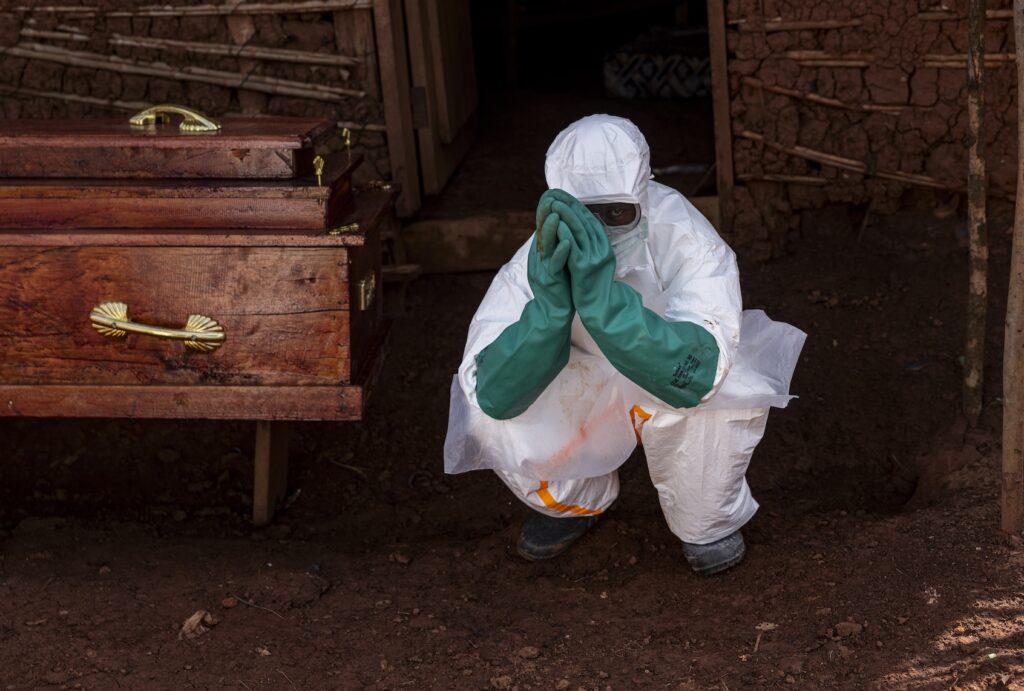
(Photo by Michel Lunanga/Getty Images) A health worker wearing protective equipment crouches beside the coffin of a suspected Ebola victim during safe burial procedures outside a family home in the community of Mongbwaluon May 24, 2026 in Mongbwalu, Ituri Province, Democratic Republic of Congo.
Matthew Herder, a professor of law and Medicine at Shulich School of Law at Dalhousie University, told Salon that the current outbreak is likely worse because of the lack of U.S. support for a response in the region and that future outbreaks are also likely to be difficult to contain because of cuts to public health investments at home and abroad.
“The National Institutes of Health was previously, and for decades, the biggest funder of biomedical research against infectious diseases and other threats to public health globally,” Herder said. “When you essentially force that institution to cut all of those programs, research programs inside the United States that have application elsewhere as well as domestically, you are undercutting the biggest funder of research for preparedness that we have on the planet.”
Herder explained that the U.S. has not only played a critical role in emergency response to these outbreaks, but also in setting up surveillance systems that can help detect these issues earlier and in training local workforces to better monitor and respond to outbreaks when they do happen.
We need your help to stay independent.
Herder said that, while the U.S. pullback from public health is worsening the response to the current Ebola outbreak, albeit in ways that are hard to quantify, the cuts to public and global health investments could have more widespread consequences in the event of an outbreak of a faster spreading respiratory virus, like COVID-19 or a flu.
Herder used the example of H5N1, an influenza virus that has been circulating in wild birds since 2022 in the U.S. and elsewhere, and which has since spread to mammals, everything from bears to house cats, whales and a few humans, as the sort of transmissible disease that could become a disaster if it begins to widely infect humans while U.S. public health infrastructure is in its current diminished state.
Early in Trump’s second term in office, he signed an executive order withdrawing from the World Health Organization, something he had attempted to do in his first term. The legal process of leaving the WHO was completed in January of 2026.
“The language of that order isn’t just about withdrawing, it’s about the cessation of sharing information with the WHO. And the world’s greatest hub of tracking influenza in particular is at the CDC in Atlanta,” Herder said. “So you have this virus circulating in livestock, poultry and whales around the United States, and the central hub for that information is directed to no longer share it with the rest of the world.”
Herder highlighted how cuts to public health investments also include a cessation of financial support for the development of mRNA vaccines from the government, which are among the most adaptable platforms for developing new vaccines for flu viruses. This, Herder said, could slow the development and deployment of new vaccines.
Start your day with essential news from Salon.
Sign up for our free morning newsletter, Crash Course.
“Right now, the U.S. still remains an incredibly powerful economic actor,” Herder said. “So if someone develops a vaccine against that virus down the line, they may be able to use their purchasing power to capture the doses they need to respond — but they won’t be at the forefront of preparing for it, surveilling it, and they won’t as well placed as they have been in the past to make sure they have doses for their own domestic needs.”
Haiyun Damon-Feng, assistant professor at Cardozo School of Law, underscored how the ongoing politicization of the work that agencies like the CDC do further undermines the ability of the U.S. to respond to public health threats at home.
“The CDC, for example, is not primarily a regulatory agency. They primarily have this more epistemic function where they gather, surveil data, and they put together analysis, and they have historically employed a whole cadre of public health experts and scientists to do this work,” Damon-Feng said. “And we saw in the very beginning of this administration the kind of slashing of that infrastructure.”
This, combined with the cuts to foreign aid programs like USAID, puts the U.S. in a particularly vulnerable position in terms of responding to both domestic and global public health threats. Damon-Feng, however, also noted that it makes it harder for the public to hold public health officials responsible for their actions.
“If we have politicized control over what we believe to be true, or what facts we’re exposed to, or what facts are even allowed to see the light of day, you can think about kind of the type of censorship that has been reported coming out of various federal agencies, that is going to have a hugely detrimental effect on our ability to hold our elected officials and appointed officials accountable,” Damon-Feng said.
Read more
about public health
