
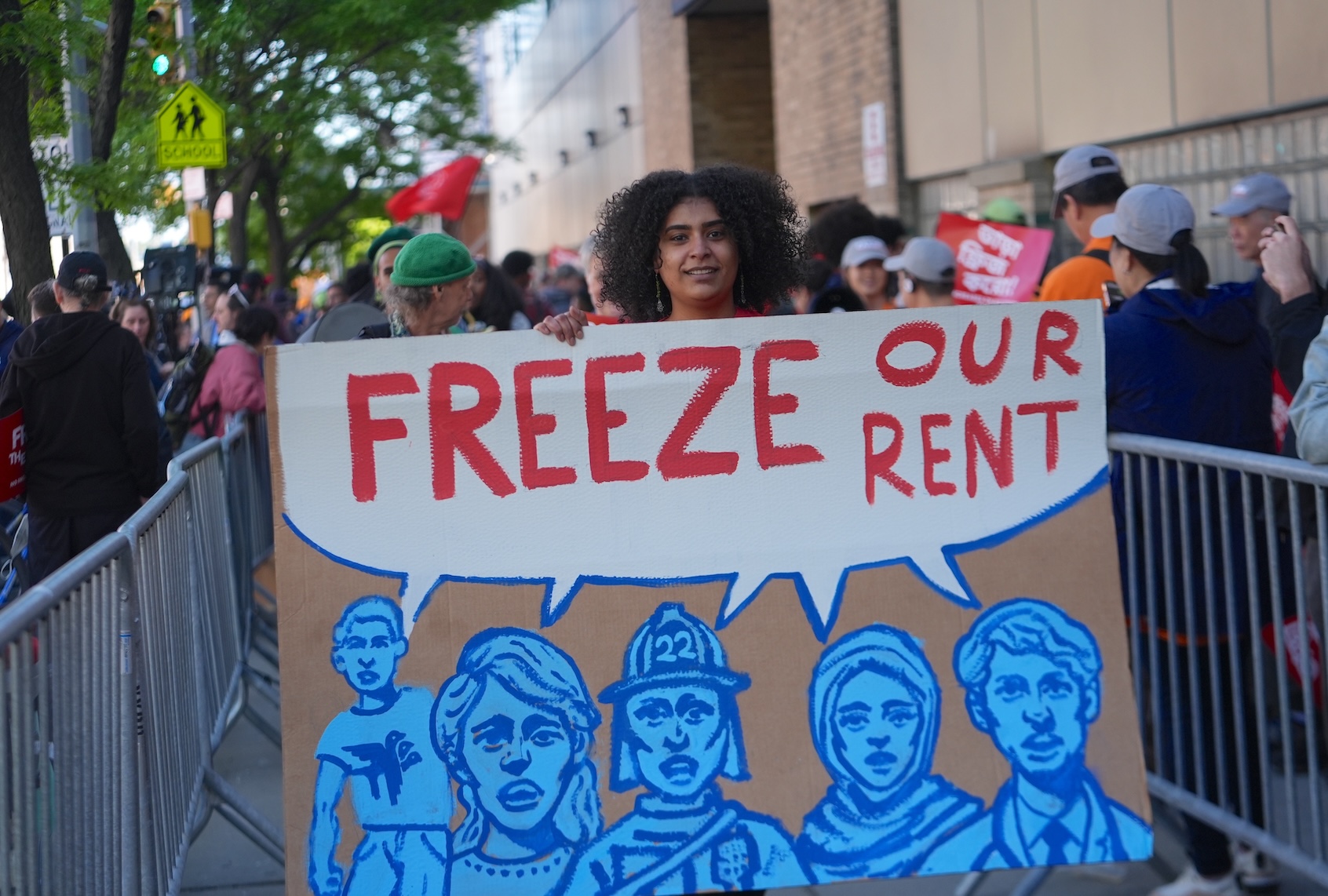

On Thursday, tenants and organizers gathered outside the theater at the New York City College of Technology for a block party, but not just any block party. This was in preparation for testimony at a bureaucratic meeting that plays an outsized role in the lives of millions of New Yorkers and controls the ultimate fate of one of Mayor Zohran Mamdani’s central campaign promises: freezing the rent.
Inside the theater, the Rent Guidelines Board, which has nine members all appointed by the mayor, met to hear public testimony regarding the board’s primary responsibility: deciding how much to raise the rent in New York City’s roughly 1 million rent-stabilized apartments, which account for about 42% of all rental apartments in the city.
The hearing on Thursday is part of a series hosted by the board at venues around the city in which the board hears testimony from members of the public, from both renters and landlords. As one might expect, renters typically advocate for a smaller rent increase (or none at all) and landlords tend to advocate for a larger increase. The Thursday hearing is the ninth of 11 public board hearings, but only the second where the board will hear from members of the public.
In recent years, under former Mayor Eric Adams, renters in stabilized units saw relatively large increases in their rent, with the board approving a 2.75% increase for one-year renewals in 2024 and a 3% increase in 2025. While these increases pale in comparison with some of the largest increases in the board’s history (in 1968, they approved a 10% increase, for example), they were a marked uptick from the low rise in stabilized rents during former Mayor Bill de Blasio’s administration. In both 2015 and 2016, for example, the board froze the rent for one-year lease renewals, and in 2019 and 2020, the board only approved a 1.5% increase.
However, with Mamdani running City Hall, and a burgeoning tenants’ movement in the city, organizers, renters and elected officials aligned with the cause have been preparing for these public testimony hearings, with the hopes of ensuring that the case for a rent freeze is made as strongly as possible.
At one event in early June, hosted by Churches United for Fair Housing and City Council Member Crystal Hudson at the Major Owens Center in Brooklyn, tenants received a briefing on what the Rent Guidelines Board does and how to best prepare their testimony for the event. This included a rundown of the board’s nine members, of which two represent landowners, two represent tenants, and five represent the public good.
“We’re gonna break down each of these folks, we’re gonna do a little bit of power mapping, so that we can best plan how we’re going to target these specific individuals,” one organizer said at the event. “I can tell you from experience organizing that these moments really do matter. People sharing their real everyday stories about their struggles and what they need and how they’re trying to get by really does affect people. That’s what our goal is.”
As it stands, six of the board’s nine members were appointed by Mamdani, one of whom, Adán Soltren, a tenant member, was appointed by Adams and reappointed by Mamdani. The terms of the three remaining members not appointed by Mamdani expire at the end of the year.
During the organizing meeting, attendees were given a pamphlet with a two-paragraph description of each board member’s career, at least as it relates to housing and development, and then attendees were split into groups to confer as to whether they believed the member would vote in favor of tenants or landlords. After a few minutes of deliberation, the whole group went through each board member and voted on whether or not they were likely to support tenants, landlords or seemed to be relatively neutral.
We need your help to stay independent.
Though the board is appointed by the mayor, they technically operate independently, meaning that despite Mamdani’s appointments, a rent freeze is not guaranteed. Still, organizers at the event said they were optimistic that the changes to the board would tilt the odds in favor of a more pro-tenant decision.
Part of the goal of the organizing done by Churches United for Fair Housing and groups like it is to make sure that a healthy amount of the time at the three-hour hearing is occupied by tenant testimony rather than landlord testimony. Each hearing is scheduled for just three hours, but they almost always go longer. A recent hearing lasted for about five hours. Showing up at these hearings is one of the best ways for both tenants and landlords to ensure the board hears their testimony. This makes the time valuable for both tenants, hoping to save money on rent in the future, and landlords, aiming to collect more in rent.
Getting bodies in the room is also valuable as the hearings sometimes get rowdy. For example, at a recent hearing, a renter was met with boos after naming a wealthy real estate investment company as a “real estate manipulator,” while recounting a story about how their landlord had ceased performing basic maintenance in an effort to save money.
“A few years after I moved in, Pinnacle, run by a rich real estate manipulator, bought the building and immediately enacted a rollback — not on stabilized rents, but on maintenance,” the tenant said. “Pinnacle deliberately let our building and more than a hundred others across four boroughs slide into disrepair. Now roofs leak, elevators and boilers break down, ceilings fall, and repairs are just reluctant patch-up jobs. by understaffed, unqualified workers.”
Board members were not, however, the only people tenants were briefed on, with organizers including two private-sector key figures in New York City politics and housing policy in their briefing packet, those figures being New York Apartment Association CEO Kenneth Burgos and Real Estate Board of New York president James Whelan.
Both of these figures were vocal in the 2025 mayoral race. Burgos sounded the alarm to anti-Mamdani forces that the underdog needed to be taken more seriously during the primary. Afterwards, Burgos was early in recognizing that attempts to defeat Mamdani in the general election were likely futile.
Whelan, who often acts as a voice for real estate interests in the press, made it clear early in the election that former Gov. Andrew Cuomo was the preferred candidate of the industry. Whelan said that the real estate board would work with Mamdani in September. However, many who were active in the effort to stop Mamdani’s election, which ultimately turned out to be a disorganized failure, took that as a sign that defeat was imminent.
All of the hearings of the Rent Guidelines Board will culminate at a final vote on June 25, which will not only decide whether the rent goes up and by how much, but on whether Mamdani, who ran on the slogan of “freeze the rent,” can make good on a key campaign promise in his first year.
Read more
about this topic
