

America has always been a haven for cult leaders. Its commitment to religious freedom, a concept on which the country was originally settled — and which the founders understood to be necessary to avoid the sectarian wars that had consumed Europe for centuries — guaranteed that anyone capable of attracting a following could form one without government interference. The country’s equal commitment to capitalism meant that it was possible to make a tidy profit at it in the process.
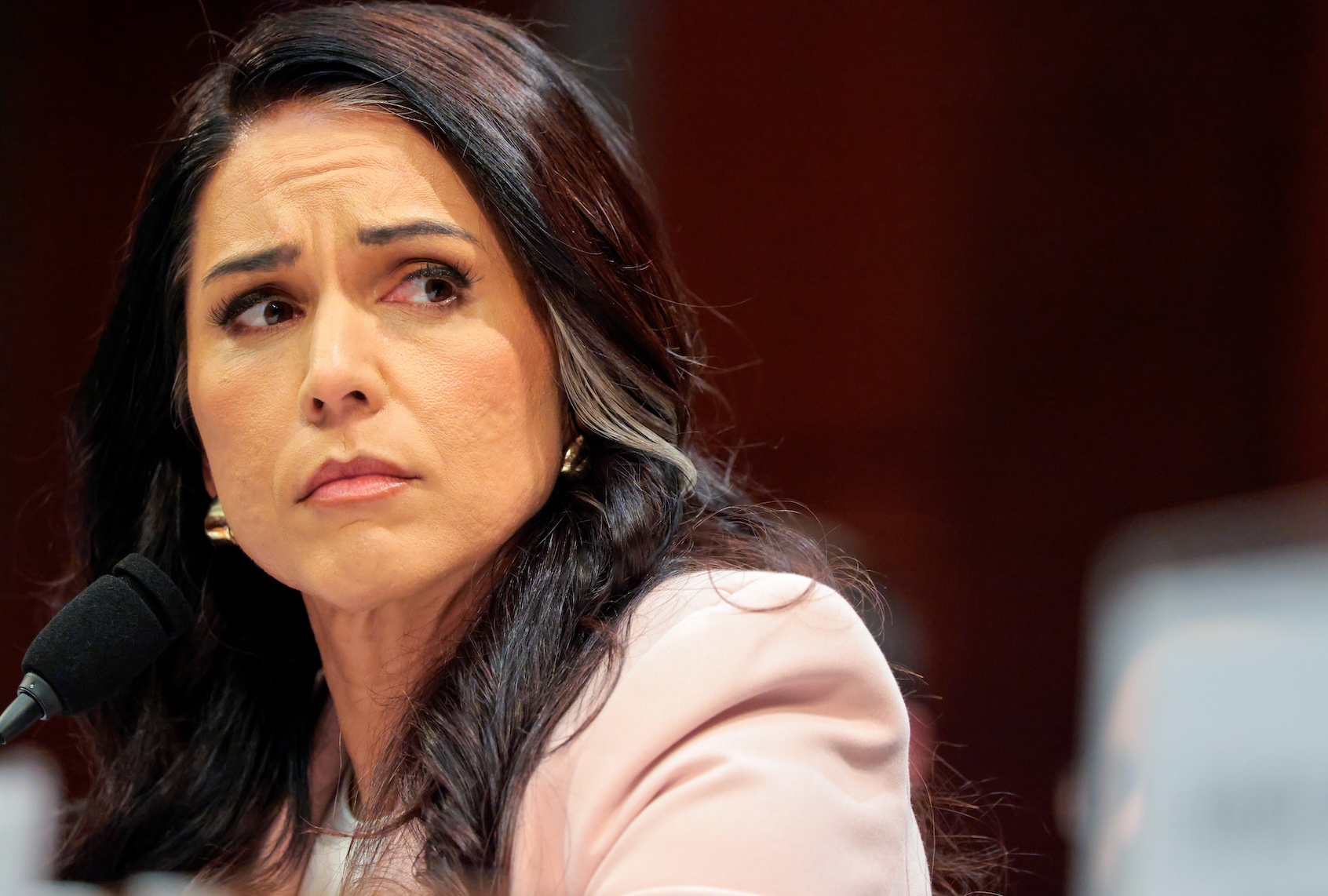
In other words, cults are as American as McDonald’s apple pie. So the latest revelations about former Director of National Intelligence Tulsi Gabbard’s membership in what the Washington Post described as a “breakaway Hare Krishna group” led by a guru who “controlled his followers’ major life decisions and demanded total obedience and secrecy” — and apparently held major sway over her political career and positions — shouldn’t come as a surprise.
Quite a few religions were considered cults in the beginning, Christianity among them, so it does make some sense not to wade too deeply into the finer distinctions. The English considered the Puritans a cult, and we know how that ended up. What you may call a cult today could be the Mormon church tomorrow, with millions of citizens among its adherents. Despite their long history, one might consider the Amish or Mennonite faiths as cults, simply because they adhere to a superannuated culture that rejects modern life. Despite their unorthodox belief system, some more contemporary examples, such as Scientology, are savvy in deploying the religious protections offered by the Constitution to secure legal and financial benefits. (Read up on Operation Snow White.) In short, there are almost as many permutations of religious belief in the U.S. as there are people.
But for all the more or less mainstream — or at least accepted — religions that may have started out like small cult-like sects, there are many actual, card-carrying cults in the U.S., numbering in the thousands. Many of them are run by con artists and grifters, and even among those fueled by true belief, there is most often an element of greed. But virtually all cults are defined by one thing: a charismatic leader who exercises dominance over the flock. That manifests itself in many ways, often with sex and deviancy — pedophilia being a common feature — and always dominance over the thinking and agency of those who follow.
There have been cases of religious cult leaders who pursue power beyond their own following. Along with his Unification Church, the Rev. Sun Myung Moon built a political propaganda empire, which had tentacles all over Washington, D.C., at one time. And there are global historical examples like the Taiping Rebellion, which successfully took over a part of China in the 1800s and led to the deaths of about a quarter of the Chinese population at the time. (Its leader had a series of visions and believed himself to be the younger brother of Jesus Christ.) The takeover of the city of Münster by religious fanatics in 1534-35 is another example. People who seek power usually want more of it.
All of this is relevant to Gabbard, who is one of the most enigmatic and eccentric characters in American politics today — which is saying something. Before Jon Swaine’s exposé in the Post, it had been well known for years that Gabbard grew up in a cult in Hawaii and has continued to be affiliated with it throughout her life. She and her family, who are also members, portrayed it as a benign Hindu sect that believed in peaceful coexistence and love, and although she was questioned about it at every phase of her very unusual political path, questions about its leader, Chris Butler, never really stuck to her. At every twist and turn in her ideology, Gabbard deftly side-stepped any concerns that she might have some sort of hidden agenda.
Swaine ran up against a brick wall — until he found a whistleblower who had a cache of documents. Those indicated that Gabbard has been taking specific, explicit direction for years from Butler.
Swaine’s story about Gabbard’s ongoing relationship with Butler has brought it all back to the surface. The reporter had been investigating Gabbard’s cult, dubbed the Science of Identity Foundation (SIF), for some time. But as with most cults, it is very secretive, and Swaine ran up against a brick wall — until he found a whistleblower who had a cache of documents. Those indicated that Gabbard has been taking specific, explicit direction for years from Butler.
Even as a young man, Butler started to amass a cult following, and he has had an interest in politics since the 1970s, at one time forming a group that (unsuccessfully) ran candidates for office. Over time, he and his apostles took on various ideologies, dropping them for new ones as times changed and power beckoned. As Swaine documents, Butler “inveighed against Muslims, homosexuality, gun control and public schools, but also promoted environmentalism and anti-capitalism.”
Gabbard and her family were Republicans in the beginning, ultra-social conservatives whose main platform was homophobia. But they later morphed into progressive Democrats, abandoning their former platforms like snakes shedding their skin when they needed a refresh. Gabbard herself did all this in the national spotlight, going from conservative Democrat to Democratic socialist to MAGA apostle in the span of a decade — and culminating in a job running the most powerful spy apparatus in world history.
Start your day with essential news from Salon.
Sign up for our free morning newsletter, Crash Course.
All this shapeshifting gives few clues about what Butler has been pursuing all these years, aside from power itself, which he has apparently wielded in the person of Gabbard. If he has an agenda, it is impossible to discern what it is. He had Gabbard sucking up to murderous dictators at the same time she was supposedly one of the leading anti-war figures in Congress. Her sharp turn from supporting Bernie Sanders to riding the Trump train was dizzying.
We may never know what Butler and Gabbard were after. Two days after she learned Swaine’s article would be published, she resigned from her job as DNI citing her husband’s diagnosis with a rare form of bone cancer. But I wouldn’t count on her leaving politics. Her whole life has been shaped by her guru to obtain political power. What they want to do with it is unknown.
We need your help to stay independent.
According to VeryWell Mind, an organization devoted to mental health, there are several specific characteristics of a cult. Among them are a charismatic, authoritarian leader, a demand for total loyalty, coercion and control of followers, exploitation by the leader to advance their agenda, a requirement to sever ties with people outside the group and, finally, an “us vs. them” mentality. These would certainly describe Gabbard’s cult. But in reading that list, you can’t help but realize that it describes a much bigger and far more powerful cult that is exerting power across the country and world as we speak — and I’m fairly sure you know the one I’m talking about.
Whether MAGA is an actual cult, or a cult of personality like those that formed around Joseph Stalin, Chairman Mao — or even someone like Saparmurat Niyazov of Turkmenistan, who built a golden statue of himself that rotated with the sun and renamed the months of the year after himself — is irrelevant. It’s a cult. So while Gabbard’s guru managed to maneuver his acolyte into a high-profile, important role in the most powerful country in the world, the very top position is currently held by a cult leader with a following in the tens of millions. There’s no way she could ever compete with that.
CORRECTION: This article has been updated to reflect the correct date of the Münster Rebellion.
Read more
about Tulsi Gabbard
