


Joey remembers falling asleep to the sounds of league bowling when she was a little kid in Eastern Michigan. “Both my parents bowled, and my older brother was supposed to keep an eye on me, but he would tell friends to meet him there to play pinball,” she recalls. That left her free to nest in a pile of family coats under a row of seats. There was something calming and oceanic about the rhythm of rolls and cracks around her, blending with the ambient murmur of banter and gossip into white noise. In middle school, she joined a youth league and spent her Saturdays at the same lanes. “I learned to flirt there, I learned to smoke there, I learned to trash-talk there,” she says. “It’s where I grew up.”
Returning to her hometown alley last year with her own daughter and grandson, she says, was the opposite of nostalgic. “Everything was loud and flashing and neon. Overstimulating. Expensive.” The floor was so grubby that the thought of sitting anywhere on it was nauseating, and the lanes were dark, lit primarily by bright neon stripes and squiggles. “They turned it into a funhouse,” she remembers saying.
Want more from culture than just the latest trend? The Swell highlights art made to last.
Sign up here
The “they” is Lucky Strike Entertainment, formerly known as Bowlero Corporation, the private equity–backed behemoth that in the past 10+ years has bought more than 350 of the nation’s bowling alleys and transformed them into a (to quote the Bowlero website) “quirky, edgy, retro-inspired bowling phenomenon” that has deprioritized league bowling, escalated the cost of bowling with algorithm-driven dynamic pricing, and accelerated the demise of one of the 20th century’s most dependable third spaces. And now, thanks to a class-action lawsuit filed in May by disgruntled bowlers, the company stands accused of violating antitrust laws, as well as “the veritable destruction of the decades-old pastime of bowling in America.” (Bowlero, which rebranded as Lucky Strike Entertainment after acquiring all Lucky Strike bowling centers, has since added water parks to its portfolio.)
A rapid loss of third spaces has drawn increased attention in recent years, as the pursuit of profit and the hostility toward the very ideas of community and interdependence has mounted.
In a 2024 exposé on Bowlero’s rise, Amos Barshad introduced a now-familiar category of villain — the private-equity vulture — as more than the average mercenary buying up distressed properties and selling off their parts. Bowlero was engaged in an intentional decimation of bowling itself, asserted Barshad: It became the world’s largest operator of bowling centers, the suit alleges, “not by offering better lanes and a superior customer experience, but by gobbling up its competitors through unlawful acquisitions, and then cutting supply, raising prices, pushing alcohol, promoting gambling, and alienating virtually every customer except those who have no interest in bowling.”
The new model was flashy, black-light entertainment with thumping music, huge video screens, arcade games and claw machines, along with upscale food and drink at double or triple the prices of standard bowling-alley fare. Leagues were de-emphasized in favor of open bowling, parties and corporate events. Prices were jacked up (often with Uber-esque surge pricing at peak hours), but budgets for staff, janitorial service and lane maintenance were cut. In 2019, the company purchased the Professional Bowlers Association (PBA) with an eye toward making tournament broadcasts, as Bowlero CEO Thomas Shannon told CNBC’s Jim Cramer, into extended ads that would drive business to Bowlero’s ever-expanding collection of properties.
Bowlero’s intent to own every 32-lane bowling alley in America is about profit, obviously, but it’s also about the pursuit of a different class of participant. Bowling as we know it has always been a solidly blue-collar pursuit. As a pastime that took off in postwar America with the debut of the literally game-changing automatic pinsetter (alleys previously depended on a revolving stable of pinboys), bowling alleys shed their reputations as seedy, rowdy men’s clubs where patrons drank, smoked, gambled and brawled. The automatic pinsetter ushered in a new era: clean, well-lit places in which to spend leisure time. As a sport, bowling was accessible, low-cost, and with adult, junior and senior leagues, age-inclusive. This made alleys community destinations and social hubs. League bowling took off, offering a reliable income stream for bowling alleys and centers; and as more women joined leagues, some places even offered free daycare. By the mid-1960s, there were approximately 12,000 bowling alleys in the United States that were largely sustained by league play; they were often family businesses that were passed down over generations.
As a business, bowling is private equity’s polar opposite in that its values are primarily community-based.
Bowling leagues were barometers of social engagement, which is why Robert Putnam theorized their decline as emblematic of a broader decrease in community participation and social capital in his 2000 book “Bowling Alone: The Collapse and Revival of American Community.” Putnam wrote that as regular social engagement and recreation dwindled, so did participation in daily civic life. “People divorced from community, occupation, and association,” he wrote, “are first and foremost among the supporters of extremism.” A rapid loss of third spaces — social hubs like libraries, cafés, pubs, parks — has drawn increased attention in recent years, as the pursuit of profit and the hostility toward the very ideas of community and interdependence has mounted. Both phenomena made Bowlero possible and, plenty might argue, inevitable.
To be clear: No one seems to actually like Bowlero, as either a company or an experience. The number of social-media groups and threads predicated on the opinion that Bowlero/Lucky Strike absolutely sucks testifies to a deep feeling, in both serious bowlers and casual enthusiasts, that the corporation is an invasive rot. Even worse, the people ravaging the sport don’t even have the decency to pretend to like bowling. (“I don’t think anyone takes bowling seriously,” Shannon said in a 2011 Bloomberg interview. “Why would you?”) The 11 plaintiffs in the lawsuit have a range of beefs: inconsistent but ever-increasing costs, lack of lane maintenance, malfunctioning pinsetters and ball returns, adoption of string pins, and more. But all are results of rapid consolidation and indifference to bowling as anything more than a line that goes up or goes down.
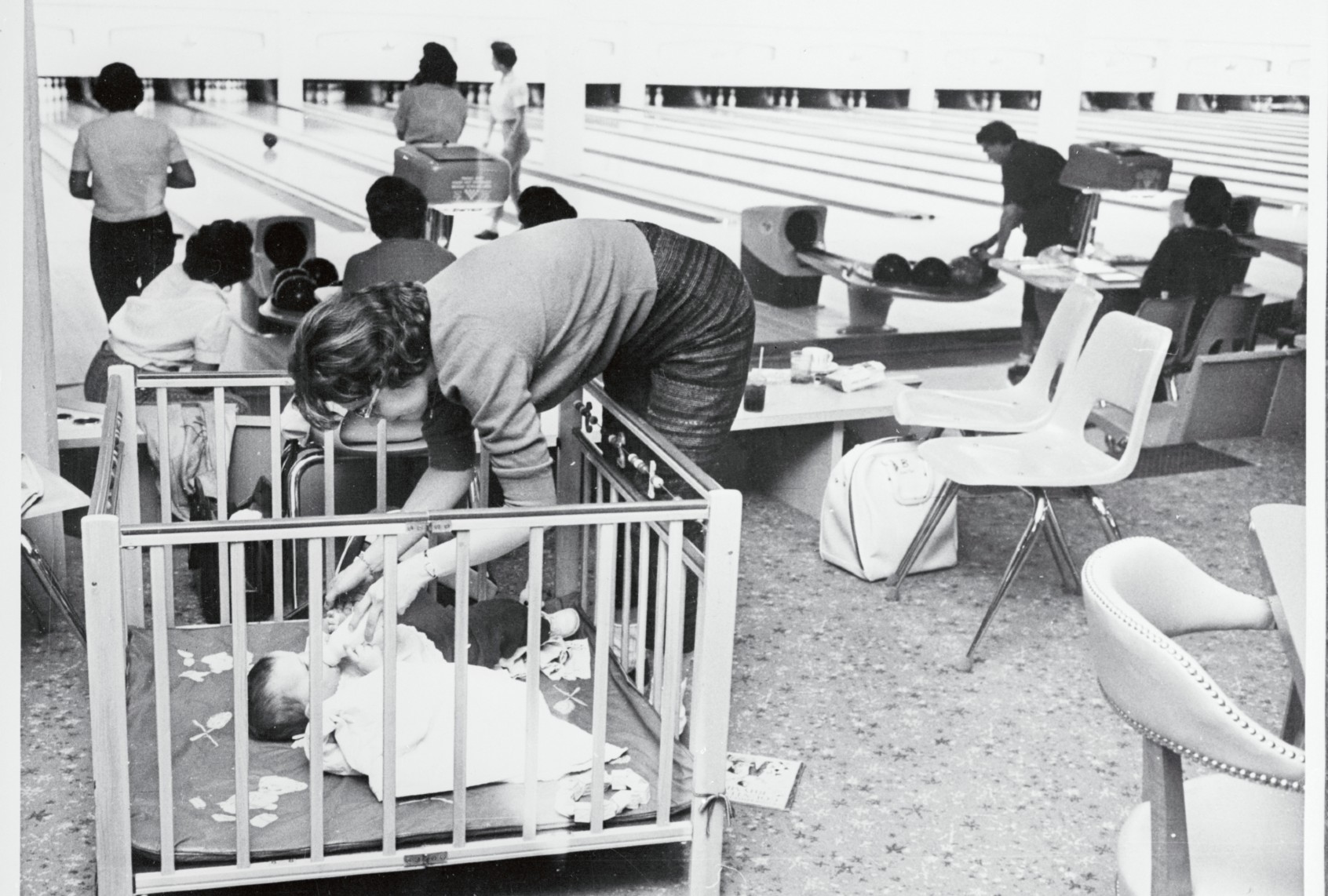
(Bettmann/Getty Images) A woman comforts her child in a bowling alley
As a business, bowling is private equity’s polar opposite in that its values are primarily community-based. The bowling alleys that opened in the mid-20th century were profitable, but it wasn’t a line of work people got into for the money. Shannon, whose first bowling-related project was the makeover of New York City’s Bowlmor Lanes as a buzzy, boozy nighttime destination, started Bowlero specifically to repackage bowling as explicitly not blue-collar, not age-inclusive, and not community-oriented, and ran it accordingly. A pattern of discriminatory hiring and firing was blatant enough that a federal investigation was opened in 2023; Facebook groups and Reddit threads proffer firsthand stories of special-needs employees fired from longtime employment at alleys, elimination of senior-only hours and more.
Everything conservative politicians profess to prize about real Americans — the work ethic, the family values, the comforting whiteness — is what private-equity gobbles up as it stomps through consumer landscapes.
This is all predictably, depressingly American, Barshad writes. “In the interest of short-term profit, a corporation goes about methodically worsening a beloved national pastime. Do you sometimes ask yourself, why does it feel like everything is getting worse? Bowlero provides one possible answer: because somewhere, someone’s making money off the decline.” And according to the experts Barshad interviewed, the company’s m.o. — constant growth, expansion and spending that drives its stock price up, use of revenue to pay shareholders and buy back stock — kicks the question of whether the growing empire is actually profitable down the road year after year while pocketing the dividends. “Executives may believe it will one day expand itself into a hugely profitable quasi-monopoly,” writes Barshad. “But for Shannon, it doesn’t matter if Bowlero soars or crashes. Either way, he gets paid.”
There are Bowlero/Lucky Strike defenders, of course, people who will point out that bowling alleys were already shuttering well before Bowlero came along, or argue that as a publicly traded entity it has a duty to its shareholders, or simply shrug that late capitalism is doing what it does. All of that is true. But Bowlero/Lucky Strike seems uniquely craven because it’s not just razing bowling alleys, but erasing whole swaths of histories and traditions: German immigrants who brought their 9-pin kegelbahn to the American Mid- and Southwest, women who joined leagues in numbers big enough to make bowling the nation’s most popular participation sport, the creation of a surprisingly robust canon of bowling movies.
We need your help to stay independent.
Everything conservative politicians profess to prize about real Americans — the work ethic, the family values, the comforting whiteness — is what private-equity gobbles up as it stomps through consumer landscapes. Bowlero’s discriminatory business practices matter. Its lack of respect for the game, visible in badly maintained lanes and balls, matters. Its surface-focused venality — expressed in, say, purchasing bowling centers that historically partnered with Special Olympics programs and then using arbitrary lane restrictions and price increases to push those programs out — matters. Bowling’s history is a reminder that money and value are not synonyms.
“Bowling was a part of my life because of my parents,” says Joey, “but not because there was pressure to. It was just the thing that gave shape to our life as a family. I never saw my dad cry anywhere but there,” she adds, at league celebrations of birthdays and retirements and, if she remembers correctly, a bowler’s funeral. In the Midwest’s unofficial Bowling Belt (Illinois, Michigan and Wisconsin), independent alleys are still hanging tough, Joey says — but the junior-league presence that kept new generations rolling just isn’t likely to thrive in a Bowlero or Lucky Strike. “It’s so loud,” she said. “How would you even concentrate?”
Read more
sports + economics
