

Mikael McLaren counts himself as one of the lucky parents. When his daughter, now 21, sought to run cross-country in middle school and field hockey in high school, she was allowed. He didn’t have to go toe-to-toe with her school over regulations barring trans students from playing sports that aligned with their gender identity, or break the news that it would deny her the same access to athletic opportunities afforded to other girls in her school. It wasn’t without some obstacles, but her teams didn’t care that she was transgender; they only cared that she could play. Ultimately, his daughter had the power to decide for herself to quit hockey her senior year as the political climate in Ohio became more hostile.
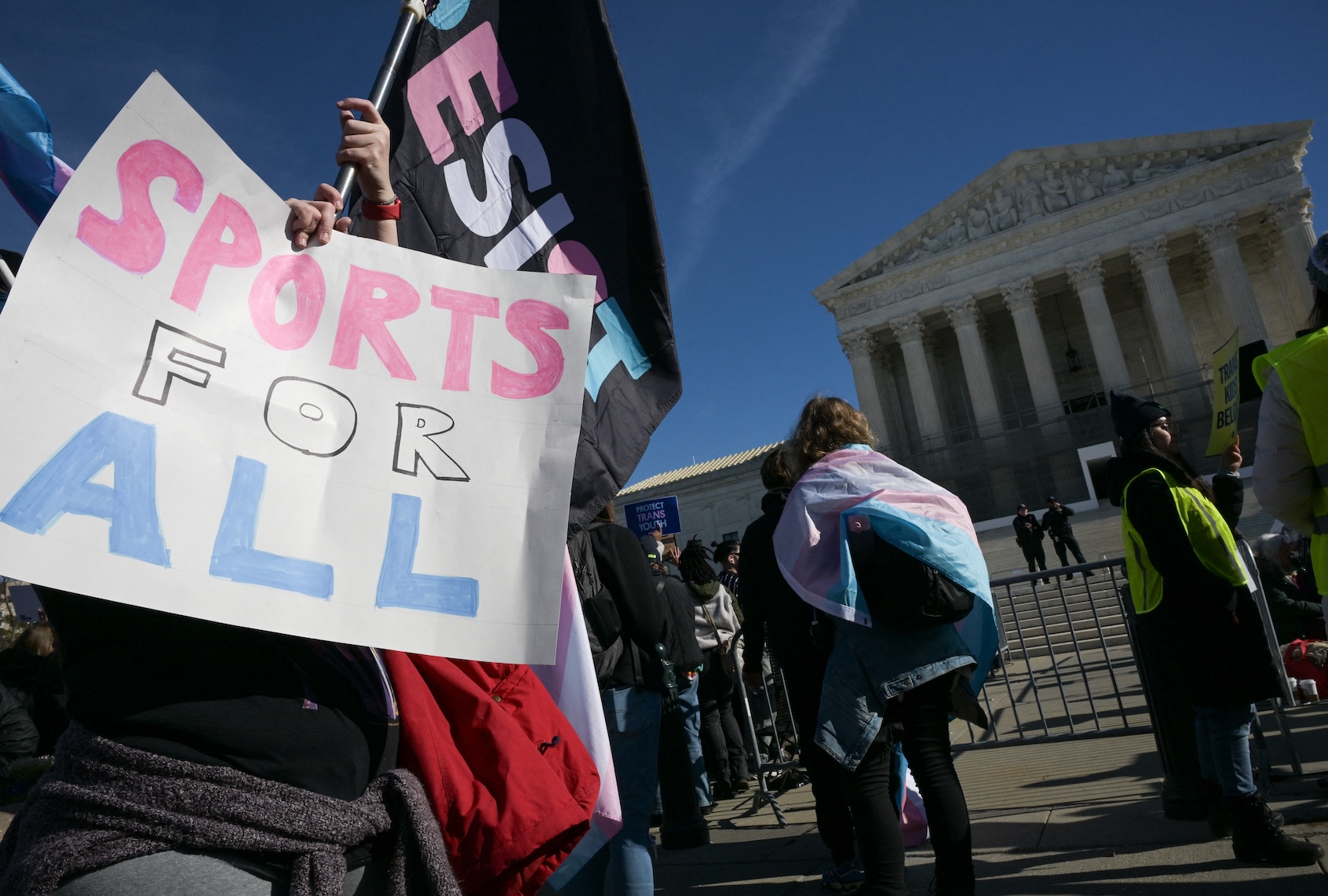
But McLaren knows that many other transgender children aren’t so supported, and he fears the Supreme Court has now opened the door for even fewer to have the same access his child had. On June 30, the court ruled 6-3 in favor of laws in West Virginia and Idaho banning transgender student athletes from competing in women and girls’ sports. Though the decision was narrow in its scope — the justices maintained that states and school associations should create policies on sports participation that best suit their students’ specific needs — parents say it doesn’t change how harmful the ruling is and will be to transgender children.
“It’s a two-for-one deal for the legislators,” McLaren told Salon. “Not only do they get to continue to really put the boot on the throat of an already marginalized community, but they also get the added bonus of being able to police women’s bodies.”
“At this point, there is no safe space,” he added. “School is not a safe space anymore. Sports teams are not a safe space. Going out into public as a visible transgender person — people are emboldened to act and react when they see transgender people — is becoming less and less safe.”
The conjoined court cases, Little v. Hecox and West Virginia v. BPJ, asked the justices to determine the constitutionality under the 14th Amendment and lawfulness under Title IX of state bans on student athletes’ participation in school sports based on sex assigned at birth.
The Supreme Court sided with the states, holding that, under the 14th Amendment’s equal protection clause and Title IX, public schools and universities in West Virginia and Idaho are allowed to determine eligibility for women’s and girls’ sports based on biological sex.
“The legislatures and the schools are better equipped — and under the Constitution, are the more appropriate entities — to assess the competing medical and scientific considerations and draw appropriate lines,” Justice Brett Kavanaugh wrote in the majority opinion. “Of course, no line that the States draw will satisfy everyone. But the Judiciary is not the proper institution to make what would often be arbitrary and highly intrusive athlete-by-athlete assessments.”
“At this point, there is no safe space.”
Josh Block, a lawyer for the student athletes and senior counsel for the ACLU’s LGBTQ & HIV Project, called the ruling a “narrow, disappointing result” during a Tuesday press conference. While it does bar transgender girls from enjoying the same access to sports as cisgender girls, the justices did not broadly limit Title IX protections for transgender students, bar other states from creating policy that allowed for trans girls to participate with cisgender girls, nor hold that discriminating against people based on transgender status is permissible under the Constitution, he explained.
“The folks that passed these laws in West Virginia, Idaho and other states across the country passed them with the goal of pushing transgender girls, and transgender people in general, out of public life,” Block said, adding: “They were hoping that this case would be a vehicle for the Supreme Court to give them everything they asked for, and I think what’s really important is that the court said, ‘No,’ over and over again.”
The decision is a “serious loss” for girls in states with bans, but it’s also not the end, added Sasha Buchert, director of nonbinary and transgender rights at Lambda Legal, who also represented the respondents.
“It’s a fight that’s going to continue state by state, school by school. In other words, this really says that, ‘Sure, a state may discriminate, not that they must discriminate,’” she said. “So states, schools and athletic associations should be taking every step to ensure that athletic opportunities exist for transgender girls.”
So far, of the 19 states with laws prohibiting discrimination in schools based on sexual orientation and gender identity, 17 have explicit guidance on the treatment and inclusion of trans students, according to the Movement Advancement Project. Twenty-seven states, however, have a law that bans transgender students from participating in sports consistent with their gender identity, and two have state regulations or agency policies with such a ban.
Start your day with essential news from Salon.
Sign up for our free morning newsletter, Crash Course.
A Georgia parent, who asked to remain anonymous out of fear for her and her trans daughter’s safety, told Salon that she worries about what the Supreme Court decision means for the ban in her state.
“It should not matter what state you live in. You should be able to [play on a team sport] anyway, regardless of what state you live in,” she said. “This idea that we’re from Georgia, so now she can’t play is horrifying.”
The parent said she and her family have been reeling from a Georgia High School Association sports regulation much like the laws the Supreme Court upheld. After the GHSA codified birth-assigned sex in its Constitution and prohibited boys from playing on girls’ teams in response to last year’s state ban, her high-school-aged daughter was barred from continuing and removed from her sports team despite several years of playing with her friends.
The high school, the parent said, offered her daughter a team manager role or the opportunity to practice and not compete, but that “was not even close to being a reasonable expectation.” She recalled the devastation of having to inform her child of how the law would affect her.
“I think that’s probably the hardest thing we’ve had to deal with in raising her. It was really the first time that she had been discriminated against because of her trans identity,” the parent said, describing how disappointed, upset and disgusted her daughter was by the news. “It was a really difficult conversation to have. It was probably one of the worst days of my life, when I told her what was going on.”
For Ali Munshi, whose daughter Eliza Munshi had to navigate Virginia’s sports ban in 2025, the ruling struck a particularly strong nerve. Despite having the support of her community, friends and school, her daughter was prohibited from playing on the girls’ track and field team on account of Virginia’s 2023 policy separating sports teams by sex rather than gender identity. She remembered she and Eliza’s father being proud and nervous when their child decided she would play on the boys’ team to make a statement instead.
“We all really do want the same things,” Ali Munshi said. “We want fairness, and we want our kids to be protected. Being the parent of a trans kid is no different than that. I don’t want trans kids to get special treatment; I want them to get equal treatment.”
We need your help to stay independent.
Eliza Munshi told Salon that it was important for her to take a stand, forgo the option to only practice with the girls’ team and instead compete in boys’ shot put and discus to be visible enough in the community that she could spark greater understanding from others.
“As far as putting myself out there goes, I’m so comfortable in my gender and my expression and the way that I identify [that] putting myself out there is the least I could do,” she said. She had always heard stories of the trans children who struggled, were denied access to gendered bathrooms and gender-affirming care, but not many about children like her who had support. “I carried that with me through track as well,” Eliza Munshi said. “I was like, ‘I can show people what a success story looks like.’”
“I think people have such an idea in their head of what this scary trans person looks like — this man with a beard and a dress trying to play women’s soccer — and that’s just not what’s happening,” she added, emphasizing that no one transitions just to get an advantage in sports.
Ali Munshi said she recognizes her daughter’s success as a natural outcome of her family and community affirming and encouraging her from an early age. That other trans kids wouldn’t receive the institutional, social and familial support to be who they are without judgment or roadblocks is what makes the Supreme Court’s decision especially scary.
“The hardest part for me is the message that it sends: that, somehow, being trans is wrong and bad,” Ali Munshi said about the ruling. “I don’t want kids to think that, and I don’t want parents to think that because affirming your kid is right and life-saving.”
Read more
about trans rights
