

The news came the way it always comes in my family, sideways, through a phone. I was in my living room, sunk into the chaise lounge I retreat to, comfortable in a way that now embarrasses me, when I heard my mother’s voice in the other room calling my father. Something in her tone. You learn your parents’ registers the way you learn weather, and this was the register of bad news from far away.
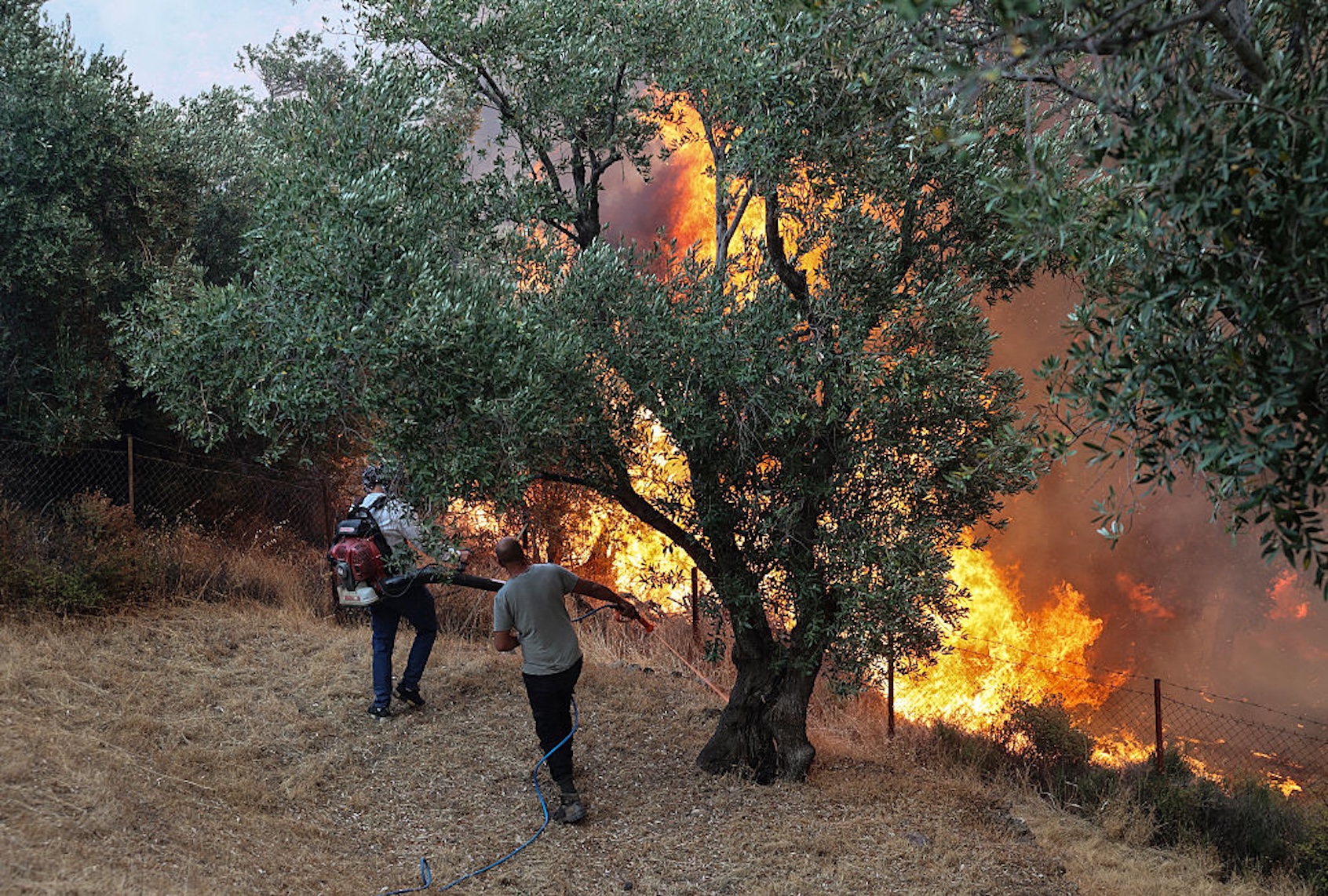
Greece was burning again. Crete worst of all, in the south, where a fire near Rethymno had driven some 8,000 people from their homes in a single night. Fires on Paros and Andros, scattered across the Aegean. And then the name I had been bracing against: Lesbos. A blaze near Plomari, the old ouzo town on the island’s south coast, was eating coastal homes while roughly 100 firefighters fought it, and a seaside resort emptied into the dark.
The fires are not a freak event, and no one in Greece pretends they are. They began in early July and have barely paused since; this is the second week of a major outbreak, dozens of fronts at once, fed by a record European heat wave, a spring of too little rain and the Meltemi, the dry seasonal winds that come screaming down the Aegean in July and August at up to 100 kilometers an hour and turn a spark into a wall. Scientists have said it plainly: Climate change is loading the dice, the Mediterranean’s pine and olive and dry scrub catch faster and burn hotter than they used to, and summers like this one are becoming the rule, not the exception. Greece has always burned in August. It has not always burned like this.
My father is from Lesbos. My mother’s people are from there too, further back, so the island runs down both sides of me like a watermark you only see when the light hits it right. It is where my family’s houses stand, where a portion of my life is already promised, where I know I will one day go to live for a while, because the pull has never once loosened. It is, if I am honest, where I come from in the deepest sense, not only the blood but the making. My love of poetry, my hunger for art — I trace all of it back to that island, to Sappho, who sang there 26 centuries ago and somehow reached a Greek-American boy in Pennsylvania and told him what he was.
I have not set foot on Lesbos in 10 years.
That is the sentence, the amount of time, I keep circling. Now I watch it burn on a screen from a soft chair, an ocean and a lifetime away, useless.
There is a particular helplessness to diaspora I have never quite found the words for, though I keep trying. You love a place you are not in. You grieve a fire you cannot smell.
There is a particular helplessness to diaspora I have never quite found the words for, though I keep trying. You love a place you are not in. You grieve a fire you cannot smell. You refresh a feed for news of a village whose name your relatives say with their whole mouths and you say with an accent that gives you away. The distance is not only miles. It is the knowledge that everyone there is living what you are merely watching, and that watching, from comfort, is its own small shame.
I was made by that island’s water. They tell me that as a baby, I would not leave the sea. I would stay in the Aegean until I cried at being carried out, submerging myself again and again until, the family story goes, I matched the sea, my skin gone the temperature of it, indistinguishable, a small animal that had already decided where it belonged. Even now, when I step into that water, something in me resets. The sun on it, the salt, the particular blue no postcard has ever gotten right — it reconnects me to my own being, returns me to whatever I was before the world got complicated.
There was a year, when I was barely one, that the island nearly kept me for good: a lost passport, a wary government that took an American baby for a Greek one, and a U.S. congressman who finally untangled it and got me home. It is a longer story than this essay can hold, but its shape has never left me. The point is this: That island has been trying to keep me since before I could speak, and I have spent a decade letting the ocean between us win.
And here is the thing I cannot hold simply, what kept me on the chaise longer than the news required. That same sea that baptized me is, for thousands of others, a grave.
Start your day with essential news from Salon.
Sign up for our free morning newsletter, Crash Course.
Lesbos is not only my father’s Eden. For more than a decade it has been a frontline, the first Greek soil that exhausted, terrified people touch when they cross from Turkey in boats that were never built for open water. My sacred water is someone else’s last water. My homeland is a stranger’s checkpoint and, if they are lucky, their refuge.
I don’t know how to make those facts, that awful juxtaposition, clean, and I have stopped trying. Both experiences are true. The island is sacred to me for what it gave me, and it is sacred to the fleeing for what it offers them, which is the oldest thing land can offer: safety, ground, a place to stop running.
When the fires come, they do not check anyone’s passport. They take the olive groves and the goats and the summer houses, and they take the makeshift shelters and the fragile new footing of people who had already lost everything once. In Crete, the deadliest front this week, three firefighters have already died trying to hold the line against the blaze. That is what steadies me and breaks me in the same breath, that a land this rich in what it gives, in shade and figs and refuge and myth, keeps burning while the world half-watches.
We need your help to stay independent.
A Mediterranean summer on fire has become a genre now, a seasonal rerun we thumb past on the way to something else. This year’s footage looks like last year’s, and that of the year before, a sameness that is its own quiet violence. Repetition sands horror down into wallpaper. But it is not wallpaper to the family loading a car in the dark, or to a firefighter’s widow, or to a man in Pennsylvania watching his one island go up in flames on a screen. Familiar is not the same as bearable.
What the fire has done, strangely, is make me want to go back not to take but to give. To help. To stand on the ground instead of scrolling past it. I have spent ten years loving Lesbos as an inheritance, a thing I own from a distance, and the smoke on my screen has shamed that love into something more useful. My mother’s ancestors and my father’s boyhood and Sappho’s fragments and the sea that raised me are all still there, waiting, under a sky the color of alarm. My uncle is in Athens. My family’s houses are still standing, for now. And I am here, finally understanding that loving a place from afar is not the same as loving it.
I think I will go to Lesbos this year. Not because the fire is out, but because it isn’t. The sea is still there. It is still the color no one can name. And it is still, for me and for the strangers arriving on its shore, the difference between drowning and being born.
Read more
about climate change
