
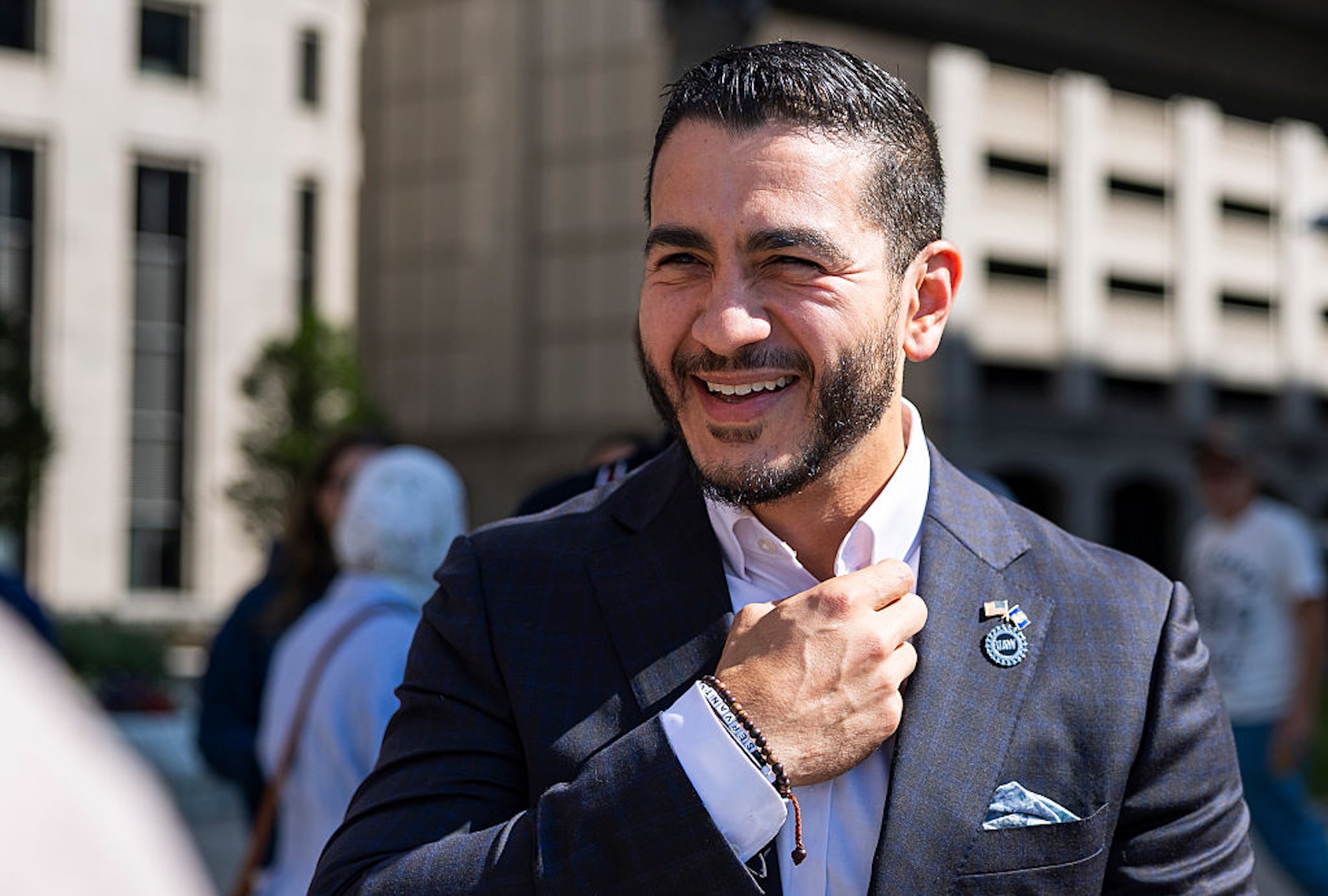

On Wednesday morning, shortly after Dr. Abdul El-Sayed won the hotly contested Michigan Democratic Senate primary in a slender victory, the Republican Party let slip the dogs of war. Barely 15 minutes after the Associated Press called the race for the unabashed progressive and first-time candidate for federal office over the centrist Rep. Haley Stevens, Donald Trump was crowing on Truth Social that the 41-year-old El-Sayed’s win was “great news for the Republican Party.” The newly minted Democratic nominee, he wrote, is “a Communist loser who hates Jews and Israel.”
As he has for 10 years, the president set the tone for the rest of the GOP.
By the noon hour, the National Republican Senatorial Committee had fired off an attack ad that led with Islamophobia and recalled the attempts from some quarters to define a certain Illinois senator who carried the name Barack Hussein Obama. “Abdulrohman Mohamed El-Sayed,” the ad began, making a point to use the candidate’s full name, an obvious move to launch the process of otherizing him to voters in Michigan and across the country, “[is] the most radical Senate candidate in America.”
But the day’s vilest moment came three hours later when Alabama Sen. Tommy Tuberville, who has always demonstrated a willingness to go there, invoked the T-word in a brief interview.
But the day’s vilest moment came three hours later when Alabama Sen. Tommy Tuberville, who has always demonstrated a willingness to go there, invoked the T-word in a brief interview as he boarded an elevator after voting to confirm Dr. Erica Schwartz, Trump’s controversial nominee to head the Centers for Disease Control and Prevention.
“The guy was basically a cheerleader for 9/11,” Tuberville told me, linking El-Sayed to a comment made by the popular far-left streamer Hasan Piker, with whom the candidate campaigned, that “America deserved 9/11.” (When asked in April by POLITICO about Piker’s remarks, El-Sayed characterized the question as a “gotcha game” and said “I’m not here to disavow people’s views”; Piker later apologized for the comments, calling them “inappropriate,” “messed up” and a failed attempt at satire.) “I mean, come on,” Tuberville continued, “the country’s changed, but it hasn’t changed this much to put people in [office] that are basically terrorists.”
When I asked if he was calling El-Sayed a terrorist, the senator replied, “I say he’s got the ability to become one.”
Tuberville has the political incentive to make such inflammatory remarks; they will play well to Republicans in Alabama, where he is running for governor, and he has no grand designs on national office. But they and the GOP’s larger response to El-Sayed’s win reflect another emotion that is running throughout the party. Although Republicans got the Democratic opponent they professed to want for former Rep. Mike Rogers, who lost a Senate race to Elissa Slotkin in 2024 only by the thinnest of margins, they are also scared — and with good reason.
El-Sayed has got game. When I approached his campaign for comment on Tuberville’s remarks, I was directed to an exchange he had on Wednesday night with CNN’s Kaitlan Collins, in which he addressed the Republican onslaught.
“There are people like J.D. Vance or Donald Trump or Mike Rogers, who want to define America as being too small to include some kinds of people, and they point to my name, they point to my faith, they try to insinuate that somehow I’m less American because of those things,” El-Sayed said. “They want America to be small. I believe that America is big. It’s open-minded. It’s big-hearted. It can include any of us, regardless of how we pray, regardless of where our families come from, regardless of who we love or how we identify. That’s the America we’re building. And I think America, in Michigan in particular, has an opportunity to remind us just how big we are.”
Although El-Sayed has never run for federal office, these are not the words of a political novice. He is a gifted communicator, able both to make open-hearted, aspirational appeals and channel anger at billionaires and elites, a needle Sen. Bernie Sanders, I-Vt., for all of his influence on the Democratic Party, has never quite been able to thread.
Start your day with essential news from Salon.
Sign up for our free morning newsletter, Crash Course.
But unlike eloquent politicians known to be showhorses, enjoying the social media clips from their media hits, El-Sayed is a workhorse, and this combination makes him formidable. One reason for his primary win is that he simply outworked Stevens, visiting over 110 cities, according to his campaign, holding over 500 public events and, in the process, building a genuine movement. This tenacity, along with rallying cries of “Medicare for All” and getting money out of politics, helped him overcome the opposition of the Democratic establishment and over $60 million in spending by super PACs supporting Stevens.
Nevertheless, after the race was called for El-Sayed, the Democratic Party quickly coalesced behind him and he was reportedly fielding calls from former Vice President Kamala Harris, former Transportation Secretary — and Michigan voter — Pete Buttigieg and Senate Minority Leader Chuck Schumer.
We need your help to stay independent.
The stakes are high. Polls taken before the primary showed El-Sayed trailing Rogers by a larger margin than Stevens. Democratic control of the Senate runs through Michigan, and as many have pointed out, El-Sayed’s win has teed up a first-of-its-kind test: whether a progressive can win in a swing state that narrowly voted for Trump in 2016, went for Biden four years later and returned to Trump in 2024. El-Sayed will need to be even more nimble than he already is and avoid giving the GOP talking points.
Despite generous overtures to Stevens and assurances to the Jewish community El-Sayed made in remarks on Wednesday morning after the race was called, there are intraparty divisions left to heal. He must set to work convincing centrist and moderate Democrats, Black voters in urban areas and suburban voters, all of which Stevens carried, as well as disaffected independents, that he is worthy of their vote. The race will be tough, but it is winnable, even as he continues to face GOP efforts to define him on their terms.
Responding to a reporter who asked about how Republicans are deploying his name in their attacks, El-Sayed said, “That’s the only play they got.”
Whether that’s true or not, between now and November, we’ll see if it works.
Read more
by Jason Kyle Howard
