

The lead-up to the Iran war seemed so abrupt that it’s easy to forget that there was a brief stab at diplomacy led by President Donald Trump’s special envoy, Steve Witkoff. In February, some experts even believed that the United States and the Islamic Republic had the makings of a decent deal — albeit one that would have been remarkably similar to the agreement negotiated by the Obama administration in 2015 and torn up by Trump during his first term. But the negotiations fell apart, and the U.S. and Israel began bombing Iran two days later.
While the right had long had its sights set on war with Iran, the president’s decision was surprising to some observers. Many had assumed Trump would focus his grand ambitions on the Western Hemisphere, especially considering his incursion into Venezuela and strikes against boats in the Caribbean, as well as his threats to annex Greenland, Panama and Canada, which he had taken to calling the 51st state.
Although Trump may have diverted his attention to Iran in a moment of vanity, his ambitions in his own hemisphere weren’t just another troll. In December 2025, the administration turned his rage against Greenland and Canada into official policy. The 2025 National Security Strategy was called “Western Hemisphere: The Trump Corollary to the Monroe Doctrine,” but it went much farther than the 1823 policy, which had simply held that the U.S. would not allow European powers to colonize any countries in the hemisphere. The Trump Corollary, which right-wing media dubbed the “Donroe Doctrine,” directly asserted American regional hegemony and dominance. Announcing the policy, the president said, “Under the Trump administration, we are reasserting American power in a very powerful way in our home region.”
The idea was assumed to address growing Chinese influence in the region. But events of the last few days have proven that Trump and his advisers interpret the doctrine much more broadly. They have made clear that not only does it serve as a threat to competing powers, it also functions as an edict to all the countries in the hemisphere — they are now under American dominance and must adhere to its economic and strategic preferences.
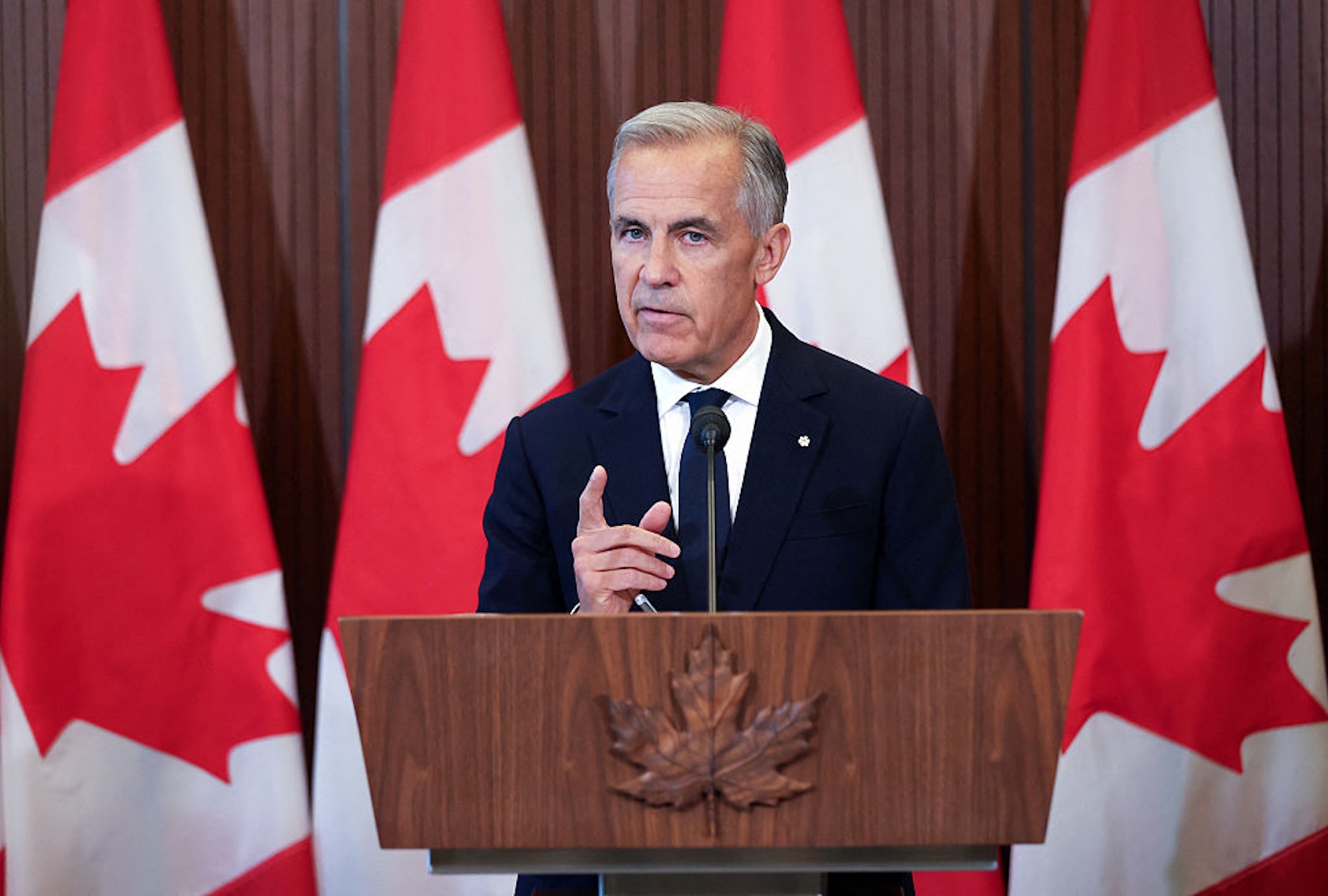
That’s the mindset Canadian Prime Minister Mark Carney is now confronting as he faces an all-out trade war with Trump. Over the weekend, the president announced he was imposing 50% tariffs on Canada, a move that experts say will be devastating for that nation’s economy, after the prime minister refused to give in to his demands for a new trade deal. Carney retaliated on Tuesday by imposing tariffs of up to 50% on around 700 U.S. products, including steel, aluminum and common household products. The measures are set to begin Sept. 8.
Carney understood this threat from the beginning. He took Trump’s fantasies about Greenland and Canada seriously, and he saw the “Donroe Doctrine” for exactly what it was. In what will be remembered as a seminal speech, Carney openly declared in January at the World Economic Forum in Davos that there had been a “rupture” in the world order and countries such as Canada — the “middle powers,” he called them — had better join forces as the “great powers” attempted to assert dominance. “Recently, great powers began using economic integration as weapons,” he said. “Tariffs as leverage. Financial infrastructure as coercion. Supply chains as vulnerabilities to be exploited. You cannot ‘live within the lie’ of mutual benefit through integration when integration becomes the source of your subordination.”
Carney pointed out that the rules-based order that had brought prosperity to much of the world after World War II had been toppled, and it was clear by whom: America, supposedly the world’s guarantor of that very order.
Carney pointed out that the rules-based order that had brought prosperity to much of the world after World War II had been toppled, and it was clear by whom: America, supposedly the world’s guarantor of that very order. The U.S. had decided, largely at the hands of a delusional TV personality who had gained his only knowledge of global economics from watching CNN during the late 1980s, to blow up the rules and institutions it had created for its own and other participants’ economic benefit.
Like his predecessor Justin Trudeau, Carney saw Trump’s threats against Canada’s sovereignty as genuine. Before he left office, Trudeau had warned business and labor leaders that Trump was determined to take over Canada in order to seize its resources, particularly its mineral wealth. “Mr. Trump,” he said, “has it in mind that the easiest way to do it is absorbing our country and it is a real thing.”
The president was after the same thing in Greenland. His threats to the island nation, which all of Europe was up in arms about in the lead-up to Carney’s speech in Davos, were predicated on Trump’s belief that America had the right to simply take over the country and seize its rare earth minerals. The concern was so dire that the NATO countries actually sent troops to Greenland to protect it in case Trump ordered a military invasion. The Davos meeting seemed to sober up the Western allies who, until then, had more or less assumed that Trump was just hot air.
Start your day with essential news from Salon.
Sign up for our free morning newsletter, Crash Course.
Nearly nine months after Carney gave that speech, Trump has fully demonstrated the prime minister was right. After already abrogating much of the United States-Mexico-Canada agreement that Trump signed in his first term, Trump threatened yet more tariffs on Canada, obviously as a coercive measure, and the two countries sat down for more trade talks. Trump announced last week, just before his deadline, that they had a deal. On Friday, the whole thing fell apart because of last-minute demands by the U.S., that Canada not make any unilateral trade deals with other countries. On top of that, it appears the administration has also demanded that Canada change its domestic policy requiring certain language and cultural inclusion in digital and streaming products.
These provisions go way beyond any kind of normal trade agreements, and Carney rightfully walked away, saying, “Last spring, I warned that America is trying to break us so that they can own us. And I promised: ‘That will never, ever happen.’ We are keeping that promise.” When a reporter asked him why it feels like Canada is going to war with the U.S., Carney replied, “You’re at war when you get attacked. We got attacked.”
It’s hard to see this any other way. Trump started a shooting war in Iran, assuming he could win it in a weekend and take their oil. (“To the victor go the spoils,” he always says.) For all intents and purposes, America has lost that war, and it is now in an expensive, pointless standoff in the Middle East. Now we are in another one.
We need your help to stay independent.
Trump has decided to ignore international law by blowing up boats in the Caribbean, installing friendly puppets who will allow the U.S. to seize their resources and is now attempting to use economic coercion to try to force Canada to give up its sovereignty and accept a status as a kind of 21st century vassal state. None of that has redounded to America’s benefit. Instead, Trump’s hubris has made the country an international pariah.
Carney understands the stakes, and he has intentionally and carefully drawn a line. Both countries will suffer economic harm from this trade war, and Canada will likely suffer more. But while the prime minister has his people behind him as he fights for his country’s dignity and sovereignty, Trump will have no such support in America. Americans don’t want this war any more than they want the one in Iran.
Perhaps the U.S. and Canada will come to some agreement in the coming days and avert more economic upheaval. But it would only be a temporary ceasefire. The battle lines have been drawn, and America is not the good guy in this war. Trump has turned the entire world against the country, including its closest neighbors. Now, America is less safe and economically secure than it has been in a very long time.
UPDATE: This article has been updated to reflect Canadian Prime Minister Mark Carney’s announcement on Tuesday, Aug. 25 that his country would impose stringent tariffs in response to President Donald Trump’s actions.
Read more
about Trump’s tariffs
