
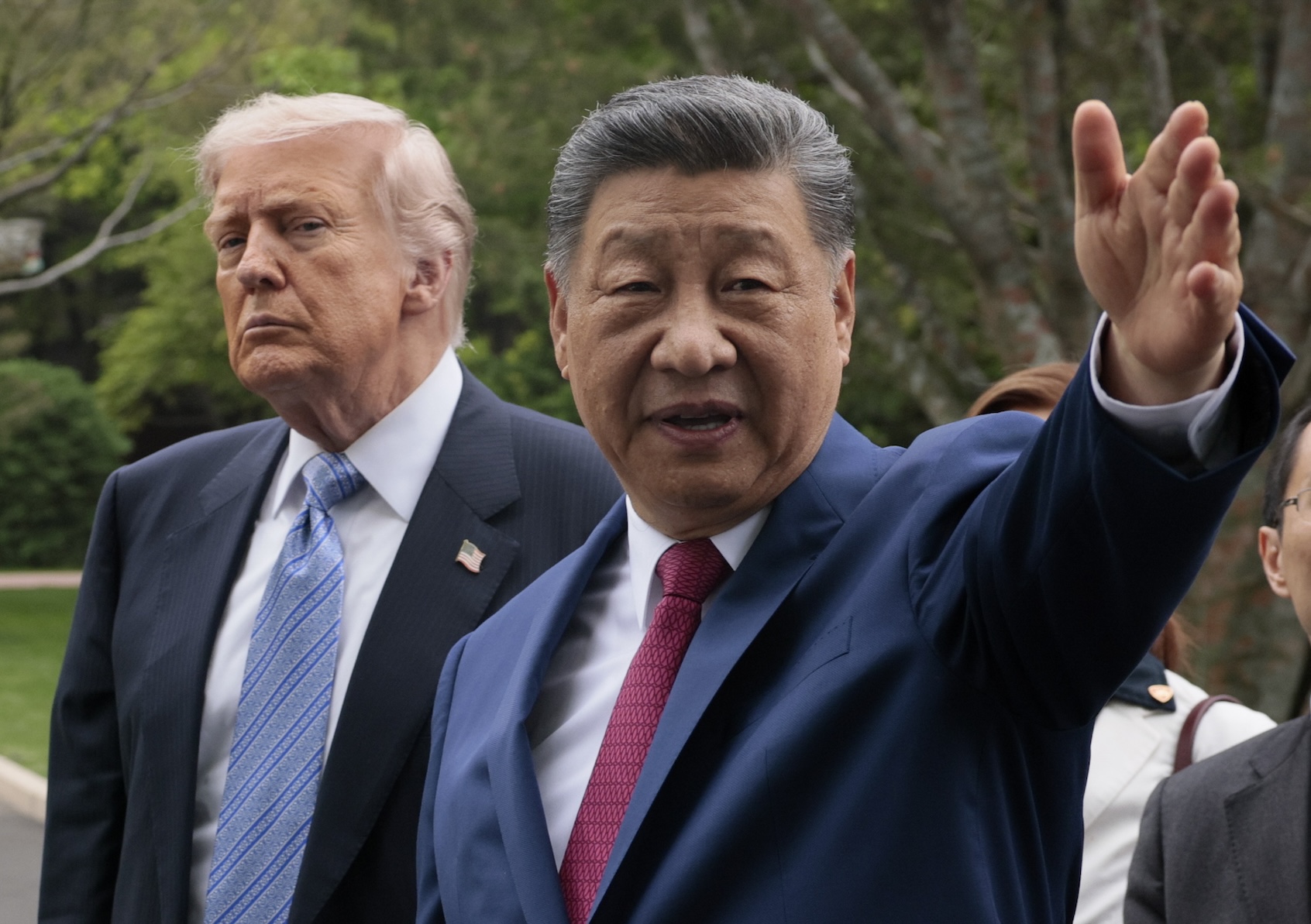

So Donald Trump went to Beijing, and we didn’t even get a stupid T-shirt. If we had, it might have come with a purposefully incomprehensible slogan, absent any sound or fury but definitely signifying nothing. It might, for example, have featured the phrase “constructive strategic stability,” which is how Chinese President Xi Jinping describes a (marginally) improved relationship with the United States. In the deeply coded discourse of superpower relations, I think that translates into vigorous competition and disagreement, but without an actual shooting war. Which, if I’m not mistaken, is precisely the status quo.
Or maybe our souvenir T-shirt could repurpose Xi’s observation, during a speech on Thursday, that Trump’s promise to make America great again “can go hand in hand” with his own self-defined mission: the “great rejuvenation of the Chinese nation.” That got Fox News talking heads and Republican officials very excited, since they have all apparently forgotten that up until roughly a week ago they were supposed to be relentless China hawks who favored 145 percent tariffs and blamed Xi’s regime for spreading the global “hoax” of climate change.
That might be too much information to get on one T-shirt, but it still isn’t enough. We’d also need to explain on the back, in smaller type, that Xi’s slogan — which really isn’t his, since it goes back at least as far as Deng Xiaoping in the 1970s — envisions overcoming a “century of humiliation” by colonial powers and restoring China to global prominence as a military, economic and technological power by 2049 (to celebrate the centennial of the People’s Republic).
If you’re getting the impression that the deeper we dig into the tangled verbiage surrounding last week’s so-called summit between Trump and Xi, the less it looks like a massive win for America — and, indeed, the more it looks a pseudo-event in which nothing really happened at all — you’re on the right track. And honestly, we’re only getting started.
Leaders of other nations have interacted with Trump enough by now to appreciate that they can throw “RuPaul’s Drag Race” levels of shade at him and he’ll have absolutely no idea. Trump came away from Beijing claiming that the Chinese had promised to buy hundreds of Boeing aircraft (although less than half the number teased in advance) and $10 billion worth of U.S. beef, soybeans and other agricultural products. But the official Chinese readout mentioned no such commitments — new phone, we’re sorry; Boeing who? — and even a minor trade deal to license U.S. meat imports, without guaranteeing them, immediately fell apart.
On his second day in Beijing, Trump posted on Truth Social that Xi had “very elegantly referred to the United States as perhaps being a declining nation,” which did not resemble anything the Chinese leader had actually said in public.
On the day of Trump’s arrival, the front page of China Daily featured a photo of Xi shaking hands with the president — the president of Tajikistan, that is. James Palmer of Foreign Policy reports that the official announcement of Trump’s visit took up 12 seconds of China’s leading TV news program on May 11, followed by a much longer segment entitled “The Integrated Development of the Yangtze River Delta Continues to Achieve New Breakthroughs.”
That all seems like overt trolling, but if the Chinese side was counting on Trump to throw the worst possible shade on himself, driven by his inimitable combination of self-soothing bluster and a desperate desire to be liked, their restraint paid off. On his second day in Beijing, Trump posted on Truth Social that Xi had “very elegantly referred to the United States as perhaps being a declining nation,” which, to be clear, did not resemble anything the Chinese leader had actually said in public. I don’t know whether to call that projection, unleashing the id or saying the unsayable — but it’s awesome T-shirt material, am I right?
Predictably, our president declined to take this real or imagined insult personally, assuring his followers that Xi was talking about the “tremendous damage” inflicted by “Sleepy Joe Biden,” and not about the “16 spectacular months of the Trump Administration” in the “hottest Nation anywhere in the world.” Presumably he means the one where gasoline is nearly $5 a gallon, the one trapped in an unwinnable phony war in the Middle East and almost universally despised around the world. (Side note: Trump’s social-media prose poetry has gone way downhill, in my view, now that his grammar and syntax are obviously being managed by AI. Make run-on sentences great again!)
It’s not trivializing this summit or missing the point, I would argue, to understand it as first and foremost a semiotic spectacle, conducted through language, symbols and signifiers. Quite the opposite, in fact: It’s missing the point far more to pretend, as mainstream media feels compelled to do, that “issues” of substance were being discussed or that history-shaping “deals” might get hammered out between the two leaders.
We need your help to stay independent.
I’m not saying serious issues don’t exist in the U.S.-China relationship, or don’t matter: The long-simmering trade war between the two countries has damaging global ripple effects, the unresolved status of Taiwan remains a dangerous potential flashpoint for superpower conflict, and China is uniquely positioned to broker a peace deal between the U.S. and Iran. But none of those things was likely to be meaningfully addressed in this kind of encounter, which both sides (along with most observers) understood primarily as theater.
That may help explain how we wound up with “Alice in Wonderland”-style competing proclamations that made it sound as if Xi and Trump had been in different conversations, or perhaps different universes. The American readouts didn’t mention Taiwan at all, while the Chinese made clear that Xi had issued Trump a stern warning not to screw up the “strategic ambiguity” surrounding China’s claim to the island. There’s no way to explain a policy this nonsensical, but it’s largely about what isn’t said: The U.S. never says that Taiwan is an independent nation (which it clearly is) and never says what it will do if China gets tired of this charade and seizes Taiwan by force (most likely nothing). Somehow or other, that has kept the peace for almost 50 years.
Xi and the Chinese leadership clearly understand that Trump can be flattered, cajoled, coerced and bamboozled, but can’t be relied upon to tell the truth, stick to his word or maintain a consistent position about literally anything.
Trump, of course, couldn’t resist making this murky situation even murkier after the fact, telling reporters on board Air Force One that he had in fact discussed with Xi a pending arms sale to Taiwan (an explicit violation of longstanding U.S. policy) and might use that as a “very good negotiating chip” with China. That’s not how diplomacy works, but let’s play along: Trump seems to believe that Xi will lean on the Iranians to open the Strait of Hormuz, and I bet he’d be delighted to scrap the Taiwan arms deal in exchange for the same exact situation that existed before he started, and lost, an immeasurably stupid war. For the record, the Chinese have made no such promise, and simply observed that the Iran war should never have happened.
When asked about Taiwan, Trump actually said this: “You know, we’re supposed to travel 9,500 miles to fight a war. I’m not looking for that.” So much winning! It must get exhausting.
As I suggested earlier, getting bogged down in the details — yes, Iran is not quite as far away as Taiwan! — is just a way to avoid the larger symbolic narrative, which in this case amounts to another massive humiliation for the U.S. and its stricken president. Xi and the Chinese leadership clearly understand that Donald Trump is a hopelessly untrustworthy negotiating partner and that someone else will be president three years from now (difficult as that is for Americans to imagine). Trump can be flattered, cajoled, coerced and bamboozled, as circumstances demand, but he can’t be relied upon to tell the truth, stick to his word or maintain a consistent position about literally anything.
Want more sharp takes on politics? Sign up for our free newsletter, Standing Room Only by Amanda Marcotte, also a weekly show on YouTube or wherever you get your podcasts.
Similarly, those in the media or the foreign policy establishment who profess dismay that China’s rulers now view the U.S. as a global equal are also failing to observe the obvious. Their argument has a rational basis, to be sure: Even in its damaged Trumpian condition, the U.S. remains orders of magnitude larger than China as an economic and military power. There’s compelling evidence that Chinese authorities have fudged their economic growth numbers for years, and China’s accelerating population decline points toward an unavoidable demographic crisis.
But Trump said it out loud: The entire world now perceives America “as perhaps being a declining nation,” and in the realm of international relations, perception has a tendency to become reality. As Palmer writes in Foreign Policy, Trump’s “obsequiousness” was the most striking aspect of his visit to China, and it seemed “more a case of psychology than geopolitics — another reflection of the U.S. president’s own growing insecurities.”
Trump heaped unwonted praise on Xi, even complimenting the Chinese leader for his looks (something that may never have happened within Xi’s immediate family) during a rambling Fox News monologue: “If you went to Hollywood and you looked for a leader of China to play a role in a movie … you couldn’t find a guy like him, even his physical features.”
There’s a certain pathos to Trump’s borderline-homoerotic paeans to male beauty, which are as close as he ever comes to expressing genuine admiration for another person. He only goes there when he desperately wants something, and whatever he thinks he wants from Xi Jinping — personal validation, political salvation, a shared friendship for his retirement years — he isn’t going to get it.
Read more
from Andrew O’Hehir
