
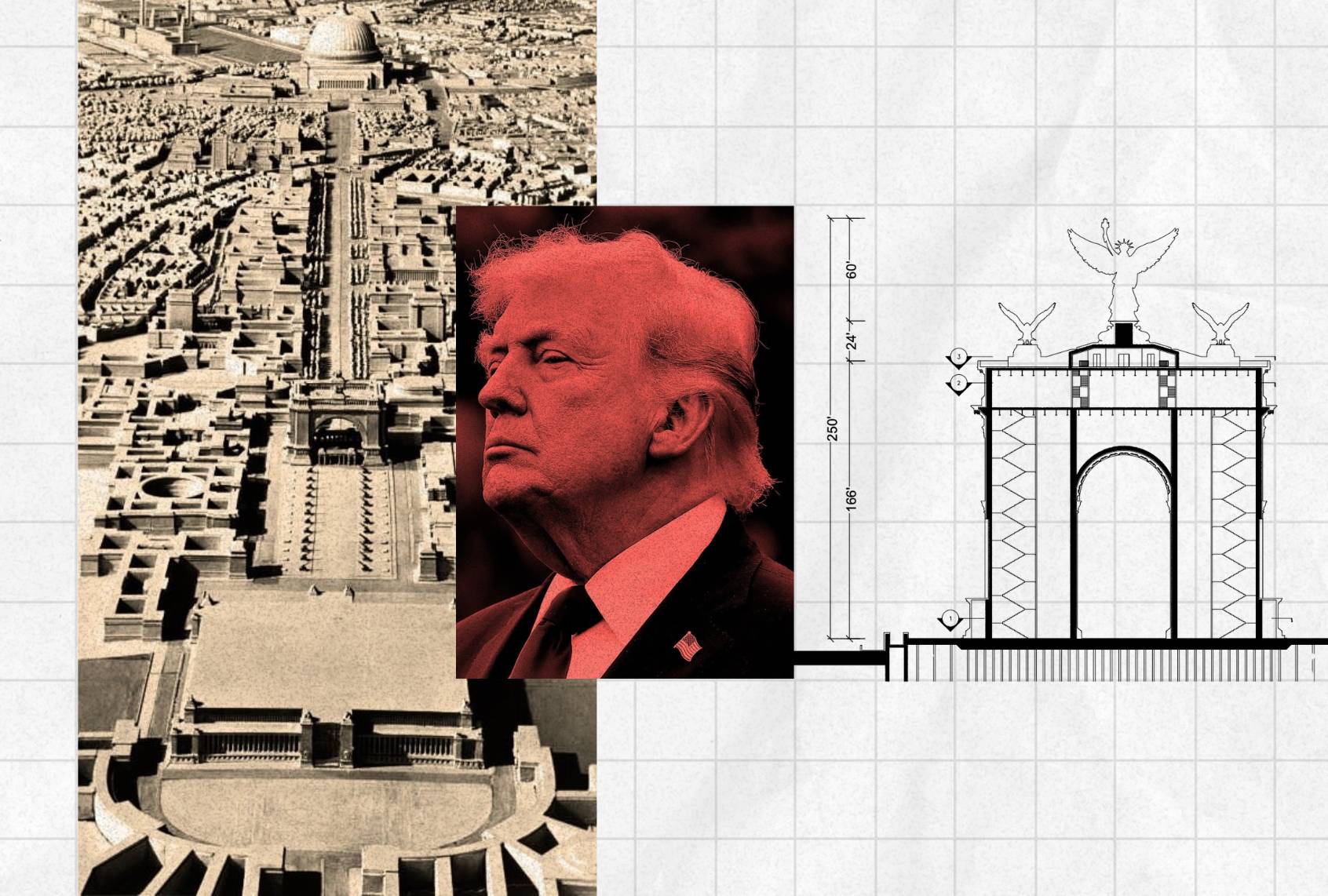

It might be a bit too convenient, at this moment in history, to observe that failing tyrants, as they feel their power slipping away, start building grandiose monuments to themselves. But at least in the modern context, it’s not wrong. Let’s put it this way: Any leader of the last century or so who wants to celebrate his glorious reign with, just for example, a grand triumphal arch and a plan to destroy and rebuild important landmarks of his capital city is only imitating the past, while ignoring its most obvious lessons. He’s likely to end up celebrating only his own decadence, poverty of spirit and enormous hubris.
As British journalist Jonn Elledge observed recently, if Donald Trump ever encountered Percy Shelley’s sonnet “Ozymandias” during his mediocre education, he clearly didn’t get the point. Here’s the tl;dr, Mr. President: That line about “Look upon my works, ye mighty, and despair!” sounds awesome but is meant to be ironic. (If that’s a new concept, see me after class.)
Look upon my works, indeed. Having waged a tariff war against the rest of the world and failed completely, and then waged a war of conquest or regime change or fill-in-the-blanks against Iran and failed even more completely, Trump now appears prepared to spend the rest of his presidency playing beat-the-clock on a range of ill-fated construction projects. It’s almost too obvious to say that this reflects a declining president at the head of a declining imperial superpower, or that given the resources at his disposal and the fact that his party controls all branches of government, that might be the least-bad outcome in the short term.
On principle, I don’t give political advice, but principle isn’t worth much these days and this one’s a gimme: Any potential 2028 Democratic presidential candidate who doesn’t promise to undo, reverse or demolish the White House ballroom, the Kennedy Center “renovation” and the so-called Arc de Trump, along with any and all other attempts to screw up the monumental landscape of Washington, D.C., should be immediately disqualified. I’d also support a public burning of all Trump-infected U.S. passports, if he actually gets around to creating them. No doubt that would violate bureaucratic rules and air-quality standards, and also might suggest some troubling historical comparisons.
Having waged a failed tariff war against the world and then a failed war of conquest against Iran, Trump now appears prepared to spend the rest of his presidency playing beat-the-clock on a bunch of ill-fated construction projects.
Since we’re on that subject, history is full of contradictions for the Trump regime, which is never quite sure how to handle that touchy subject: Sometimes it tries to launder and bleach history for its own purposes, and sometimes it tries to pretend that history never happened or doesn’t matter. We know from earnest news reports that Trump was greatly impressed by the Arc de Triomphe in Paris — a deeply problematic monument that more or less commemorates those killed during the French Revolution and the Napoleonic Wars — and couldn’t see why he shouldn’t have his own version, only bigger. He wasn’t the first person to have that reaction, as the headline above this article has informed you. We’ll get to that.
So that led to Trump’s godawful design for the 250-foot Triumphal Arch of the United States, an AI-slop imitation of something that was already a jumbled imitation of stuff from the distant past. This is simultaneously one of Trump’s least consequential crimes and one of his most offensive. If the gods are good to us, it will go down in history alongside the conquest of Greenland and the nuking of hurricanes, on a list of things that couldn’t possibly have happened but almost did. At least we cannot claim the president is dishonest about his intentions. When asked last year whom the arch was meant to honor, he answered, “Me.”
Someone probably tried to deliver a canned history of the actual Arc de Triomphe to Trump at some point. As with “Ozymandias,” if he’d been paying attention (and were an entirely different kind of person) he might have learned something. Construction of the great arch in the Place de l’Étoile began in 1806 under the emperor Napoleon, as part of his ambitious scheme to rebuild Paris — but, honestly, that was the easy part. It was abandoned after Napoleon’s fall in 1814 and then completed, very slowly, by a series of architects under three different monarchs and several competing agendas. By the time it was finished in 1836, Napoleon was long dead, his empire had collapsed and no one could quite say what the damn thing was meant to signify: It carried the names of more than 300 battles and 500 French generals from different periods of history, with more added up to the 1890s.
We need your help to stay independent.
If the moral of that story is too difficult to parse, here’s the part Trump would definitely appreciate: When Napoleon planned his 1810 wedding with the Austrian princess Marie Louise, he wanted to bring his bride into Paris through his glorious new arch. But construction had barely begun, and only the bases of the arch’s four pillars had been built. So his architects hired 500 workers to build a full-size replica of the nonexistent arch, out of canvas and painted wood, for the imperial wedding. That’s right: They built a fake Arc de Triomphe, decades before the real one. Thank you for your attention to this matter!
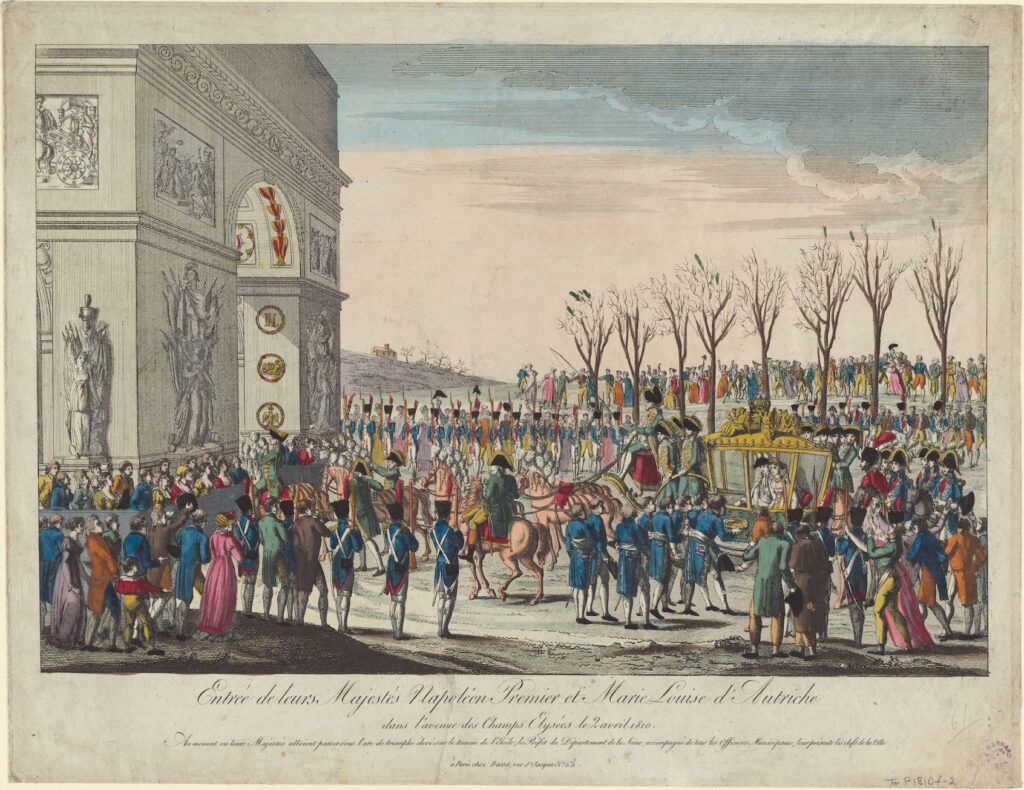
(Fine Art Images/Heritage Images/Getty Images) The wedding procession of Napoleon and Marie Louise passes through the temporary replica of the Arc de Triomphe, April 2, 1810.
If the Arc de Triomphe was itself a throwback, a failed effort to attach Napoleon’s short-lived regime to the supposed glories of the Roman Empire — which built dozens of triumphal arches, only a few of which still exist today (mostly as reconstructions) — its imitators have an even sketchier history. Formally speaking, latter-day triumphal arches can be found all over the world, although most tourists who encounter the Marble Arch in London or the Washington Square Arch in New York probably don’t experience them as such.
But there’s only one existing triumphal arch that was deliberately constructed to be bigger than the Arc de Triomphe. That would be the imaginatively-named Arch of Triumph in Pyongyang, North Korea, which was completed in 1982 for the 70th birthday of Kim Il Sung, that isolated nation’s legendary founder. It’s remarkably difficult for Westerners to visit this impressive structure, but Wikipedia tells us it contains “dozens” of internal chambers and observation platforms, that its vaulted gateways are decorated with carved azalea and that its arch is inscribed with the inspirational text of the “Song of General Kim Il Sung.”
Trump’s proposed arch would be more than 50 feet taller than the North Korean arch, which is itself 33 feet taller than the Arc de Triomphe. So much winning! And yet, sad trombone noise: I am definitely not the first nor the last person to observe that Hitler’s arch was a whole lot bigger.
Trump’s proposed arch would be more than 50 feet taller than the North Korean arch, which is itself 33 feet taller than the Arc de Triomphe. So much winning! And yet, maybe not: I am definitely neither the first nor the last person to observe that Adolf Hitler’s plans to remake Berlin as “Germania,” grand capital of a continental or even global Aryan empire, included a triumphal arch (Triumphbogen, in German) on such an epic scale that the entire Arc de Triomphe would have literally fit inside its opening.
Architect Albert Speer later claimed that he always knew it would be impossible to build something that big in the swampy soil of central Berlin. But he didn’t hesitate to gratify the Führer’s desires, a phenomenon we recognize all too well these days. His proposed arch was to be 170 meters wide by 170 meters deep and 120 meters high — i.e., nearly 150 feet taller than the Arc de Trump! — and inscribed with the names of 1.8 million German soldiers killed in World War I. It would sit at one end of a massive north-south boulevard (20 feet wider than the Champs-Elysées), with an implausibly huge assembly hall at the other end whose 700-foot dome could accommodate 180,000 people.
Want more sharp takes on politics? Sign up for our free newsletter, Standing Room Only by Amanda Marcotte, also a weekly show on YouTube or wherever you get your podcasts.
Mercifully, none of these hideous Nazi-porn fantasies got anywhere near the realm of reality. (Speer sank a big concrete pillar to test the soil, which is still there.) By 1939, Speer had been reassigned to manage Germany’s war production, including the construction of concentration camps, whose purpose he later pretended not to have understood. Six years later, Hitler was dead, Speer was on trial for war crimes (he dodged execution but spent 20 years in prison) and the thousand-year Reich was in ruins.
It’s an inexact parallel, if it’s any kind of parallel at all. Trump is not Hitler, despite an undeniable generic resemblance. His evil is on a much smaller scale, and so is his vision. But postwar Germany, unlike France after Napoleon, had no victory to celebrate and no one left who was eager to honor the fallen tyrant. We may see the same thing happen here soon enough.
Read more
from Andrew O’Hehir
