


It wasn’t a great week for the far right’s self-appointed crusade to reconquer Europe as a fairytale paradise of whiteness and Christianity. Maybe that’s because that whole idea is vaporware, rooted in a nonsensical social and historical vision and devoted to a losing battle against economic and demographic reality. But that quality of noble, doomed struggle toward impossible goals is both the far-right movement’s fundamental weakness and the source of its power and danger.
Viktor Orbán, the pudgy poster boy for “illiberal democracy” and object of a mysterious man-crush by legions of American conservatives, suffered a catastrophic electoral defeat in Hungary that felt, at least for a day or two, like the global MAGA movement’s Waterloo moment. As for Donald Trump, what is there to say? The entire world is over him, big time, and it’s the unique curse of America’s narcissistic self-regard that we’re still stuck with him, dominating the headlines day after day with his empty, contradictory and randomly-punctuated blather. Trump heads into the latter stages of his presidency as a damaged and toxic figure, a human AI meme desperately trying to spin his way past the massive humiliation of the Iran war he chose to fight and the global energy crisis he single-handedly created.
Political leaders of Europe’s “patriotic” or ultra-nationalist right-wing parties only halfheartedly tried to save Orbán and have, at long last, absorbed the lesson that Trump was never a reliable friend and doesn’t care about anyone or anything except his own power and glory. The Old World’s three biggest far-right names — Giorgia Meloni in Italy, Marine Le Pen in France and Nigel Farage in England — never had much in common with each other or with Trump and now understand that, in politics, you always fight alone. As for the ambitious schemes to reshape Europe’s political map variously proposed by JD Vance, Stephen Miller, Steve Bannon and Elon Musk, among others, to this point none have amounted to more than flatulent rhetoric.
If we throw in the semi-related fact that Mark Carney’s Liberal Party just won a parliamentary majority in Canada, it might feel for a minute like the forces of right-wing reaction are in full retreat. But that’s not convincing either, and only partly because Carney, a former governor of the Bank of England, is a deeply strange choice as leader of the global democratic resistance. None of those formerly determined to “make Europe great again” — a slogan from early 2025 that most implicated European leaders would rather forget — have given up or gone away.
If Orbán is already yesterday’s man and Trump is most of the way there, those guys are only the visible symbols of a seething, enduring discontent that can be found both percolating upward and trickling downward throughout the Western-style democracies. Those currents have multiple overlapping causes and cannot entirely be described in terms of right and left. It may be comforting to the liberal mindset to insist that it’s all Astroturf outrage orchestrated by Machiavellian billionaires, or that racism, xenophobia and other forms of small-minded bigotry are the only salient factors. That doesn’t mean it’s true.
If Orbán is already yesterday’s man and Trump is most of the way there, those guys are only the visible symbols of a seething, enduring discontent that can be found throughout the Western-style democracies.
At least two contradictory things can be said about Orbán’s downfall: It holds important lessons for both sides in the battle for Europe, and nearly everyone (this writer included) is assigning too much importance to a parliamentary election in an isolated Eastern European nation of less than 10 million people. Everyone in Hungary’s democratic resistance, regardless of ideology, united behind Péter Magyar, a charismatic candidate who only left Orbán’s nationalist party two years ago. After his smashing victory, Magyar made clear that he would govern as a normative pro-European leader, cracking down on corruption, supporting the basic rights of LGBTQ people and turning away from Orbán’s bromance with Vladimir Putin.
All of that was cause for celebration in Budapest and around the world, and fair enough. It also seems clear that Magyar will govern as a standard-issue center-right neoliberal. He is likely to confront Hungary’s economic stagnation by imposing fiscal austerity budgets and hocking the future, to whatever extent is deemed necessary, to Europe’s central bankers and bureaucrats. Whether you and I believe that is good or bad is beside the point, and how much political runway Magyar will have, as his country recovers from the Orbán hangover, is unknowable. But the real problem is that those policies, and the underlying ideology, are exactly what led to the systemic crisis of liberal democracy in the first place.
Magyar’s big win, in other words, feels rather too much like Joe Biden’s one-sided victory in the pandemic-year presidential election of 2020. It’s nearly impossible to remember now how much that felt, for millions of Americans — and many more millions around the world — like a moment of redemption and release, and like the sure and certain end of the Trumpian nightmare. As drastically different as Hungary and the United States are, the central quandary remains the same: Pulling together a pro-democracy coalition to bring down a reactionary regime is one thing; managing democratic governance in a way that disempowers or defeats the deeply entrenched reactionary forces within Western society is quite another.
It’s nearly impossible to remember now how much Joe Biden’s 2020 victory that felt, for millions of people around the world, like a moment of redemption and release, and like the sure and certain end of the Trumpian nightmare.
Both sides in the perennially undecided but potentially cataclysmic battle for hearts and minds across the Western-style democracies tend to oversimplify the contradictions, or rather to insist that since their own side is obviously correct, there are no contradictions. In a lengthy interview with the New York Times last week, Barnard political scientist Sheri Berman makes a strong case that the populist right epitomized by leaders like Trump and Orbán has dramatically overplayed its hand, and that its record in power has been a disastrous litany of corruption, economic mismanagement and cultural failure.
But Berman also says that intellectual and political elites on both sides of the Atlantic have been overly eager to dismiss the widespread anxiety or insecurity caused by rapid economic and social change as nothing more than backwardness and bigotry. That sense of “frustration and dissatisfaction” has been fueled by “growing inequalities” within almost every Western nation and an inescapable awareness that “establishment parties, politicians and institutions” are increasingly detached from the public they supposedly served. At this moment, we can see political leaders as different as Magyar, Mayor Zohran Mamdani of New York and Gov. JB Pritzker of Illinois trying to break through this alienation and dislocation.
Another Times report last week explored the clownish overreach of the second Trump administration’s so-called diplomacy. This has evidently involved sending a pair of young and blissfully ignorant State Department ideologues to Europe to spread fake news about internet censorship and the “great replacement” and to forge largely ineffectual alliances with “patriotic” nationalist parties opposed to immigration and wokeness.
We need your help to stay independent.
But to repeat myself, it’s overly convenient to see the invisible hand of sinister MAGA influencers behind every troubling upsurge of populism, when the real politics of Europe and the world are driven far more by unresolved contradictions. In a dramatic crisis that seemed to emerge out of nowhere on Europe’s western periphery, the Republic of Ireland’s centrist coalition government has been badly shaken by two weeks of protests against soaring fuel prices, originally sparked by a leaderless movement of truckers and agricultural contractors forged on Facebook and WhatsApp.
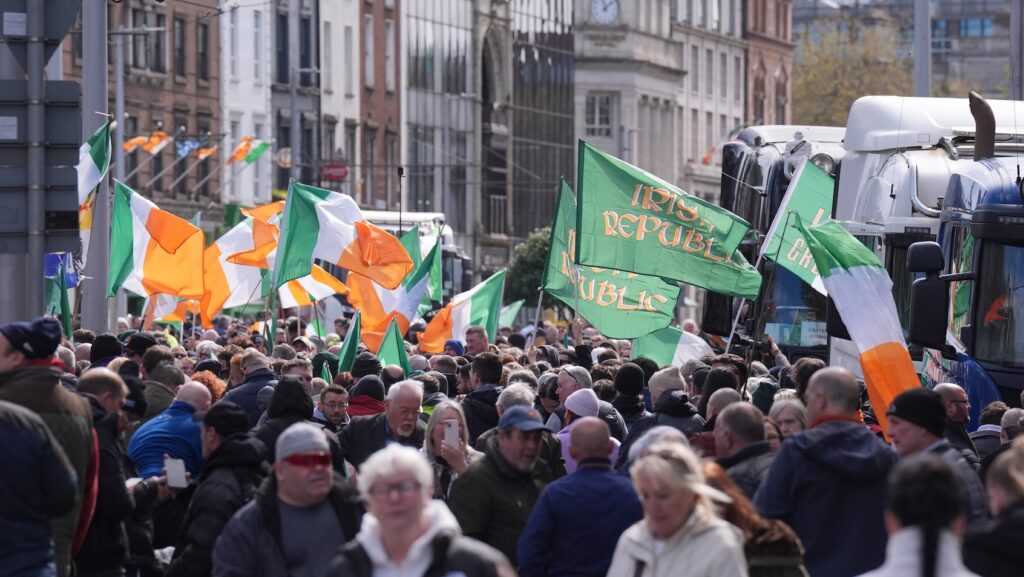
(Niall Carson/PA Images via Getty Images) Protesters on O’Connell Street in Dublin on the fifth day of a national protest against rising fuel prices, April 11, 2026.
By the time the rest of the world noticed that Ireland’s main arterial roads, the country’s principal oil refinery and Dublin’s iconic O’Connell Street had been shut down by convoys of trucks and tractors, the protests had indeed been partly transformed by inchoate right-wing outrage. Demands for government aid on diesel prices (in U.S. terms, now around $8 a gallon) were at least rational enough, but other protesters wanted the Irish government to drill for oil off the west coast or to end financial aid to asylum seekers and use that money for farm support.
Want more sharp takes on politics? Sign up for our free newsletter, Standing Room Only by Amanda Marcotte, also a weekly show on YouTube or wherever you get your podcasts.
Ireland is an anomalous country in several different ways. It has no far-right, anti-immigrant political party of any consequence, but feels tremendous anxiety about that possibility, especially after Steve Bannon’s threat or promise to forge an “Irish Trump,” perhaps in his secret underwater lair. The Irish state also possesses a huge budget surplus, entirely due to tax revenues from U.S. technology and pharmaceutical firms, and was able to make the fuel protest go away, however conditionally, by throwing roughly $800 million at it.
As with the “Yellow Vest” protests in France in the early 2020s, or the pandemic-era trucker protests in Canada, it’s a mistake to draw categorical boundaries around this kind of angry populist upsurge and decide that it means whatever you want it to mean. (Irish legislators on both the left and right tried to claim common cause with the fuel protests, but with no ability to exercise meaningful control.) Contradictions abound here: As Berman told the Times, there are indications that the far-right political wave has crested and is losing popularity. That doesn’t mean that old-school, pre-Trump liberal democracy, in ruins almost everywhere, is coming back. Something else is waiting to emerge, but what?
Read more
from Andrew O’Hehir
