
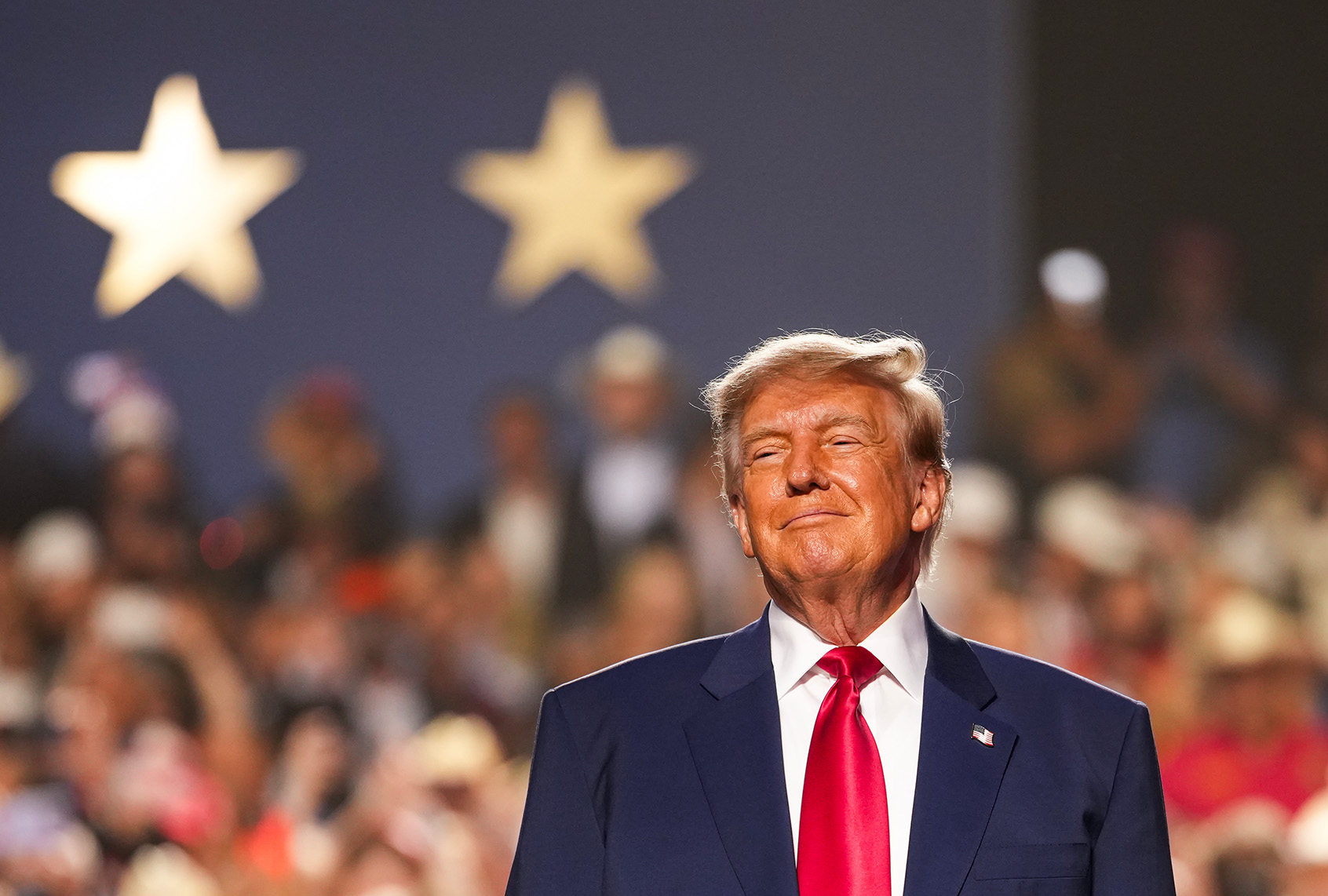

Donald Trump recently claimed that when he goes to international gatherings, all the leaders stand up. Supposedly, they do this as a sign of respect for him personally: “They didn’t stand up for our last president; they didn’t care about him … they laughed at him. But our country is respected again.”
He’s been using versions of that line ever since he was first inaugurated back in 2017. But he’s always portrayed America as a disgusting hellscape seen by the rest of the world as a laughingstock — except when he is president, when we magically enter magically a “golden age” in which the entire planet turns to him as its undisputed leader.
Needless to say, this is utterly delusional. Foreign leaders do not stand at attention when he enters the room. The footage of such meetings is public, and we know that they do not see themselves as vassals to this president. He’s just making that up. And neither they nor the people in their countries “respect” America again. In fact, the opposite was clearly true during Trump’s first term, and people around the world respect the U.S. even less the second time around.
Which is completely understandable. The man who proved his incompetence in a global crisis and then incited an insurrection to overturn the election after losing his re-election campaign was returned to leadership once again four years later by the American people. As George W. Bush famously said, “Fool me once, shame on me; fool me twice … won’t get fooled again.”
Last spring, Pew Research Center released its annual survey comparing how Americans and others around the world view the United States’ global role. It wasn’t pretty. They reported, “In most countries, majorities say the United States does not promote peace and stability around the world and does not take other countries’ interests into account on matters of international policy.” Views within America’s traditional allies, the countries whose leaders Trump claims “stand up” to honor him, are particularly negative. The Pew poll registered huge declines in the belief that the U.S. is a reliable partner since Trump took office for the second time.
Results were even more devastating when it came to global views of Donald Trump in particular. In the countries surveyed, 76% of respondents said they had no confidence in his leadership of world affairs. Majorities above 70% disapprove of his policies on immigration, Venezuela, Ukraine, Iran, Gaza, Greenland and tariffs. Maybe Trump believes that equals respect.
Perhaps more surprising, a recent Gallup poll on Americans’ view of the U.S. role in the world found that 60% of those surveyed accurately understood how the rest of the world views this country, and the same proportion was unhappy about that. In other words, Americans are not massively deluded about Trump’s standing in the world, and he’s nearly as unpopular at home as everywhere else.
A recent Gallup poll found that 60% of Americans surveyed accurately understand how the rest of the world views this country. Americans are not deluded about Trump’s standing in the world, and he’s nearly as unpopular at home as everywhere else.
The real question under all this is a bigger one: How has Trump’s erratic and irresponsible behavior changed not just the U.S. relationship with the rest of the world, but the world itself? After all, as the world’s dominant superpower and guarantor of security for dozens of countries over the past 80 years, America’s influence on the planet has been overwhelming. The entire post-war economic world order was organized by the U.S. and a handful of allies, along with the institutions that undergird global commitments to human rights and international law. For better or worse, America has been the leader of what used to be called the “free world,” and that is simply no longer true.
It must be said that the recent precipitous decline in respect for the U.S. as a global leader does not rest solely on Trump’s shoulders. The war in Iraq was a tragically misguided venture that tested the Western alliance more than 20 years ago. You’ll recall that the “coalition of the willing” in that war did not include most of America’s traditional allies, which adamantly objected to the 2003 invasion.
Barack Obama’s administration was able to resurrect America’s standing to some extent, producing such notable international achievements as the Iran nuclear deal and the Paris climate accord, both of which were immediately undone by Trump in his first term, proving to the world that any agreement signed by the U.S. was subject to the whims of the next leader and essentially not worth the paper it was printed on.
We need your help to stay independent.
One of Trump’s first acts in his second term was to withdraw from 66 international organizations, most of which the U.S. had been instrumental in creating. One of those was International IDEA, an intergovernmental organization based in Stockholm and devoted to supporting and strengthening democracy around the world. It just issued a new recent report on the state of American democracy and the effects of its decline on the rest of the world, and the conclusions are sobering.
The group finds that the U.S. saw “statistically significant declines” in seven different indices of democracy between 2020 and 2025, those categories being “Access to Justice, Economic Equality, Effective Parliament, Freedom of Expression, Freedom of the Press, Free Political Parties, and Judicial Independence.” Those declines predate Trump’s return to power, as the report notes, but have “manifested most spectacularly during the second Trump administration.”
What may be even more concerning is the reported damage to democracy in the rest of the world, perceived as results or effects of the American decline. International IDEA reports that since Trump’s second inauguration, the U.S. “has become the most prominent example and accelerator of the disturbing trend toward a belittled and diminished Rule of Law” and damaged democratic principles. Worse yet, America’s “threats and actions against other countries have undermined national sovereignty as well as international law and risked provoking more widespread violent conflict.” It considers this threat — meaning, to be clear, America’s threat to the world — “multifold, far-reaching, and difficult to overstate.”
Want more sharp takes on politics?
Sign up for our free newsletter, Standing Room Only by Amanda Marcotte, also a weekly show on YouTube or wherever you get your podcasts.
It’s tough to argue with that. Trump’s tariff war with Europe, his threats against Canada and Greenland, and his administration’s erratic actions in Ukraine, Venezuela, Iran and elsewhere, as well as the abrupt shutdown of humanitarian aid and the dismantling of international institutions, have proved that threat to be real. The rest of the world is reorganizing rapidly, and to a large degree seeking to exclude the U.S. as much as possible. No one can honestly predict how that’s going to look when all is said and done.
We are in uncharted territory. The U.S. is still an economic behemoth with the most powerful military in world history and assets all over the globe. But without meaningful domestic political constraints or a serious commitments to democratic institutions either at home or abroad, the United States is considered more of a global threat than a guarantor of security. That offers a clear opening for others to act in unpredictable ways to take advantage of the situation. Russia’s invasion of Ukraine might be considered the most obvious example, but there are others and there will soon be more. Whatever happens next, we know one thing: The world is never going back to the way it was.
Read more
about the crumbling Trump regime
