
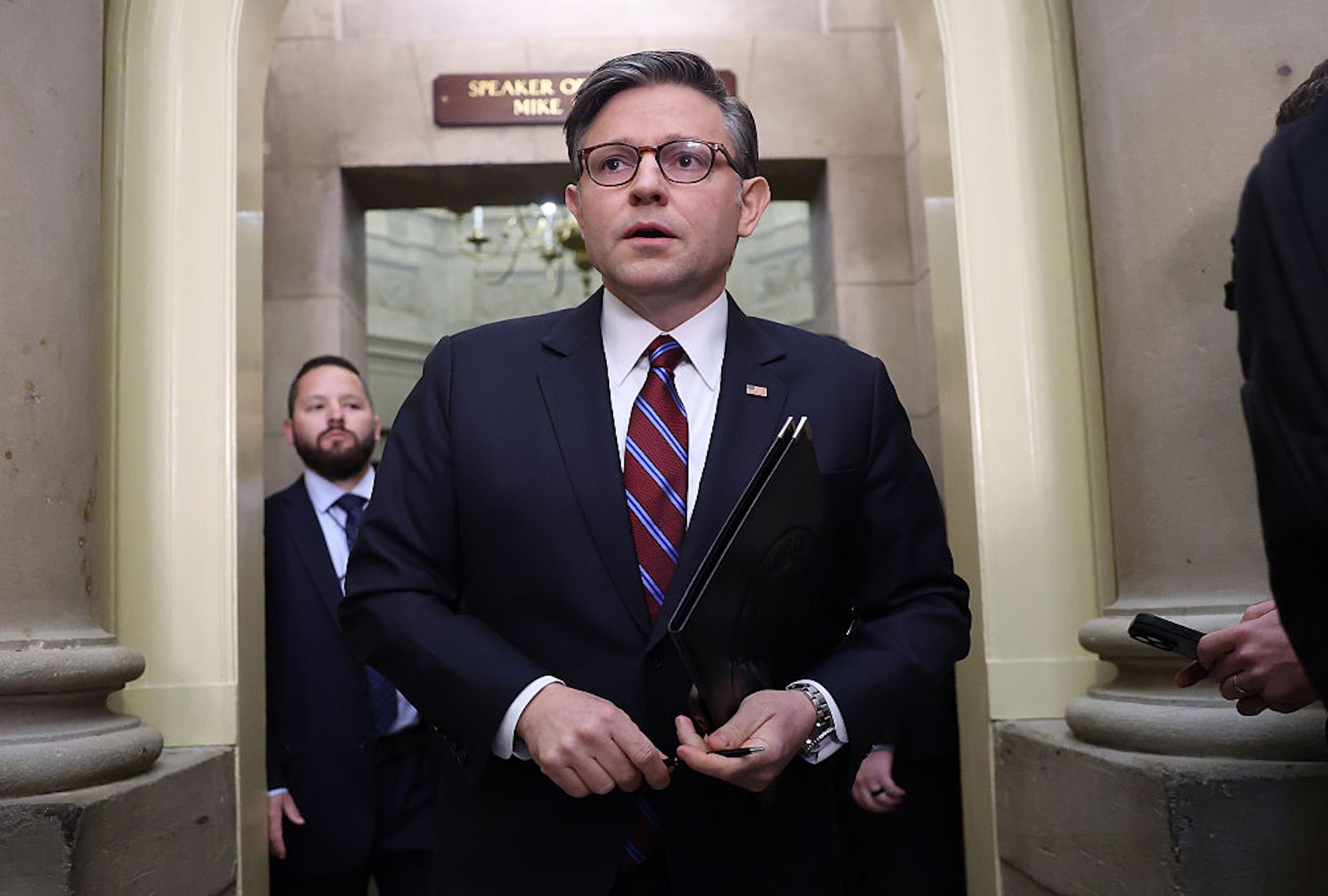

If you’ve ever read anything by biographer Robert Caro, you get the feeling that he could wring 100 pages out of what he had for breakfast. His books on New York City planner Robert Moses and President Lyndon B. Johnson function as both biography and challenge, their hefty page counts daring readers to dive in. It’s unlikely that Speaker of the House Mike Johnson will ever get the “Master of the Senate” treatment, and the reason for this is clear: You don’t need a doorstop to dissect the nuances of his legislative strategy. His favorite trick can be summed up in the language of an infant’s board book: See Mike run.
Johnson was in the middle of his fourth term as a congressman from Louisiana’s fourth district when disgraced Florida Rep. Matt Gaetz led a revolt against Kevin McCarthy, whose speakership didn’t even last nine months. The fractured Republican caucus struggled to agree on who should replace the relatively moderate McCarthy, with the Trumpist wing ultimately winning out and pushing Johnson, a 2020 denier, into the top slot.
Unlike his predecessor, Johnson had held no leadership positions within the House prior to picking up the gavel. His most high-profile assignment was chairing the Republican Study Committee, a glorified book club obsessed with cutting federal spending. With Gaetz, the figurehead of the revolt that led him to power, chased out of Congress by allegations of sexual impropriety, Johnson has spent his nearly three years as speaker governing scared.
Whenever a tough House vote looms that might further fracture his caucus, Johnson plays calendar games in an attempt to avoid the issue altogether. And if that doesn’t settle the problem, he turns tail and books a flight back to Louisiana.
Handed a fractured caucus and working at the behest of his mercurial puppeteer, Donald Trump, the speaker has made remarkable strides in the field of running away from problems. Whenever a tough House vote looms that might further fracture his caucus, Johnson plays calendar games in an attempt to avoid the issue altogether. And if that doesn’t settle the problem, he turns tail and books a flight back to Louisiana.
As the Republican figurehead of the hot-blooded House, Johnson is admittedly in an unenviable position. He can’t run afoul of Trump, since the party has largely remade itself in the president’s image. But he has to keep the few remaining GOP moderates content lest he face rebellion from the center. Where Trump can just lie about his policy positions until reporters move on and Vice President JD Vance can hide behind the general apathy the public feels toward him, Johnson’s job requires going on the record repeatedly about individual policies that might be unpopular with voters.
Along with Senate Majority Leader John Thune, R-S.D., Johnson has effectively ceded congressional authority to Trump and the executive branch. When the president co-opted Congress’ power to impose tariffs for himself, Johnson warped time itself to avoid representatives’ backlash. Trump declared a national emergency in an attempt to impose the tariffs, a designation that opens an expedited lane to congressional resolutions in response. The law requires resolutions meant to end a declared emergency to be considered within 15 days. Under Johnson’s leadership, his party floated a provision changing the definition of a “day” and hid it inside a procedural vote to move a budget bill forward.
When rabble-rousing Kentucky Rep. Thomas Massie wanted to make good on Republican campaign messaging. When he pushed a vote to force the release of the Epstein files in 2025, Johnson packed his gavel and adjourned the House. Later that year, when the House pushed through a shutdown-averting spending bill he knew would be a tough sell in the Senate, he extended lawmakers’ Rosh Hashanah vacation by several weeks in an attempt to pressure the upper chamber into funding Trump’s government. (It didn’t work. The shutdown ran well into November.)
In June, Johnson lost control of the House floor when a group of Trump hard-liners gummed up procedural votes to grind all legislation to a halt. Rep. Anna Paulina Luna of Florida led the charge, demanding that party leadership find a way to pass Trump’s federal elections bill. When no obvious path forward was forthcoming, Johnson sent everyone back to their districts.
Facing steep inflation amid the war with Iran, Johnson made sure to shorten the House’s summer session in advance for fear of tricky resolutions that might tie Republicans to Trump’s unpopular agenda. You can probably guess Johnson’s response when Massie surprised him with legislation to do just that, one where a vote up or down would signal support of or dissent against the war in Iran.
The Kentucky congressman brought articles of impeachment against Defense Secretary Pete Hegseth on Tuesday. Johnson responded by announcing the end of the already shortened session. He canceled all planned votes for the session’s final day and sent lawmakers home under the guise of campaign season.
Want more sharp takes on politics? Sign up for our free newsletter, Standing Room Only, written by Amanda Marcotte, now also a weekly show on YouTube or wherever you get your podcasts.
Speaking to reporters, Johnson painted the decision as an “attaboy” for a productive Congress and urged his fellow Republicans to sell their constituents on the good job they’re doing on Capitol Hill. He called Massie’s move a “publicity stunt by someone who wants attention” and pushed back on the idea that the House is going home with work left to do. “The House has done its work,” he said. “We’ve passed over 900 pieces of legislation.”
While technically accurate, Johnson’s characterization was also deceptive. The House has indeed passed 948 measures this session. But that term is an all-encompassing one, representing bills, joint resolutions of Congress and even celebratory resolutions, such as H. Res. 1837, which the House passed in June to congratulate the Carolina Hurricanes for winning the 2026 Stanley Cup. But they have only enacted 112 bills with the force of law to date, which represents an historic low.
Democrats met Johnson’s comments with sneers, accusing the speaker of being an absentee head of the chamber. “We’ve got Speaker Johnson fiddling, and at least Nero had the decency to stay in town while Rome burned,” Rep. Sam Liccardo, D-Calif, shared in a press release. “The American people need action, not vacation.”
We need your help to stay independent.
Johnson’s tactical retreat was also unpopular with many of his fellow Republicans. Massie railed against the idea of going home early on the House floor. “We’re calling off Congress? And we’re in the majority?” he said. “I’m trying to get justice for the Epstein survivors . . . I’m trying to stop a war.”
Rep. Ralph Norman, R- S.C., said legislators were coasting on the American taxpayers’ dime: “The House has now canceled at least 63 scheduled voting days this Congress, including nine days this month alone, and now we’re leaving Washington until after the election. The Founders did not envision taking this much time off and still getting paid . . . We still have work to do.”
Johnson, though, is unlikely to face tricky votes again. The latest polls are projecting a blue wave washing out Republican control of the House — and perhaps even the Senate. Johnson can rest easy knowing his tenure was so consistent, and that he met what could turn out to be the final challenge of his speakership in the same way he has faced all the others: by sprinting in the other direction at top speed.
Read more
about Mike Johnson
