
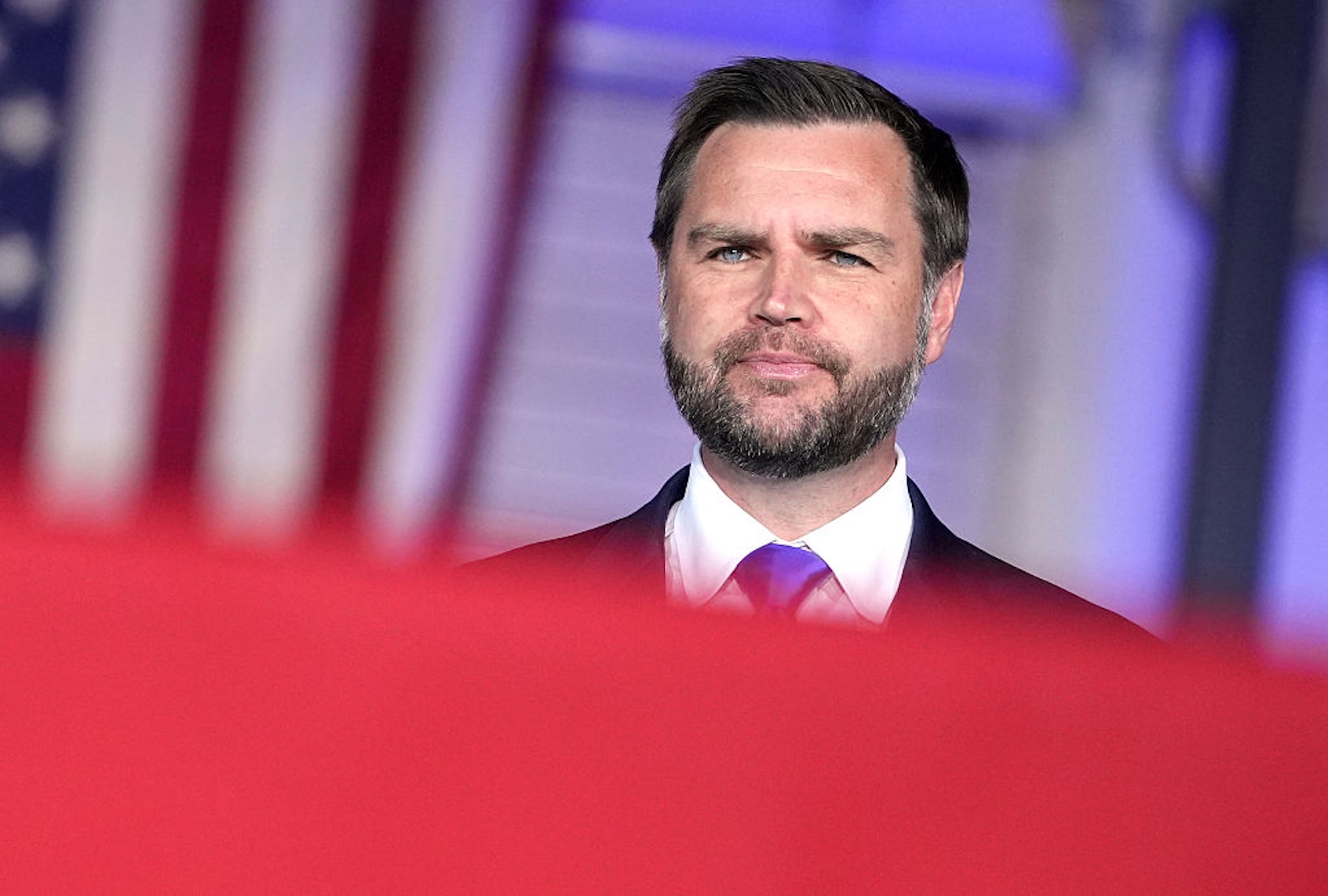

There’s something about JD Vance that makes him almost impossible to assess. Like Bigfoot, he’s a naturally blurry creature. His voice lands somewhere between the parents in Charlie Brown specials and those buzzers they put outside convenience stores to chase off teens. The vice president is hostile architecture in human form, a suit stuffed with charisma’s anti-matter.
This has served him well in his quest for political power. Being instantly forgettable is an asset for someone who made their name as a liberal hillbilly whisperer only to switch to an online edgelord identity at the behest of far-right backers. But if you’re willing to hold and rotate Vance’s recent statements in your mind, you’ll find something uncharacteristically interesting. He’s put the tiniest sliver of distance between himself and President Donald Trump on artificial intelligence, and it provides an inkling of how Republicans might move beyond a decade of Trumpism.
I’ll catch you up on the current AI conversation. Large-language models built by companies like OpenAI and Anthropic keep breaking out of their testing sandboxes. The companies actively promote that their products are breaking the law and hacking into other private businesses, showcasing their power while appearing somewhat concerned with safety. Recently, those same AI CEOs have started pleading for government regulation of artificial intelligence, a “stop me before I kill again” plea that many critics believe is meant to lock in their position at the top of the industry.
Trump has been incredulous about the ask. He has thrown his red hat in with AI boosters and reacted to the idea of slowing down as a slight against his discernment.
Trump has been incredulous about the ask. He has thrown his red hat in with AI boosters and reacted to the idea of slowing down as a slight against his discernment. In a day-long rant on Truth Social, the president said the only “guardrails that AI needs is a strong and smart . . . president.” He said that there was a “sick conspiracy . . . against AI and data centers” and that slowing down AI development would leave us behind China on the global stage.
“We already have tremendous CRIMINAL and REGULATORY power over these companies!” he wrote. “Conspiracy Theorists, Treasonists, Traitors, and Leakers, BEWARE!”
In the week since, Vance has taken a slightly more skeptical tone on AI development. On Monday he told reporters on Monday that the U.S. needs to be “careful” about AI. He looked sideways at CEOs’ request for industry regulation, saying that the move might be a “Trojan Horse” masking their true intentions.
“I feel a little bit weird about the fact that you have so many frontier AI tech companies kind of coming to the government and begging the government to regulate them,” he said. “Any technology has risks. Any new technology brings both risks and benefits . . . I don’t think Americans should be scared of anything.”
Vance kept up the narrowed-eyes view of AI companies during an event later in the week hosted by the “All-In,” comparing Anthropic co-founder Dario Amodei and OpenAI CEO Sam Altman to Victor Frankenstein, and laid the blame for their tinkering at their feet. “Why is it that the people who are at the frontier of the AI economy are throwing up their hands and saying, ‘Well, we’ve built Frankenstein,’ and the solution to Frankenstein apparently is to create a one world governance structure for artificial intelligence?” Vance said. “What I would say to those people: If you’re building Frankenstein, stop. If the cat is out of the bag, then build the defensive mechanism against Frankenstein.”
The vice president’s words sound good — like a rap on the knuckles of the tech billionaires who can’t stop claiming they’re building doomsday devices. But a half-second of reflection shows that it’s all flash, no different in substance from what Trump was pushing on Truth Social. The end result of Vance’s “knock it off” grandstanding and Trump’s “eternal AI boom” rah-rahing is the same. AI continues to be unregulated. The money keeps flowing. The only thing that’s changed is a skosh of skepticism making the news.
Want more sharp takes on politics? Sign up for our free newsletter, Standing Room Only, written by Amanda Marcotte, now also a weekly show on YouTube or wherever you get your podcasts.
The Vance pushback is the tip of an iceberg of AI wariness throughout the Trump White House. Per a Friday report from the New York Times, advisers are urging the president to be more cautious in his blanket statements around AI’s safety. Trump reportedly views AI as a “golden goose” and is desperate to keep up the building boom for data centers.
Vance is not the only one among the Republican Party’s 2028 presidential hopefuls trying this trick. Likely candidates such as Texas Sen. Ted Cruz have painted themselves as slightly wary of AI, but not so skeptical as to endanger the money flowing from the Silicon Valley spigot.
Cruz has been working to block a bill that would require AI companies to submit new models to the government for testing before wide release. He’s said that the idea of an AI-led extinction event is “scary stuff” and called for “some guardrails” on the technology, but he’s balked at extensive government intervention, warning that the market will disincentivize creating Skynet.
We need your help to stay independent.
“If any company sells a product that causes massive harm, they’ll get sued into oblivion,” he shared on X. “That’s how companies go broke and rich people become poor people.”
Look for this half-twist away from Trump’s over-the-top enthusiasm to appear elsewhere in Republican ranks. Grocery bills and gas prices are rising. The president’s war in Iran, and America’s ongoing support of Israel in its multi-front war throughout the region, are increasingly unpopular. The fight against data centers and private surveillance cameras has crossed partisan lines, bringing erstwhile enemies together in the fight against creepy tech.
National candidates who previously toed the MAGA line will need to find a way to put breathing room between themselves and the agenda they supported, without risking the anger of Trump’s blindly loyal base. Side-eyeing the people responsible for the problem while dutifully stepping out of their way solves that tricky equation. It’s a neat trick — even when Vance does it.
Read more
about AI
