
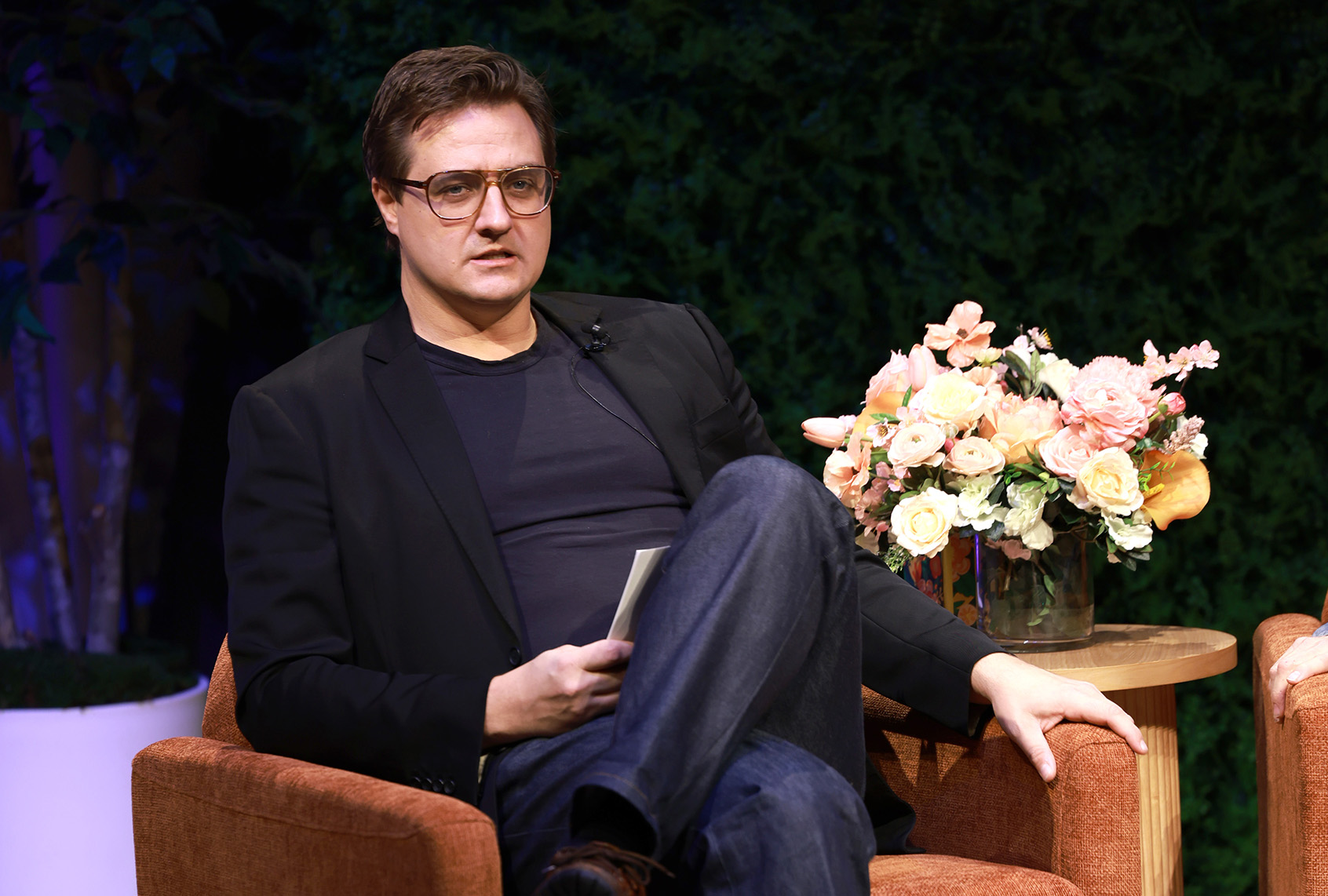

When MS NOW heads to Arlington, Texas, on Saturday, Sept. 26, for “MS NOW Live: Together in Texas,” host Chris Hayes will be stepping into an environment he finds both familiar and necessary. For Hayes, host of “All In with Chris Hayes” and author of “The Sirens’ Call: How Attention Became the World’s Most Endangered Resource,” gathering face-to-face with his audience isn’t just network promotion — it’s nurturing the one thing he has left in a media environment defined by change.
“I love live events,” he told me in an interview ahead of the event, describing having “a head start” on the live-events model with book tours and podcast live shows. “There’s a great energy that comes from being in a room with people. I think it’s a different energy than anything else, particularly true and truer every day in the increasingly screen-based and mediated world.”
Held at the College Park Center at the University of Texas at Arlington, MS NOW’s day-long fan event brings together 15 of the network’s top anchors — including Rachel Maddow, Lawrence O’Donnell and Jen Psaki — for in-depth conversations with thousands of Texas viewers ahead of the November midterms.
Hayes will arrive in Texas with a deep respect for his viewers, whom he calls “sophisticated and informed” about the issues — from Democratic hopes surrounding state Rep. James Talarico’s Senate campaign to fights over data centers, development and the future of Texas communities. But he will also be bringing a theory of what’s been happening in the Lone Star State over the past several years. Describing the state as, “on its own terms,” perhaps the country’s most successful laboratory for right-wing policy, Hayes said that Texas’ long-running Republican experiment has produced a contradiction: Policies that helped make Texas affordable, fast-growing and attractive to newcomers are also changing the electorate and straining the coalition that built the model in the first place.
Hayes said that Texas’ long-running Republican experiment has produced a contradiction: Policies that helped make Texas affordable, fast-growing and attractive to newcomers are also changing the electorate and straining the coalition that built the model in the first place.
“There [are] certain parts about the Texas model that have genuinely been successful,” Hayes conceded. “Housing is pretty cheap. It’s been pretty fast-growing, and in that cheap housing and fast-growing, it’s a place that’s diversifying, and a lot of immigrants have made a life there.”
But the state’s Republican leadership has to face reality: “If people want to move to Texas, which a lot of people do, then the state’s composition is going to change,” he said. The same in-migration fueling the Texas boom is also, in some measure, quietly padding the GOP’s own coalition. “[The state GOP] have a very ambiguous, ambivalent relationship to that.”
This tension surfaced most recently in the backlash to social-media posts by former Tarrant County GOP Chair Bo French, a candidate for the Texas Railroad Commission, a state agency with a remit that goes beyond its name, regulating oil, gas, alternative fuels, pipeline safety, and surface mining and reclamation. French posted a photo on X after Texas’ upset win over Ohio State showing University of Texas students — many of them South Asian — in the stands, and appeared to condemn a changing, more diverse Texas. Hayes said the response from prominent Texas Republicans, including Sen. John Cornyn and former George W. Bush adviser Karl Rove, was partly about the political consequences of alienating the growing number of South Asian Texans, some of whom may already be conservative or Republican-leaning.
“I wouldn’t be surprised if the people in the photo are Republicans,” Hayes said, referring to the image French criticized. “This is Texas.”
Hayes sees Talarico as a serious test of whether that opening can be exploited into statewide electoral gains for Democrats. “Talarico, I think, is a strong candidate, and I think he’s got a real shot,” he said. Texas Democrats still need “a whole bunch of things to break the right way” to win statewide, he cautioned, calling Texas “the great white whale” of statewide Democratic politics — a state the party hasn’t won in three decades. But this cycle, Hayes argued, offers real structural openings. Ken Paxton, he said, is “a worse candidate” than even Sen. Ted Cruz; he isn’t an incumbent and lacks basic retail political skills. “He’s a real dud on the campaign trail,” Hayes noted, adding that Trump himself may be reassessing his endorsement calculus in real time.
Against that backdrop, Hayes was direct about Republican efforts to turn Talarico’s faith and masculinity into political liabilities. “They are all but calling him a gay slur,” he said of the GOP’s campaign against him, adding that the assault on Talarico’s masculinity “reeks of desperation.”
Hayes did not dismiss the possibility that Paxton and the GOP’s attacks on Talarico could work with some voters, particularly in a polarized environment where campaigns often seek less to persuade than to cement partisan loyalties. “You just need to snap people back to their fundamental, their partisan fundamentals,” he said. A Republican voter who may have doubts about a candidate can still be nudged toward the familiar conclusion: “I don’t really like the Democrat. Those aren’t my people.’”
Want more sharp takes on politics? Sign up for our free newsletter, Standing Room Only, written by Amanda Marcotte, now also a weekly show on YouTube or wherever you get your podcasts.
But Talarico, Hayes suggested, may be better positioned than past Democratic efforts to resist that hyper-partisan reflex. What makes Talarico’s race worth watching this cycle, in Hayes’ framing, is less about the candidate himself than about the structural gap that’s opened up on the other side. He noted that Democrats haven’t come this close in decades: Beto O’Rourke’s 2018 run against Cruz, he noted, came down to roughly “2.3 points” — the modern high-water mark for a statewide Texas Democrat. “Talarico has run a phenomenal race, and he’s a really good candidate.”
While Hayes expects the midterms to dominate the conversation in Arlington this weekend, audience members, he said, often arrive with their own closely held theories about what messages Democrats should use — and what could stop what he called “the desecration of our country” by Donald Trump. He anticipates intense interest in artificial intelligence and the infrastructure behind it, particularly data centers. The issue, Hayes said, has become more salient to his audience in recent weeks as AI tools have visibly improved and communities are increasingly confronting the land, water, power and development demands associated with data center construction.
“The data center issue really gets something deep in people,” he said. “I think Texas is an interesting place for it.”
We need your help to stay independent.
Along with Georgia and Virginia, the Lone Star State has become central to the national conversation around data centers. It’s become a wedge issue in at least one Texas congressional race — alongside anger over the Trump administration’s attempt, which has been temporarily halted, to build a border wall in Big Bend National Park, and broader frustration with Republican Gov. Greg Abbott. (On Monday, Abbott ordered the state’s environmental regulators to stop approving permits for the construction of new data centers pending an electrical audit.) Hayes compared the reaction to a form of territorial politics. “It’s territorial in a literal physical sense — the ground, your backyard, your community, the park that you love.”
For Hayes, the Texas event is a chance to hear directly from people confronting the physical consequences of the state’s rapid development. The event also offers Hayes an opportunity to put into practice the central concern of his book, “The Sirens’ Call,” which examines how digital platforms commodify attention. MS NOW’s live event asks whether journalism can build something more durable than a click or a fleeting social-media interaction.
“I like people,” Hayes said. “I feel energized by them.” Such direct relationships, he stressed, are the core asset of modern journalism, even as tech platforms continually insert themselves between news outlets and their readers and viewers through algorithm tweaks. “As everything gets kind of disintermediated and chopped and screwed, and the platforms insert themselves between you and the audience,” he said, “what do you have? You have the people that like and respect your work . . . Nurturing that is pretty darn important.”
Read more
from Sophia Tesfaye on the media
