
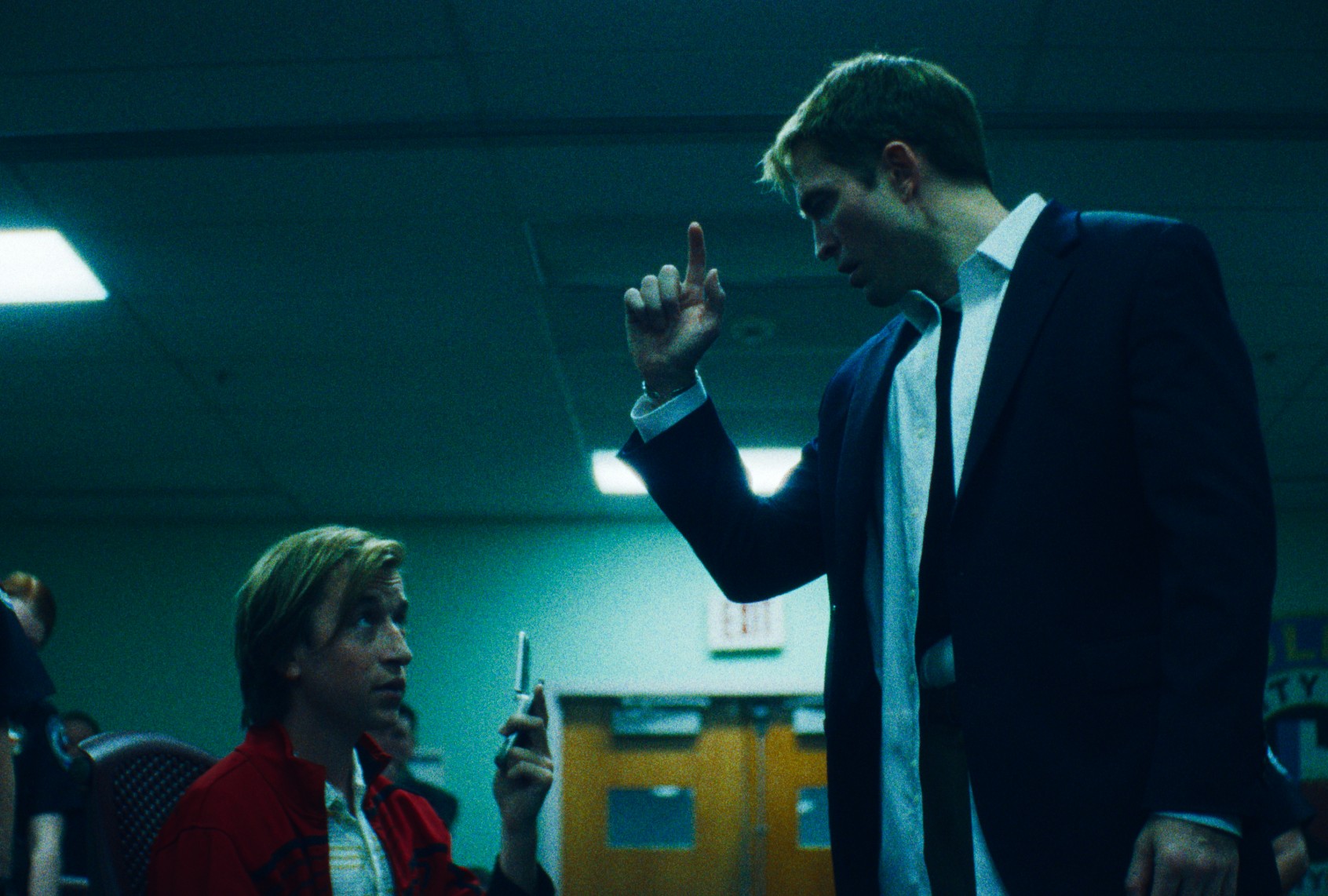

In “Primetime” — Lance Oppenheim’s psychological crime thriller about the rapid ascent and swift fall of the “Dateline NBC” segment “To Catch a Predator,” and its host, Chris Hansen (Robert Pattinson) — television is a complex ecosystem where hyperawareness is paramount to survival. To prosper in this broadcast biome, close surveillance is key. Attack too early and risk being mauled; retreat and risk going hungry, growing weaker and becoming the prey.
Though a skilled hunter, even a reporter like Hansen can’t go up against an apex animal like ABC’s “Lost” when it comes to ratings and audience share. To assert dominance and secure his spot on the food chain, Hansen needs to observe the waters and hook a big fish. His cohort Xavier Von Erck (Matthew Maher) — the founder of Perverted-Justice, the vigilante group in charge of luring the “Dateline” prey — believes he’s found just that in an internet chat room.
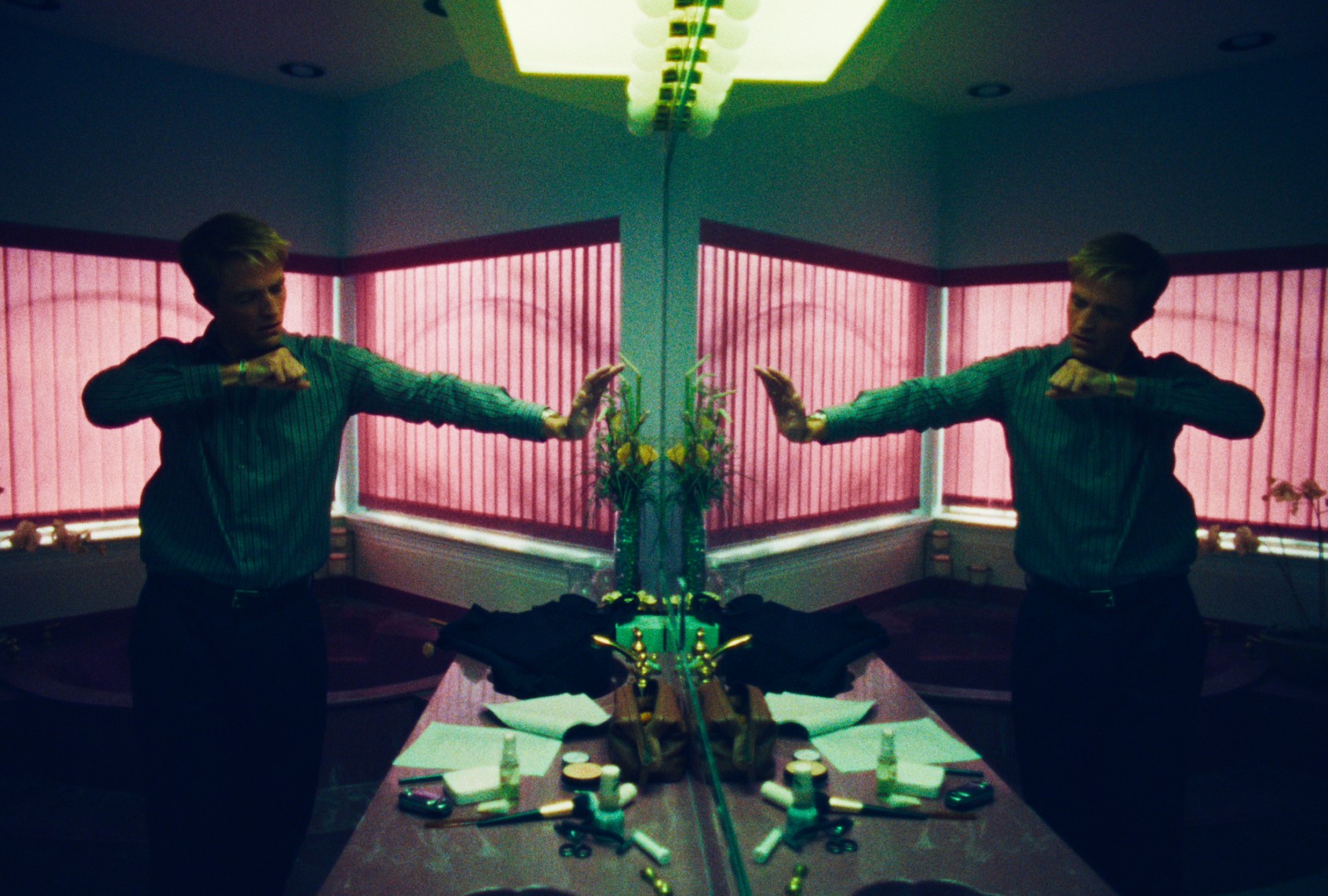
“This is big, the biggest,” Erck says. “A whale.” Oppenheim douses their conversation in blue, with the eerie artificial light of a computer illuminating both men from below. The effect erases the color from Pattinson’s eyes, fusing his iris and pupil into a black circle, like a shark that’s caught the scent of fresh blood. Emboldened by his animalistic observation, Hansen decides to weaponize Erck’s information and go in for the kill.
(A24) Robert Pattinson in “Primetime”
Buzzy new films like “Primetime” rarely reflect the modern surveillance state’s inflection points as well as older media like “To Catch a Predator” can. But if Gen Z is really interested in retracing history’s steps to learn about surveillance culture, “Primetime” is merely the tip of the iceberg.
To anyone who’s spent even a modicum of time online in the last 20 years, this attack pattern looks familiar. In the World Wide Web’s wilderness, casual users, corporations and government intelligence alike collect data about everyone and everything, building digital footprints and algorithmic profiles that sit hidden just behind our newsfeeds. Gen Z and digital natives grew up in this extreme surveillance state, emboldened by controversial legislation like the Patriot Act and USA Freedom Act, which allowed unprecedented surveillance as a post-9/11 counter-terrorism measure. And while younger people have been raised in a vigilantly monitored world, that doesn’t make the lack of privacy any less disconcerting.
Want more from culture than just the latest trend? The Swell highlights art made to last.
Sign up here
Certainly, that’s why Gen Z has taken to “Primetime,” a film set in an era most of the generation is too young to remember firsthand, but one that has had a critical impact on their lives and well-being. In 2006, “To Catch a Predator” sat at the intersection of the surveillance state, militaristic nationalism motivated by the backdrop of the Iraq War, and digital culture proliferated by cellphones that were affordable and could accompany us anywhere. By the time Gen Z bled into Gen Alpha, all of these things morphed into one well-oiled machine, a self-regulating ouroboros. Though we may all be steeped in this reality, it’s unsurprising Gen Z would feel cheated out of a life where surveillance wasn’t constant — where they didn’t have to wonder whether a person on the train is scrolling on their phone or covertly taking a photo.
Naturally, “Primetime” has become a point of fascination for zoomers, who made up 69% of the film’s opening weekend audience. While younger viewers adore Pattinson and the movie’s distributor, A24, alike, it’s the film’s subject matter that’s driving their conversations. “Primetime” traces a straight line from today back to the mid-aughts, clarifying the connection between pivotal historical events and their contemporary consequences. And though I didn’t find that the film actually said much about those events, it’s easy to see why so many people under 30 argue otherwise. Buzzy new films like “Primetime” rarely reflect the modern surveillance state’s inflection points as well as older media like “To Catch a Predator” can. But if Gen Z is really interested in retracing history’s steps to learn about surveillance culture, “Primetime” is merely the tip of the iceberg.
Whether or not that tip feels sharp depends largely on one’s relationship to our everyday insanity. Most zoomers likely grew up perceiving “To Catch a Predator” and Hansen through memes — chat logs removed from their disturbing context, or compilation videos of the show’s “funniest” moments. That perception in itself is upsetting, not only because it trivializes survivors’ experiences, but confirms just how much the show succeeded in turning criminal intent toward minors into entertainment. For those who already understood these inherent problems, “Primetime” doesn’t pose many new questions, which gives one the sickly feeling that the film is repeating some of Hansen and the show’s mistakes. For others, who are only beginning to understand “To Catch a Predator” as a planet that orbited the surveillance state’s blinding sun, Oppenheim’s film may be rife with new threads to pull.
The film’s strongest narrative aspect in this regard is how accurately it reflects Perverted-Justice’s sting tactics, which made many “To Catch a Predator” cases unprosecutable or their evidence inadmissible by wading into entrapment. The team would hunt down potential predators in chat rooms and, in many instances, encourage prey to do things they were initially reticent to do or flat-out didn’t want to engage in. Occasionally, when the alleged predators would express their reluctance, the Perverted-Justice decoys would play mad or upset.

(A24) Skyler Gisondo in “Primetime”
To build out a profile on their prey, the decoys would use chats to draw personal information out of their subjects. Furthermore, the on-camera interventions and arrests were largely faulty, too. Hansen wasn’t a cop; he never read anyone their rights. And the police lying in wait would greet the predator with unnecessary aggressive, martial force. The surveillance state is the primal wilderness, where anything goes, and “To Catch a Predator” employed the laws of the jungle: Identify, lure, attack, kill.
“Gossip Girl” burst onto the scene in 2007 just as the cellphone was becoming the staple accessory for every teenager in America. The series’ writers keenly understood the technology’s wicked possibilities. Surveillance was no longer a military or government tactic; it was for everyone with a wireless connection.
The methods are strangely akin to those employed in the concrete jungle, where badly behaved teens act with as much life-altering, brutal force as the characters in “Primetime.” If “To Catch a Predator” is the paradigm of reality television’s reflection of the surveillance state, the original “Gossip Girl” — which aired concurrently, however briefly, with Hansen’s show — is the prototype for the insidious ways surveillance is weaponized. That might sound like an offbeat comparison, but just because a teen soap is, well, a teen soap, doesn’t mean it has no cultural merit.
“Gossip Girl” is an especially ideal time capsule for understanding how cellphones and all digital technology became useful tools for constant civilian monitoring. For anyone unfamiliar, the series follows a group of privileged teenagers living in New York’s Upper East Side, whose lives are chronicled by the anonymous titular blogger. Gossip Girl knows all of their desires and vices, their wins and their foibles. “She” walks among these spoiled brats, yes, but also relies on a steady stream of tips from readers. Photos, videos, intimate details; any hearsay is fair game, and Gossip Girl will go to the ends of the Earth to prove it— right up to the point where it’s revealed that Gossip Girl was actually not a “she” at all, but a male classmate.
This is all deliciously compelling on its own, but the series’ writers do a great job of emphasizing that these takedowns are products of the world we live in now. Gossip is currency, and anyone looking to climb the social ladder can use it to pay their way to the top — at the cost of their soul, of course. Characters blackmail one another left and right, sometimes with criminal intent. And while it’s entertaining to watch, the real marvel is how prescient the series is today.
We need your help to stay independent.
“Gossip Girl” burst onto the scene in 2007 just as the cellphone was becoming the staple accessory for every teenager in America. The iPhone was four months old when the show premiered, and the series’ writers keenly understood the technology’s wicked possibilities. Surveillance was no longer a military or government tactic; it was for everyone with a wireless connection.
And while, like “To Catch a Predator,” one might argue that “Gossip Girl” encouraged this phenomenon by turning surveillance into entertainment, I’d say the show more often depicts its awful consequences. While the teenage characters already see the amateur espionage as part of their lives, the show’s adults are horrified by Gossip Girl and “her” web of tipsters. With age comes sagacity, and that transition sits parallel to the zoomers’ fervent response to “Primetime.”
The surveillance state perseveres by making itself invisible, an incontrovertible part of everyday life, especially for those who have grown up inside it. Sometimes, it’s much easier to see the boundary lines between the material and the intangible when someone or something points them out. “To Catch a Predator” and “Gossip Girl” are two sides of the same coin; the former an arm of dystopia, the latter a critic. “Primetime” may try to play both of these sides to its detriment. But what it lacks in searing critique of its subject matter, “Primetime” makes up for by showing viewers of all ages where older media and younger generations collide. Often, the best way to understand the world now is by revisiting its past, warts and all.
Read more
about unexpected parallels in media
