

Though writer-director Aaron Sorkin’s “The Social Reckoning” fancies itself a journalism thriller, the film offers only a handful of real thrills. Fans of the subgenre, known and loved for its depiction of journalism’s slow yet effective behind-the-scenes processes, might see this as a fatal flaw. After all, isn’t a journalism thriller without tension just a drama? Perhaps. But in the case of Sorkin’s latest — billed as a companion piece to the massively successful, defining 2010 film “The Social Network,” which he also penned — the lack of twists and revelations is a feature, not a bug.
Set between 2019 and 2021, Sorkin’s film stares down the dawn of a new decade, preparing for the birth of our current web of chaos, cruelty and thinly veiled deceit. Fifteen years after Facebook first took the web by storm, the company has now grown into a conglomerate whose arms shuffle politics, culture and social mores around the world’s face like pieces on a game board. Facebook’s users are being radicalized at alarming rates thanks to algorithms that feed them extremist groups and all of their content. Facing problems everyone else turns a blind eye to, Facebook civic integrity team member Frances Haugen (Mikey Madison) reluctantly begins a working relationship with Wall Street Journal reporter Jeff Horwitz (Jeremy Allen White). At the risk of losing her job and being indicted for violating her NDA, Frances provides information droplets that eventually become the Journal’s “Facebook Files” series, exposing a deluge of damning, ethically dubious information against the company. In other words: The perfect material for someone like Sorkin.

(Sony Pictures Entertainment) Jeff Horwitz (Jeremy Allen White) and Frances Haugen (Mikey Madison) in Columbia Pictures’ “The Social Reckoning.”
Of course “The Social Reckoning” arrives too late to feel revolutionary; it would be late even if it depicted something that happened last week. Wedged in the tiny space between irrelevancy and timeliness, Sorkin’s companion piece doesn’t need to say anything new to do its job. The film only has to persuade us to pay attention to its shouts.
Between “The West Wing” and “The Newsroom,” Sorkin’s indulgent forays into the sociopolitical have long been criticized for their hubris. But despite his work being a bastion of Hollywood’s overwrought liberal optimism, “The Social Reckoning” presents a similar but discernibly different picture from the ones Sorkin’s already painted. Here, Sorkin funnels his penchant for self-important sanctimoniousness through the journalism thriller’s always-intriguing lens. And though the result is sometimes stale, the banality creates an eerie dissonance between the film’s subject matter and the world outside the cinema, pitting the snail’s pace that good investigative journalism requires against an external culture that moves at 5x that speed. This same discrepancy has made the journalism thriller itself feel somewhat archaic. If audiences already know the intimate details of how a very real public leak, whistle-blow, or scandal came together, what’s left for them to learn by fictionalizing it all?
The answer, unfortunately, is very little. But just because the viewer might not learn something new by watching “The Social Reckoning,” doesn’t mean that they won’t understand something better. Sorkin’s film highlights the conflict between slow-moving reporting and the light-speed pace of modern culture, a velocity enhanced by the very tech the film has in its crosshairs. The movie isn’t so much about the Facebook leaks as it is about an era when bone-chilling data revealing a company’s malevolence isn’t enough to stop evil machinations in their tracks. Of course “The Social Reckoning” arrives too late to feel revolutionary; it would be late even if it depicted something that happened last week. Wedged in the tiny space between irrelevancy and timeliness, Sorkin’s companion piece doesn’t need to say anything new to do its job; it only has to persuade us to pay attention to its shouts.
And persuade it does — for the most part, anyway. While “The Social Reckoning” might stand in the shadow of its formative predecessor, the film confidently asserts its own merit. It’s a well-oiled machine, moving at a perfectly amiable pace thanks to Madison and White’s lead performances alongside a host of quippy, Sorkin-style side characters. (Few things in the film are more enjoyable than Betty Gilpin’s wise-cracking Wall Street Journal bureau chief.) Granted, much of this pleasantness relies on watching the movie anytime before sunset. This is a matinee coffee film, not a popcorn feature, lest anyone expect edge-of-your-seat tension.
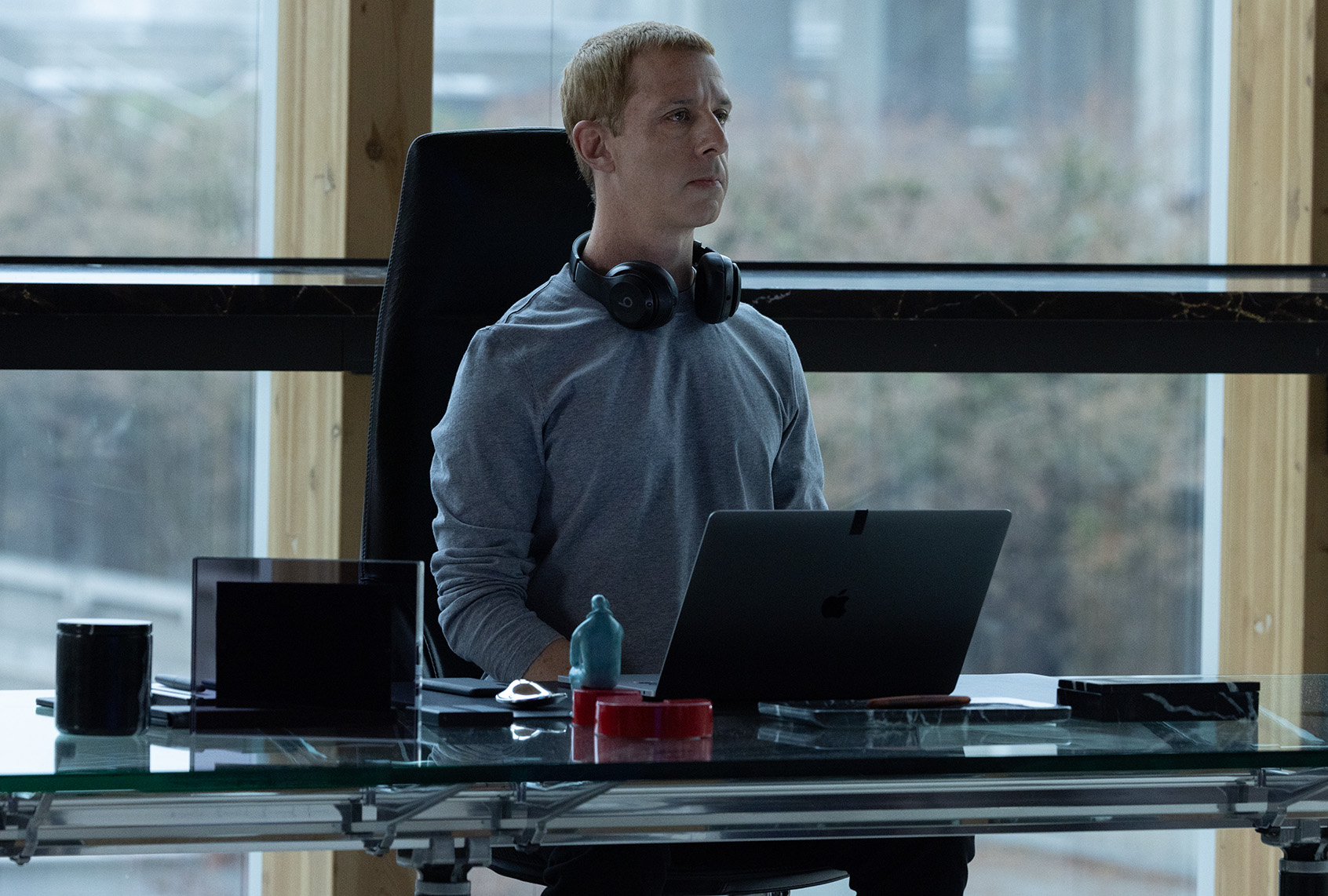
Because, really, what’s ultimately compelling about a movie peering into Facebook’s impropriety? That’s like asking someone if they know that violence is bad, or puppies are cute. The funny thing is, though, that nowadays, surveying 10 people about those questions could easily return 10 different answers, or responses rife with caveats and asterisks. That intentional confusion and misdirection is exactly what Sorkin gestures to in vignettes of Mark Zuckerberg (Jeremy Strong), intercut throughout the film, preparing for a civil hearing about Facebook refusing to fact-check political ads on its platform. Zuckerberg is a spin artist, skilled at worming his way out of trouble by tailoring the world around him to suit the beast he created. Facebook feeds a culture where up is down and left is right, and vice versa. Sorkin’s depiction of Zuckerberg as a sniveling coward might be smug, but it’s not inaccurate. The intention is not to show the audience who Zuckerberg is — Sorkin spent one film doing that already; it’s to assess the trickle-down effect of his spinelessness.
Want more from culture than just the latest trend? The Swell highlights art made to last.
Sign up here
Zuckerberg and his cronies have the upper hand. They can change things in the blink of an eye, so imperceptibly that users will barely notice a change if at all. Journalism can’t move at that pace — not good, well-sourced, fact-checked, influential journalism, that is.
To do this, Sorkin compares Facebook’s reluctance to fact-check political advertising with its enthusiasm for spinning the truth to get engagement. Naturally, these two things are the same, but their effects eventually diverge, meaning that political ads are only one metric for inciting engagement. The most frightening aspect of mining engagement — the part we might not always think about — is how the tools and algorithms designed for it must change as users age out of different platforms. How do Facebook, Instagram and all of Zuck’s other spawn remain integral parts of our lives until we die if users eventually get weary enough to figure out their existence is better off without them? For publicly traded companies like these, declining engagement results in lost value.
This is the crux of Frances and Jeff’s concerns. (And, by extension, Sorkin’s film.) They want to expose the obscure operations, to implore users to reconsider their relationship with these platforms. The problem is that Zuckerberg and his cronies have the upper hand. They can change things in the blink of an eye, so imperceptibly that users will barely notice a change if at all. Journalism can’t move at that pace — not good, well-sourced, fact-checked, influential journalism, that is. When Frances hands Jeff documents that confirm Facebook knows all about Instagram’s negative impact on teenagers, she urges him, “Get it out there, before they start marketing Instagram Kids.”
We need your help to stay independent.
The line chills not because something like Instagram Kids feels plausible, but because it’s already a reality. Impressionable people of all ages around the globe have direct access to the platforms that exacerbate rage and depression for monetary gain and immeasurable power. They had that access before “The Facebook Files,” and they have it today, years after those stories ran. So, what’s the point of all this?
I’d wager the film’s purpose is not to explain, but to appeal. “The Social Reckoning” exists to make what we already know compelling again, reminding — perhaps even convincing — viewers that journalism is not only worthwhile, but critically important. So, too, are the movies that depict journalism’s procedures and how arduous and exhausting they are. Everyone’s mileage will vary, but I find the film’s matter-of-fact formal structure more convincing than not. “Spotlight” won the best picture trophy only a decade ago. And while that film far exceeds “The Social Reckoning,” I wonder whether the reaction would be entirely the same today. Haugen and Horwitz battled similarly daunting foes, and the rot they uncovered was just as systemic and frightening as the reporting. The primary difference is that the corruption Sorkin points to is unique to the digital age, where everything is ephemeral — trumped by the next headline. Maybe, he posits, we shouldn’t forget so easily.
Read more
about thrillers that aren’t entirely what they seem
