
Celebrity

Exotic mating rituals of a tribe called Hollywood

A penetrating field study reveals the mysteries of courtship, marriage and procreation as practiced by the indigenous peoples of La-La Land.

  • more
    • All Share Services

Topics: ,

Exotic mating rituals of a tribe called Hollywood

The august anthropologist Claude Lévi-Strauss believes that the customs, traditions and myths of all cultures, no matter how bafflingly diverse, mimic the characteristics of the human mind. However disparate the details of our lives, deep down we’re all a lot more alike than we think.

Lévi-Strauss, we’re reasonably sure, has never spent much time with the members of Hollywood’s A-list. We, on the other hand, have spent the year in slavish observation of their every move, mood and utterance. And certain patterns have emerged (linking them most intimately, strangely enough, to the cruelly elitist but drop-dead gorgeous Mbaya-Guaicuru of Brazil).

Deprived of contact with other, lesser tribes and cut off from civilization by armies of publicists, agents, bodyguards and sinister husband-Svengalis, these well-insulated hill and coast dwellers have survived undisturbed in the manicured desert of Southern California for decades. The royals of the tribe enjoy disporting themselves at tournaments (also known as “awards ceremonies”) while leaving menial tasks to others. Like the Mbaya-Guaicuru, described here by Lévi-Strauss, “these kings and queens like nothing better than to play with severed heads brought back by their warriors.”

A lively scientific interest in the customs and traditions of the Hollywood A-list has also made it the most closely studied tribe on earth. And, as if in grotesque demonstration of the Heisenberg uncertainty principle, these gentle, insular peoples have become a vain peoples, a self-obsessed peoples, a peoples who need peoples — kept, naturellement, at a safe but adoring distance.

And while, as aspiring A-lister Geoffrey Rush said earlier this year, “There’s no secret establishment in the deserts of Australia where they’re turning out hunky men and beautiful women ready to invade the village of Hollywood,” the traditions of the Hollywood tribe still reflect both their tragic isolation and their fulminating conspicuousness. From their glimmering manses, they look out on the wider world with childlike wonder. They display their rank by strutting about in revealing costumes. They smile for the birdie. They can say money in 22 languages. They are often very cute.

We have spent the past year compiling an inventory of the customs of a native community and its lifestyle. Beyond this, we are powerless to interfere.

- – - – - – - – - – - -

Courting

No one is leerier of a mésalliance déclassé or, for that matter, an alliance flambé than this fierce entertainer tribe. Consequently, their social interactions have become highly structured. They can be broken down into five distinct phases:

1) The display of affection

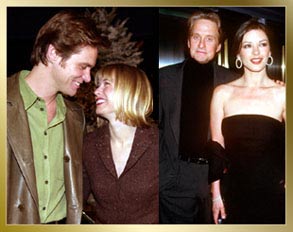
The courting process starts when two tribal members of equal rank begin to engage in furtive displays of affection, usually described as a “friendship.” (In January, Jim Carrey presented Renée Zellweger with a $200,000 Harry Winston diamond “friendship ring,” for example.) The couple generally carries out these early rituals away from the rest of the tribe (frequently while on location in Europe). This stage is sometimes known as “canoodling” and may include eye gazing, hand-holding and synchronized absences from tribal meetings (also called “premieres”). This behavior serves to announce the couple’s attachment to the community as well as to their protector, the director of their current film, and to their on-again, off-again ally/enemy, the press.

If the union is deemed favorable by the community and the press, the couple will be feted in boldface type and anointed by the tribal foot servants, the paparazzi. But as with all A-list courting rituals, the couple must carefully adhere to prescribed behavior or risk being shunned by the community. The latter was the case in this otherwise auspicious romance:

Meg Ryan and Russell Crowe “secretly” kicked off their courtship while filming “Proof of Life” in London and later took it on the road to Australia for the Olympics. While denying their romantic involvement, the pair was spotted “canoodling” on both continents, sometimes pausing in mid-display of affection to sign autographs. The union (which had big box-office potential and required Ryan to shed her longtime marriage to Dennis Quaid, who may not be long for the A-list tribe) was approved by the press and the paparazzi and seemed set to proceed to the next level.

When, however, the couple refused to appease their matchmaker, director Taylor Hackford, by using their relationship to promote the film in print interviews, he declared war. “I am deeply hurt that they couldn’t [do interviews],” Hackford said, setting in motion a wave of criticism against the transgressive couple, “and [ensuring] that ‘Proof of Life’ will probably best be known as the film that sparked a love affair between Russell Crowe and Meg Ryan.”

That the film had less heat at the box office than its leads had for each other somewhat erodes Crowe’s and Ryan’s status within the tribe.

2) The proclamation of love

Once the new couple has been embraced (read: hounded mercilessly) by the press and the paparazzi, and once the tribal chiefs have become convinced of the couple’s mutual bankability, the couple then proceeds to rechristen the “friendship” as “love.”

Catherine Zeta-Jones says she went through a “nine-month sacred love dance” with Michael Douglas before they began publicly yodeling about their affection for each other. (He even started a Web site to issue his own press releases about their relationship.)

This ritual — which includes extolling each other’s virtues ad tedium and gushing about how “lucky” they feel — is intended to both elicit envy (a tradable commodity) and signal that the love is unlike any other that ever came before. Emphasis on the mate’s “talent,” “genius,” status and/or physical beauty plays an important part in the degree of love expressed.

After going public, Zeta-Jones began saying gooey things about Douglas. Douglas returned the favor by singing his wife’s praises thus: “She’s got a great voice, and she’s a great jazz tap-dancer. One of my big thrills is to beg her to put on those shoes and do it. She’s great.”

Hinting at the startling intensity of intercourse is also looked upon favorably, as is tattooing one’s lover’s name on one’s shadowy recesses.

Angelina Jolie and Billy Bob Thornton, each of whom has been inscribed with the other’s name, describe the love feeling even more vividly.

“You know when you love someone so much you can almost kill them?” Jolie asked the world at large back in June. “We nearly kill each other … I nearly was killed last night, and it was the nicest thing anyone ever said to me.”

“I was looking at her sleep and I had to restrain myself from literally squeezing her to death,” Thornton explained, adding that sex is “almost too much” for them. “It’s so intense that sometimes we can look at each other and think, ‘You know what, we can’t get into this right now or something’s going to happen.’”

Statements such as these are considered not only acceptable but utterly charming and very salable.

Which brings us to the next phase …

3) The impulsive engagement

In between projects, the couple hurl themselves headlong into engagement, reinforcing the idea that the love in question — even if just weeks old — is unlike any other.

Stricken with testicular cancer, Canadian comic Tom Green listed his girlfriend of only three months, Drew Barrymore, as the likely recipient of his donation at a sperm bank. Not long after, the two confirmed their engagement.

The impulsive engagement nearly resulted in an impulsive on-air marriage on “Saturday Night Live,” but Barrymore impulsively backed out, intuitively sensing that exchanging vows on the show would be somehow — she wasn’t sure how — “inappropriate.”

4) The denial of engagement

News of the engagement is leaked to the press so that the couple can begin emphatic and acrimonious denials of the engagement, which call attention to the engagement, which does in fact exist. Fervent denials also serve as a reminder that the love is a fiercely guarded love like no other.

Madonna was seen wearing a ring resembling a small glacier around the time of the birth of her son, Rocco. As the ring had been given to her by the child’s father, Guy Ritchie, she immediately took umbrage at the press’ suggestion that a wedding was imminent. Ritchie had taken to referring to Madonna as “the missus,” so naturally Madonna issued a strong denial that the two intended to marry. Her denial was apparently so strong that her publicist continued to deny reports of an upcoming wedding even after Madonna herself began confirming them.

5) The clandestine wedding preparations

Once the engagement has been resoundingly denied, the couple can begin exhaustive wedding preparations while criticizing public interest in the preparations.

Exclusive pictures of the wedding may then be pre-sold to the highest-bidding glossy publication. Zeta-Jones and Douglas funded their lavish wedding extravaganza by selling exclusive images (reported to have commanded $1.4 million) from the happy day (reported to have cost $1.5 million).

(At this stage in the courtship, the engagement may still be denied.)

If the wedding itself is clandestine, the engagement may be denied even after the marriage has taken place. Representatives for Jolie insisted that not only had she not married Thornton in Las Vegas, but they weren’t even dating.

The search for the wedding site

The wedding site is of utmost importance, as it sets the tone for the way the new couple would like to be perceived. Are they “rock ‘n’ roll”? Vegas will do nicely. Are they “traditional”? A lavish hotel might be gutted, raised and rebuilt for the occasion by the set decorators of a hit show. Are they “down-to-earth”? A natural setting is preferable — Steven Spielberg’s backyard or Aaron Spelling’s bucolic private planet. If the couple want to be remembered simply as “richer and better than anyone else,” they might try the Vatican.

Although Brad Pitt and Jennifer Aniston refused to confirm their nuptials until the week they occurred, they somehow managed to put together a whopping million-dollar wedding with hundreds of guests and $20,000 worth of fireworks on the Malibu, Calif., estate of TV exec Marcy Carsey. The romantic sunset ceremony featured the Pacific Ocean as a backdrop.

Not long thereafter, speculation about the locale of Zeta-Jones’ and Michael Douglas’ nuptials occupied the British tabs for months, until they finally decided to embrace convention at New York’s Plaza Hotel. And, oddly enough, after expressing interest in Westminster Abbey, St. Paul’s Cathedral and a site near Princess Diana’s grave, Madonna and Ritchie settled on Scotland’s Skibo Castle, where Zeta-Jones and Douglas had been expected to wed.

The marriage ceremony

Preparations for the marriage ceremony begin months in advance of the event as the bride and groom and sundry servants start bringing to fruition what may be the happiest, most well-publicized time of the couple’s year.

The prenup

If the union is deemed particularly remunerative for one of the lovers, the press engages in a denunciation of the motives and/or depth of feeling of the possessor of the lesser fortune, particularly when the details of the prenuptial agreement become known.

As Zeta-Jones and Douglas prepared to consecrate their union in the eyes of God and the National Enquirer, there were rumors that Douglas had offered Zeta-Jones $1.4 million for every year she stayed married to him — in the event that they ended up divorced. Zeta-Jones had insisted on three times that amount, and a compromise was reached at $2.8 million.

But the prenup is not just a defense against a resounding future fleecing; it also formalizes (far more than the informal “engagement”) the couple’s intention to marry. It also allows the economically superior half of the couple to display his or her wealth while the economically inferior one flaunts his or her noble intentions.

Recently irritated by speculation that she was only in her relationship with Douglas for the money, Zeta-Jones asserted that “prenups are brilliant, because it’s all sorted out.”

So while attorneys hammer out the details of the post-separation dowry, the more impecunious lover often takes the opportunity to loudly praise the intended’s business acumen.

“If I were marrying someone of lesser fortune who was 25 years younger,” Zeta-Jones reasoned, “I’d be doing exactly the same thing.”

This occurs only after the more impecunious lover has been foiled in his or her attempts to raise the amount offered to an acceptable fortune.

The gathering of the tribe for the wedding feast

The wedding should draw a crowd of at least 400 of the couple’s closest business associates. Mothers may attend in the rare instances that they are not “estranged.” They may not, however, sit in the front row unless they happen to be Mike Ovitz.

It is acceptable to decline to invite “problematic” blood relatives, though if the couple is young and new to marriage, the inclusion of family is often considered quaint. Charmed guests at the Aniston-Pitt wedding remarked that “it was an emotional wedding; it was not a business thing.” The more traditional union of Madonna and Ritchie was attended by Gwyneth Paltrow, Celine Dion, Sting and Elton John, but not by Madonna’s brother Martin.

The authoring of the vows — by the couple

Not only are traditional vows a bit restrictive, but they tend to shed the spotlight on the minister, shaman or cult leader conducting the ceremony, who is rarely cuter than the couple and often drones on and on.

Young celebrity couples often use their vows as a short comedy interlude to lighten up what can sometimes be very long and overly “serious” ceremonies.

Aniston and Pitt delighted their guests with solemn promises such as “I promise to make your favorite banana milkshake” and “I promise to split the difference on the thermostat.”

The assembly then goes wild.

Pregnancy and childbirth

Public ululation about the desire for progeny is believed to aid in conception. Earlier this year, Kate Winslet expressed a wish to have three or four children, while Ben Affleck claimed to want eight. That Winslet now has one daughter, Mia, and Affleck has none does not mitigate the belief. When, despite repeated assertions by a couple that they want children desperately, conception does not occur, they explore adoption. Adoption allows the mother to be photographed in maternal attitudes immediately, without having to wait to shed the weight gained during pregnancy.

Sharon Stone was “ready for motherhood” two years ago, explaining why she and husband Phil Bronstein “make love every moment that we get a chance.” This year, the couple adopted a boy and named the child Roan, after a Celtic seal.

Denial of pregnancy

News of a pregnancy is leaked to the press, allowing the couple to indulge in emphatic and acrimonious denials. After months and months of denying rumors that she was pregnant, Madonna came forth with the news. These denials serve as a reminder that the fetus is a fiercely guarded fetus like no other fetus that ever came before. Fetus love also recharges protective instincts, and strains relationships between the A-list power brokers and the press.

“We would be grateful if the media would kindly allow us some privacy at this special time,” said Ritchie when Madonna’s pregnancy was announced. “And we thank you all for your good wishes.”

Body consciousness

Once pregnant, the female of the couple attempts to fend off weight-gain-induced panic by dwelling on increased bust size.

Kelly Preston, Zeta-Jones and others, as young, female members of the tribe, can easily become fixated on the characteristics of reproductive organs — even secondary ones.

“My husband loo-ooves it when I’m pregnant,” said Preston of John Travota, whose increase in affection for her is apparently related to her breasts becoming engorged with milk.

Childbirth

Natural delivery or childbirth assisted by anyone who is not a member of the medical profession is often seen as preferable.

Before giving birth to her daughter, Winslet declared she would decline drugs during delivery, explaining: “Giving birth is what we’re designed to do, so we should bloody well get on with it.” Winslet did, however, allow that she might call her acupuncturist for a little shot of relief.

Childbirth is seen as a new challenge for the competitive female member of the tribe. Childbirth also provides rare hands-on life experience.

“I’m stoical and have a pretty high pain threshold,” Winslet said. “I’ve had a good training for labor with some of my film roles, especially ‘Titanic.’”

Child rearing can then be handed off to qualified professionals.

Retreat and reemergence

The postnatal period is time for retreat and renewal. The female is kept sequestered until the fat comes off.

When Zeta-Jones’ intended arrived at the maternity ward with a box of chocolates in hand, she chastised Douglas for his insensitive gift choice in light of her desire to shed her pregnancy weight before their wedding. Douglas returned bearing a $25,000 diamond bracelet.

Adoptive parents may appear in public immediately, but are also required to engage in the ceremonial postpartum public display of emotion.

Postnatal public emotion

New mothers are expected to proclaim newly discovered baby love.

Winslet says motherhood has made her “squishy” and that she is now “a lot less hectic than I was. I’ve stopped smoking and I’ve become a much calmer, softer person.”

After the birth of her son, Madonna echoed Winslet. “I’m more comfortable with myself and I am different,” the Maternal One said. “It grounds you when you’re a parent. I could have spiraled into the clouds, but I look at my children and the person I love and realize this is reality.”

Members of the tribe also attempt to incorporate these new and exciting emotions into their work.

“I’m sure I’ll find it a lot easier to cry on-screen,” Winslet says.

Divorce

When a marriage lasts so long that it ceases to draw attention, one member of the couple (often the over-50 male) is obliged to cast the other member of the couple (usually the under-50 female) adrift on an ice floe with a very large sum of money.

This year, the divorce of former spouses Bruce Willis and Demi Moore became official, and Harrison Ford announced he was separating from Melissa Mathison, his wife of 17 years.

This rite of passage is often followed by denials of a relationship between the man and a much younger, much skinnier woman.

Ford denies that he is romantically linked to actress Lara Flynn Boyle, as does Willis. Flynn Boyle was formerly linked to petty chieftain Jack Nicholson, who is now romantically linked to himself.

Continue Reading Close

Even Justin Bieber has a dark side

An alleged brawl with a photographer spells no more Mister Nice Guy for the teen sensation

  • more
    • All Share Services

Topics: ,

Even Justin Bieber has a dark sideJustin Bieber (Credit: Reuters/Eric Gaillard)

When you think of Justin Bieber, the first thing that leaps to mind probably isn’t “spoiling for a fight, international fugitive.” But this weekend, the doe-eyed, blow-dried young idol startled his fans – and at least one paparazzo who underestimated him – by allegedly taking a swing at a photographer at a Calabasas shopping mall.

The lensman claims Bieber hit him as he was taking photos of the singer with his girlfriend Selena Gomez. After complaining of pain, the photographer was taken to the hospital and released shortly after. TMZ reports that witnesses say the man was blocking Bieber’s car and that after the scuffle, a person identifying himself as a lawyer approached the photographer and suggested he call an ambulance and file a police report. Sheriff’s department spokesperson Lillian Peck refused to comment on the case, but if a report has been filed, Bieber, who left the scene after the incident, would now be the subject of a police investigation.

Meanwhile, the singer has said nothing of the incident, opting instead to alert fans that he’s “OFF TO EUROPE! PHASE 1 of operation secret concerts!” The guy who spars with Mike Tyson is so tough that he doesn’t even acknowledge his alleged brawls.

It must be a particularly pugilistic time of year. Earlier this month, Will Smith slapped a Ukrainian television journalist who tried to kiss him at the Russian premiere of “Men in Black III.” Smith then told the crowd, “He’s lucky I didn’t sucker-punch him.”

Whatever went down, neither Bieber nor Smith are the first celebrities to get into it with an invasive press. Three years ago James Gandolfini hit a man who was videotaping him shopping in New York City. And Sean Penn has a long and storied history of mixing it up with the paparazzi – mostly recently in 2009, when he pleaded no contest to vandalism after allegedly “kicking and punching” photographer Jordan Dawes.

Whenever a celebrity loses his cool with a reporter or photographer, the story inevitably turns into an occasion for getting judgmental about both sides. You don’t have to look far in the comments of any article on the Bieber story to see a range of self-righteous responses — disgust at the invasiveness of the photographer, incredulity that the seemingly mild-mannered J.B. could take anybody on, the inevitable disdain for a famous person who dares to erupt in anger.

The fact that it’s Bieber makes the story so unique. It’s a reminder that everyone – even guys with soccer-mom hairstyles and Disney princess girlfriends – has their breaking point. It’s one thing when Nic Cage goes ballistic. What else is new? But there’s an assumption that nice guys like Will Smith and Justin Bieber never lose their cool. That they exist to blandly take whatever invades their orbit with the unflappable grace of Ryan Seacrest getting ashes tossed on him at the Oscars. Yet in an era of long lenses and the easy assumption that everyone in the public eye is fair game to be touched, to be thwarted in their movements, to have their privacy violated, it might be helpful for the gossipmongers and ambulance chasers alike to remember that everyone has a dark side. And that someday, Betty White just might haul off and belt you.

Continue Reading Close
Mary Elizabeth Williams

Mary Elizabeth Williams is a staff writer for Salon and the author of "Gimme Shelter: My Three Years Searching for the American Dream." Follow her on Twitter: @embeedub.

Travolta’s florid lawsuit

A sexual assault claim against the star is one of the most spectacular legal documents in ages

  • more
    • All Share Services

Topics: ,

Travolta's florid lawsuitJohn Travolta (Credit: Reuters/Thomas Peter)

On the spectrum of Hollywood bombshells, the news Monday that John Travolta has been slapped with a lawsuit involving an alleged gay sexual overture ranks about as shocking as Lindsay Lohan getting picked up for violating parole. Whether or not the allegations can be proven true, the suit is just the most public acknowledgment of rumors that have floated around Travolta for years. So persistent and pervasive are the stories about his proclivities that back in 2009, Carrie Fisher famously boasted that “We don’t really care that John Travolta is gay.” But it turns out the most surprising thing about the whole dust-up is how fantastic a document the lawsuit itself is.

In the $2 million suit, an unnamed massage therapist alleges that back in January, he was summoned by the actor to a bungalow at a Beverly Hills hotel. The Plaintiff says Travolta attempted to touch him, touched himself and when the plaintiff made it clear the massage was not the happy ending variety, became verbally abusive. Travolta has already shot back with a countersuit and a statement, via his representative, that “None of the events claimed in the suit ever occurred. The Plaintiff, who refuses to give their name, knows that the suit is a baseless lie. It is for that reason that the Plaintiff hasn’t been identified with a name even though it is required to do so. On the date when Plaintiff claims John met him, John was not in California and it can be proved that he was on the East Coast. Plaintiff’s attorney has filed this suit to try and get his 15 minutes of fame. John intends to get this case thrown out and then he will sue the attorney and Plaintiff for malicious prosecution.” We may never know whether the Plaintiff, known only as “Joe Doe,” is the victim of harassment or a guy trying to cash in on decades of innuendo, but one thing is certain – his lawyers write a hell of a lawsuit.

We open on the night of Jan. 16. Beverly Hills. An “unidentified male” calls the Plaintiff’s cellphone and says he has a “celebrity client who [demands] full confidentiality,” and directs him to a location where the client will pick him up. Plaintiff  “states that to his amazement, Defendant himself” appears, “wearing dark glasses, jeans with a very loose fitting athletic shirt and chronograph silver watch. There were Trojan condoms in the console of the vehicle, and there also appeared to be two or three wrappers from chocolate cake packages.” The chocolate cake packages are a nice touch, don’t you think?

The scene then moves to the hotel bungalow, where “there was an overweight black man preparing hamburgers …. From watching his skill and dexterity in food preparation, it seemed he was some sort of professional chef.”

Here’s where it gets interesting. The Defendant “shamelessly stripped naked in front of the Plaintiff, and the ‘chef’ was gazing at Plaintiff as he appeared to be semi-erect.” Over the course of the massage, the client “kept purposefully sliding the towel down that covered his buttocks to reveal about half of the gluteus area.” Soon, Travolta is trying to touch the Plaintiff’s scrotum, and snickering “to himself like a mischievous child.” When the Plaintiff refuses, Travolta allegedly offers, “Come on dude, I’ll jerk you off!!!” Three exclamation points.

But after promising to behave, and assuring the Plaintiff that “his predatory behavior was finally under control,” he begins masturbating. “Defendant’s penis was fully erect, and was roughly 8 inches in length, and his pubic hair was wirey [sic] and unkempt.” He then “lumbered to his feet and began to move toward Plaintiff with erect penis bouncing around with its stride.”

From this point, the narrative turns even more disturbing and pathetic. The Plaintiff claims Travolta became erratic, telling him “that Hollywood is controlled by homosexual Jewish men who expect favors in return for sexual activity. Defendant went on to say how he had done things in his past that would make most people throw up.” He then allegedly says he “knew a Hollywood starlet in the building that wanted three way sex and to be double penetrated.” When the Plaintiff refuses again, Travolta allegedly drops the matter and takes him back to their original meeting point, calling him “selfish” and “a loser” and paying him double the original asking price for their encounter.

It’s a sad, tawdry story, one that is nothing if not vivid. It will likely come down to one person’s word against another’s, with little satisfying result for any of the parties. But it is also one of the most strangely written documents to come along in ages, a dark tale short of evidence but long on exclamation points and editorializing about the Defendant’s “mischievous,” “lumbering” behavior. As proof of anything that transpired, it may not stand up. As the most vividly written thing since “Fifty Shades of Grey,” however, it’s just begging to become a movie.

Continue Reading Close
Mary Elizabeth Williams

Mary Elizabeth Williams is a staff writer for Salon and the author of "Gimme Shelter: My Three Years Searching for the American Dream." Follow her on Twitter: @embeedub.

When Lindsay Lohan moved in

The actress turned my Venice Beach neighborhood into a media circus, but also brought us all together in a new way

  • more
    • All Share Services

Topics: , , ,

When Lindsay Lohan moved inAmid a stream of confetti, Lindsay Lohan arrives at court in Beverly Hills, Calif., on July 20, 2010. (Credit: AP/Jason Redmond)

When Lindsay Lohan moved two doors down from me last year, I had briefly fantasized about some sort of feel-good neighborly encounter between us. This happened on the night when I spotted the first of many satellite vans that would defiantly park in the red zone in front of my house. The van, coupled with the all-male paparazzi contingent prowling the alley behind my garage with an abundance of video equipment, provided me with a fresh understanding of what it means to live under siege.

And so, hunkered down inside my house, I had imagined the following scenario: The actress, fleeing down the alley from these men and unable to enter her own home, would accept my offer of temporary shelter. I’d quickly usher her into my living room where I’d offer her a non-alcoholic beverage. My cats, who normally hate strangers, would allow her to pet them and she would feel inspired to reveal some shard of a more authentic self that existed beneath her celebrity train wreck veneer. She would confide her secret fears, gripes and vulnerabilities and I would nod with empathy.

My ability to just listen to her, to treat her like any other human being, would move her to tears. She would confess that she had never met anyone like me since becoming famous, someone who could just interact with her without any other agenda other than offering assistance. I would modestly dismiss this compliment yet secretly bask in a newfound sense of warm and fuzzy altruism. We would hug goodbye, and I would proceed to tell friends and family: Wow, Lindsay is so down-to-earth! The media has her wrong!

A year later, the actress has fled my neighborhood and I never once spoke to her. I never rescued her from the paparazzi hordes. I never knocked on her door bearing a homemade fruit pie. And I never found out whether discrepancies existed between the LiLo of the tabloids and the young, often harried-looking woman who darted in and out of her garage as if she were a soldier en route from the minefield to the relative safety of the barracks.

Instead, my year-long experience as the actress’ nearly next-door neighbor can be summed up in three missed opportunities for potentially friendly interaction, all of which occurred in the alley behind our houses.

Missed opportunity No. 1: While taking out my trash, I spotted her engaged in the identical task. It was a Sunday afternoon and we both had our hair in ponytails and wore sweat pants and T-shirts. Our sartorial similarities made her seem all that more approachable. Be neighborly, I told myself. Go over there and say hello! Tell her you don’t really believe she shoplifted that necklace. But before I could act, she had disappeared into her garage. After that, I only saw her assistants take out the garbage, along with the many strangers who combed through it.

Missed opportunity No. 2: Driving my car one day, I almost ran her over. She had been speed-walking down a sidewalk that intersected the alley, and I had to brake hard to avoid a collision. I raised my hand in apology, and she gave me an uninterested glance before walking onward. Up close, I could see the roots of her bleached blond hair, and she looked tired, fragile and older than her 25 years. After that, I couldn’t help feeling sorry for her despite my increasing resentment that she had transformed my street into a media circus and necessary tourist detour from the nearby Venice Beach boardwalk.

Missed opportunity No. 3: My husband and I had just wheeled our bikes outside for a morning ride and could not help noticing the actress’s black Cadillac Escalade idling in front of our garage. So we stood there with our bikes and waited until she emerged from her own garage. We pretended not to watch her get into her vehicle and she pretended that we didn’t exist.

Recently, I told my sister that I had never met my famous former neighbor. She was shocked and not because she took me for a celebrity brown-noser. Rather, she lives in a New Jersey town where to be a good neighbor means to interact with the people who live among you. “I can’t imagine not knowing my neighbors,” she said.

I, on the other hand, have lived my entire adult life in either New York City or Los Angeles, in apartment buildings and on streets where most of my neighbors remained nameless if recognizable strangers. For the most part, I’ve lived in places that bear not even the slightest traces of the era where people traded gossip over clothing lines and knew when to knock on each other’s doors bearing cakes and casseroles. Today, I know much more about the lives of remote acquaintances who frequently post on Facebook than I do about the people who physically inhabit my street.

Of course, my neighbors and I knew plenty about the actress in our midst, no matter that she had installed a bamboo fence to obscure her roof deck. So when we did run into each other, we finally had a common topic of conversation to which we could collectively shake our heads and say things equal parts blasé and judgmental like: There goes the neighborhood. We could say these things with authority, because even though we couldn’t see beyond our neighbor’s bamboo fence, someone else could, since we could get online updates on the actress’ troubled life from dozens of celebrity news sites. Thanks to the actress in our midst, we now had a reason to gather on a street where privacy and anonymity generally trumped interaction. And we could mock her with impunity. Hadn’t the tabloids made it clear that she deserved it?

In truth, my fantasy of rescuing and bonding with the actress didn’t stem from a desire to be a good neighbor but from my own conflicted relationship with celebrity. As the actress’ year on my block progressed and people camped out on beach chairs hoping for Lindsay sightings, I had to ask myself whether I was any different from those interloping looky-loos I wanted off my street. Because while I might have physically avoided the actress all those months, giving her the privacy she seemed to desperately need, I also sucked up all the tabloid information on her I could in the name of wanting to know what was happening two doors down.

When meeting new people at parties, I could mention my famous neighbor and, boom, we’d have something to talk about for at least the next 10 minutes. I could feel special when friends told me they just spotted a fraction of my house in some TMZ photo that mostly depicted the side-by-side townhouses of the actress and on-again, off-again flame Samantha Ronson. My physical proximity to the actress made me interesting to other people and so I mattered in a way that could only apply in a world obsessed by celebrity and inundated by the public gossip of Internet tabloid culture.

A few months ago, I noticed the actress’ overflowing mailbox, much of its contents soggy from rain. So I did what I always did whenever I saw a crowd amass on the sidewalk in front of my house or spotted more than one news van parked across the street. I consulted TMZ and E! Online to help make sense of what I saw, and I learned, along with the rest of the world, that the actress, fed up with all the gawkers and stalkers, had evacuated Venice Beach for the Chateau Marmont.

Several days later, I watched two moving trucks cart away her belongings and observed her assistants darting in and out of her townhouse on last-ditch errands. Afterward, I went online to read more articles about the actress’s departure featuring anonymous quotes from my “rejoicing” neighbors who basically pronounced the nightmare over. The anonymous neighbors said other mean things about the actress that made me briefly resurrect my fantasy of rescuing her from peril. And then I said goodbye to the actress from a distance, in very much the same way I had not exactly welcomed her to the neighborhood.

Continue Reading Close

Susan Josephs is a Los Angeles-based writer. She frequently writes about dance for the Los Angeles Times and is at work on a new play.

Ryan Seacrest’s bland ambition

He's an asexual icon for traditional cultural conservatism, boring his way into the hearts of millions

  • more
    • All Share Services

Topics: ,

Ryan Seacrest's bland ambition (Credit: Fox/Benjamin Wheelock)

Imagine, for a moment, that Dick Clark had died in 2002 instead of 2012. How would his obituaries have been different? In most ways, there would have been little change. In the last decade, Clark has continued with the ventures he’d been known for, hosting and producing a New Year’s Eve broadcast, various radio programs, game shows and TV specials. But there would have been two big differences. The first thing was Clark’s 2004 stroke, and his courageous return to public life despite a speech impediment modulating his famous voice.

And the second? The second is Ryan Seacrest.

Seacrest appears in Clark’s obits like the Boswell to Clark’s Samuel Johnson, quoted instead of family members as the apparent authority on Clark’s life and legacy. His tribute to Clark on “Idol” the night after his death became a news story in and of itself. For years, Seacrest had been slowly positioning himself as the new Dick Clark, taking over as the host of the New Year’s broadcast when Clark was ill, and modeling his career after Clark’s by taking ownership stakes in radio shows and TV ventures. Seacrest has become so entwined with Clark’s story that when news of the death broke, it was hard not to picture Seacrest kneeling in some dark rite, screaming to the heavens as Clark’s power possessed him, “Highlander”-style.

The problem with this image is that it’s far too interesting to have anything to do with Ryan Seacrest, a man who has made a career out of being professionally boring. If we’re going with a sci-fi reference, it’s easier to think of him like the bureaucrats in “Brazil,” toiling away in some back office, looking up briefly as an intern arrives to tell him the news, nodding curtly, shedding a single tear, and immediately returning to work. (During his tribute on “Idol,” he said that Clark was “in a better place saying, ‘Hey, let’s get on with the show, OK?’”) Seacrest is not someone who does dramatic things in fields. He is a person who stands in places of no place and intones blank words like a priest performing some long-deprecated rite. And he’s been very, very successful at it.

Seacrest’s extraordinary rise, so counter to the prevailing trends of the time, points to a current of artistic and social conservatism in the mass audience that persists despite the relentlessly progressive story we like to tell ourselves about the march of culture.

Like Clark, Seacrest got his start in radio. Clark’s early jobs were in an industry where local was king, getting spots at small-bore stations in upstate New York and only going national when “Bandstand” was picked up for TV distribution. Seacrest, however, came to radio just as it was being deregulated and local stations were being eliminated in favor of national conglomerates like ClearChannel. As such, he was able to move to Los Angeles and, at the age of 20, take over a morning radio show that became nationally syndicated. He followed that up with his own form of conglomeration, taking over the weekly “American Top 40″ from Casey Kasem in 2004, and launching his own new programming ventures, like “On Air With Ryan Seacrest,” a four-hour block he records daily and which is distributed to more than 150 stations nationwide.

But his big break was “Idol.” Premiering in 2002, it at first seemed an unlikely phenomenon. Why would anyone want to watch a “Star Search” where the contestants didn’t change? The country did not lack for pop stars, after all: Between “Total Request Live” and Radio Disney we were experiencing something of a bumper crop in those years. The success of “Idol” speaks to both the unalloyed effectiveness of its format and something deep in the national mood at that moment. Bathed in post-millennial anxiety, and eager as always to avoid discussing the possible causes of and responses to a national tragedy, “Idol” seemed to reflect our best selves. It was meritocratic (the best will win, regardless of their social position), individualistic (only single singers, no messy bands), populist (the people vote), and aggressively cheerful.

Key to that success was Seacrest. The judges represented the business aspect of the transaction, the reward at the end. The voters were America, of course. But Ryan was the Idol. For struggling amateurs, he was the end product they were training for, smooth, professional and unchallenged, a perfect pop product encased in a suit. While the contestants’ images varied, Seacrest’s presence on stage was a constant reminder of what the producers had in mind when they talked about a pop star.

There have long been rumors that Seacrest is gay. It’s hard to know what to do with these, exactly, but there is something undeniably unsettling about his sexuality. The image he projects is that of a non-threatening teenage boy, a pre-pubescent heartthrob like Ricky Nelson, David Cassidy or Justin Bieber. But Seacrest, who has dated Teri Hatcher and Sheryl Crow, is decidedly post-pubescent. He is, as they say, a grown man. Merv Griffin, who hired him to host a children’s computer-themed quiz show called “Click!” in the mid-’90s, said that “he had this spiky haircut, and we knew all the little girls in the audience would love him, and they did.” And they do. And he doesn’t care. Which is, maybe, a big point in his favor.

But it’s a point against the audience. All teen idols grow up, and as moral panicky as the process can be (“I’m Not a Girl,” etc.), we’ve seen it happen enough times now to know that part of the pleasure of a non-threatening teenager is knowing the threat they will inevitably become; Justin Bieber is fascinating because we want to see how it all spirals down. For Seacrest to stay in that neuter state reflects a childish, eyes-closed denial of reality among those audience members who still like it. The last decade has seen a remarkable opening of public discourse about all kinds of sex; currently the news media is tirelessly (and tiresomely) covering a story that basically amounts to “Hey, some people like bondage!” Adult sexuality is at least an option for our public conversations now, and lots of openly gay celebrities have remained idols in their own way, able to publicly pursue relationships without having to maintain the facade of blank sexlessness. But if Seacrest, the Delphonic seer of conventional wisdom, is in fact gay (or sexual at all) and truly thinks breaking face would kill his career, then maybe he’s right. For all the recent gains we’ve made, there’s a sizable portion of our fellow citizens who would much rather have Ricky Schroder stay a boy. Whether you want to have Seacrest or be him, he is selling the troubling fantasy that desire doesn’t have to be dirty.

Throughout a decade in which celebrity scandals were everywhere, Seacrest himself remained steadfastly above the fray. The scandal boom was great for entertainment news, but unstable workers are bad for the entertainment business. Scandal-plagued actors may get more publicity, but they make it a lot harder for a production to get insured, and the harder it is for the talent to hit their marks, the longer it takes to make the product. You never had to worry about that with Seacrest. A tireless worker and consummate professional, a morality clause would just be superfluous for any contract you might want to strike with him. In a decade of turmoil, Seacrest was the rock, the thing you could always depend on.

But since when has good TV been about dependability? The fun of watching “Idol” is its anarchy, whether it’s Paula’s looseness and Simon’s free-form contempt, an unknown amateur maturing into a star or flaming out under pressure, or the direction of each season, which producers, for all their tinkering, ultimately leave in the hands of the audience. “Idol,” at its best, is a show that can genuinely surprise everyone. In the midst of that glorious chaos, Seacrest stands apart, a stable center. His ability to parlay that personality into lucrative positions on other shows indicates that stability is what a certain portion of the audience wants. And that’s worrisome.

During an authoritarian period in American politics, culture was the lone bright spot. It seemed to be rapidly democratizing: corporate conglomerates were failing, user-generated content was everywhere, and even highly controlled mediums like TV were expanding their offerings to become far more adventurous. But no shift brings everyone along with it, and as easy as it now is to find people who like “Mad Men,” cultural progressives are haunted by fears about what everyone else is watching. Maybe, like Glenn Beck said, we really are surrounded; certainly a lot of people seemed to watch “Two and a Half Men.” Seacrest is like your square brother who went into banking: His success makes you wonder if the cultural power you feel when you’re with your people is really all that strong. Despite the fact that Ryan Seacrest has never done anything even slightly objectionable, people hate Ryan Seacrest. And that’s why.

“Idol” has, inevitably, begun to wane in influence and audience. As the paying audience for pop music massively declined during the ’00s, “Idol” had been able to stay ahead of the curve by making it about competition and narrative rather than music. But that audience had broken down too, splintered into niches by the expanding array of entertainment options. This should have spelled doom for Seacrest, eternally a mass-market guy. But he saw it coming, saw that the family-friendly audience he served would soon just become one market among many, and formed Ryan Seacrest Productions in 2006. His major hits so far have all involved the Kardashians, but he just signed a big new deal with Comcast, and more could be on the way.

If Dick Clark is an eternal teenager trapped in a ‘50s image of adolescence, Seacrest is a teenager from 2002 who’s persisted across time, simultaneously trying to please parents and safely experience more sensual pleasures from the standpoint of a moment when America had a serious interest in being pure and virginal. He’s achieved this by splitting his personality across business ventures, appearing as a squeaky-clean host on TV and radio while using his production company to push delightfully trashy reality fare like “Keeping Up With the Kardashians.” When we look at Ryan Seacrest, we see innocence; when we look at Ryan Seacrest’s productions, we see naughtiness framed as a secondhand experience. A man so averse to scandal that he takes pains to present himself as asexual, Seacrest is one of the few remaining examples of television’s “Least Objectionable Programming” doctrine, a remnant of the era of mass audiences. His particular evil genius has been to recognize that you can do just this but for every audience. Give the family hour what it wants, give the late-night gossipers what they want, and keep it all firmly separate with plausible deniability.

Continue Reading Close

Michael Barthel is a PhD candidate in the communication department at the University of Washington. He has written about pop music for the Awl, Idolator, and the Village Voice.

Hollywood’s new era of ensemble

The power posse of "Friends With Kids" proves there's strength in numbers VIDEO

  • more
    • All Share Services

Topics: ,

Hollywood's new era of ensembleAdam Scott and Jennifer Westfeldt in "Friends with Kids"

We are living in a cinematic golden age. Exhibit A: that new Megan Fox movie.

The history of film is strewn with enterprising multi-hyphenates who knew how to rock a repertory. Orson Welles had pulled together a formidable troupe of regulars by the time he’d barely cut his wisdom teeth. Fellini and Hitchcock were known for their stock companies of familiar faces. But in recent years, strengthened by the talent pools of ensembles like the Groundlings and Upright Citizens Brigade, the power posse has become the norm — and it’s changing movies and television for the better.

Ten years ago, Jennifer Westfeldt co-wrote and played the title character in the entertaining little bi-curious romance “Kissing Jessica Stein.” Now she’s the writer, director and producer of one of the better anticipated movies of the spring – the reproductive comedy “Friends with Kids” — with a cast that includes the ubiquitous Adam Scott, Kristen Wiig, Maya Rudolph and Chris O’Dowd, as well as the aforementioned chick from those “Transformers” movies. It certainly sweetens Westfeldt’s marquee appeal that her partner – and a co-star of the film — is none other than Don Draper himself, Jon Hamm. But what will likely draw butts into theaters for “Friends with Kids” isn’t one star in particular, but the sum of its comic pieces. We’ve already seen Wiig, Rudolph, and Hamm score with “Bridesmaids.” Scott’s a reliably funny presence on the often pitch-perfect “Parks and Recreation,” and has shown his ensemble chops in “Our Idiot Brother” (with fellow workhorses Elizabeth Banks and Paul Rudd) and in memorable bits for the biggest, loosest comedy troupe in the world right now – Funny or Die.

For over a decade now, the likes of Judd Apatow and Will Ferrell have been paving a new kind of path – and along the way have changed the way both veterans like Ben Stiller and younger guys like Seth Rogen and it girl Kristen Wiig have shaped their careers. Think of it as the visionary-as-clown – the person who can whip up a diarrhea joke and direct and produce and do a guest stint on “Saturday Night Live” — and maybe wind up with a few Oscar nominations along the way.

What they – and now Westfeldt — have in common is the apparent great talent for playing well with others. She’s not Angelina Jolie, carrying blockbusters on her shoulders. She’s not Robert Downey Jr., cranking out “Iron Man” and “Sherlock Holmes” sequels. She’s more Robert Downey Jr. cutting loose in “Tropic Thunder.” But what a movie like “Friends with Kids” represents isn’t just an entrepreneurial spirit that’s becoming more and more the norm, but a truly formidable contemporary pool of talent. Anybody can get together a bunch of buddies to make a movie. But to watch actors like Scott or Rudolph or Wiig within the same frame is to see performers who at this point now have a lengthy history in and out of each other’s careers. Jon Hamm and Ellie Kemper didn’t just make “Bridesmaids” together – Hamm was one of Kemper’s high school drama teachers.

No wonder these actors know how to play off each other in a way that just seems to get funnier and more natural all the time. No wonder they move gracefully between acting and directing and writing for each other. And no wonder audiences are responding – comedy may rely heavily on self-deprecation, but there’s an extra refreshing lack of ego in the generous way these stars continue to grace each other’s work. Not everything they touch is brilliant, of course. (“Notes from the Underbelly”? Meh.) But the way they drop in on each other’s television shows, pop up suddenly together in a Funny or Die clip, represents the best of the “Let’s put on a show” spirit. It’s a star system where the star is eclipsed by the constellation. And one in which the words “Friends” in a movies title seems, happily, like truth in advertising.

Continue Reading Close
Mary Elizabeth Williams

Mary Elizabeth Williams is a staff writer for Salon and the author of "Gimme Shelter: My Three Years Searching for the American Dream." Follow her on Twitter: @embeedub.

Page 1 of 182 in Celebrity