
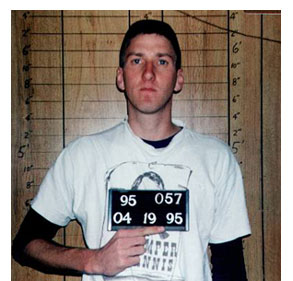

“Who is Timothy McVeigh?” This question opens “American Terrorist: Timothy McVeigh and the Oklahoma City Bombing,” by two Buffalo News reporters, Lou Michel and Dan Herbeck. Their heavily promoted new book, based on years of research into the case and more than 75 hours of interviews with McVeigh himself, provides the answer we already knew: He is a quintessential product of America’s right-wing subculture of hatred. The only surprising thing about “American Terrorist” is that there is nothing surprising in it: McVeigh is exactly the person we all figured he was.
It is a familiar type. There are thousands, perhaps hundreds of thousands, of Americans who hold beliefs identical to McVeigh’s. He is a prototypical extreme-right zealot: He hates and fears the federal government, worships guns, fetishizes “liberty” (defined in almost purely negative terms, as freedom from external interference of any kind), embraces survivalism and sees himself as having acted in a proud American tradition of resistance to tyranny that goes back to the Founders. Throw in belief in the gold standard, certainty that a U.N.-run “New World Order” is poised to take over the world, racial resentment and an obsessive fixation on Ruby Ridge and Waco as proof that federal agents are jackbooted thugs waiting to make their final move, and the all-too-familiar portrait is complete.
This belief system is not confined to the fringes of American society. It has deep roots in the American psyche. What historian David H. Bennett calls “the party of fear” recurs in many related forms throughout our history, from nativist, anti-foreigner fraternities like the Know-Nothings to the Ku Klux Klan, Father Coughlin’s anti-Semitic radio broadcasts, McCarthyism, the John Birch Society, the Moral Majority and Christian Identity. People who subscribe to such views are to be found at gun shows and NRA rallies, in militia groups, on government-bashing Internet forums, in radical anti-abortion groups, at anti-tax rallies, at Klan rallies and holed up in survivalist cabins in the West. They devour “The Turner Diaries” and “The Protocols of the Elders of Zion” and Tom Clancy novels, listen to Jerry Falwell and Pat Robertson and Rush Limbaugh and the hundreds of resentment-spewing right-wing radio ranters all over the country. They avidly read Matt Drudge and fire off angry, often obscenity-filled e-tirades to liberal Web sites, sometimes boasting ominously that “our side has the guns.” And, of course, in a more toned-down, respectable form, most of McVeigh’s beliefs are shared by the activist core of the Republican Party.
There is a common ideological thread that runs from Timothy McVeigh to bedrock Republicanism, and the shared emotional leitmotif of that ideology is anger. What distinguishes America’s worst domestic terrorist from Newt Gingrich, Tom DeLay and George W. Bush is the intensity of that anger. McVeigh and his fellow extremists burn with rage, are consumed and obsessed by it. They are the pathological white-hot center of the right wing. Radiating out from that center, next come the extreme conservatives, the rabid Clinton-haters and Bible-thumping doomsayers, the angry zealots for whom business-as-usual Republicanism is too moderate — the group normally thought of as the true-believer Republican “base.” After this suburb, you cross the city limits into mainstream conservative territory — and the distinction between the city and the suburb is pretty blurred.
Of course, the critical point is that none of those thousands or tens of thousands of Americans who share McVeigh’s rage and radical beliefs — and those millions who share his general anti-government philosophy — drove a Ryder truck loaded with 7,000 pounds of explosives to the Murrah Federal Building in Oklahoma City and blew it up, killing 168 men, women and children. Timothy McVeigh did. Hence the question that inescapably hangs over every sentence of this book: Why? What made this particular man, who will be executed in a little over a month, commit the worst act of domestic terrorism in American history?
Reading this book provokes two opposite responses. The first is that we’ll never know. No one can unlock a human heart, can fathom why a certain person decides to kill.
The second is that we know for certain why he did it. He was the perfect candidate. He led the perfect life. It all adds up.
Both responses are valid. At some ultimate level, McVeigh’s hideous deed remains shrouded in existential darkness. But at a more practical level, it seems completely natural, utterly comprehensible, that this man in particular did it. McVeigh’s deed was ignited by his life experience and beliefs as inevitably as a bomb is set off by a lit fuse.
One thing is disturbingly clear: Whatever else he is, Timothy McVeigh is not insane. A psychiatrist, Dr. John R. Smith, who examined him when he was in prison concluded that he was not delusional, or even evil. “Clinically, he saw him as an essentially decent person who had allowed rage to build up inside him to the point that he had lashed out in one terrible, violent act. ‘I’ve seen it many times,’ Smith maintains. ‘Nice people do really terrible things.'” This evaluation jibes with the portrait of McVeigh that emerges from “American Terrorist.” Obsessive, fanatical, single-minded, cold-blooded and very, very angry, yes. Insane, no.
Before turning to the substance of Michel and Herbeck’s book, one thing should be noted: There is absolutely nothing objectionable about it or its publication. Many of the victims of the bombing are outraged by the fact that the authors, by publishing a book based in part on interviews with McVeigh, gave the mass murderer a forum for his views; they believe that the book is exploitative and its profits blood money. Some have called for a boycott. Apparently yielding to pressure, Wal-Mart, the world’s largest retailer, announced on April 5 that it would not carry “American Terrorist.”
All of these charges are baseless, and Wal-Mart’s decision to drop the book is cowardly and outrageous. While the sensitivity of the victims’ relatives and friends is understandable, there is nothing exploitative about this book. McVeigh committed the worst terrorist crime, and after Jonestown the second-worst act of violence, in American history: Anything he says is by definition newsworthy. Michel and Herbeck present McVeigh’s point of view, as it is their responsibility as journalists to do, but they don’t regurgitate it uncritically. The portrait of McVeigh that emerges is of a zealot, still convinced he was right, without remorse, who sees his deed as an act of revolutionary violence and has a highly developed rationalization for why it was necessary. This is information that we are all better off having.
Immediately after the bombing, most authorities and many Americans believed that a Middle Eastern terrorist group was responsible. But an FBI agent named Clinton R. Van Zandt, who had been the bureau’s main negotiator at Waco, had a better idea. Van Zandt recognized the significance of the date of the bombing — April 19, the anniversary of the fiery conclusion of the siege. “You’re going to have a white male, acting alone, or with one other person,” Michel and Herbeck quote Van Zandt as saying. “He’ll be in his mid-twenties. He’ll have military experience and be a fringe member of some militia group. He’ll be angry at the government for what happened at Ruby Ridge and Waco.”
Van Zandt was right on every particular. And if he had added that the white male came from a fractured and emotionally sterile family, had read “The Turner Diaries,” was a gun nut and a survivalist, had no girlfriend and a dead-end, low-paying job, his portrait would have been even more accurate.
But if just about every detail of Timothy McVeigh’s life is exactly what you would expect if you were trying to imagine the biography of an extreme-right-wing terrorist, his mind and personality is another matter. It isn’t easy to be certain that the authors have really captured McVeigh, or for that matter any of their characters. Michel and Herbeck are solid just-the-facts-ma’am newspaper reporters, with about the level of literary sophistication and analytical power generally found among daily reporters. In some ways this is a good thing: They don’t muddy the waters with any highfalutin speculations or psychoanalyzing, and they don’t let their own egos or literary ambitions get in the way. But though they’ve assembled all the facts, their limited ability to synthesize them, to put them together into a compelling psychological portrait, prevent any of their characters from really coming to life. Nor do they evaluate the sincerity or lack thereof of any of McVeigh’s statements: If he is a con, they don’t tip the reader off. Still, by the end of the book you feel like you’ve been given enough information to fill in most of the psychological blanks yourself. And it really isn’t a very complicated story.
Four things in McVeigh’s biography stand out — any one of which, if changed, would probably have prevented the catastrophe from occurring. Those four are his relations with his family, his right-wing ideology, his military experience and the Waco siege.
McVeigh’s home life was rather sad and sterile. McVeigh’s father, Bill, as portrayed by Michel and Herbeck, is almost a caricature of a repressed American dad: a decent but emotionally distant man, a hard-working provider who was incapable of relating in any demonstrative way with his family. McVeigh’s mother, Mickey, had a completely different personality type, but she was no more successful at establishing a bond with her son: an outgoing beauty, she came to feel increasingly bored and stifled by her marriage. When they separated, the parents let the three children decide which parent they wanted to live with: The two daughters (13 and 5 at the time) decided to stay together and chose their mother, but 11-year-old Timothy chose his father, saying, “I don’t want Dad to be alone.”
The authors don’t go into this, but the separation and its aftermath must have inflicted a double wound on Timothy: He was not only cut off from his mother, but from his two sisters. (Not to mention the trauma of the choice itself: being forced to make such a decision, which the 11-year-old McVeigh must have viewed as betraying his mom, could not have been easy.) Little Tim was left with his dad, whose long hours at the Lockport, N.Y., General Motors radiator factory meant that he was rarely around. When he was around, he didn’t connect with Tim. In an emblematic anecdote, the authors relate how Bill tried to make his son into a softball player, but scared and humiliated him by throwing the ball at him too fast.
McVeigh later denied that his mother’s departure hurt him that much, although his father believes it did — as did McVeigh’s first and only girlfriend, who sensed his anger towards her. In 1992, after leaving the military, McVeigh denounced his mother to a woman he was interested in, calling her a “whore” and a “bitch.” But to the authors, his criticisms were much more muted: “The real problem, he said, was that he never really felt that close to his parents in the first place. He wished they spent less time at work and more time with him and his sisters.” The authors quote him as saying “I have very few memories of interactions with my parents.”
McVeigh did have a close relationship with one person: His paternal grandfather. But that relationship, infrequent after McVeigh’s youth, seems not to have been enough to warm his soul. McVeigh was certainly capable of friendship and loyalty (after his arrest, he forgave his old friend and semi-conspirator Michael Fortier for testifying against him), and there are occasional stories throughout the book that reveal that he could be both generous and caring. But the overwhelming sense is of an icily angry young man who could increasingly turn his emotions off entirely, becoming a virtual zombie — a person who never cared about any other human being enough, or felt he was cared about enough, to develop any real feeling for others.
How much one should blame his parents for this it’s impossible to say. McVeigh himself refuses to do so, telling the authors, “I am not looking in any way, shape or form to blame anything on my parents or my upbringing. All in all, from birth to age eighteen, I emerged pretty much a functional person in the real world, and that’s all that counts.”
McVeigh’s failures with women did not make things better. In the Army, he relied on a no-frills seduction line: “Okay, we’ve just met. We could sit here for three hours, wasting money on drinks, or we could just go now and get laid.”
“It worked once or twice, but not often,” the authors comment, presumably with no better evidence than their subject’s word that it worked even once. Later, McVeigh apparently slept with Marife Nichols, the mail-order bride of his co-conspirator pal Terry Nichols; other than that, his romantic life seems to have been empty. (McVeigh asserts that he slept with Nichols; when contacted, she replied, “I don’t think so.”)
The second key element in McVeigh’s life was his embracing of right-wing ideology. After dropping out of a two-year business college, he decided to educate himself. The materials he chose to read had a decisive impact on what he came to believe — and, eventually, do. Besides gun magazines, which he devoured, he was influenced by a book called “To Ride, Shoot Straight and Speak the Truth” by Jeff Cooper, an authority on self-defense and firearms. Cooper’s book was a training manual that extolled masculine, tough-guy virtues — like Soldier of Fortune magazine, another favorite.
Even more important to McVeigh was “The Turner Diaries,” a notorious novel by a former American Nazi that, as the authors explain, “had become a kind of bible for a loose movement of gun collectors, militia groups, and government protesters after its publication in 1978. The 200-page book related the story of Earl Turner, a gun enthusiast who reacts to tighter firearm laws by making a truck bomb and destroying the FBI headquarters building in Washington. The book described gun laws as links in a chain. The links form slowly, one by one, until finally citizens find that their individual rights have been choked off.” In a bitterly ironic twist, the authors reveal that while awaiting trial McVeigh read another anti-government novel, John Ross’ “Unintended Consequences,” which tells the story of a hunter who, enraged by government atrocities against members of America’s gun culture, assembles a team of heroic, patriotic killers who murder government agents individually. “McVeigh considered ‘Unintended Consequences’ a much more compelling story than ‘The Turner Diaries,'” the authors note, saying that McVeigh might have mounted a sniper campaign rather than a bombing mission if he had read Ross’ book first. They quote him as saying “It might have changed my whole plan of operation if I’d read that one first.”
McVeigh, convinced that the threat to American liberties described in “The Turner Diaries” was real, decided that he had to be able to survive if the government descended on the people and chaos reigned. He began to stockpile food and water and became an avid gun collector. (Guns, in survivalist circles, are more than tools that allow their owners to survive: They can also be used for barter, to replace money.) He became a security guard to make more money so he could buy more guns. One of the reasons he joined the Army, as he did a year after becoming a security guard, was to “buttress his survival and shooting skills.” After leaving the Army, when his life began to spiral downhill, he embraced ever more radical versions of anti-government ideology — brooding about the coming One World Order, reading pamphlets asserting that the government was building massive crematoriums to dispose of its victims, cursing and hurling things at the TV when President Clinton appeared. By the end, he was firmly convinced that it was his duty as a patriot to teach the government a lesson it would never forget, to strike a blow for liberty. He is still certain that he did the right thing.
McVeigh was an intelligent man, but cartoonish ideas ruled large regions of his brain. He was a devoted Trekkie for whom “Star Trek: The Next Generation” “represented a utopian model for the future.” More disturbingly, he rationalized the deaths of the innocent men and women he was going to kill in the Murrah building with a moral argument drawn from “Star Wars.”
“McVeigh saw himself as a counterpart to Luke Skywalker, the heroic Jedi knight whose successful attack on the Death Star closes the film. As a kid, McVeigh had noticed that the ‘Star Wars’ movies showed people sitting at consoles — Space-Age clerical workers — inside the Death Star. Those people weren’t storm troopers. They weren’t killing anyone. But they were vital to the operations of the Evil Empire, McVeigh deduced, and when Luke blew up the Death Star those people became inevitable casualties. When the Death Star exploded, the movie audiences cheered. The bad guys were beaten: that was all that really mattered. As an adult, McVeigh found himself able to dismiss the killings of secretaries, receptionists, and other personnel in the Murrah building with equally cold-blooded calculation. They were all part of the Evil Empire.
“‘I didn’t define the rules of engagement in this conflict,’ he said later. ‘The rules, if not written down, are defined by the aggressor. It was brutal, no holds barred. Women and kids were killed at Waco and Ruby Ridge. You put back in [the government’s] faces exactly what they’re giving out.”
The third key element in McVeigh’s life was his experience in the Army. McVeigh was a super soldier, the ultimate gung ho warrior, so dedicated that he bought an entire second set of gear which he kept spotless for inspection. “Any captain or lieutenant would gladly take a hundred Timothy McVeighs in their platoon,” his roommate said. He was a deadly shot: a gunner on the Bradley Fighting Vehicle, he scored 998 points out of a possible 1,000 using its mounted 25 mm cannon. Of the three guns mounted on the Bradley, the versatile cannon was McVeigh’s favorite weapon. According to a fellow soldier, it “could really get your adrenaline pumping … Each round is a little more powerful than a stick of dynamite, and you’re able to fire ten of those in a second.” For a man as obsessed with weapons as McVeigh, having his finger on the trigger of that cannon must have been the ultimate rush — or the near-ultimate.
During the Gulf War, McVeigh was given the opportunity to try out the weapon on live targets. His lieutenant saw a dug-in enemy machine gun nest. “It was more than a mile away, but Rodriguez knew McVeigh could hit it. He gave the order to fire … An Iraqi soldier popped up his head for a split second. From his position roughly 19 football fields away, McVeigh fired, hitting the soldier in the chest. The man’s upper body exploded. ‘His head just disappeared … I saw everything above the shoulders just disappear, like in a red mist,’ McVeigh recalls.”
But McVeigh was not bloodthirsty. His commanding officer ordered him to keep firing, but McVeigh surreptitiously disobeyed, seeing only surrendering Iraqis: to placate the lieutenant, he fired a few more rounds harmlessly into the desert. McVeigh received a medal for his deed, but “the would-be Rambo was emotionally torn about what he had done … as he reflected on his actions, McVeigh found that his first taste of killing left him angry and uncomfortable. The carnage and sadness he saw in the hundred-hour war left him with a feeling of sorrow for the Iraqis.” It was too easy: McVeigh, who according to the authors always hated bullies, felt like one himself. In an extraordinary quote, he says, “‘What made me feel bad was, number one, I didn’t kill them in self-defense. When I took a human life, it taught me these were human beings, even though they speak a different language and have different customs. The truth is, we all have the same dreams, the same desires, the same care for our children and our family. These people were humans, like me, at the core.'”
It’s not easy to know what to make of this quote, which sounds like it could have been uttered by “All Quiet on the Western Front” author Erich Maria Remarque. How could the man who claims to feel no remorse after killing 168 people, including many children, suffer such conscience pangs over the killing of two enemy soldiers? But his feelings become more comprehensible when we consider that McVeigh had grave doubts about the war in the first place, because Iraq was not directly threatening the U.S. and because he was serving as part of a U.N. force “that, he feared, was eventually planning to take over the world.” In any case, if we assume his statement is sincere, it becomes more difficult to picture him as an unfeeling sociopath.
McVeigh himself commented that the Army taught him how to turn off his emotions and become a killing machine. Combined with his icy temperament and apocalyptic ideology, this programming proved deadly. There are certain people — some of the military’s best soldiers probably — who should not receive military training.
The event that coincided with (although, according to the authors, did not cause) McVeigh’s descent into fanaticism was his leaving the Army. The downhill slide began when he washed out of the Special Forces. McVeigh applied to become a Green Beret, but entered its grueling training camp too soon after the Gulf War. He wasn’t in shape and was unable to keep up, and withdrew. When he returned to the regular Army, something didn’t feel right. His “gung-ho attitude was slowly giving way to bitterness, anger and a desire for isolation.” He became more and more obsessed with guns, had an ugly run-in with black GIs (he was convinced they got special treatment) and briefly joined the KKK, although he didn’t renew his membership, turned off by their almost exclusively racist ideology. “McVeigh’s enemies weren’t blacks, they were the politicians who were pushing more gun laws.”
Above all, he was increasingly bitter about his combat experience, the lies he had been told by the top brass, the entire mission. “Much more than his failure to make Special Forces, his war experience had soured him on the military. The more he thought about it, the worse he felt about the killing he had done for the American government. He no longer felt comfortable serving a government that, in his opinion, pushed the values of political correctness at the expense of individual rights. McVeigh felt he could no longer stomach being part of a government that fought so hard against the sacred Second Amendment rights of gun owners. He no longer wanted to work for a government he was beginning to hate.”
The man who emerged from his 43 months in the Army was a ticking time bomb: someone with the rigid, precise mindset of a soldier but who had dropped out of its safe cocoon and, reduced to a level just above the lumpenproletariat, was consumed with ideological bitterness. With no home to tether him, for the rest of McVeigh’s life until April 19, 1995, he would drift from place to place, following gun shows, driving across country and crashing with other weird, brooding losers, in a chaotic narrative that reads like a grotesque parody of Kerouacean freedom.
The final decisive event in McVeigh’s life was an external one: The Waco holocaust. McVeigh was already teetering on the brink, but when the Branch Davidian compound erupted into flames, he went over the edge. From then on, McVeigh was determined not just to plan his own survival, but to strike a blow against the government.
The most horribly engrossing part of “American Terrorist” follows: the evolution of McVeigh’s plans to bomb the Murrah building, his coercion of the hapless, craven Terry Nichols (Nichols, by the authors’ account, tried to drop out but, intimidated by McVeigh’s threats, decided he had no choice but to help mix the explosives in the truck), the ease with which he was able to buy the deadly materials, his seeming indifference to whether or not he was caught (McVeigh removed the license plate from his getaway car and was driving with a gun bulging under his windbreaker), his final, fateful drive to Oklahoma City.
In their account of the trial, the authors paint McVeigh’s attorney, Stephen Jones, in a less than flattering light. They convincingly dismiss his attempts to prove that McVeigh was merely a pawn in a vast international conspiracy. (Hoping to cash in on the renewed interest, the publishers of Jones’ 1998 book, “Others Unnamed,” are releasing a revised edition which will purportedly “refute” many of Michel and Herbeck’s claims, in particular their acceptance of McVeigh’s assertion that he acted alone.)
One puzzling aspect of the trial that Michel and Herbeck don’t go into involves the complicated relationship between McVeigh’s attitude toward his defense, his willingness to admit his guilt and his desire to use the trial as a forum for his political views. McVeigh wanted to use a “necessity” defense, arguing that he was innocent because he needed to blow up the building to defend himself from imminent harm at the hands of the government. His lawyers, for obvious reasons, counseled him against using this defense — but the result was that he never got to expound on his political beliefs. Why didn’t McVeigh stand up to his lawyers, acknowledge that he was certain to be found guilty and take the stand? The authors never discuss this: Presumably McVeigh felt that he had some chance of being acquitted, and in addition was so bitter that he didn’t really believe anything he would say would be heard.
On one of the most inflammatory issues raised by the case, “American Terrorist” supports McVeigh’s claim that he didn’t know there was a child-care center in the Murrah Building. McVeigh claims that if he had known the child-care center was there, he might have switched targets — although he says he would have done so not so much out of concern for the lives of children as out of concern over the bad press his action would get as a result. In any case, McVeigh makes no bones about the fact that he wanted a high body count: Lots of casualties would serve as a wake-up call and would be fair payback. “It was the same tactic the American government used in armed international conflicts, when it wanted to send a message to tyrants and despots,” note Michel and Herbeck. The authors don’t mention it, but presumably McVeigh, as a Gulf War vet, was aware of the hideous carnage U.S. forces unleashed on thousands of retreating Iraqis on the “Road of Death” — a turkey shoot that, combined with the United States’ failure to pursue Saddam Hussein, would have heightened McVeigh’s rage.
So what, if anything, can we learn from McVeigh’s story? In one sense, nothing. It proves only that given exactly the right set of circumstances, and genes, a constellation of rage-filled, paranoid beliefs can lead an apparently “normal” man to become a terrorist. After all, there are thousands of survivalists and gun-worshiping militia members, and hundreds of thousands of people who hate and fear the federal government — and there has been only one Timothy McVeigh. Bennett’s “party of fear” remains a marginal force in American society.
But it isn’t quite as easy as that. It’s difficult not to conclude that the difference between McVeigh and those zealous Christians who murder abortion doctors, for example, is one more of degree than of kind. (McVeigh was pro-choice and didn’t believe in God, but he shares with the terrorists of the Christian right a fanatical conviction of his own rectitude.) It would be as foolish to dismiss McVeigh as an isolated nutcase, and fail to examine the ideological and social world from which he emerged, as it would be to dismiss Islamic terrorists as kooks without analyzing their belief system.
Why are so many Americans drawn to the belief system that led McVeigh to murder? Clearly, certain types of people — paranoids, the insecure, authoritarians — have a natural affinity for far-right ideas. It is worth pondering what the nature of that affinity is. And at the heart of it is that all-American icon: the gun.
A gun is pure power. Life? Click. Death. Firing a gun allows the participant to wield more power than almost anyone does in the ordinary course of events: This power is exhilarating and seductive. For some people, wielding that amount of power is terrifying: like a tear in the fabric of reality. Most nations have enshrined this attitude as their national policy towards guns. But in the United States, with its mythology of the frontier and the armed militiaman, the national attitude is different. There is a very large group of Americans who like the power of guns, but learn to control that power and treat it with respect. This group includes most law-abiding gun owners.
But there is another, more disturbing group. For those with paranoid, insecure, authoritarian temperaments, the power of the gun ties in with, or allows them to construct, a monstrous, Ayn Randian, cartoon-like vision of personal freedom — a Wild West landscape of the soul, a pre-Revolutionary utopia where one’s every desire is gratified, where stout yeomen carve out their own destinies, free from interference from parents or Uncle Sam. But this infantile, infinitely expansive, id-like fantasy clashes with the fact that the dreamer lives in society, a society of laws and government and parents. And so these gun-worshipping dreamers build up an equally monstrous vision of coercive governmental power — an Evil Empire. And every now and then, one of those dreamers acts.
Timothy McVeigh would most likely have existed even if America’s mainstream conservatives did not preach a gospel disturbingly similar to his. He comes out of the poisons in our populist soil: He is, to paraphrase William Carlos Williams, a pure product of America gone crazy. But while it would be unfair to blame right-wing ideology for McVeigh, it would be myopic not to see the connection between them. Call it collateral damage.
