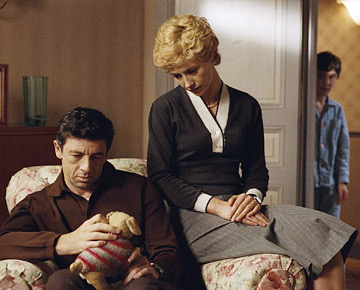

Claude Miller's wrenching "A Secret" distills the French nation's Nazi-era guilt into one family's incredible-but-true wartime story.
Photo courtesy Strand Releasing
Patrick Bruel, Cécile de France and Valentin Vigourt in “A Secret.”
A clanking, old-fashioned period drama infused with almost unbearable grief, Claude Miller’s film “A Secret” has an enormous significance in France that it can never possess elsewhere. Loaded with stars, costumes, props and beautiful locations, “A Secret” can’t be called nostalgic, since it expends all that energy evoking an era that’s still difficult to face. More than 60 years have passed since the end of Nazi occupation, but now that almost all the protagonists and antagonists have been swept off the stage, a younger French generation is coming to grips with the national shame of the 1940s.
Miller, a French cinema veteran (best known in America for “The Little Thief” in 1988) who was himself born in Nazi-occupied Paris, here adapts the best-selling novel by Philippe Grimbert, based on the extraordinary wartime history of Grimbert’s own family. His surname is a venerable one, with roots in the French medieval aristocracy, as one character in the film observes. It’s also a fake. Grimbert’s grandparents were actually named Grinberg; it was his father, fictionalized in the novel and film as athletic, masculine Maxime (Patrick Bruel), who changed the name — and had his son baptized — in an ambiguous effort to erase the past.
Many European Jews attempted to pass as Christians in the 1930s and ’40s, of course, and one can only applaud those fortunate few who stayed alive by pulling it off. But the mystery posed at the beginning of “A Secret” is why Maxime and his ex-swimmer, ex-model wife Tania (fast-rising Franco-Belgian star Cécile De France) are trying to assimilate as French Catholics in the postwar years, with anti-Semitism banished from public discourse and a minor renaissance of French Jewish life under way. When teenage François Grimbert (Quentin Dubuis), a bookish lad who constantly disappoints his father, flirts with a Jewish girl at the swimming pool, his parents exchange a peculiar glance: Will this budding romance expose their secret?
What secret? Of course I’m not going to tell you, don’t worry. Miller exposes it in pieces, hopscotching back and forth in time from the mid-1980s, when adult François (the great Mathieu Amalric, consigned to a modest narrator role) finally confronts Maxime about the past, back to François’ ’50s childhood and then to the family’s gradually revealed prehistory, 10 to 20 years earlier. Despite the cut-up chronology, there’s nothing unconventional about Miller’s storytelling, which relies heavily on Amalric’s voice-over narration, expositional family conversations about the fate of the Jews and strategically placed newspaper headlines. Hitler and Mussolini meet in Venice! War begins in Poland!
From a family confidante (Julie Depardieu) with secrets of her own, François learns that his romantic fantasies about how Maxime and Tania met, and how they evaded the Holocaust, are completely wrong — and furthermore that everyone in their circle of family and friends knows the truth except him. Here’s the only clue I’ll offer, which is revealed early in the film: Maxime indeed fell in love with Tania the day they met. But she was already married, and they met because Maxime was marrying Hannah (Ludivine Sagnier, displaying her range in a shrinking-violet role), her husband’s sister.
That’s only the first piece of a complicated puzzle, I swear. Amid all this international and domestic melodrama — after the Germans arrive, Tania wears her yellow Star of David badge in the streets, as required, but takes it off while modeling for Molyneux — Miller gradually builds toward a wrenching “Sophie’s Choice”-style climax, an event so awful and incredible that it has to be true. Maxime and Tania were of course the victims and not the perpetrators of French anti-Semitism and widespread French collaboration with the Nazis. But their postwar life together is haunted by much the same kind of guilt and shame, the same urgent desire to forget, that has shaped French society for much of the last six decades. Is it time to move on? Sure it is; France, Europe and the world are immeasurably different places today. But as citizens of a nation that keeps refighting the Civil War at least once per generation ought to know, the past never stops mattering.
“A Secret” is now playing at the IFC Center and Paris Theatre in New York and opens Sept. 12 at the Royal Theatre in Los Angeles, with national release to follow.
Pick of the week: Surviving a parents’ nightmare, with wine and sex
Pick of the week: A young couple faces their son's deadly illness, with Parisian flair, in "Declaration of War"
Valérie Donzelli and Jérémie Elkaïm in "Declaration of War"
Channeling personal trauma into creative work is pretty much what artists do, as Dr. Freud and Vincent van Gogh could have told you. In the case of French actress and director Valérie Donzelli’s striking and imaginative film “Declaration of War,” the autobiographical element is so strong that the movie’s virtually a docudrama – but a dazzlingly strange docudrama with musical numbers, choreographed interludes and prodigious cinematic verve. What could have been a wrenching family tear-jerker, in which a young couple discovers that their infant son is dangerously ill, becomes a bittersweet tragicomedy in the classic French style, suggestive of Jacques Demy, Christophe Honoré or François Ozon. (“Declaration of War” opened the Critic’s Week at Cannes this year, and now reaches theaters just after its United States premiere at Sundance.)
Mind you, “Declaration of War” still is a profoundly affecting family drama, no matter how much artifice Donzelli piles on top of it. If you’re a parent of young children (as I am), you’ll have to use your own judgment about how much you can take. I understand why some people respond to the health catastrophes of other people’s kids by shutting them out, as if the bad juju might be infectious. That’s how the young father in the film (Jérémie Elkaïm, who is or was Donzelli’s real-life partner, and co-wrote the screenplay) reacts when another kid in their son’s hospital ward dies: Geez, that’s too bad; let’s move on. Let’s face it, every parent harbors these fears, and every time you’re waiting for a phone call from the doctor – even if it’s about allergy testing, or a strep-throat culture – you secretly prepare for the worst.
Although the story of “Declaration of War” apparently hews closely to the real-life saga that Donzelli and Elkaïm endured along with their son, Donzelli kicks it up to a mythic and slightly surreal level right away. When their two characters first meet, and click erotically, against the pounding dance-pop of a Parisian nightclub, they discover that their names are Roméo (Elkaïm) and Juliette (Donzelli). “Does this mean we’ll have a love story with a tragic ending?” he murmurs in her ear. You can view that choice as daring or way too precious; I kind of think it’s both, but by that point I had already been sucked in by the visual and auditory undertow of Donzelli’s style, and just went for the ride. (Full credit also to the spectacular cinematography of Sébastien Buchmann.)
Almost as soon as their son is born, Roméo and Juliette half-suspect something is wrong: He cries all the time, wants to feed constantly, and won’t let them get any sleep. (I would point out that most parents, especially first-time parents, go through some version of that.) But when Adam is 18 months old (and still not walking), their pediatrician notices an odd asymmetry to his facial expressions, and sends them for a neurological consultation and then a CAT scan and then an MRI. The results are pretty nearly as bad as they could be: Adam has a large tumor compressing his brain stem, which will require immediate surgery. And without giving away the whole story, the news doesn’t get any better after that.
That’s the story, and perhaps as an act of catharsis, Donzelli has chosen to tell it as a gorgeous, stylized and highly sensual motion picture. Both she and Elkaïm are gorgeous physical specimens and vividly kinetic performers, and “Declaration of War” finds delight in the most unlikely moments: Juliette sprinting down hospital corridors at high speed, as her son is being anesthetized for his MRI; the two parents riding a fairground Ferris wheel like teenage lovers, at a point when they’ve sold their apartment and quit their jobs to move into the hospital’s parents’ wing. They’re surrounded by a constellation of supporting characters who come together, Greek chorus-style, to support their struggle: Roméo’s working-class mom and her female partner, Juliette’s more bourgeois siblings and parents.
I recognize that the whole thing sounds self-indulgent, and may be so — playing a version of yourself in the arted-up story of your own child’s life-or-death battle with cancer. But the breadth and brio of “Declaration of War” are such that I never tried to resist, and I honestly believe any parent can identify with the ways Donzelli turns quotidian details – a drive to the train station, or a ringing phone at the dinner hour – into thriller-worthy moments of intense drama. Among other things, this movie is a comic and tragic exploration of contemporary European family values, one that makes clear how much is lost, and how much gained, when people are forced to face a crisis of this magnitude.
I’ll drop a big hint and say that while the ending of “Declaration of War” is heartbreaking in various ways, you don’t have to fear the most downbeat or tragic conclusion. (Donzelli and Elkaïm’s real-life son, Gabriel, appears in the film.) Instead, this is a story about two pampered young Parisians who had to grow up in one hell of a hurry and deal with something dreadful, and who were fortunate enough to live in an affluent Western country that still, even in straitened economic times, views healthcare as a right and not a privilege. (Yeah, hint, hint.) So they confronted every parent’s worst nightmare and made it through, more or less, without losing their passion for wine, sex, vigorous exercise and cheesy French love songs.
“Declaration of War” opens this week in Los Angeles, New York and San Francisco, with wider national release to follow. It will also be available on-demand nationwide through many cable and satellite providers, beginning Feb. 3.
Pick of the week: Take the Robert Bresson challenge
Pick of the week: Exploring the spiritual vision and radical technique of an often-overlooked French genius
Anne Wiazemsky in "Au Hasard Balthazar"
Watching any movie always involves getting used to a particular director’s narrative rhythms — that is, how he or she is telling the story, as well as what kind of story it is. Watching the films of Robert Bresson, the ascetic French director who made only 13 features in a 40-year career, reminds us that most of the movies we watch, from Steven Spielberg to the Coen brothers to Pedro Almodóvar, share an essentially similar set of narrative principles. Bresson’s best-known pictures simply don’t. This winter and spring, North American viewers get an exceedingly rare opportunity to see Bresson’s films projected on the big screen, in a near-complete retrospective that opens this week in New York and will move on to many other cities. (For more details, see below.)
Bresson moves the camera rarely and only when necessary, uses only the crudest special effects and minimal musical motifs (or none at all, in later films), and never relies on editing tricks to heighten the drama, which never amounts to much by the standards of post-D.W. Griffith action-oriented cinema. Most famously, he has no interest in conventional drama or characterization, compelling his nonprofessional actors — or “models,” as he called them — to do repeated takes, in an effort to strip all “performance” from their line readings. (Bresson was apparently displeased when Anne Wiazemsky, the teenage star of his 1966 “Au Hasard Balthazar,” went on to become a professional actress.) His scenes are direct, clear and concise, with little visible emotion or inflection. Faces are often expressionless and eyes downcast. He frequently depicts action or motion by means of synecdoche, showing feet walking, hands turning doorknobs and so on.
Viewers accustomed to the pace and style of Hollywood movies can sometimes find themselves alienated by the seemingly obscure or symbolic mode of European-style art-house cinema — What am I missing? Why don’t I get this? — but Bresson presents almost the opposite problem. There are no 12-minute shots of people driving cars; his movies are brief and tell simple stories that aren’t difficult to follow in the slightest. “Au Hasard Balthazar,” which I take to be his masterpiece (it’s a pretty conventional opinion), is exactly what it seems to be, a fable about the parallel lives of two suffering innocents, an abused donkey and an abused girl. “Pickpocket,” from 1959, is an even more compact tale about a petty criminal who begins to imagine a different way of life, and half-intentionally allows himself to be captured and imprisoned.
In those cases and others, the austerity and simplicity of the film can be disorienting on its own terms; you cast about for some familiar emotional or psychological foothold and don’t find one. It takes a while to relax into what critic Kent Jones has called Bresson’s “perfect rhythmic clarity,” a “profound sense of harmony between images and sounds” that appears artless but is in fact exquisitely controlled. The mysteries of films like “Au Hasard Balthazar” and “Pickpocket” and “Mouchette” (probably his three most highly regarded works) lie entirely in how you interpret them and what you take away from them, in how and whether the spiritual or transcendental lessons Bresson tries to impart work on you.
Bresson is almost certainly the most important Christian, and specifically Roman Catholic, filmmaker in cinema history. (We can have the debate about Martin Scorsese some other time, but he’d be happy to concede the point.) Yet it’s not clear how much comfort the faithful have ever found in his work, which is rooted in the severe strain of French Catholicism known as Jansenism, and in the demanding, uncompromising Jesus Christ of the Sermon on the Mount. Bresson’s influence, which has never been wide, is largely found among semi-experimental filmmakers who tend toward atheistic or agnostic worldviews, from the French New Wave to Jim Jarmusch and Michael Haneke. It was Jean-Luc Godard, no friend of the Church, who described “Au Hasard Balthazar” as containing “the world in an hour and a half.” Belgian filmmaking brothers Jean-Pierre and Luc Dardenne, of “The Son,” “L’Enfant” and the forthcoming “Kid With a Bike,” are the most obvious Bresson acolytes in contemporary cinema, and perhaps the most sympathetic to his faith.
That said, Bresson’s rarely seen color films of the 1970s appear to render an increasingly ambiguous verdict on the relationship between man, God and the world. It’s often startling to encounter motorbikes or transistor radios or rock music in Bresson — he seems to belong to a pre-technological era — but it’s safe to say he generally views such things in a baleful light. If anything, as the settings and themes grow more modern in pictures like the Dostoyevsky-inspired “Four Nights of a Dreamer” (1971), the teen-suicide drama “The Devil Probably” (1977) and the Tolstoy adaptation “L’Argent” (his final film, made in 1983), Bresson’s rejection of modernity grows more forceful. In Kent Jones’ wonderful phrase, it’s as if he has “drifted to the edge of his ‘Christian universe’ and measured the void beyond on behalf of his defeated protagonists.”
If you’re already an admirer of Bresson’s most famous films, this retrospective allows you to see them again, in full-screen projection and often gorgeous new prints, and also to catch other works you’ve likely never seen at all. “Four Nights of a Dreamer” has been unavailable in North America for many years (except in a squashed, scratched-up and illicit bit-torrent version), and I had never previously seen the 1974 medieval mashup “Lancelot of the Lake” or Bresson’s 1943 debut feature, the convent melodrama “Les Anges du Péché” (also known as “Angels of the Streets”).
If you’re a newcomer to Bresson, I can’t promise that you’ll fall in love with these movies passionately and immediately. A famous French academic supposedly once quipped that Bresson’s films were more interesting to read about than to see, and while I don’t quite agree, I get what he meant. There’s an adjustment process in dealing with Bresson’s sui-generis version of cinema; not everybody can make it, and there’s no shame in that. His films do demand an open, contemplative cast of mind, but on the other hand they never waste your time and I personally find them almost addictive: The more of his aesthetic and worldview you absorb, the more of it you want to see.
Here are my five favorites, with the proviso that “A Man Escaped,” Bresson’s marvelous drama based on his experiences as a World War II POW, and his most commercially successful film, will play a separate theatrical run in most locations. (One Bresson film, “Une Femme Douce” from 1969, is apparently not included in this retrospective.)
Diary of a Country Priest (1951) After making his first two films in the familiar costume-drama style of the 1940s French industry (often called the “tradition de qualité”), Bresson struck out in a revolutionary new direction with this intimate and memorable adaptation of Georges Bernanos’ novel about an idealistic young curate battling apathetic parishioners and a debilitating illness. At 115 minutes, “Country Priest” is much longer than most Bresson movies, but the narrative simplicity and direct, non-actorly performances he would refine in later works first come into focus here. One of Martin Scorsese’s favorite films, this is arguably Bresson’s most straightforward declaration of faith — but even the most skeptical viewer will find its emotion powerful and its depiction of human suffering free of cant or sentimentality.
Pickpocket (1959) Both an ingeniously choreographed crime film and a moral drama influenced by Dostoyevsky’s “Crime and Punishment,” “Pickpocket” marks the apotheosis of Bresson’s stripped-down style. There’s little or no psychological realism or conventional drama at work in Martin La Salle’s portrayal of a master thief who plies his trade at the Gare de Lyon and easily outwits the cops who seek to ensnare him. See it once to appreciate the spare elegance of the pickpocketing scenes, and then a second time to appreciate how subtly Bresson accomplishes the story of a man’s self-willed corruption, his liberation through imprisonment and his redemption through love, all in less than 80 minutes.
The Trial of Joan of Arc (1962) Largely based on transcripts and eyewitness accounts of the 15th-century trial and execution of France’s patron saint, this quasi-journalistic account is almost the opposite of Carl Theodor Dreyer’s far more famous “Passion of Joan of Arc.” With its memorably straightforward performance by Parisian college student Florence Carrez, this rarely screened film may be the most extreme example of Bresson’s form of reverse sympathetic magic. In stripping the story of this legendary heroine down to a legalistic procedural — focusing entirely on what was said and done — he forcefully makes a case for Joan as an uncompromised (and possibly divine) martyr to moronic bureaucracy and petty politics.
Au Hasard Balthazar (1966) Probably the film best loved by Bresson adherents, and almost certainly his most heartbreaking. Teenage Anne Wiazemsky (Jean-Luc Godard’s future wife) plays the rural teenage girl who is betrayed and abused, partly or arguably due to choices she herself has made. But it’s her fuzzy-nosed co-star, the long-suffering eponymous donkey, who steals the show, bearing his burdens and accepting an animal version of martyrdom without complaint. Beneath the deceptively simple story lies a complex and tangled portrait of rural life defined by pride, greed, cruelty and human sin of all varieties. (Animal lovers: While the actual donkey used in the film may have been harassed and irritated during the shoot, he was not actually beaten or substantively harmed.)
The Devil Probably (1977) Shot in color among the disillusioned, long-haired youth of post-’60s Paris, Bresson’s next-to-last film remains controversial, viewed by some critics as a classic study of postmodern alienation and by others as an aging filmmaker’s desperate grasp at hipness. (Bresson himself was 75 when this was made.) As usual, the acting is affectless, the camera largely static and the story is deliberately “de-dramatized.” We already know that androgynous 20-something drifter Charles (Antoine Monnier) will die after his explorations of religion, revolutionary politics and psychoanalysis; what we don’t know is exactly why or how. Both a visually ravishing work and a supremely unforgiving one, “The Devil Probably” has the feeling of a stern farewell to youth, movies and the modern world. Bresson would indeed retire from filmmaking after “L’Argent,” his next film, although he would live on for many years, dying in 1999 at age 98.
The Bresson retrospective opens this week at Film Forum in New York; Jan. 19 at the Pacific Film Archive in Berkeley, Calif.; Jan. 20 at the Harvard Film Archive in Cambridge, Mass.; Jan. 21 at the Gene Siskel Film Center in Chicago; Jan. 31 at Bard College in Annandale-on-Hudson, N.Y.; Feb. 9 at the TIFF Cinematheque in Toronto; March 1 at the Los Angeles County Museum of Art; March 3 at the Cleveland Cinematheque and the National Gallery of Art in Washington, D.C.; March 6 at the George Eastman House in Rochester, N.Y.; March 9 at the Belcourt Theatre in Nashville; April 4 at the Pacific Cinémathèque in Vancouver, Canada; April 13 at BAM in Brooklyn, N.Y.; May 1 at Northwest Film Forum in Seattle; and May 10 at the American Cinematheque in Los Angeles. (Further venues and dates may follow.)
3. Bernard-Henri Levy
The philosopher is a living parody of a blowhard foreign intellectual
One upside to America’s frothing populist hatred of intellectuals is that we don’t produce many Bernard-Henri Lévys. Unfortunately, we tend to take other nations’ tedious, fame-seeking big thinkers far too seriously. I think our magazine editors are seduced by accents — it’s the only explanation for why they keep trying to sell us “BHL” and Niall Ferguson.
So BHL, the famous and wealthy French philosopher, gets assigned to travel across America for the Atlantic, and produces the laundry list of clichés you’d expect: We’re all fat and religious and we worship the flag and baseball.
BHL the intrepid reporter writes a book on the killing of Daniel Pearl, and it’s rife with errors and prejudice.
He’s prospered in intellectual circles despite his tragic inability to button a shirt in part because he’s a successful businessman, born into wealth and friends with the French corporate elite. He writes with the self-assuredness of someone quite convinced of his brilliance, and that self-assurance perhaps explains why he so regularly makes shit up and gets shit wrong.
Like, for example, claiming that Himmler, who killed himself, stood trial at Nuremberg. And citing a well-known fake satirical philosopher in a book.
For a taste of the sort of hackneyed, half-assed work he produces on the major issues of the day, try this item on the eurozone crisis. It’s the sort of inane nonsense that gives claptrap a bad name. BHL noticed that the crisis involved Greece and Italy and that made him excited because he could then write about how civilization was invented in those places. To understand the European debt crisis, apparently, “we should be rereading Gibbon, Humboldt, or even Polybius — these theoreticians of the fate and the fall of the Athenian paradigm or the Roman road — rather than Friedman or Keynes.” Actually I think in this particular instance Friedman or Keynes would be a bit more helpful?
As if being pompous, self-serious, self-important and lazy weren’t enough, he’s also the public face of not one but two campaigns dedicated to defending powerful men against rape accusations. He organized a petition decrying Roman Polanski’s extradition to the United States to face prison for jumping bail after being convicted of raping a child years ago. Polanski didn’t deserve to go to jail, according to BHL, because he is a very good filmmaker.
Then BHL’s dear friend Dominique Strauss-Kahn was arrested for raping a hotel maid, and BHL wrote a truly astounding column defending his friend by attacking the victim and decrying the American justice system for not providing adequate special treatment to a man as rarefied and well-respected as Strauss-Kahn.
“What I do know is that nothing in the world can justify a man being thus thrown to the dogs,” BHL said of the totally standard treatment of Strauss-Kahn following his arrest for rape.
HACKIEST 2011 MOMENT:
After the charges against Strauss-Kahn were dropped due to unknown inconsistencies in the accuser’s story, BHL declared victory and claimed that Strauss-Kahn was the victim of “torture” due to his class, and his being French.
I must state, to be clear, that I don’t think it has much to do with this worldwide religion and delirium that is anti-Semitism. But what I do believe is that this is the appearance of a new variation on Maurice Barrès’s phrase that has become, “That X—in this case Dominique Strauss-Kahn—is guilty, I deduce not from his race, but from his class.”
Hm, yes, Americans, always throwing rich powerful white men in jail. Our rich white male prison population is truly our national disgrace.
- – - – - – - – - -
(Read the introduction here. Read the 2010 Salon Hack 30 List here.)
“The Artist”: Silent, black-and-white and totally irresistible
A star you've never heard of in a fake 1920s movie -- can this really be Oscar bait? See it and find out
Jean Dujardin and Bérénice Bejo in "The Artist"
When French director Michel Hazanavicius’ new film “The Artist” premiered last spring at Cannes, Harvey Weinstein snatched up the United States rights and a handful of prognosticators pronounced it an Oscar candidate. That sounded far-fetched at the time, and maybe still does. But save your derision until after you see the movie, a project so idiosyncratic, so unlikely, so simultaneously innocent and sophisticated that it could only have been devised by the French. Furthermore, “The Artist” is also an outrageous and nearly impossible amount of fun, which is not a concept Americans much associate with French films — and that’s the factor that may put the movie and its lantern-jawed, meta-handsome leading man, Jean Dujardin, in this winter’s awards race.
Unless you’re a fan of the alternate film universe that is French comedy, and specifically the recent “OSS 117″ spy spoofs, you’ve never heard of either Hazanavicius or Dujardin. But the qualities that would seem to make their movie supremely unmarketable are also its strengths. “The Artist” is in black-and-white. It’s not merely a silent film — well, at the risk of issuing a spoiler, let’s say it’s almost a silent film — but one that both imitates and spoofs the Silent Age dramas of the late 1920s, movies that hardly any living people have actually sat through. That’s at least three strikes against the film, possibly four or five — but ever since that Cannes premiere, audiences at festivals around the world have responded to “The Artist” rapturously and uproariously. Not everyone will like it that much, undoubtedly, but if you do, it’s the kind of movie you’ll tell all your friends about, and drag them back to see if they seem reluctant.
“The Artist” of the title is a huge silent-era star named George Valentin, played indomitably by 39-year-old Dujardin, sailing into the winds and tides of 1920s Hollywood with his ship’s figurehead of a face. In Hazanavicius’ giddily postmodern “OSS 117″ movies, Dujardin plays Hubert Bonisseur de la Bath, the chauvinistic, xenophobic and generally clueless 1960s superspy who’s like the Gallic bad conscience of James Bond (and seems to have unresolved and unconscious sexual-identity issues to boot). An irresistible presence both on-screen and in person — he had the Cannes press corps eating out of his hand — Dujardin has jokingly described himself as the poor man’s Sean Connery, which is funny but not entirely fair. He’s more like the Monty Python version of Connery, or Connery cranked to 11. Dujardin doesn’t speak much English, which may be the only thing that’s kept Hollywood scouts away from him so far. After this performance I’m pretty sure that any agent in the business would happily spring for any combination of Berlitz and Rosetta Stone in which he’d care to partake.
With his jutting jaw, sleek hair and pencil-thin mustache, Dujardin’s George comes uncannily close to Douglas Fairbanks, and like him dominates the silver screen as a series of dashing adventurers in nearly identical international espionage scenarios, which Hazanavicius recaptures in delicious and affectionate detail. George has a beautiful wife, an enormous house in the Hollywood hills, and a loyal dog who co-stars in his films (and who will provide any number of “awww” moments later on). He has a minor flirtation with an up-and-coming flapper-flavored extra named Peppy Miller (the irresistible Bérénice Bejo). In giving Peppy her first break, he never foresees that she will soon surpass him. George’s studio is overseen by an avaricious exec played by John Goodman (who would have been huge in the silent era, based on this evidence), who has to break the grim technological news: The talkies are coming in, and George is yesterday’s copy of Photoplay.
True to his naive and optimistic nature, George believes that the public loves him and that talking pictures are a shallow fad. Sic transit gloria mundi, bub. “The Artist” is perhaps less deliriously enjoyable after it switches from its early romantic-comedy mode to the ensuing Theodore Dreiser-style melodrama of George’s fall into alcoholism, bankruptcy and disaster. (While Peppy, of course, becomes America’s borderline-insipid sweetheart.) But that too is very much in the spirit of the movies it emulates, which packed two or three genres into a single picture. Hazanavicius loads the picture with laughs, charm and surprises, along with glorious Los Angeles locations. I’ve got three words for you: Tap-dancing numbers. I said tap-dancing numbers! (Or is that really just two words?) “The Artist” finishes with a terrific bang, and positively bursts with affection for an era of American cinema and culture that Americans have all but forgotten. (Hazanavicius could have used an actual American on set during the shoot: Some of the English intertitles and supporting materials — magazine and newspaper articles — are either unconvincing or flat-out wrong.) In the long and fraught history of Franco-American cultural relations, this movie is more than a peace offering; it’s a loving, goofy, joyous French kiss.
“The Artist” opens this week in major cities, with wider release to follow.
“The Bride Wore Black”: Truffaut’s delicious homage to Hitchcock
Jeanne Moreau plays the ultimate femme fatale in a summery, deceptive fable of a woman's murderous revenge
Jeanne Moreau in "The Bride Wore Black"
What begins as a French cinephile’s almost obsessive tribute to Alfred Hitchcock becomes progressively weirder, wittier and more Continental in François Truffaut’s 1968 “The Bride Wore Black,” which begins a New York run this week and will then play in many other cities. Truffaut is sometimes viewed as a relative lightweight among the company of big-name ’60s and ’70s European directors, and there’s no doubt his work is uneven. But I find myself appreciating his double-edged, seductive films more and more on repeat viewings. With its summery, Mediterranean surface, Jeanne Moreau as the ultimate femme fatale heroine and a knife-twisting tale of murderous revenge and unexpected romance, “The Bride Wore Black” is well worth rediscovering.
The first thing we see in “The Bride Wore Black” is a printing press churning out black-and-white images of a topless Moreau, but that’s one of several misdirections in this movie, since the story is almost entirely chaste, and the color photography of famed cinematographer Raoul Coutard (who shot Godard’s “Breathless,” Truffaut’s “Jules and Jim” and numerous other New Wave classics) is brilliant. With a deliberately obtrusive Bernard Herrmann score and its roots in a novel by Cornell Woolrich (whose short story “It Had to Be Murder” was the basis for “Rear Window”), “The Bride Wore Black” is more like a Hitchcock movie than some of Hitchcock’s actual movies, at least at first.
Moreau plays a woman named Julie Kohler, who leaves home after a failed suicide attempt and begins hunting down a list of apparently unconnected men, whom she has never met. To a consummate lady-killer on the Riviera, she appears as a potential conquest in a white evening gown; to a lonely, middle-aged bachelor, she’s the fairy princess he’s been waiting for; to a bourgeois politician (the outrageously young Michael Lonsdale), she’s his young son’s schoolteacher. Julie’s plot is ridiculous, and the tragedy she’s avenging is even more so, but as in many Hitchcock pictures, those things are excuses for a cinematic exploration of the war between the sexes that is ambiguous, more than a little mean-spirited and ultimately surprising.
“The Bride Wore Black” is now playing at Film Forum in New York. It opens Nov. 25 at Northwest Film Forum in Seattle and Dec. 9 at Pacific Cinémathèque in Vancouver, Canada. Also coming soon to Berkeley, Calif., Huntington, N.Y., St. Louis, Milwaukee, Pleasantville, N.Y., and Houston. Check website for details.
Page 1 of 39 in France
Demi’s last night out
One day you’re in
Pitch and catch
Whip-it
My debate with Charles Murray
More tips for literary lovers
U.S., China need a green peace, not a trade war
Santorum mangles the Founding Fathers
Chris Christie’s gay marriage headache 

