
Cannes Film Festival
Cannes: A delightfully odd immigration comedy
"Le Havre," an exquisite fairy tale from beloved Finnish director Aki Kaurismaki, is a festival smash
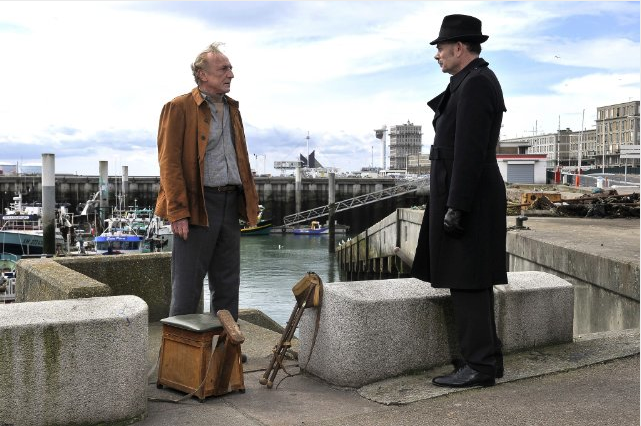
A still from "Le Havre" CANNES, France — Aki Kaurismäki, a Finnish director who makes mordant, wistful black comedies laced with pop-culture nostalgia, is pretty much the last person you’d expect to make a movie about Europe’s “refugee problem” (what we would call illegal immigration). As he would happily agree, his films have more to do with vintage American gangster movies, fairy tales and early rock ‘n’ roll songs than with social realism. But from early works like “The Match Factory Girl” and “I Hired a Contract Killer” to his 2007 neo-noir “Lights in the Dusk,” Kaurismäki has always been concerned with the fates of those who are downtrodden and cast out. His dark humor and precise, mannered style tend to conceal the politics beneath his films, but it’s not that much of a stretch to suggest that he’s the last major Marxist left in European cinema.
Maybe the guy needs to get out of Finland more often. In 1991 Kaurismäki went to Paris to make “La Vie de Bohème,” arguably his best film, and “Le Havre,” set in the Normandy port city of that name, feels on first viewing every bit as good. Kaurismäki takes on the story of an African immigrant boy and a bohemian shoeshine man and delivers a film that’s exquisitely his own yet bursting with a newfound optimism and faith in human possibilities. It’s an intimate movie made on a small scale but very nearly an instant classic, fueled by a passion for vintage French cinema and the neighborly, communal French society of years gone by, and employing Kaurismäki’s bone-dry comedy to break through the wall of audience cynicism. “Le Havre” was greeted with uproarious applause at Tuesday morning’s Cannes Film Festival press screening, and feels at this moment like the front-runner in the evolving Palme d’Or competition. (With films by Lars von Trier, Pedro Almodóvar, Takashi Miike, Paolo Sorrentino and Nicolas Winding Refn still ahead of us, horse-race analysis is pretty useless.)
The hero of “Le Havre” is named Marcel Marx (played by craggy French character actor André Wilms), which has to be one of the greatest movie names of all time. That’s like the entire history of the 20th century — art, literature, movies, politics — in two words, and Marcel walks through Le Havre with the exhausted dignity of a man who has seen it all. He works at the Havre train station shining shoes with a Vietnamese immigrant comrade (Quoc-Dung Nguyen), but in a sneaker-and-sandal age, it’s not much of an occupation. Still, as he says at one point, it’s the closest you can get to people without being a shepherd — and, no, I don’t know why that line is so funny, or even what it means. As we eventually learn, Marcel had a wild youth as a writer and drinker in Paris, but these days he goes home every night to his wife, Arletty (Kaurismäki regular Kati Outinen, and yeah, that’s another French-movie-history reference), has a drink or two at the local bistro, eats dinner and goes to bed.
At least that’s what his life is like before both calamity and opportunity strike: Arletty becomes suddenly and seriously ill (I mean, she is the heroine of a French movie), and round-faced, serious Idrissa (Blondin Miguel), a teenage escapee from a shipping container unloaded in Le Havre by accident, comes into it. Idrissa seems like a refugee not just from the African nation of Gabon but also from the 21st century, thrown into Marcel’s stylized, congenial neighborhood of little shops and houses, a vision of postwar, pre-technological France frozen in amber. (The only time you ever see a cellphone in “Le Havre” is when the neighborhood informant is turning Idrissa in.) Instead of defaulting to the xenophobia that is all too common in Europe (and America) these days, the people of Marcel’s quartier recognize him as a kindred spirit and take him in. Kaurismäki doesn’t even halfway pretend to offer a solution or an analysis of the refugee problem; this is a fable about human beings banding together to protect a child, in the sure and certain knowledge that the bureaucratic state means him no good.
Shot (by cinematographer Timo Salminen) with the precise choreography, exaggerated 1940s-style lighting and deadpan blend of comedy and melodrama that characterizes Kaurismäki, “Le Havre” sneaks up on you. For a while it’s just a dry, amusing blend of familiar archetypes — along with the crusty old codger, a kid who wants to find his mother, a dying woman, and the old-time neighborhood, let’s add a classic French “flic,” or cop, in a black trench coat, marvelously played by Jean-Pierre Darroussin. (Let’s just throw this out for future consideration: “Le Havre” as a possible remake of “Casablanca.”) And then these people and the exquisite comic timing and the peculiar tone and the dog named Laika (!) and the benefit concert by Little Bob, the “Elvis of Le Havre,” become something bigger than cinema, something as impossible and ridiculous as human goodness in a terrible world.
American influx at Cannes
American filmmakers dominate this year's line-up at France's annual glitzy celebration of cinema
Workers sets up a giant 65th Cannes Film Festival official poster featuring Marilyn Monroe on the Cannes Festival Palace, Monday, May 14, 2012. The Cannes Film Festival will start on Wednesday, May 16.(AP Photo/Lionel Cironneau)(Credit: AP) CANNES, France (AP) — Despite the mood in Europe, don’t expect any austerity at the Cannes Film Festival, the annual Cote d’Azur extravaganza where glamour is wrapped in world cinema fervor and gauzy Mediterranean sunshine.
Except for the Oscars, it’s the flashiest red carpet in the world, a ruby staircase flanked by tuxedoed photographers — and a world away from financial turmoil.
Yet Cannes, the 65th edition of which starts Wednesday, fetes its directors as much as it does its stars. This year, there are plenty of both: esteemed international filmmakers like Abbas Kiarostami and Michael Haneke to big-name talent like Brad Pitt and Nicole Kidman.
Continue Reading Close“The Kid With a Bike”: A heart-rending fable of good and evil
Belgium's Dardenne brothers turn "Bicycle Thieves" upside down in the wrenching fairy tale "Kid With a Bike"
Thomas Doret and Cécile De France in "The Kid with a Bike" As anybody who’s ever taken a film-history course knows, there’s already a pretty famous European movie about a preteen boy and a bicycle. If Vittorio De Sica’s 1948 neorealist classic “Bicycle Thieves” (in my day, and perhaps in yours, the English title was singular) is about a kid who has a father but must search for a lost bike, Jean-Pierre and Luc Dardenne’s new film is about a kid who finds his bike but must search for his lost father. Whether or not you’ve ever heard of the Dardennes or their cinematic excursions into the social underbelly of Belgium’s third-largest city, “The Kid With a Bike” is an edge-of-your-seat emotional roller-coaster ride, set among ordinary people in a nondescript neighborhood. It’s a story about a 30-ish, unmarried hairdresser and an angry, abandoned child, and from those ingredients the Dardennes create something that’s part thriller, part love story, part fairy tale and altogether wonderful.
Continue Reading Close“CSI,” if written by Chekhov
"Once Upon a Time in Anatolia" is a cop movie and a road movie -- but mostly it's gorgeous cinema
No, “Once Upon a Time in Anatolia” isn’t a rediscovered spaghetti western from the 1960s, but Turkish director Nuri Bilge Ceylan is making a rather dry joke with his Sergio Leone-like title. An international film-festival favorite who remains largely unknown outside Turkey and Europe, Ceylan has been described as his country’s answer to Ingmar Bergman — a moral dramatist whose enigmatic, apparently realistic films explore the paradoxes of life in contemporary Turkey. You could call “Once Upon a Time in Anatolia” a police procedural, but I don’t want to mislead you; don’t expect much action or suspense, at least not in the normal movie-world sense of those words.
Continue Reading Close“Sleeping Beauty”: A young woman’s creepy sexual odyssey
Emily Browning bares all in Australian director Julia Leigh's disturbing fable of a world without consequences
Emily Browning in "Sleeping Beauty" Australian novelist-turned-filmmaker Julia Leigh’s “Sleeping Beauty” is one of the strangest pictures I’ve seen all year, and given my known proclivities, that’s actually saying something. It plays like a mixture of not-that-softcore porn, Lacanian psychoanalysis and feminist conceptual art, and seeing it near the beginning of last spring’s Cannes festival was like drinking a tall, chilly draft of laudanum in the Riviera sunshine. Whether “Sleeping Beauty” is good-strange or bad-strange is a highly subjective question; I found it gorgeous, opaque and disturbing in roughly equal portions, but it’s a riveting experience all the way through.
Continue Reading CloseInterview: Steve McQueen talks naked bodies and “Shame”
The British artist-turned-filmmaker on his NC-17 drama starring Michael Fassbender as a sex-addicted New Yorker
Michael Fassbinder and Steve McQueen at the Venice Film Festival (Credit: AP/Andrew Medichini) If you know about Steve McQueen as a legendary race-car-driving 1970s movie star but not as a British artist-turned-filmmaker who’s one of the hottest talents in contemporary cinema, consider this your introduction. The younger McQueen — and yes, it’s his real name — was born in London in 1969, about a decade before the movie star’s death. By the mid-’90s he had become a prominent gallery artist on the burgeoning British art scene, but began to move toward narrative films and videos with such black-and-white, minimalist shorts as “Bear” and “Deadpan,” the latter a restaging of one of Buster Keaton’s most famous stunts.
Continue Reading ClosePage 1 of 13 in Cannes Film Festival
