

In the wake of the extrajudicial killing of American citizen Anwar al-Awlaki and several other people in Yemen this week, we’re faced (once again) with the realization that the United States Constitution has become a largely meaningless totem. It gets waved around enthusiastically by people on all sides of the political spectrum whenever it seems to serve their interests, but nobody pays much attention to what it actually says. Presumably President Obama, the military-intelligence establishment and the mainstream media are declaring Awlaki a special case. Thanks to the secret provisions of secret laws, he was deprived of all the rights of citizenship and not subject to the ordinary rule of law that extends back not merely to the Constitution but to the Magna Carta (at least).
Some similar exemption must also be made for the Canadian citizen Omar Khadr, who was 15 years old when he was found, badly injured and barely alive, after a 2002 firefight between U.S. troops and Taliban forces in Afghanistan. (Khadr’s father, an al-Qaida supporter and fundraiser, had apparently dropped him off at a Taliban compound a few weeks earlier.) Based on what we see in the painful, revealing documentary “You Don’t Like the Truth: 4 Days Inside Guantánamo” — the first film to show actual interrogation footage from inside the secret American military prison at Guantánamo Bay, Cuba — Khadr became a sort of ritual sacrifice by the Canadian government, an offering to its American allies and/or overlords. His case became a hot political issue north of the border, where Canadians pride themselves on a society that is more egalitarian, and more civilized, than that of their American neighbors.
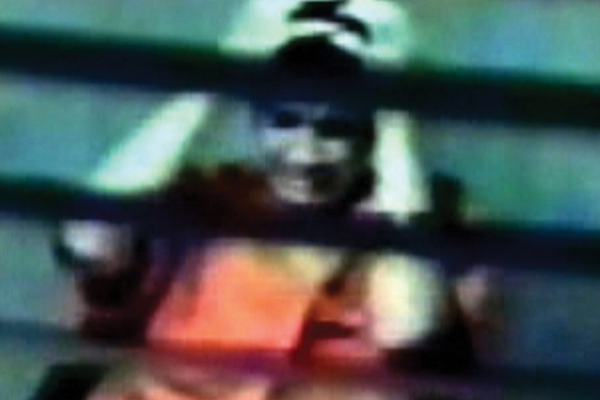
Following a Canadian Supreme Court decision, most of Khadr’s seven-hour interrogation at Gitmo by CSIS officers — the approximate Canadian equivalent of the CIA — has been declassified, and veteran lefty documentarians Luc Côté and Patricio Henríquez use that claustrophobic, low-resolution 2003 footage as the basis for “You Don’t Like the Truth.” That sounds like something the interrogators might have said to Khadr, but it isn’t. It’s what he tells them after realizing they don’t want to hear his allegations that he was tortured by American forces, and that all his supposed confessions about knowing Osama bin Laden and attending al-Qaida barbecues were made up on the spot, to stop the pain.
You won’t see Khadr suffer physical torture on these surveillance tapes, although the interrogators rely on time-honored tactics of psychological abuse, alternately berating him and plying him with Big Macs. You will see a teenager who speaks idiomatic North American English, and who is obviously relieved to see fellow Canadians, whom he naively assumes have come to help him. And you’ll see him go through a near-total breakdown, sitting alone in the room weeping for his mother, after he realizes that no one cares about what happens to him and that he’s only interesting to his interrogators as long as he keeps making up stories about Osama and al-Qaida.
I have no idea whether Khadr actually threw a grenade that killed a U.S. Delta Force soldier, as was alleged after his capture. (Khadr has consistently denied it, and photographic evidence suggests that he had been shot through the back and was out cold before the soldier’s death.) But the Canadian interrogators barely mention it, and it feels suspiciously like an inflammatory distraction, thrown in mostly to alienate all possible North American sympathy. At best it’s an ancillary question. If Khadr was a genuine military combatant, then he can’t be prosecuted for killing an enemy soldier in battle. Furthermore, he would have to be considered a child soldier under international law, which theoretically immunizes him even for war crimes. Convicting him on such charges, as the government eventually did in a secret court on secret evidence, required the finding that he wasn’t a soldier but a civilian terrorist (even though he was supposedly linked to two organizations, al-Qaida and the Taliban, with whom the U.S. government has repeatedly said it’s at war).
Côté and Henríquez intersperse brief and highly effective interview segments between snippets of the interrogation tape, with subjects ranging from former U.S. military officers (including Khadr’s lawyer and psychiatrist) to former Guantánamo inmates (including Moazzam Begg, now a leading British activist for other detainees) to Khadr’s mother and sister (wearing full-face Islamic veils) to Damien Corsetti, the much-demonized former soldier who knew Khadr as a guard at Bagram. What comes through repeatedly is that questions of law and reason, or guilt and innocence, played no role in the case of Omar Khadr. He was a vulnerable and confused kid whose own government turned its back on him, which made him a perfect candidate to become one of the few Gitmo detainees convicted of something. He was 15 when he was captured, and will be 31 when he (supposedly) gets out.
“You Don’t Like the Truth: 4 Days Inside Guantánamo” is now playing at Film Forum in New York, with more cities and dates to follow.
