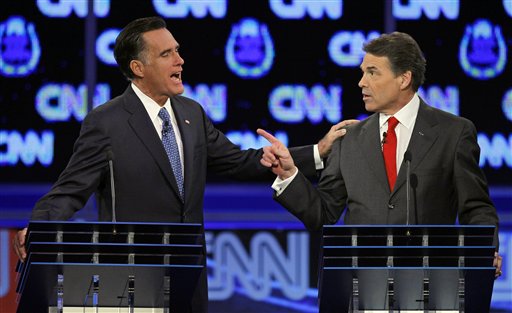

Republican presidential candidates former Massachusetts Gov. Mitt Romney, left, and Texas Gov. Rick Perry speak during a Republican presidential debate Tuesday, Oct. 18, 2011, in Las Vegas. (AP Photo/Chris Carlson) (Credit: AP)
It’s probably not a good idea to declare a winner of Tuesday night’s Republican presidential debate just yet. It was a volatile two hours with multiple accusations of lying and one instance of physical contact between candidates. As Taegan Goddard noted when it ended, “Because there were so many heated exchanges that will be replayed over the next 48 hours, the perception of who did well could change significantly for those who didn’t tune in tonight.”
What we can say is that the three candidates who came into the debate with the strongest poll numbers — Mitt Romney, Herman Cain and Rick Perry — each turned in performances that could lead them to be labeled the night’s loser when perceptions harden and turn into conventional wisdom.
Let’s start with Romney, one of the two stars of the evening’s most combustible moment. It came when Perry, who clearly showed up eager to prove that he could land a punch (and stay awake for two hours!), got personal on the subject of immigration and brought up an old story about illegal immigrants doing landscaping work at Romney’s Belmont, Mass., property.
The background, for what it’s worth: In December 2006, the Boston Globe reported that the landscaping company Romney had used for years employed undocumented workers. Romney claimed that he’d had no idea and promised to look into it. But a year later, the Globe reported that Romney was still using the same company and that the company was still employing undocumented workers. Romney immediately fired the company and insisted that its owner had guaranteed him “in very certain” terms after the 2006 story that the legal status of every worker would be verified going forward.
Thus did Perry turn to Romney on Tuesday night and say: “You hired illegals in your home, and you knew about it for a year. And the idea that you stand here before us and you talk about that you’re strong on immigration is on its face the heighth (sic) of hypocrisy.” Whether Romney handled this ably or terribly is a matter of interpretation.
You could say he handled it well because he didn’t miss a beat in brushing off Perry’s charge (“I don’t think I’ve ever hired an illegal in my life. And I’m looking forward to finding your facts on that”), then turned the tables by highlighting Perry’s vulnerabilities on immigration (opposition to a border fence and support for in-state tuition for the children of illegal immigrants). “If there’s someone who has a record as governor with regards to illegal immigration that doesn’t stand up to muster it’s you, not me,” Romney declared.
Romney has done this kind of thing before, and he’s pretty good at it. On issue after issue, he left a paper trail in Massachusetts that should make him totally unacceptable to the national Republican electorate. And yet every time an opponent has tried to call him on a particular aspect of his history in one of these debates, Romney has feigned confusion over how anyone could question his consistency and thrown the charge right back in his opponent’s face. He sells it with such confidence that it can be easy to believe. (Actually, he was good at this back in his Massachusetts days too.) Is this how his exchange with Perry on Tuesday will be remembered? Maybe.
But Romney’s behavior was also different this time. Perry clearly got under his skin in a way that no other candidate has this year, and it showed, particularly when Perry tried to interject during Romney’s answer and Romney responded by stepping toward Perry, putting a hand on his shoulder and repeating several times, “I’m speaking!” In previous debates, Romney has made sure to smile and maintain composure when his opponents have attacked him, but his expression changed to one of anger as soon as Perry interrupted him. It was the most heated moment of the night, one that is already featuring prominently in highlight packages, and Romney looked red-faced and almost unhinged during it. TPM captured video of the full exchange:
Another potential problem for Romney came moments later, when he tried to put the landscaping story in context. In retelling his version of the story, Romney said that he’d gone to the company and said, “Look, you can’t have any illegals working on our property. I’m running for office, for Pete’s sake, you can’t have illegals.” Here’s more video from TPM:
With that, Romney generated a clip that will be recycled endlessly if he wins the Republican nomination, and also one that could shape assessments of his debate performance in the next few days.
Then there’s Perry. You could say he had a good night because he brought some of Romney’s worst tendencies to the surface for the first time in this debate season. But he also looked very bad as he did it, and in several other moments.
For one thing, Perry failed to set up the immigration attack properly. It’s an old story, one that played a role in the 2008 GOP race but that hasn’t been the source of much conversation this time around. Many viewers on Tuesday had probably forgotten about it, and the details were probably fuzzy for those who did remember it. But when he brought it up, Perry provided no context; he simply assumed that everyone knew exactly what he was talking about. His rebuttal after Romney’s initial response was just as weak.
“You stood here in front of the American people and did not tell the truth that you had illegals working on your property,” Perry said, “and the newspaper came to you and, and brought it to your attention, and you still a year later had those individuals working for you.” Since he provided none of the specifics, most viewers probably had only a vague idea of what Perry was talking about.
He also may have come across as excessively confrontational. As he went after Romney, it very much felt like Perry was repeating lines he’d rehearsed before the debate. And when he was left to improvise, Perry frequently seemed unsure of himself, with awkward, painful pauses marring many of his answers. At one point, he actually got into a tiff with Anderson Cooper, eliciting audible jeers from the crowd by bluntly refusing the moderator’s request that he answer a specific question. (In fairness, the crowd may have been disproportionately composed of Romney backers; the debate was held in Nevada, a state where Romney won a decisive victory in 2008. But did most viewers at home, who heard Perry booed on several occasions, know this?) To the extent Perry had a good night on Tuesday, it was in spite of himself.
And what about Herman Cain, who came into the debate with all the momentum in the world, the sudden leader in multiple national polls? Well, the fact that it’s taken this long to get to him probably tells you all you need to know about how things went for him. His night could probably be split into two parts: The first 10 minutes, when every other candidate on stage took turns blasting Cain’s 9-9-9 tax plan while Cain struggled to formulate a compelling response (he repeatedly invoked an apples/oranges metaphor, which proved almost impossible to follow, like when he said that “We are replacing the current tax code with oranges”); and the next 110, when he seemed to fade into the background and return to the relative anonymity he’s enjoyed in most other debates this year.
The best that can be said about Cain’s performance is that it might have been overshadowed by the Romney-Perry theatrics. So while there’s a chance his bubble burst onstage in Las Vegas, there’s also a chance that it will endure just a little longer. After all, if the debate demonstrated nothing else, it’s just how slim the pickings are for Republicans.
Steve Kornacki writes about politics for Salon. Reach him by email at SKornacki@salon.com and follow him on Twitter @SteveKornacki
More Steve Kornacki.
At the very least, the Republican Party base’s revolt against its own establishment cost the GOP a 50-50 Senate tie in 2010, with primary voters forcing unelectable nominees on the party in three races that it had otherwise been on course to win. A decent case can be made that the uprising actually cost Republicans outright Senate control.
And now the same thing may be happening all over again, with Nebraska joining a growing list of unexpected 2012 Senate battlegrounds – at least for the moment.
The impetus is the surprise victory of Deb Fischer, a little-known state legislator, over two seasoned opponents in Tuesday’s Nebraska Republican Senate primary. Fischer’s candidacy seemed dead in the water until about a week ago, when she was endorsed by Sarah Palin. A last-second ad blitz from a super PAC controlled by the founder of Ameritrade added to her momentum, and Fischer ended up beating out state Attorney General Jon Bruning, who had been the favorite, by five points.
The outcome was greeted with immediate joy by Democrats, with the DSCC putting out a statement calling Fischer an “untested” and “accidental” nominee for the seat being vacated by Democrat Ben Nelson. The hope for Democrats is that the 61-year-old Fischer, who has represented a rural western Nebraska district in the state Senate since 2005, will melt under the spotlight of a high-stakes general election contest – much the way Sharron Angle, Christine O’Donnell, Ken Buck and Joe Miller did in 2010.
This may prove to be wishful thinking. Fischer could end up being a perfectly competent candidate, one who isn’t prone to erratic behavior and pointlessly inflammatory rhetoric and who doesn’t have any serious skeletons in her closet. Certainly, she showed strong communication skills in her acceptance speech Tuesday night. And because of Nebraska’s deep red shading and its particular antipathy toward Democrats in the Obama-era, Fischer’s margin for error is probably substantial. The same mistakes that derailed Angle in Nevada may only be the difference between, say, a 20- and 10-point win in Nebraska.
That said, Fischer absolutely is an untested candidate. Bruning and the race’s other major candidate, state Treasurer Don Stenberg, spent months firing shots at each other and gobbling up all of the attention. The intensity of their battle probably helped create the opening that Fischer seized, but the late timing of her surge also spared her from facing much in the way of media scrutiny or attacks from her rivals. She raised and spent very little money, and not much is known about her.
For Democrats, that’s reason to cheer. Had Bruning (or even Stenberg, a veteran of eight previous statewide campaigns) won the primary, the general election race would have been a snore. Polls showed both men comfortable ahead of the Democratic candidate, former Senator Bob Kerrey, who won elections in the state in 1982 (for governor), 1988 and 1994, back when he was something of a local hero. But Kerrey spent the last decade running the New School in New York and hasn’t been on a Nebraska ballot in 18 years. Partisan divisions have hardened since then, and Kerrey now faces cries of carpet-bagging.
There’s no meaningful Fischer/Kerrey poll numbers out yet. Presumably, the GOP nominee will begin with a solid lead, just because this is Nebraska (and because right now she embodies a neat underdog story). The question is how she’ll hold up, and on that score there’s some real doubt, which means that Nebraska is in play, at least provisionally.
Add in Indiana, where the Tea Party-aligned Richard Mourdock knocked off Dick Lugar last week, and two GOP primaries in one week have resulted in a surprise general election opportunities for Democrats. And primary season isn’t over yet. As Josh Kraushaar notes, the GOP’s grassroots seem poised to rise up against former Governor Tommy Thompson in Wisconsin; that race is already considered a toss-up, but a weak GOP nominee could tip the scales.
Other developments over the last year have also bolstered Democrats’ chances of holding the Senate, including the emergence of Elizabeth Warren in Massachusetts (her recent troubles notwithstanding), Olympia Snowe’s unexpected retirement in Maine, and encouraging news from Arizona and maybe even North Dakota. What looked like an awful Senate map for Democrats at the start of this cycle has come to seem more manageable – even more so after Tuesday night’s shocker in Nebraska.
Steve Kornacki writes about politics for Salon. Reach him by email at SKornacki@salon.com and follow him on Twitter @SteveKornacki
More Steve Kornacki.
Let’s be clear: No matter what, Republicans in the state of Nebraska will be nominating a very conservative candidate for the U.S. Senate today. But the sudden prospect of a surprise victory by an underfunded state legislator best known for the endorsement she received from Sarah Palin lends potential national significance to tonight’s outcome.
To set the stage, the front-runner in the race is (and has been the entire way) Jon Bruning, Nebraska’s third-term attorney general. The 43-year-old Bruning has made some gestures to his party’s restive base, suing the Obama administration over its healthcare reform law and contraception mandate and likening welfare recipients to raccoons. But his polished demeanor and political resume – elected to the state Senate at age 27, a seamless rise to the AG’s office six years later, and now a Senate bid – make him seem more like an establishment man on the rise.
Which can be a problem in the Tea Party era. Conservative leaders and voters today aren’t as easily satisfied as they once were by candidates who are with them on paper. They want proof of absolute commitment to the cause – reason to believe that a would-be senator won’t ever compromise away a single conservative principle, no matter how much pressure is coming from party leaders, polling and the press. And Bruning, who has had to contend with revelations about his personal investments in state-regulated businesses and his purchase of a summer home with two executives from a company that the AG’s office had previously sought to help, doesn’t really have the image of a true believer.
Until very recently, Bruning’s main challenger for the GOP nomination was supposed to be Don Stenberg, the current state treasurer and a former attorney general. Backed by some serious money from the Club for Growth, Sen. Jim DeMint’s Senate Conservatives Fund and FreedomWorks, Stenberg has been portraying himself as the candidate of purity and pounding away at Bruning. But Stenberg, a veteran of three failed Senate bids and two other statewide offices, is something of a perennial candidate, and he lacks the freshness and outsider credentials that Tea Party conservatives tend to respond to. Thus did Bruning still seem poised to win the primary … until last week.
That’s when Palin came through with a surprise endorsement of the third candidate in the race, Deb Fischer, whose personal story is the most naturally appealing to the Tea Party crowd. The 61-year-old didn’t enter politics until 2004, when she won a seat in the state Senate, and on the campaign trail plays up her work as a rancher. She doesn’t ooze the same ambition as her opponents, and of the three candidates she’s the most likely to be immune to Potomac Fever.
The Palin announcement offered a huge jolt of momentum to Fischer’s effort, and was followed a day later by an endorsement from 1st District Rep. Jeff Fortenberry. Then, over the weekend, came one more surprise: a last-minute $200,000 ad buy from a super PAC that has decided to promote Fischer, and savage Bruning. (The super PAC is run by Ameritrade founder Pete Rickets, whose son, Pete, defeated Stenberg in the 2006 GOP Senate primary.)
Where, exactly, the race stands in hard to say. Fischer’s campaign has been promoting internal polls that show her leapfrogging Stenberg and threatening Bruning for the lead. There hasn’t been a reputable public poll since earlier in the race, when Bruning was still the runaway favorite.
The national implications are twofold. If Fischer does manage to win, Nebraska could actually emerge as a Senate battleground this fall. With Democrat Ben Nelson declining to seek reelection, the seat has long been assumed to be an automatic Republican pickup, even after Bob Kerrey, a one-time governor and senator, decided to return to the state and launch a comeback bid. Polls have shown Kerrey getting trounced by Bruning – and with Barack Obama on course to lose the state by at least 20 points, it’s not as if Kerrey is going to get any help from the top of the ticket.
Fischer, though, would be a wild card. She’s largely untested, and there’s a lot that isn’t known about her background and her skills as a candidate. If she wins the nomination, she might do fine in the general election, but there’s also the chance she’d prove to be another Sharron Angle. And, of course, it could be that she does turn out to be the next Angle, and that it still doesn’t matter, given Nebraska’s partisan bent. (It’s doubtful that a Stenberg win would do much to help Kerrey, since he’s a more established figure and has been able to win before.)
The bigger consequence of a Fischer win, though, would be to reinforce the message that was sent to Republican senators by last week’s Indiana Senate primary, when Dick Lugar was trounced by his Tea Party-aligned challenger. As I wrote yesterday, the Tea Party movement really isn’t about making the GOP a more conservative party; it’s about making what is already a conservative party more obstinate, unyielding and hostile to Democrats. A surprise victory by Sarah Palin’s candidate today would help that cause.
Steve Kornacki writes about politics for Salon. Reach him by email at SKornacki@salon.com and follow him on Twitter @SteveKornacki
More Steve Kornacki.
The possibility that Mitch McConnell might be ousted when Senate Republicans pick their leader after the November elections was raised by a Sunday New York Times story, which found several Tea Party-aligned GOP candidates refusing to commit to backing him. McConnell, though, still has plenty of allies and remains the prohibitive favorite to retain his post.
But there’s a more interesting question at work here than whether he can hang on: Why would he even want to?
The impetus for the Times piece was the landslide victory of Richard Mourdock over Richard Lugar in an Indiana Republican primary last week, which refocused attention on the rising influence of Tea Party-style conservatism in the upper chamber. Mourdock, if he’s elected, will join a bloc of Republican senators whose governing approach mirrors that of South Carolina’s Jim DeMint, the Tea Party’s de facto leader on Capitol Hill.
To promote unity within his ranks and to secure his grip on power, it’s important for McConnell to respond to his party’s evolution toward the DeMint/Tea Party style, something he’s been doing lately. The problem, though, is that this style severely constrains his ability to exercise the traditional prerogatives of a Senate leader and threatens to render him the upper chamber’s equivalent of John Boehner, who lives with the knowledge that any deal-making with the other side could spur an intraparty coup.
This reflects an important point about Tea Party Republicanism: It isn’t really about ideology; it’s about governing tactics.
After all, the battle for the Republican Party’s ideological soul was fought and settled decades ago. In the late 1970s, a movement somewhat similar to the Tea Party gave rise to a number of primary challenges to sitting GOP senators. The targeted incumbents, though, were genuine liberals – New Jersey’s Clifford Case, Ed Brooke of Massachusetts, and New York’s Jacob Javits. The Republican Party of that era was in the midst of a sweeping geographic and demographic evolution, one that established it as the home for white Southerners and newly mobilized evangelical Christians and left the old Rockefeller wing extinct. When Ronald Reagan triumphed in 1980, it certified the GOP as the conservative party it remains today.
The primary challenges of the current Tea Party era are not defined by similarly vast ideological gulfs. Lugar, for instance, was generally a party man in his Senate votes, racking up a fairly conservative record and voting against President Obama’s major domestic initiatives. But he did leave some room for independence and compromise, particularly in his specialty area of foreign policy. His opponent, Mourdock, was to Lugar’s right on some issues, but what really distinguished him is his belief that the Senate is a venue for partisan warfare.
“Bipartisanship,” Mourdock declared last week, “ought to consist of Democrats coming to the Republican point of view.”
This is as concise a distillation of the Tea Party’s governing vision as you’ll find. It’s not really about moving the GOP to the right; the party is already there, and has been for a while. It’s about reflexively opposing the other party on every issue, resisting compromise at all costs, and exploiting every available legislative tool to stymie the other side. This mind-set is already pervasive in the House, and as the Times story shows, it’s now making its way into the Senate.
The lesson that Lugar’s defeat sends to individual Republican senators is that they risk the same fate if they don’t get with the Tea Party program. Traditionally, there’s been room for them to carve out a specialty area – like Lugar with foreign policy – and to reach across the aisle to advance legislation that affects it. But that model is fast giving way to the Tea Party’s expectation of relentless, 24/7/365 partisan warfare.
A case study in how this works can be found in Orrin Hatch, who was spooked when his Utah colleague Bob Bennett was denied renomination in 2010. Hatch’s voting record is reliably conservative, but he has (or had) a reputation as a deal-maker. When Bennett went down, though, Hatch swore off compromise and recast himself as a Tea Party-friendly partisan warrior. It will probably be enough to save his job, which only reinforces the message of Lugar’s defeat.
All of this affects what McConnell is, and isn’t, able to do as the GOP’s leader. In the past two years, he’s played a crucial role in resolving standoffs with the White House that House Republicans instigated – over the debt ceiling last summer and expiring payroll taxes before Christmas. But his ability to keep doing this depends on having space to negotiate and cut deals with Democrats, and with every Tea Party primary triumph, that space erodes a little more.
The Senate is not the House yet, but the Tea Party is pushing it in that direction. As Norm Ornstein and Thomas Mann explain in their new book, the principles of a parliamentary system – absolute party loyalty and reflexive, unyielding opposition from the out-of-power party – are coming to define Capitol Hill. For McConnell, this will force a personal reckoning over whether he’s comfortable functioning as the kind of leader such a system demands. For the rest of the country, it will force a different kind of reckoning, as the total incompatibility of the parliamentary style with the American system becomes apparent.
Steve Kornacki writes about politics for Salon. Reach him by email at SKornacki@salon.com and follow him on Twitter @SteveKornacki
More Steve Kornacki.
For those who are anxious to see the filibuster die, this week has produced some very hopeful developments.
The biggest news came late yesterday afternoon, when what Harry Reid thought was going to be a routine exercise – approving a bill already passed by the Republican-controlled House to reauthorize the Export-Import bank – was ruined by surprise Republican objections, forcing the majority leader to file a cloture motion and delaying action on the bill at least until next Monday.
This is the 84th time in the current Congress that Reid has formally sought to bypass a Republican filibuster or filibuster threat, a continuation of a trend toward Senate obstructionism that has been building for decades – but that really took off when Republicans returned to minority status in 2007. In the Congress that began that year, Reid filed 139 cloture motions, and in the next one there were 137, numbers that dwarf anything seen since the procedure for cloture was developed in 1917.
And if anything, this understates the degree to which filibustering has become an everyday tool; how often have Reid and Democrats not even bothered to file cloture on bills, knowing they lacked the necessary 60 votes and not wanting to waste precious days of precious Senate time?
Faced with yesterday’s Republican maneuver, an exasperated Reid took to the Senate floor and said, “If there were anything that ever needed changing in this body, it’s the filibuster rules, because it’s been abused, abused, abused.”
He also invoked the names of two of his Democratic colleagues, Tom Udall and Jeff Merkley, who attempted before the current Congress convened in January 2011 to sell their party on what they called the “Constitution option” – under which Democrats would exploit a technicality to change Senate rules on the first day of the new session with a simple majority vote, not the two-thirds supermajority normally required. Merkley and Udall weren’t actually proposing to get rid of the filibuster; the new rules they envisioned would just have stopped the mere threat of a filibuster from killing a bill and forced senators to engage in “real” filibustering. But the ultimate ability of the minority party to kill legislation it doesn’t like by forcing proponents to secure 60 votes would have stood.
As benign as their plan was, it still prompted an outcry from the right and was regarded as too extreme even by some Democratic senators. In the end, Reid struck an agreement with Mitch McConnell, his Republican counterpart, that made some very modest and superficial reforms – an agreement that, as Reid’s frustration yesterday demonstrated, didn’t change much.
“If there were ever a time when Tom Udall and Jeff Merkley were prophetic, it’s tonight,” Reid said in his floor speech yesterday. “These two young, fine senators said it was time to change the rules of the Senate, and we didn’t. They were right. The rest of us were wrong — or most of us, anyway. What a shame.”
The question is whether Reid’s outburst signals a real shift in his thinking, or if he was simply blowing off steam (or trying to gain some leverage with Republicans by flirting with rules reform). In the near-term, it doesn’t really matter. if filibuster rules are going to be changed, it will almost certainly be at the start of a Senate session, not in the middle of one, so the earliest Democrats would move on anything is next January. And with all of the vulnerable Democratic seats up this fall, there’s a real chance they won’t be running the Senate next January, anyway.
That said, there’s another big development this week that increased the Democrats’ chances of holding on to the Senate — and their incentive for changing the rules if they do: Richard Lugar’s primary loss in Indiana.
With Indiana Republicans now saddled with a far-right candidate, Richard Mourdock, Democrats have a real opportunity to pick up Lugar’s seat. If they succeed, it will radically diminish the GOP’s odds of reclaiming the chamber.
But even if Mourdock goes on to lose in the fall, his primary triumph ensures that Senate Republicans will be even more ideologically inflexible, compromise-resistant and filibuster-dependent going forward. The threat that they’ll suffer the same fate as Lugar (and the other Republican congressional incumbents and establishment favorites who went down in the 2010 primary season) will hover over every vote that every GOP senator takes.
So if Reid really has had it with the filibuster, next January may be a good time to do something about it, because the problem isn’t going to get any better. Of course, if divided government is still the rule next year – a Democratic White House and Senate and a Republican House, say – then any filibuster reforms wouldn’t have much practical effect on the enactment of laws. But the Merkley-Udall proposal could be a good starting point, a means of reestablishing the precedent for filibuster reform and laying the groundwork for a more sweeping overhaul at a later date.
Steve Kornacki writes about politics for Salon. Reach him by email at SKornacki@salon.com and follow him on Twitter @SteveKornacki
More Steve Kornacki.
FILE - In this March 15, 2012, file photo, Vice President Joe Biden in Toledo, Ohio. (AP Photo/Madalyn Ruggiero, File) (Credit: AP)
One of the striking aspects of this week’s gay marriage drama is how neither Barack Obama nor Joe Biden played to type.
When they teamed up four years ago, Obama was the face of the new Democratic Party, one composed of college-educated professionals and young voters who held decidedly liberal cultural views. Biden’s addition to the ticket was partly a nod to the party’s blue-collar roots – specifically, to the white, working-class voters who had continued to line up behind Hillary Clinton all the way to the end of the 2008 primaries, even when it became clear Obama would be the winner. In Biden, a Scranton-born Catholic who once took heat for calling Obama “articulate and bright and clean,” it was hoped, these voters would find reassurance that the Democratic Party was still for them, too.
If they were playing their assigned roles, it would have been Obama leading the way on same-sex marriage this week, issuing an eloquent call for equality that would prompt Biden to come around too. Instead, it was the vice president who made the first move, making a surprise declaration on Sunday that he’s “absolutely comfortable” with gay marriage and setting off a 72-hour media frenzy that culminated in Obama finally admitting in public that “I think same-sex couples should be able to get married.”
There’s some obvious political logic to this role reversal, which has helped fuel speculation that the events of the past few days were all part of an orchestrated White House rollout: Biden launches a trial balloon on Sunday, Education Secretary Arne Duncan ups the ante on Monday, until finally it’s safe for Obama to make the leap that his base has been expecting him to make for years.
But as conspiracy theories go, this one’s a bit hard to swallow. For one thing, Biden wouldn’t have addressed gay marriage on “Meet the Press” unless David Gregory had brought it up, and little about Duncan’s statement on “Morning Joe” the next day suggests it was anything but a spontaneous response to an unexpected question (a question that was almost drowned out by one of the show’s hosts). And the insideraccounts of the White House’s deliberations that are now emerging all suggest that Biden’s comments were unscripted and forced Obama to dramatically speed up his timetable for confronting the marriage question.
This puts Biden in an unlikely role: hero to the left – the man who gave Obama no choice but to say what he’s been scared to say since taking the national stage. As Ana Marie Cox remarked on Twitter Wednesday afternoon, “I applaud the leadership of President Biden.”
What exactly prompted Biden to speak out the way he did on Sunday remains unclear. If you put aside the notion that the White House instructed him to do so, it’s possible Biden was simply speaking from the heart, motivated by his own interactions with gay couples and their children. It’s also possible that his candor was accidental, a botched effort to mimic Obama’s tortured rhetoric about “evolving” on gay marriage without actually endorsing it.
Whatever his motive, Biden has clearly sped up history. It’s long been assumed that Obama considered the issue too risky to address before this year’s election, although some unnamed advisors are now telling the New York Times that he was going to get to it by the fall. Either way, there’s every reason to believe that the only reason Obama took such a bold step on Wednesday is because of what Biden did on Sunday.
At the very least, this makes Biden a major figure in what will go down as one of the Obama administration’s signature moments, guaranteeing that his vice presidency will be remembered in history – something that can’t be said for many of his predecessors. But this also has the potential to generate newfound respect and appreciation for Biden among the younger, more culturally liberal party base, voters who until now have been conditioned to regard Biden as an almost comic figure – the tone-deaf, gaffe-prone great-uncle of American politics.
For a 69-year-old vice president who still has hopes of winning the top job for himself someday, this is surely a welcome development.
Steve Kornacki writes about politics for Salon. Reach him by email at SKornacki@salon.com and follow him on Twitter @SteveKornacki
More Steve Kornacki.
Steve Kornacki surveys the burgeoning and bloated world of political news and opinion and explains the day's most essential story in Opening Shot, posted by 8:30 a.m. each weekday. Bookmark this page; follow @SteveKornacki on Twitter.