
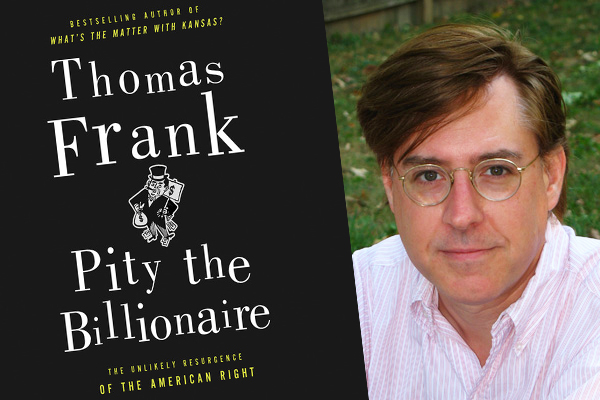

In his new book, “Pity the Billionaire,” Tom Frank turns his mordant eye on the unlikeliest political development of the Obama presidency: how the crash of 2008 served to strengthen the political right. The deregulation of Wall Street, championed for 30 years by right-wing leaders, had led to an economic catastrophe so frightening that the country elected a liberal Democrat to the presidency. Yet two years later, the most conservative faction of the Republican Party, the Tea Party, had taken effective control of the House of Representatives, the regulation of Wall Street had stalled, and the champions of economic deregulation in Washington had emerged stronger than ever.
Frank, author of the bestselling book “What’s the Matter With Kansas?” provides a pithy and nuanced explanation of what he calls the “hard-times swindle.” He spoke with Salon from his father’s home in Kansas City, Mo.
Early in the book, you describe the moment in the spring of 2009 when free-market economics had been so thoroughly discredited that Newsweek could run a cover story proclaiming, “We’re all socialists now.” What happened? Why did that moment dissipate?
I saw that cover so many times [at Tea Party events]. For these people, that rang the alarm bell. I think the AIG moment [when the bailed-out insurance behemoth used taxpayer relief to dole out huge bonuses to its executives] was in some ways the high point of the crisis, when [the politics] could have gone either way. There was this amazing public outrage, and that for me was the turning point. Newsweek had another cover, “Thinking Man’s Guide to Populism,” and I remember this feeling around the country, that people were just furious. Somehow the right captured the sense of anger. They completely captured it. You could say they had no right to it, but they did. And one of the reasons they were able to do it was because the liberals were not interested in that anger.
I’m speaking here of the liberal culture in Washington, D.C. There was no Occupy Wall Street movement [at that time] and there was only people like me on the fringes talking about it. The liberals had their leader in Barack Obama … they had their various people in Congress. But these people are completely unfamiliar with populist anger. It’s an alien thing to them. They don’t trust it, and they have trouble speaking to it. I like Barack Obama, but at the end of the day he’s a very professorial kind of guy. The liberals totally missed the opportunity, and the right was able to grab it.
Looking back on it, I feel like people like myself were part of the problem. We sort of assumed with the Democrats in power, the system would correct itself.
One of the problems with liberalism in this country is that it’s headquartered in Washington and its leaders are a very comfortable class of people. Washington is one of the richest cities in the country, maybe the richest. It’s not a place that feels the crisis, that feels the economic downturn. By and large, the real estate market stayed OK. The city continued to boom. The contracts continued to flow. What we’re talking about here is the failure of modern liberalism. At one time it was a movement of working-class people. The idea that liberals wouldn’t feel economic pain was ridiculous. That’s who liberals were. No more.
You write that after Obama took office, “market populism was the only utopian scheme available to disgruntled Americans.” There was no liberal utopian scheme that said, “Here’s how we get out of this.”
There wasn’t even a Rooseveltian scheme, which was not utopian but very practical. Just to talk about Roosevelt would have been fantastic. One of the research points in the book that I thought was really interesting … was the history of the bailouts in 1932 and 1933 — when the Hoover administration did a lot of bailouts. We don’t remember that. [These bailouts] were massively unpopular for the same reason they were unpopular this time around: really blatant cronyism. We don’t remember that a big part of Franklin Roosevelt’s campaign [in 1932] was to be against these bailouts. There were maybe five newspaper articles in 2008 that mentioned this pre-history of the bailouts. It just never came up.
It was like the party’s muscle memory of the New Deal was lost. With Obama the muscle memory of the Democratic Party is the Clintonian technocracy of the 1990s.
That’s exactly right. Their message was: The technocratic way is going to solve our problems. Just leave it up to the experts who are going to figure a way out. [Obama and the Democrats] seemed to think they didn’t need to dirty their hands by making a populist appeal. They did a lot of good things — the stimulus package of 2008 was good thing — but they didn’t realize you have to sell something like that. They were like, “We know what the answer is: Keynesian stimulus. So let’s just do it.” They didn’t understand that this nation only adopted Keynesian stimulus spending back in the 1930s amidst this terrible wrenching experience, the Depression, and an enormous campaign [by FDR] to tell the nation why this was necessary.
If you don’t sell it — if you just do this spending — well, people have a lot of suspicion of government handouts. Government debt bothers people for very obvious reasons. [Obama] didn’t make any effort to make the argument. It was just “listen to the experts.” I have a quote from [Obama economic advisor] Christy Roemer where she says, “Things would be better if we listened to the experts.” And she’s one of the good guys, one of the best people in the Obama administration. That’s their view.
You have an interesting discussion about how the Tea Party movement mimics what was once the left-wing style. This seems to be the dominant mode: The right is saying, “We’re the revolutionaries. We’re taking on the powers that be.”
At first I thought it was a peculiarity of Glenn Beck, and then I noticed it across the board. They picked up this 1930s style and language, complete with utopianism, with this intense faith in an economic system that will solve all your problems and that represents you perfectly, this miraculous economic system … So [the right] is constantly talking about this infernal elite that controls government, controls corporations, and controls the academy, and that we have to wrench ourselves free.
So maybe it is true that the Obama technocracy is the infernal elite. Maybe not in the hellish way it is portrayed on the right, but in the sense that these are the defenders of bailouts, the defenders of the system.
I wouldn’t go too far with that, because I don’t think that is a way of understanding our modern world that can bear a lot of the weight. It is true that the Democrats completely imagine themselves as being the party of the professional class, and that is an elite. It’s not the elite, but it is an elite. The Democrats very definitely identify with academia. That’s the home of the professions, where they come from.
Still, I think that the conservative idea of revolting against the ruling class by holding up the market as an ideal is completely backwards. There is a ruling class in this country. But the notion that the free market is an act of rebellion against it seems pretty fanciful. I can say it stronger than that. It is absolutely preposterous.
At one point you talk about “a cognitive withdrawal from the shared world.” It seems like the modern digital communication revolution encourages this. “A cognitive withdrawal from the shared world” — that sounds like a description of the Internet.
This is where we’re going. You can now believe things that are demonstrably false and never be challenged, directly or indirectly. You can withdraw. That’s the end that the Internet is constantly pushing us toward. That’s what modern marketing is all about.
So it’s a technological phenomenon, but it’s also an ideological phenomenon, a product of the times we’re in. You saw this in the ’30s, especially on the left. People would be so committed to this economic utopia [communism]. They believed in it, and their faith in it was so great … It is a product of economic collapse. People are desperate. They think their entire way of life is crumbling around them, and they reach for … a utopian system where everything is explained.
This is the genius of Fox News. It is fun to watch, and if you agree with them, it’s very gratifying to watch — and on a level deeper than most TV entertainment. The message is “You’ve worked really hard. You played by the rules and now they’re disrespecting you. They won’t let you say the word ‘Christmas.'”
You finished this book around the time Occupy Wall Street started. Were you surprised by the emergence of the movement?
I was surprised. I thought the left’s moment had passed. That was almost exactly three years after the crash of September 2008, and it seemed like the expiration date had come and gone. I’m very pleased, but in a lot of ways the horse has already left the barn.
Is it possible for the Occupy movement to reverse the gains of the right?
I hope so, but I honestly don’t know. At the end of the day I doubt it. My liberal friends have been doubting the right for decades. They’re always saying, “There’s no way these guys can recover now after this screw-up. People will never come back to them after this.” But they keep coming back.
The right does seems to be a little bit on the defensive at the moment. The dominant narrative of last summer — government spending is the problem — has been lost. Occupy Wall Street has injected a change in discourse. People aren’t defensive when they talk about inequality.
Tell me about it. When I started writing about inequality 10 years ago, it … was not something for NPR Book Talk. It was not quite within the bounds of the acceptable. Now it is. And that’s a huge change.
The main thing that has to change is that Democrats and liberals have to be able to speak to the outrage, and that requires a complete change in the way they look at the world. The problem is that they’ve been going the other direction for 30 years. Ever since the right-wing backlash began, liberals have been making their own move to professionalism. [To voice outrage] would require them to reverse course. I would like to see that happen, but I don’t know how it’s going to happen.
I think one thing has happened: Middle-class or upper-middle-class liberals in Washington, all of a sudden we realize we are insecure. The system is not just screwed up for people out there who we sympathize with. It’s screwed up for us. Economic insecurity is now pervasive even in the professional class.
Professionals are feeling the heat. They’re not insulated from market forces, like the way the professions are supposed to be. The system is not working like that anymore. Maybe that is where the change will come from.
Another thing that I think changed things was the debt-ceiling debacle last summer. That scared everybody, and it was so patently the doing of the Tea Party Republicans in the House. That was a huge turning point.
The hostage taking?
They were holding a gun to the head of the nation’s economy. They did ruin the nation’s bond rating. And you could have had an unthinkable catastrophe if they had done what they were threatening to do. Things like that should be off the table in our politics. That was an outrage in its own way as great as the bailouts. It was a shocking moment.
Yet at the end of the book, you contemplate the right wing in power, and you suggest they might do exactly that — take actions they know would ruin the economy.
They might. They see the financial crisis as something we deserve, that we’ve spent beyond our means, and now we have to pay. In their minds, we need a recession to get back on track. They think we’re due for something like the 1930s, so why not make it happen?
You conclude by saying say that the problems that editorialists fret about — inequality, global warming and financial bubbles — will endure, but so will this utopian market populism, which you describe as chasing “the dream more vivid than life itself.” You have shown how entrenched those impulses are in American politics. Maybe part of the American pursuit of happiness is to “chase the dream more vivid than life itself. “
The right has discovered the magic against relativism. They have long inveighed against relativism, but now they’ve discovered they can say anything. They can endlessly withdraw into this world of utopian fiction and everything can be explained away. It’s like some kid discovering a new video game. It’s so awesome.
So what gives you hope?
I was out in Wisconsin earlier this year, when you had thousands of people surrounding the capitol every day. There were big days when they had a hundred thousand people, and then there were the off days where you had “only” a couple of thousand — and this went for day after day. That was really a hopeful moment for me. It was the predecessor to the Occupy movement. Let’s see if they can make a comeback when it gets warm again. I would love to see it happen.
