
Body Wars
Why is Georgia shaming fat children?
A bold ad campaign claims to target childhood obesity -- but the real target is overweight kids VIDEO
(Credit: strong4life.com) It’s early January, and with ritual New Year’s resolutions following the ritual holiday gorging, everyone is dealing with a heaping portion of fat shame. But this year, the real finger-wagging is aimed at our kids.
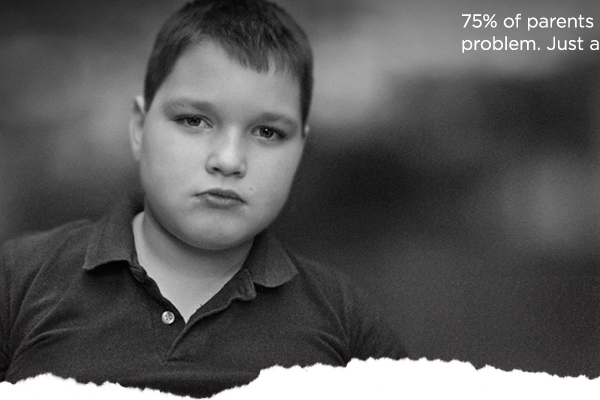
In an attention-getting series of ads sponsored by Children’s Healthcare of Atlanta, grim youngsters stare at us with accusatory eyes. “Warning,” reads one message under a photo of Tina, a chubby female. “It’s hard to be a little girl if you’re not.” In a YouTube spot, Tina admits that “I don’t like going to school, because all the other kids pick on me. It hurts my feelings.” The tag line reads, “Being fat takes the fun out of being a kid.” In another ad, overweight Bobby confronts his plus-size mother. “Mom, why am I fat?” he asks. When we live in a country in which children can be taken from their parents for the “medical neglect” of obesity, maybe it’s time to start looking hard for answers.
When the $50 million Strong 4 Life campaign launched last summer, it was a project born from a genuine and increasingly pressing healthcare crisis. Georgia has the second-highest childhood obesity rate in the nation, and where there’s obesity, there are serious, long-term health repercussions — diabetes, heart disease. But in recent days, fueled by a ramped-up billboard and television presence, the campaign has gained international attention – and criticism.
The obesity epidemic challenges parents and caregivers at every turn. How do we help our children make healthy choices when so many adults are struggling themselves? How do we encourage nutrition when our own government caves to the food industry’s push for cheap, empty fare in our school cafeterias? Children who eat school lunch now stand a 29 percent greater chance of being obese than those who don’t. Phys-ed classes are disappearing, and as many as 40 percent of our schools have done away with recess in the past few years. And at home, Strong 4 Life says that “50 percent of people surveyed did not recognize childhood obesity as a problem and 75 percent of parents with overweight or obese kids did not see their children as having a weight issue.” How can we fix a problem that isn’t just daunting, it’s still barely even acknowledged?
The Strong 4 Life campaign at least confronts the issue head-on. Despite our cultural obsession with weight problems, we still chafe at identifying individuals – especially children — who have them. Calling someone obese is considered a cruel taunt rather than a statement of fact. The unusually frank public service announcements demystify fatness. It’s not a condition reserved for the pathetic, anonymous “creatures” of People of WalMart — it’s an issue our children face in playground jeers today, and with joint problems and sleep apnea tomorrow. As Strong 4 Life’s pitch explains, “We must open our eyes and look around: Kids are now suffering from diseases once seen only in adults. … We must come together as a community and talk about it.”
But what kind of talk? As Marsha Davis, a researcher at the University of Georgia’s College of Public Health, told the Atlanta Journal-Constitution this week, “In terms of the social stigma about weight — it might actually make people feel worse.”
Children’s Healthcare’s Linda Matzigkeit says a new phase of the ad campaign is rolling out soon, but right now it’s just a series of feel-bad messages to “Stop sugarcoating it, Georgia.” Strong 4 Life does include tips for healthier living on its site, but the main thrust of the campaign is stil a horribly misguided focus on what a bummer it is to be fat. Shouldn’t we encourage our kids that being healthy is a positive thing on its own, and not just because “it’s hard to be a little girl” who’s fat? There’s absolutely nothing in a message like that other than the idea that girls are supposed to be “little.” It implies that the teasing young Tina now endures will melt away when she sheds a few pounds. Maybe. But change so you won’t get picked on? That’s a terrible philosophy, especially for the less ectomorphically inclined. Some kids will always be big, even if they’re perfectly healthy. As a Facebook commenter beautifully explained, “Just wanted you to know that you’re doing a horrible thing. Fat kids shouldn’t stop being fat because they get bullied. It’s the bullies that should be stopped.”
We cannot promote health in a culture that reduces human beings – especially very young ones – into stereotypes of big is bad. That is not healthy, productive or loving. We all want our kids to live long, strong lives, fueled on fresh air and nutritious food. But those things are products of accepting who our kids are now and who they can become, at every point on the body-mass index. Because as Marsha Davis told the Atlanta newspaper, “We need to fight obesity, not obese people.”
Mary Elizabeth Williams is a staff writer for Salon and the author of "Gimme Shelter: My Three Years Searching for the American Dream." Follow her on Twitter: @embeedub. More Mary Elizabeth Williams.
Old ladies who didn’t love me
I thought a gym class with elderly women would ease my aging anxiety, but it made me miserable in new ways
“Isn’t it soon for me to be getting arthritis?” I asked my orthopedist. I assumed I had a young person’s pain: an injury, or maybe a cyst.
“No,” he said, then checked my chart again for my age. “No, not at all.”
At 36, I had been preoccupied by my age, and this didn’t help. I’d been looking at every woman’s neck to see when the accordion stretch of the chin would kick in. Could I stave it off a few more years? Had I blown it by not being skinny, so that I couldn’t later gain five pounds to smooth out my wrinkles?
Continue Reading CloseTaffy Brodesser-Akner has written for the New York Times, Los Angeles Times, Self, Redbook, and other publications. More Taffy Brodesser-Akner.
Ashley Judd’s facial war
In a bold new essay, the actress confronts the critics of her body head-on -- and makes some incisive points
Ashley Judd (Credit: Reuters/Jean Amet) Ashley Judd would like you to get out of her face. The 43-year-old actress, activist and sometime controversial memoirist has had a high-profile return to the public eye, with the debut of her new drama “Missing.” And it’s a profile that has been the subject of much snark and WTFing.
In the past few weeks, Radar has lamented that she’s gone from “pretty to puffy” and “fattened her face with fillers” while Us declared her “nearly unrecognizable.” SheKnows hit her even harder, complaining that “the pretty face we’re used to [has been] replaced by a puffy disaster.” And when her reps declared that her swollen look was the result of steroids for a sinus infection, they only fanned the flames, leading The Stir to snap of her “way chubbier than usual” look, “Come on, Ashley, we may be dumb, but we’re not stupid.”
Continue Reading Close
Mary Elizabeth Williams is a staff writer for Salon and the author of "Gimme Shelter: My Three Years Searching for the American Dream." Follow her on Twitter: @embeedub. More Mary Elizabeth Williams.
Fat-shaming a child into a book deal
A mom's horrible dieting strategy for her 7-year-old pays off
Dara-Lynn Weiss with her daughter, Bea.
How could a story that Jezebel last week declared “The Worst Vogue Article Ever” get even more terrible? By becoming a book.
It began with a feature called “Weight Watchers” in the April Vogue, written by Dara-Lynn Weiss. In it, Weiss chronicles her then 7-year-old daughter Bea’s dieting odyssey after the child had “grown fat.” It was a tale that involved putting Bea — who at 4-foot-4 and 93 pounds was veering toward childhood obesity — on an intense regimen of calorie restriction and public shaming. “I once reproachfully deprived Bea of her dinner after learning that her observation of French Heritage Day at school involved nearly 800 calories of Brie, filet mignon, baguette and chocolate,” she writes. “And there have been many awkward moments at parties, when Bea has wanted to eat, say, both cookies and cake, and I’ve engaged in a heated public discussion about why she can’t.”
Continue Reading Close
Mary Elizabeth Williams is a staff writer for Salon and the author of "Gimme Shelter: My Three Years Searching for the American Dream." Follow her on Twitter: @embeedub. More Mary Elizabeth Williams.
Surprised to see me
The biggest shock of losing weight is the (sometimes weird) reaction by my old friends
It’s funny what you notice when you lose 40 pounds. I have noticed, for instance, that it is much easier to get dressed when your clothes actually fit. I have noticed the way certain bones feel underneath my hands (my rib cage, my pelvis) or how I look in the mirrored glass of a store I am passing. I have also noticed how people react to me. Mostly, I have noticed what they say.
“You look healthy!” they exclaim, giving me a hug, or grabbing my shoulders like an aunt at a family reunion. They say it so often and with such enthusiasm that it can have the inverse effect of upsetting me. I can’t help wondering how unhealthy I used to look.
Continue Reading CloseSarah Hepola is an editor at Salon. More Sarah Hepola.
Can a viral video save an obese man?
A 700-pound man begs for his life -- and becomes an online sensation VIDEO
Robert Gibbs (Credit: YouTube screen shot) It’s difficult to watch Robert Gibbs. But it has nothing to do with the fact that he weighs nearly 700 pounds.
In a candid and wrenching plea on the eve of his 23rdbirthday last week, the Livermore, Calif., man did something extraordinary. He braved the mockery and opprobrium of the entire Internet in the calculated hope of “trying to go viral” and turn his life around. In a clip self-explanatorily called “Overweight guy asks for help,” Gibbs explains, “I’m making this video because I don’t know what else to do. I’ve tried losing weight on my own. Tried doing everything possible. Been on diets, been hospitalized. Always done what needed to be done at the time and then I’d just gain the weight back.”
Continue Reading Close
Mary Elizabeth Williams is a staff writer for Salon and the author of "Gimme Shelter: My Three Years Searching for the American Dream." Follow her on Twitter: @embeedub. More Mary Elizabeth Williams.
Page 1 of 21 in Body Wars