
2012 Elections
The men who own the GOP
Shadowy billionaires like Freiss and Adelson are spending record amounts of money on the election
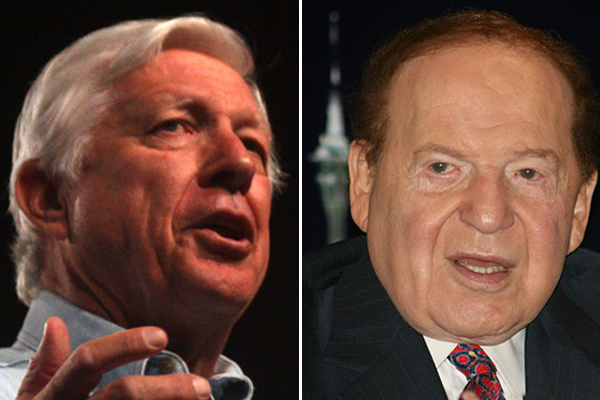
Foster Freiss and Sheldon Adelson (Credit: Wikipedia/Gage Skidmore/Bectrigger) Have you heard of William Dore, Foster Friess, Sheldon Adelson, Harold Simmons, Peter Thiel or Bruce Kovner? If not, let me introduce them to you. They’re running for the Republican nomination for president.
I know, I know. You think Rick Santorum, Newt Gingrich, Ron Paul and Mitt Romney are running. They are – but only because the people listed in the first paragraph have given them huge sums of money to do so. In a sense, Santorum, Gingrich, Paul and Romney are the fronts. Dore et al. are the real investors.
According to January’s Federal Election Commission report, William Dore and Foster Friess supplied more than three-fourths of the $2.1 million raked in by Rick Santorum’s super PAC in January. Dore, president of the Dore Energy Corp. in Lake Charles, La., gave $1 million; Freiss, a fund manager based in Jackson Hole, Wyo., gave $669,000 (he had given the Santorum super PAC $331,000 last year, bringing Freiss’ total to $1 million).
Sheldon Adelson and his wife, Miriam, provided $10 million of the $11 million that went into Gingrich’s super PAC in January. Adelson is chairman of the Las Vegas Sands Corp. Texas billionaire Harold Simmons donated $500,000.
Peter Thiel, co-founder of PayPal, provided $1.7 million of the $2.4 million raised by Ron Paul’s super PAC in January.
Mitt Romney’s super PAC raised $6.6 million last month – almost all from just 40 donors. Bruce Kovner, co-founder of the New York-based hedge fund Caxton Associates, gave $500,000, as did two others. David Tepper of Appaloosa Management gave $375,000. J.W. Marriott and Richard Marriott gave a total of $500,000. Julian Robertson, co-founder of hedge fund Tiger Management, gave $250,000. Hewlett-Packard CEO Meg Whitman gave $100,000.
Bottom line: Whoever emerges as the GOP standard-bearer will be deeply indebted to a handful of people, each of whom will expect a good return on their investment.
And this is just the beginning. We haven’t even come to the general election.
Nonprofit political fronts like Crossroads GPS, founded by Republican political guru Karl Rove, are already gathering hundreds of millions of dollars from big corporations and a few wealthy individuals like billionaire oil and petrochemical moguls David and Charles Koch. The public will never know who or what corporation gave what because, under IRS regulations, such nonprofit “social welfare organizations” aren’t required to disclose the names of those who contributed to them.
Before 2010, federal campaign law and Federal Election Commission regulations limited to $5,000 per year the amount an individual could give to a PAC making independent expenditures in federal elections. This individual contribution limit was declared unconstitutional by the District of Columbia Court of Appeals in a case based on the Supreme Court’s grotesque decision at the start of 2010, Citizens United vs. Federal Election Commission.
Now, the limits are gone. And this comes precisely at a time when an almost unprecedented share of the nation’s income and wealth is accumulating at the top.
Never before in the history of our Republic have so few spent so much to influence the votes of so many.
Robert Reich, one of the nation’s leading experts on work and the economy, is Chancellor’s Professor of Public Policy at the Goldman School of Public Policy at the University of California at Berkeley. He has served in three national administrations, most recently as secretary of labor under President Bill Clinton. Time Magazine has named him one of the ten most effective cabinet secretaries of the last century. He has written 13 books, including his latest best-seller, “Aftershock: The Next Economy and America’s Future;” “The Work of Nations,” which has been translated into 22 languages; and his newest, an e-book, “Beyond Outrage.” His syndicated columns, television appearances, and public radio commentaries reach millions of people each week. He is also a founding editor of the American Prospect magazine, and Chairman of the citizen’s group Common Cause. His widely-read blog can be found at www.robertreich.org. More Robert Reich.
Romney’s Bill Clinton gambit
He's praising the former president to paint Obama as a liberal – and to court his devotees. Why it won't work
(Credit: Reuters/Jim Young) Desperate Mitt Romney is not only taking credit for the auto bailout he opposed, and pretending to be a “job creator” rather than a Bain Capital job destroyer. Now he’s regularly praising former President Bill Clinton as a centrist whose legacy has been betrayed by the “liberal” President Obama. Actual liberals laugh, but can Romney’s gambit work?
Of course not, but Mitt’s not giving up.
In Lansing, Mich. last week, Romney derided Obama as an “old school liberal” compared to Clinton, who he called a “new Democrat.” Where Clinton “said the era of big government was over, President Obama brought it back with a vengeance,” Romney told a crowd of college students. A campaign official told CNN that Obama “really turned his back” on Clinton’s policies, including welfare reform and middle class tax cuts.
Continue Reading CloseJoan Walsh is Salon's editor at large. More Joan Walsh.
This election’s true winner
It won't be Obama or Romney; it'll be the U.S. military -- and it's going to cost us a lot of money
(Credit: nex99 via Shutterstock) Now that Mitt Romney is the presumptive nominee of the Republican Party, the media is already handicapping the presidential election big time, and the neck-and-neck opinion polls are pouring in. But whether President Obama gets his second term or Romney enters the Oval Office, there’s a third candidate no one’s paying much attention to, and that candidate is guaranteed to be the one clear winner of election 2012: the U.S. military and our ever-surging national security state.
Continue Reading CloseBarbers for Romney
Can your job predict your candidate? What small-donor data reveals
(Credit: AP/David Lienemann) Recently, Mitt Romney used a conversation he had with a firefighter as part of his campaign pitch. “I spoke with a fireman yesterday, and he has a one-bedroom apartment, and his wife is pregnant, and he can’t afford a second bedroom,” he told an audience in Virginia. “I asked the firefighters I was meeting with, about 15 of them, how many had had to take another job to make ends meet, and almost every one of them had.”
Just because Romney is a fan of firemen doesn’t mean that firemen are fans of Romney, however: pick a random donor from the Obama and Romney campaigns, and the Obama donor is 10 times as likely to be a firefighter. How do we know this? From campaign finance disclosure data. As it turns out, campaigns must make “best efforts” to obtain the occupation and employer of anyone who contributes more than $200.
Continue Reading CloseDan Kozikowski writes about the intersection of data and everyday life at dfkoz.tumblr.com. More Dan Kozikowski.
Romney’s “vampire capitalism”
Obama's focus on Bain Capital could hurt Romney with working-class white voters and all the economy's victims
Mitt Romney (Credit: Reuters) Former Obama auto “czar” Steve Rattner stepped on his old boss’s message a little Monday morning, telling the folks on “Morning Joe” that President Obama’s just-released ad blasting Mitt Romney’s Bain career was “unfair.” As Rattner explained: “Bain Capital’s responsibility was never to create 100,000 jobs, or some other number, it was to make profits for its investors.” Rattner is a big Democratic Party donor who worked at Lehman Brothers before starting his own private equity firm, Quadrangle (where he was accused of participating in a New York state pension fund kickback scheme and paid millions of dollars in settlements without admitting wrongdoing).
Continue Reading CloseJoan Walsh is Salon's editor at large. More Joan Walsh.
Americans Elect defeated by American indifference
The well-funded group fails to find a superstar moderate candidate
Condoleezza Rice and Michael Bloomberg (Credit: AP) Poor Americans Elect. The well-funded experiment in fielding a third-party presidential candidate selected by the Internet is this close to giving up. It doesn’t have a candidate. It was apparent back in March that none of the declared candidates would meet the threshold of support necessary to qualify it for the online primary votes scheduled for May. Since then, no white knight has emerged.
Continue Reading Close
Alex Pareene writes about politics for Salon and is the author of "The Rude Guide to Mitt." Email him at apareene@salon.com and follow him on Twitter @pareene More Alex Pareene.
Page 1 of 199 in 2012 Elections

