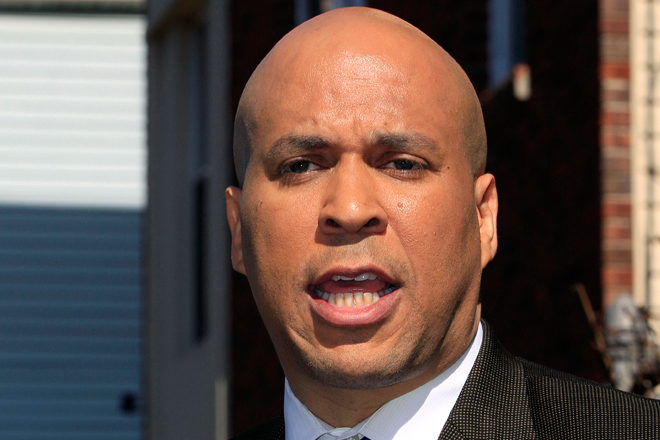

Cory Booker goes on food stamps

The Newark mayor goes on a food-stamp diet to show us what poverty tastes like

Topics: Cory Booker, Newark, Twitter, Food, Mario Batali, SNAP Challenge, Food Stamps, Nutrition, hunger,

Cory Booker goes on food stamps (Credit: AP/Mel Evans)

Cory Booker is a rare and unique brand of politician. Cory Booker is a human being. Since taking office in 2006, the mayor of Newark has made a name for himself for his role in lowering his city’s crime rate and squeezing a cool $100 mil out of Mark Zuckerberg for the public schools. He’s also, not insignificantly, one of the liveliest, most compelling public figures on Twitter. Which is where his latest escapade begins.

On Nov. 18, the mayor busted out a little Plutarch for his Twitter followers, quoting, “An imbalance between rich and poor is the oldest and most fatal ailment of all republics.” Those were fighting words to some who took umbrage with the notion, prompting Booker to follow up: “We pay 4 HUGE back end govt programs: prisons, police, etc. If we invested in Schools, nutrition, etc we’d save $ & create wealth.”

And though @MwadeNC, a self-proclaimed “Daughter of the American Revolution (DAR), fighting against any and all forms of socialism/communism. Army Veteran, Army Daughter, Army Wife” — a person whose Twitter wallpaper of friends consists of a lot of “WAR ON MARXIST THUGS” and “I’m the NRA” — probably didn’t mean it as a challenge, she nonetheless shot back that “Nutrition is not a responsibility of the government.” Booker replied, “We have a shared responsibility that kids go to school nutritionally ready 2 learn,” prompting MwadeNC to say that food stamps should cover breakfast. That’s when it got interesting. “Lets you and I try to live on food stamps in New Jersey (high cost of living),” he told her, “and feed a family for a week or month. U game?”

The woman, who’s since protected her tweets, agreed, but it’s Booker, whose journey started Tuesday morning, whom people will be watching. Though he’s doing it within a livable parameter of just a week, his budget is only $30. (He’s not getting it from food stamps, by the way; it’s coming out of his own pocket. He’s also refusing all invites where he’d be given food.) On Monday, Booker kicked off the party and posted a photo of a crumpled Pathmark receipt. Dude’s going to be eating a lot of beans. Good thing he’s a vegetarian.


Booker’s been guided by the University of Bridgeport’s SNAP Food Challenge, which invites people to eat for a week on the same budget as someone receiving food stamps, and eat only from what’s purchased during the challenge. As the university explains, “This budget translates to $5 per day, or $1.66 per meal.” Previous SNAP Challenge participants have included Las Vegas Mayor Carolyn Goodman, Philadelphia Mayor Michael Nutter, Phoenix Mayor Greg Stanton, Colorado Gov. John Hickenlooper and Mario Batali, who summed up the experience last spring by saying, “I’m fucking starving.” These, by the way, are people who, like Booker, are knowledgeable about food and cooking and who have access to fresh, nutritious food in their supermarkets. Consider how much more of a feat it is to feed a family when you’re in an economically stressed area where, as a video from Internets Celebrities revealed a few years back, your main grocery option is the snack cakes and blue-juice-laden local bodega.

New Jersey residents on food stamps receive an average of $133.26 a month. ABC News reports that a study released on Tuesday says that “almost a third of American adults went hungry or worried about someone close to them going hungry this year.” So why, in a nation of so much want, would a man voluntarily go hungry?

It’s not just because Cory Booker is supremely skilled social navigator, a man who knows a golden opportunity to seize a random comment and turn it into an event.  In a blog post on “A Movement Toward Food Justice,” he explains, with passion, reason and eloquence, his reasons for doing this: “To raise awareness and understanding of food insecurity; reduce the stigma of SNAP participation; elevate innovative local and national food justice initiatives and food policy; and, amplify compassion for individuals and communities in need of assistance.”

We stigmatize the poor. We shame them. We call them fat and lazy, equating poverty with bad choices, demanding to know how you can be hungry when you look unhealthy. We let kids go to school with empty bellies and shrug that the failure is a parental one and not a social one. Deciding to dine on a radically slashed budget doesn’t eradicate hunger, but it’s a call to empathy, for all of us. It’s a dare to be compassionate. It’s an acknowledgment that we all put our mouths where our money is, and how different that experience is when you’re doing it on just $30 a week.

Mary Elizabeth Williams

Mary Elizabeth Williams is a staff writer for Salon and the author of "Gimme Shelter: My Three Years Searching for the American Dream." Follow her on Twitter: @embeedub.

Featured Slide Shows

7 motorist-friendly camping sites

close X
  • Share on Twitter
  • Share on Facebook
  • Thumbnails
  • Fullscreen
  • 1 of 9

Sponsored Post

  • White River National Forest via Lower Crystal Lake, Colorado
    For those OK with the mainstream, White River Forest welcomes more than 10 million visitors a year, making it the most-visited recreation forest in the nation. But don’t hate it for being beautiful; it’s got substance, too. The forest boasts 8 wilderness areas, 2,500 miles of trail, 1,900 miles of winding service system roads, and 12 ski resorts (should your snow shredders fit the trunk space). If ice isn’t your thing: take the tire-friendly Flat Tops Trail Scenic Byway — 82 miles connecting the towns of Meeker and Yampa, half of which is unpaved for you road rebels.
    fs.usda.gov/whiteriveryou


    Image credit: Getty

  • Chattahoochee-Oconee National Forest via Noontootla Creek, Georgia
    Boasting 10 wildernesses, 430 miles of trail and 1,367 miles of trout-filled stream, this Georgia forest is hailed as a camper’s paradise. Try driving the Ridge and Valley Scenic Byway, which saw Civil War battles fought. If the tall peaks make your engine tremble, opt for the relatively flat Oconee National Forest, which offers smaller hills and an easy trail to the ghost town of Scull Shoals. Scaredy-cats can opt for John’s Mountain Overlook, which leads to twin waterfalls for the sensitive sightseer in you.
    fs.usda.gov/conf


    Image credit: flickr/chattoconeenf

  • Nordhouse Dunes Wilderness Area via Green Road, Michigan
    The only national forest in Lower Michigan, the Huron-Mainstee spans nearly 1 million acres of public land. Outside the requisite lush habitat for fish and wildlife on display, the Nordhouse Dunes Wilderness Area is among the biggest hooks for visitors: offering beach camping with shores pounded by big, cerulean surf. Splash in some rum and you just might think you were in the Caribbean.
    fs.usda.gov/hmnf


    Image credit: umich.edu

  • Canaan Mountain via Backcountry Canaan Loop Road, West Virginia
    A favorite hailed by outdoorsman and author Johnny Molloy as some of the best high-country car camping sites anywhere in the country, you don’t have to go far to get away. Travel 20 miles west of Dolly Sods (among the busiest in the East) to find the Canaan Backcountry (for more quiet and peace). Those willing to leave the car for a bit and foot it would be remiss to neglect day-hiking the White Rim Rocks, Table Rock Overlook, or the rim at Blackwater River Gorge.
    fs.usda.gov/mnf


    Image credit: Getty

  • Mt. Rogers NRA via Hurricane Creek Road, North Carolina
    Most know it as the highest country they’ll see from North Carolina to New Hampshire. What they may not know? Car campers can get the same grand experience for less hassle. Drop the 50-pound backpacks and take the highway to the high country by stopping anywhere on the twisting (hence the name) Hurricane Road for access to a 15-mile loop that boasts the best of the grassy balds. It’s the road less travelled, and the high one, at that.
    fs.usda.gov/gwj


    Image credit: wikipedia.org

  • Long Key State Park via the Overseas Highway, Florida
    Hiking can get old; sometimes you’d rather paddle. For a weekend getaway of the coastal variety and quieter version of the Florida Keys that’s no less luxe, stick your head in the sand (and ocean, if snorkeling’s your thing) at any of Long Key’s 60 sites. Canoes and kayaks are aplenty, as are the hot showers and electric power source amenities. Think of it as the getaway from the typical getaway.
    floridastateparks.org/longkey/default.cfm


    Image credit: floridastateparks.org

  • Grand Canyon National Park via Crazy Jug Point, Arizona
    You didn’t think we’d neglect one of the world’s most famous national parks, did you? Nor would we dare lead you astray with one of the busiest parts of the park. With the Colorado River still within view of this cliff-edge site, Crazy Jug is a carside camper’s refuge from the troops of tourists. Find easy access to the Bill Hall Trail less than a mile from camp, and descend to get a peek at the volcanic Mt. Trumbull. (Fear not: It’s about as active as your typical lazy Sunday in front of the tube, if not more peaceful.)
    fs.usda.gov/kaibab


    Image credit: flickr/Irish Typepad

  • As the go-to (weekend) getaway car for fiscally conscious field trips with friends, the 2013 MINI Convertible is your campground racer of choice, allowing you and up to three of your co-pilots to take in all the beauty of nature high and low. And with a fuel efficiency that won’t leave you in the latter, you won’t have to worry about being left stranded (or awkwardly asking to go halfsies on gas expenses).


    Image credit: miniusa.com

  • Recent Slide Shows

  • Share on Twitter
  • Share on Facebook
  • Thumbnails
  • Fullscreen
  • 1 of 9

Comments

18 Comments

Comment Preview

Your name will appear as username ( settings | log out )

You may use these HTML tags and attributes: <a href=""> <b> <em> <strong> <i> <blockquote>