



America is the richest country on Earth. We have the most millionaires, the most billionaires and our wealthiest citizens have garnered more of the planet’s riches than any other group in the world. We even have hedge fund managers who make in one hour as much as the average family makes in 21 years!
This opulence is supposed to trickle down to the rest of us, improving the lives of everyday Americans. At least that’s what free-market cheerleaders repeatedly promise us.
Unfortunately, it’s a lie, one of the biggest ever perpetrated on the American people.
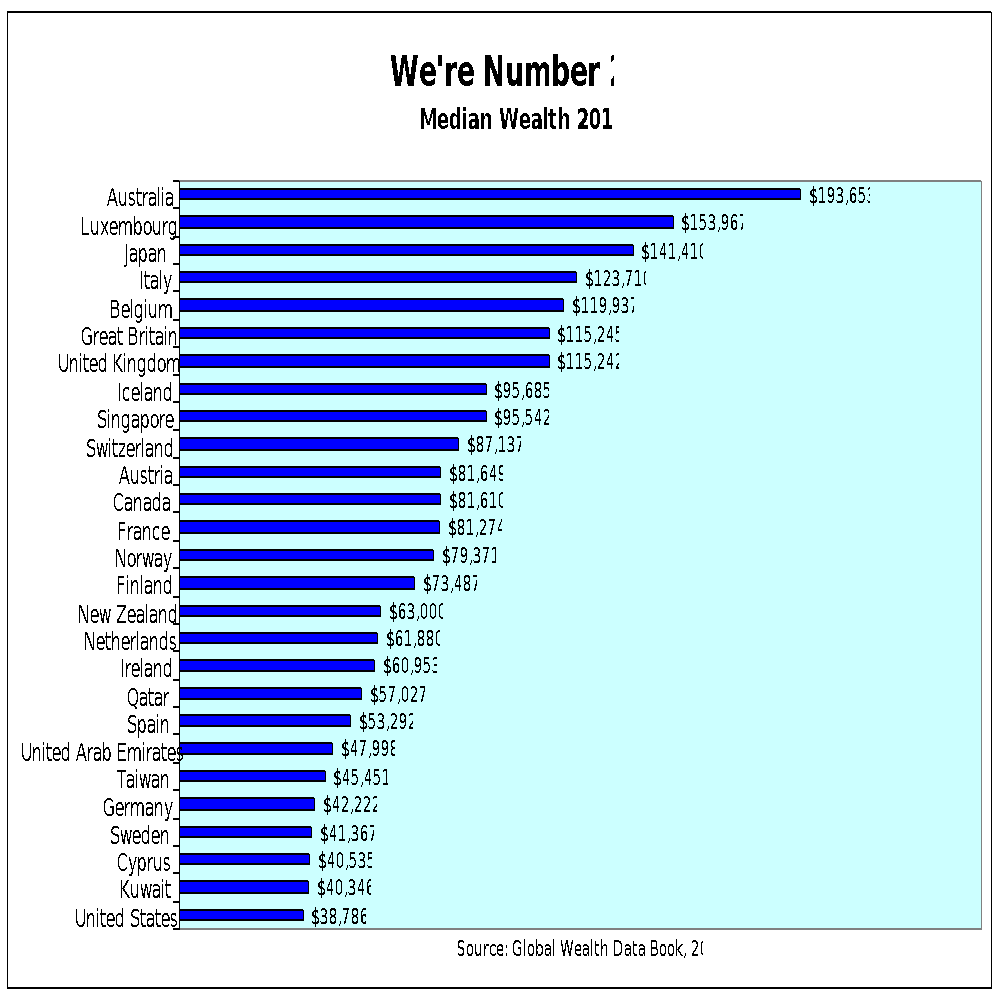
Our middle class is falling further and further behind in comparison to the rest of the world. We keep hearing that America is number one. Well, when it comes to middle-class wealth, we’re number 27.
The most telling comparative measurement is median wealth (per adult). It describes the amount of wealth accumulated by the person precisely in the middle of the wealth distribution—50 percent of the adult population has more wealth, while 50 percent has less. You can’t get more middle than that.
Wealth is measured by the total sum of all our assets (homes, bank accounts, stocks, bonds etc.) minus our liabilities (outstanding loans and other debts). It the best indicator we have for individual and family prosperity. While the never-ending accumulation of wealth may be wrecking the planet, wealth also provides basic security, especially in a country like ours with such skimpy social programs. Wealth allows us to survive periods of economic turmoil. Wealth allows our children to go to college without incurring crippling debts, or to get help for the down payment on their first homes. As Billie Holiday sings, “God bless the child that’s got his own.”
Well, it’s a sad song. As the chart below shows, there are 26 other countries with a median wealth higher than ours (and the relative reduction of U.S. median wealth has done nothing to make our economy more sustainable).
Why?
Here’s a starter list:
-
We don’t have real universal healthcare. We pay more and still have poorer health outcomes than all other industrialized countries. Should a serious illness strike, we also can become impoverished.
-
Weak labor laws undermine unions and give large corporations more power to keep wages and benefits down. Unions now represent less than 7 percent of all private sector workers, the lowest ever recorded.
-
Our minimum wage is pathetic, especially in comparison to other developed nations. (We’re # 13.) Nobody can live decently on $7.25 an hour. Our poverty-level minimum wage puts downward pressure on the wages of all working people. And while we secure important victories for a few unpaid sick days, most other developed nations provide a month of guaranteed paid vacations as well as many paid sick days.
-
Wall Street is out of control. Once deregulation started 30 years ago, money has gushed to the top as Wall Street was free to find more and more unethical ways to fleece us.
-
Higher education puts our kids into debt. In most other countries higher education is practically tuition-free. Indebted students are not likely to accumulate wealth anytime soon.
-
It’s hard to improve your station in life if you’re in prison, often due to drug-related charges that don’t even exist in other developed nations. In fact, we have the largest prison population in the entire world, and we have the highest percentage of minorities imprisoned. “In major cities across the country, 80% of young African Americans now have criminal records” (from Michelle Alexander’s 2010 book, The New Jim Crow: Mass Incarceration in the Age of Colorblindness).
-
Our tax structures favor the rich and their corporations that no longer pay their fair share. They move money to foreign tax havens, they create and use tax loopholes, and they fight to make sure the source of most of their wealth—capital gains—is taxed at low rates. Meanwhile the rest of us are pressed to make up the difference or suffer deteriorating public services.
-
The wealthy dominate politics. Nowhere else in the developed world are the rich and their corporations able to buy elections with such impunity.
-
Big Money dominates the media. The real story about how we’re getting ripped off is hidden in a blizzard of BS that comes from all the major media outlets…brought to you by….
-
America encourages globalization of production so that workers here are in constant competition with the lower-wage workers all over the world as well as with highly automated techonologies.
Is there one cause of the middle-class collapse that rises above all others?
Yes. The International Labor organization produced a remarkable study (Global Wage Report 2012-13) that sorts out the causes of why wages have remained stagnant while elite incomes have soared. The report compares key causal explanations like declining bargaining power of unions, porous social safety nets, globalization, new technologies and financialization.
Guess which one had the biggest impact on the growing split between the 1 percent and the 99 percent?
Financialization!
What is that? Economist Gerald Epstein offers us a working definition:
“Financialization means the increasing role of financial motives, financial markets, financial actors and financial institutions in the operation of the domestic and international economies.”
This includes such trends as:
-
The corporate change during the 1980s to make shareholder value the ultimate goal.
-
The deregulation of Wall Street that allowed for the creation of a vast array of new financial instruments for gambling.
-
Allowing private equity firm to buy companies, load them up with debt, extract enormous returns, and then kiss them goodbye.
-
The growth of hedge funds that suck productive wealth out of the economy.
-
The myriad of barely regulated world financial markets that finance the globalization of production, combined with so-called “free trade” agreements.
-
The increased share of all corporate profits that go to the financial sector.
-
The ever increasing size of too-big-to-fail banks.
-
The fact that many of our best students rush to Wall Street instead of careers in science, medicine or education.
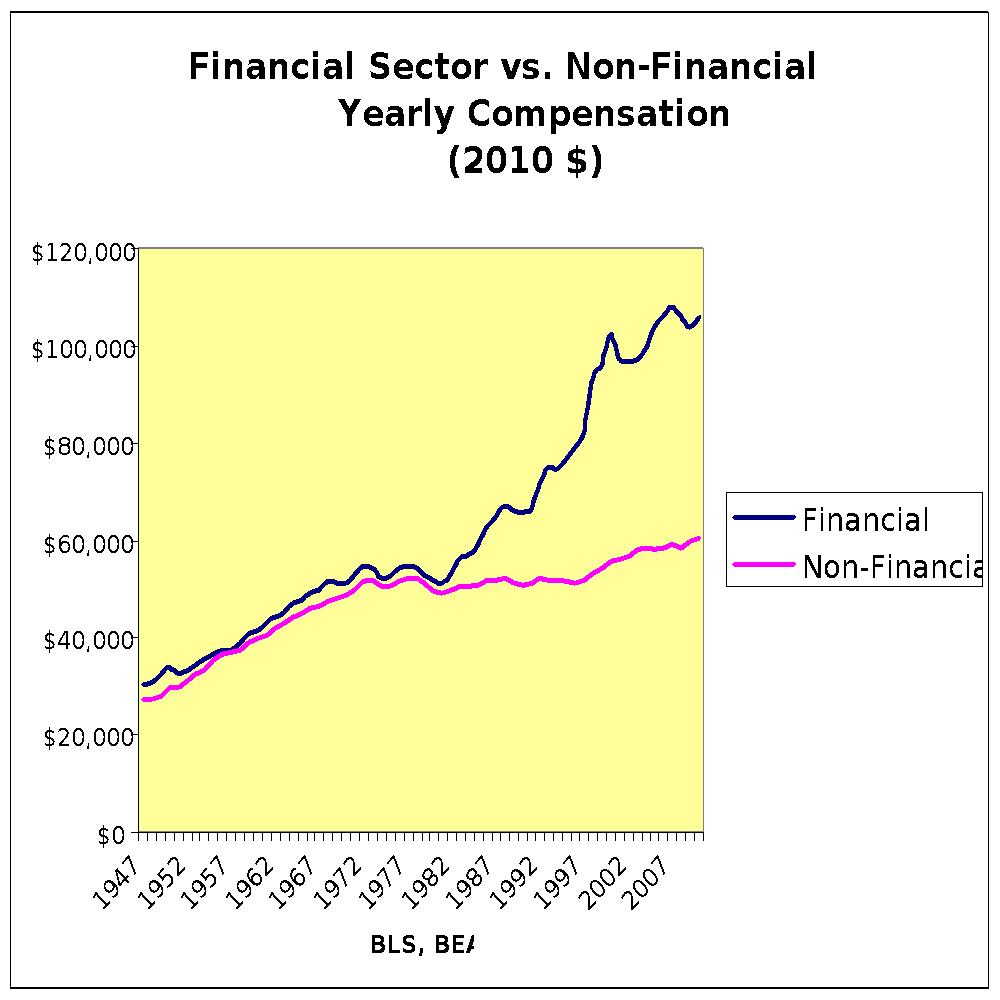
In short, financialization is when making money from money becomes more important that providing real goods and services. Here’s a chart that says it all. Once we unleashed Wall Street, their salaries shot up, while everyone else’s stood still.
Do we still know how to fight!
The carefully researched ILO study provides further proof that Occupy Wall Street was right on the money. OWS succeeded (temporarily), in large part, because it tapped into the deep reservoir of anger toward Wall Street felt by people all over the world. We all know the financiers are screwing us.
Then why didn’t OWS turn into a sustained, mass movement to take on Wall Street?
One reason it didn’t grow was that the rest of us stood back in deference to the original protestors instead of making the movement our own. As a result, we didn’t build a larger movement with the structures needed to take on our financial oligarchs. And until we figure out how to do just that, our nation’s wealth will continue to be siphoned away.
Our hope, I believe, lies in the young people who are engaged each day in fighting for the basic human rights for all manner of working people—temp workers, immigrants, unionized, non-union, gays, lesbians, transgender—as well as those who are fighting to save the planet from environmental destruction. It’s all connected.
At some point these deeply committed activists also will understand that financialization both here and abroad stands in the way of justice and puts our planet at risk. When they see the beast clearly, I am confident they will figure out how to slay it.
The sooner, the better.
