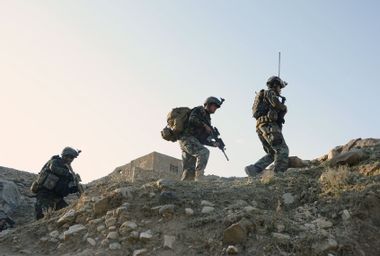
The House on Wednesday soundly rejected an effort by anti-war lawmakers to force a withdrawal of all U.S. troops from Afghanistan by the end of the year.
The outcome of the vote, 356-65 against the resolution, was never in doubt. But the 3 1/2 hours of debate did give those who oppose President Barack Obama's war policies a platform to vent their frustrations.
Opposing the resolution was easy for almost all Republicans, who have been solidly behind Obama's decision to increase U.S. troop strength in Afghanistan from 70,000 to 100,000. Only five Republicans supported the measure.
It was a harder vote for some Democrats, particularly in an election year where opposing the war can be equated with opposing the troops. Several expressed discomfort with a war that has lasted 8 1/2 years and cost the nation more than 930 American lives and the treasury more than $200 billion, but said they were voting against the resolution because it was ill-timed and unrealistic.
Among the 'no' voters was Rep. Patrick Kennedy, D-R.I., who gave an impassioned speech. The U.S. policy of needlessly sending troops into harm's way was "shameful," Kennedy said. He also lambasted the national media, calling their lack of attention to the loss of life in Afghanistan "despicable."
Rep. Dennis Kucinich, D-Ohio, authored the resolution that would have directed the president to remove all U.S. troops from Afghanistan within 30 days of its adoption. If the president deemed that deadline unsafe, he would have had until the end of the year to end U.S. military presence in the nation.
Obama has said he wants to begin withdrawing U.S. troops from Afghanistan starting in July 2011.
Kucinich based his resolution on the 1973 War Powers Act, passed during the Vietnam War era to require the president to obtain congressional approval when he sends troops to a conflict for more than 90 days.
Congress authorized the use of military force to fight terrorists in 2001, after the Sept. 11 attacks, but Kucinich said both the Bush and Obama administrations had wrongfully used that authority as carte blanche to circumvent the role of Congress in sending Americans to war.
"Unless this Congress acts to claim its constitutional responsibility, we will stay in Afghanistan for a very, very long time at great cost to our troops and to our national priorities," Kucinich said.
Republicans warned that a precipitous withdrawal would be a serious mistake, allowing the Taliban to regain power and assuring that al-Qaida and other terrorist groups would again have a staging ground to launch attacks against the U.S. and the West.
"In the case of Afghanistan, President Obama has demonstrated great responsibility and a sense of the national security interests of the United States," said Rep. Lincoln Diaz-Balart, R-Fla. "He deserves our support."
In the middle were Democrats such as Rep. Earl Blumenauer of Oregon, who voted against the resolution despite "profound reservations" about committing troops and vast resources to one of the world's most corrupt nations. He said the debate was essential, "even though I don't agree with the resolution that somehow we're going to be able to pull the plug and be able to end this in 30 days or 30 weeks."
------
The bill is H. Con. Res. 248.
On the Net:
Congress: http://thomas.loc.gov
Gen. David Petraeus, a straight shooter, admitted on "Meet the Press" Sunday that the Afghanistan war will take years and incur high casualties. His implicit defense of President Obama from Dick Cheney on the issues of torture and closing Guantanamo will make bigger headlines, but sooner or later the American public will notice the admission. The country is now evenly divided between those who think the U.S. can and should restore a modicum of stability before getting out, and those who want a quick withdrawal. The Marjah Campaign, the centerpiece of the new counter-insurgency strategy, is over a week old, and some assessment of this new, visible push by the U.S. military in violent Helmand Province is in order.
There was never any doubt that the U.S. and NATO would win militarily, fairly easily occupying Marjah and nearby Nad Ali. Marjah at 85,000 or so is a city smaller than Ann Arbor, Michigan. The campaign is only significant in a larger social and political context. The questions are:
1. Can the stategy of Gen. Stanley McChrystal, of taking, clearing, holding and building be extended deep into the Pashtun regions? Marjah is only a stepping stone to the key southern city of Qandahar, which has a population of a million, more the size of Detroit.
This outcome has yet to be seen. But for rural Pashtuns to come to love foreign occupiers is an unlikely proposition. Even the Wall Street Journal admits that in Marjah, the Marines are not exactly feeling the love from the civilians they have supposedly just liberated. Since the Taliban are typically not as corrupt as the warlords, in fact, to any extent that the US and NATO re-install corrupt warlord types in power, they may alienate the locals. And keeping civilian casualties low so as to win hearts and minds is key here. That task will become more difficult as the U.S. inserts itself more deeply into Pashtun territory, since insurgent villages will have to be defeated. The Soviet occupation produced 5 million externally displaced and 2 million internally displaced, along with hundreds of thousands dead. A campaign in Qandahar could easily displace half a million people, and they might mind. Meanwhile, on Monday, the governor of Dai Kundi asserted that a U.S. airstrike killed 27 persons, mostly civilians. There is also the question, raised by Tom Englehardt, of whether the U.S. is capable of good governance in Afghanistan when it is not in Washington, DC.
2. Can the demonstration of vitality and of a sense of progress mollify NATO publics long enough to fight a prolonged war and do intensive training of troops and police over several years?
No. Over the weekend, the center-right government of the Netherlands fell over whether to keep Dutch troops in Afghanistan. The Afghanistan war is universally unpopular in continental Europe, and governments have troops there mostly in the teeth of popular opposition, because NATO invoked article 5 of its charter, "an attack on one is an attack on all" with regard to the Taliban and al-Qaeda in Afghanistan after the September 11, 2001, attacks. It may take months after the next elections this spring for the Dutch to form a new government, in part because of the surging popularity of the far-right populist anti-Muslim "Freedom Party" of Islamophobe Geert Wilders -- a smelly party the others will probably not want in their coalition. Holland's 2000 troops are likely to be withdrawn by late summer. Canada's military is also departing Afghanistan. Are these one-off situations, or are they the beginning of a NATO withdrawal over-all, which will leave Obama in the lurch? Australia is already refusing to take up the Dutch slack, and its government is under public pressure to get out, itself. While it is entirely possible that scandal-plagued rightwing billionaire Silvio Berlusconi will survive the next elections in Italy, it is also possible that he will not, and his successor may well want out of the unpopular Afghanistan quagmire. Moreover, the Pashtun insurgents may smell blood in the water with the Dutch withdrawal from Uruzgan (the home province of Mullah Omar), and target the smaller NATO contingents (the deaths of six Italian troops last fall raised public ire against the war).
There are about 45,000 NATO and other allied troops in Afghanistan, and 74,000 American. Obama wanted to increase the European contingent by 10,000, but NATO generally declined that offer, and now the NATO contingent may begin to shrink just when more trainers in particular are desperatedly needed. The Afghanistan National Army is supposedly nearly 100,000 strong, but many critics say the true number is half that, and that even that half is mostly illiterate, poorly trained, and often suffers from uncertain loyalties, drug use, or other debilitating considerations.
3. Can an Afghan army be stood up in short order that has the capacity to patrol independently and keep order after the U.S. and NATO troops withdraw?
Unlikely. The answer to the question about Afghan military preparedness-- after nearly a decade of training and an investment of $1 billion that Afghan troops are not ready for prime time. In the Marjah campaign, they showed no initiative, no ability to fight independently. They are poorly served by their junior field officers, and they are 90% illiterate. (The Times' reporter expected to see them with maps out planning approaches!) The ethnic make-up of the particular Afghanistan National Army units sent into Marjah is also not clear. Almost no ANA troops hail from Helmand Province, and Tajiks (native speakers of Dari Persian, often from towns and cities) are vastly over-represented in the army. There is often bad blood between Tajiks and Pashtuns, the group that predominates in Marjah. The same skill set of the ANA most prized by the U.S. Marines during the assault-- the ability to sniff out which households are Taliban -- may be a liability in the holding and building phase, since it stems from a decade and a half of Tajik Northern Alliance battles against the Taliban.
4. Can the Afghan public, which includes many groups (Tajiks, Hazaras, Uzbeks) deeply harmed by Taliban rule, accept reconciliation, as well?
Unlikely. Former Northern Alliance leader popular among Tajiks, Abdullah Abdullah, warned Karzai against reconciling with the Taliban this weekend. Abdullah dropped out of last fall's presidential contest in protest against alleged ballot fraud in Karzai's favor. There is general hostility toward reconciliation with the Taliban among the parties representing northern, non-Pashtun ethnic groups.
5. Can so much pressure be put on the Taliban that at least their middle and lower ranks will accept reconciliation with the Karzai government?
So far, there is no sign that the Taliban leadership still at large is interested in negotiations. A Taliban spokesman replied to Afghan President Hamid Karzai's call for reconciliation with Kabul over the weekend with a resounding "No!" Qari Muhammad Yusuf Ahmadi told the Afghan Islamic Press in Pashto that the Taliban would cease fighting when there were not further foreign troops in his country. He said, according to the translation in The News:
The entire world knows that foreign forces have invaded Afghanistan and occupied this country. They have also started the fighting. Taliban will neither lay down weapons nor will hold talks with Karzai administration even in the presence of a single foreign soldier in Afghanistan. . .
The ongoing war in Afghanistan is between Afghans and foreigners. The responsibility of the war lies on the foreigners and their slaves. They continue fighting in the populated areas and have sent 15000 troops to small area like Marja; and are killing civilians and trying to impose infidels on Afghans.
Karzai himself has no power. The foreigners control everything and the nation is fighting against them.
Commenting on the deaths of 12 civilians in Marjah, Qari Muhammad said: "Karzai should have said who martyred the people. In fact neither Taliban kill the people and nor destroy their houses. These are foreigners who are bombing the houses and killing civilians everywhere as they have brought miseries to the people of Marja."
On the other hand, those members of the Taliban shadow government now in Pakistani custody may be less categorical. A third Taliban commander, Maulvi Kabir (the shadow governor of Nangarhar Province) has been captured by the Pakistani military, allegedly based on information provided by Mullah Abdul Ghani Baradar. Baradar, the military chief of staff for the Old Taliban of Mullah Omar, was picked up recently in Karachi in a joint operation of the Pakistani Inter-Services Intelligence and U.S. intelligence, which picked up signals from Baradar. Serious inroads are being made by these arrests into the Taliban 'shadow government' of officials who plan out roadside bombings and other attacks in specific provinces of Afghanistan while hiding out in Pakistan.
Pakistan's Prime Minister, Riza Yusuf Gilani, and the military chief of state, Gen. Ashfaq Kayani, appear to believe that capturing these high Afghan Taliban leaders will give Islamabad leverage in a negotiated settlement of the contest between the Karzai government and the Pashtun religious far right, which is in insurgency.
Obama's Afghanistan escalation among the sullen Pashtuns is a desperate policy, as dangerous as attempting to build a series of sand castles on the beach at high tide.
Ironically, his bigger success has come in Pakistan, where he appears to have convinced the Pakistani elite to intervene decisively against their own, Pakistani Taliban, and also now to begin arresting the Old Taliban shadow government that is hiding out on Pakistani soil. If he can go further and convince Islamabad that its support of the Afghan Taliban was all a long a key strategic error that has blown back on Pakistan proper, he will thereby come closer to victory than he could by any military measures inside Afghanistan itself.
"I am in control here in the White House." -- Secretary of State Alexander Haig, 1981
Ah, the good old days when even a big shot like Gen. Al Haig, who died early Saturday, could get in trouble for such mavericky declarations that defy basic constitutional precedents.
In the 21st century, that's ancient history. We've so idealized cowboy-style rebellion in matters of war and law enforcement that "going Haig" is today honored as "going rogue." Defiance, irreverence, contempt -- these are the moment's most venerated postures, no matter how destructive or lawless.
The Bush administration's illegal wiretapping and torture sessions were the most obvious examples of the rogue sensibility on steroids. But then came McCain-Palin, a presidential ticket predicated almost singularly on the rogue brand. And now, even in the Obama era, that brand pervades.
It began reemerging in September with Gen. Stanley McChrystal's Afghan escalation plan. McChrystal didn't just ask President Obama for more troops -- protocol-wise, that would have been completely appropriate. No, McChrystal went rogue, preemptively leaking his request to the media, then delivering a public address telling Obama to immediately follow his orders.
Incredibly, few politicians or pundits raised objections to McChrystal's behavior. Worse, rather than firing McChrystal, Obama meekly agreed to his demands, letting Americans know that when it comes to foreign policy, the rogue general -- not the popularly elected president -- is in control in the White House.
Of course, while McChrystal's insubordination was extra-constitutional in spirit, he at least made the effort to obtain the commander-in-chief's rubber-stamp approval. The same cannot be said for the rogues inside Obama's Drug Enforcement Agency (DEA).
Recall that one year ago, Obama instructed the DEA to follow his campaign pledge and respect local statutes legalizing medicinal marijuana. When the DEA kept raiding pot dispensaries in states that had passed such laws, Attorney General Eric Holder reiterated the cease and desist decree, stating that "What (Obama) said during the campaign is now American policy."
As even more raids nonetheless continued, the Justice Department then issued an explicit memo ordering federal agents to refrain from prosecuting those who are in "compliance with existing state laws providing for the medical use of marijuana."
And yet the DEA has recently intensified its crackdown. Here in Colorado -- where voters enshrined medical marijuana's legality in our state constitution -- the feds not only raided two dispensaries, but did so in a way that deliberately humiliated their superiors.
In January, the DEA stormed a company that performs cannabis quality tests. The firm’s alleged infraction? Following protocol and formally applying for a federal equipment license. DEA rogues responded to the request not with thanks or -- heaven forbid -- approval, but instead with the gestapo.
This was topped last week when DEA agents arrested a medical marijuana grower who dared discuss his business with a local news outlet. Sensing a P.R. opportunity, DEA agent Jeffrey Sweetin used the spectacle to insist that he will not listen to stand-down directives from his bosses.
"The time is coming when we go into a dispensary, we find out what their profit is, we seize the building and we arrest everybody," Sweetin menacingly intoned.
Once again, a rogue going wild and once again, tacit acceptance. Rather than personnel changes reining in the out-of-control agency, the president has nominated the acting Bush-appointed DEA administrator, Michele Leonhart, to a full term.
The message, then, should be clear: If you're looking for who is "in control" of our military and police forces, don't look to the established chain of command and don't look to constitutional provisions that mandate civilian authority over the government bayonet. Look to the most reckless rogues -- it's a good bet they're the ones running the show.
David Sirota is the author of the best-selling books "Hostile Takeover" and "The Uprising." He hosts the morning show on AM760 in Colorado and blogs at OpenLeft.com. E-mail him at ds@davidsirota.com or follow him on Twitter @davidsirota.
© 2010 Creators.com
"Medic!" Bullets cracked through the dry grass. Medic!"
"Who's hit?" someone yelled. The American soldiers were pinned down in a ditch Sunday, bodies prone in the mud.
"I don't know!" another voice shouted in the din of gunfire.
A U.S. soldier was down, shot in the chest by an insurgent near the besieged Taliban stronghold of Marjah. A Canadian soldier in the same patrol took a bullet in the front of his helmet, right where the center of his forehead was, like a bull's-eye. He was stunned, but unhurt.
Where were the insurgents shooting from? Which of the mud-walled compounds up ahead?
The firefight in the Badula Qulp region of Helmand province lasted about 45 minutes and tapered off after a Cobra helicopter shot a Hellfire missile into the building where the Taliban were believed hiding. Soldiers said they found the body of one suspected insurgent and heard another may have been buried quickly
It was a small skirmish in the grand scheme of the Afghan war. The focus of the fighting was to the southwest in Marjah, where U.S. Marines launched an offensive a day earlier.
But the intense gunfight showed the difficulty of fighting an enemy who knows the terrain, watches, waits and strikes when it chooses -- frequently appearing to capitalize on Western rules designed to prevent civilian casualties.
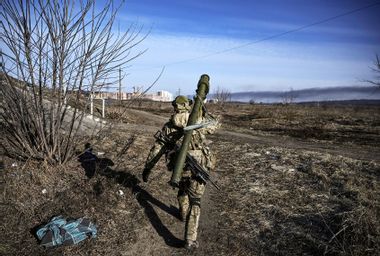
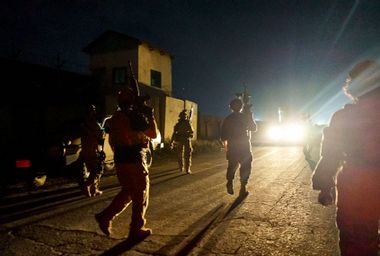
The patrol began in the early afternoon, heading off a canal road and into farmland to the west. Fifty men: an American platoon, up to 30 Afghan soldiers and 10 Canadian troops who advise the Afghans. They moved slowly, in two columns. Two Afghan soldiers with metal detectors, searching for mines, led the way.
An Associated Press reporter and photographer accompanied the patrol.
The sky was clear, the air brisk, and it was very quiet. About 700 yards off the road, the soldiers saw four or five unarmed men, watching. The men moved away. Within minutes, gunfire erupted. Caught in the open, the patrol hit the earth and returned fire.
But it was an exposed position and hard to locate the source of fire. One group of soldiers picked up and sprinted, slowly, it seemed, with their cumbersome gear, for a shallow irrigation canal. It was cover, but not for long.
"I saw five guys, moving right to left," said Spc. Nathan Perry of Cedartown, Ga., hunkered in the ditch. He said he had felt bullets "around my feet, popping off."
A Canadian berated an Afghan soldier whose gunfire was too close to soldiers scattered elsewhere in the field.
"You've got friendlies there!" he screamed. "You've got friendlies there!"
"Hey sir, where's it coming from?" an American shouted to his platoon leader, 1st Lt. Gavin McMahon of Brooklyn, N.Y.
"Somewhere over there," McMahon said. He gestured west.
The men in the ditch pushed forward, trying to reach a low earthen berm for better cover. The Taliban had a line of site straight down the canal. Rounds snapped a couple of feet away. To the AP reporter, a civilian with no military background, it seemed counterintuitive: running forward, toward the danger. Not back.
Then the American soldier got hit. The bullet hit the shoulder piece of his protective vest, and bounced down into his chest.
Spc. Benjamin McQuiston of Tucson, Ariz., was just ahead of the man, who cannot be identified until his family is notified in keeping with U.S. military regulations.
"When the shots went off, I heard him yelling. I thought he was scared. I was yelling too," McQuiston said later. "Then I heard him coughing. It sounded weird. I looked back and he was coughing up blood."
With shooting all around, soldiers cut away the injured man's shirt, and put a chest seal on the wound to prevent air entering.
"I'm going to be good," the man said. He was able to walk and had the energy to shout an obscenity at the Taliban.
McMahon was on the radio, calling for help. The mission had immediately shifted from fighting the Taliban to getting a wounded man to safety and treatment. The patrol pulled back, different groups laying down fire while others ran to cover, bunching up against mud walls.
But it wasn't over.
The AP reporter, hauling the wounded man's ammunition belt, was with two or three men who sprinted around a corner, straight into another ambush. The bullets flew past just a few feet away, maybe. It was hard to tell. It was also hard to tell what was cover and what wasn't. The only thing to do was to lie, crouch, curl up and hope.
There were glimpses of another world. A calf wandered in the midst of it all, moving its head this way and that, as though uncertain about which way to go. Up close, a big ant crawled over chunks of earth, oblivious to the adrenaline-fueled men trying to kill each other.
Spc. Andrew Szala of Newport, R.I., tried to keep the injured man talking, conscious. He chatted about the plot of a season of the American comedy series, "The Office," a send-up of white-collar life.
"Michael starts his own paper company. Pam goes with him. Jim stays behind," Szala said as the battle raged.
In the new ambush, a man was firing from above a green door. Spc. Richard French of Indianapolis was in the hatch of a Stryker, an American military vehicle, that pulled up on the canal road. He saw the man and opened fire with his M4 rifle.
"My first three rounds were tracers. I watched them go right into him. I watched him fall," French said later. "First time I ever killed anybody. That was interesting."
Close to the road and relative safety, soldiers saw a man in black walking. He was unarmed. They watched him in their scopes but did not shoot. Western forces in Afghanistan are operating under rules of engagement, or ROE, that restrict them from acting against people unless they commit a hostile act or show hostile intent. American troops say the Taliban can fire on them, then set aside their weapon and walk freely out of a compound, possibly toward a weapons cache in another location.
"The inability to stop people who don't have weapons is the main hindrance right now," McMahon said after the firefight. "They know how to use our ROE against us."
The patrol arrived back at its camp late in the afternoon. Sgt. 1st Class Norm Neumeyer of Pittsburgh walked over and told them their day wasn't over. They had to find the shooters. After a brief pause, they put their gear on and headed back down the road.
Editors' note: Photojournalist James Lee got himself to Afghanistan for an extended stay, based at Forward Operating Base Bostick near the Afghan village of Shamaser Kalay. The former Marine is keeping a photo blog at the Ventura County Star.
We were so moved by his images -- a tiny girl at a window, young police recruits, elders attending a Jirga, Afghan boys jostling for humanitarian aid -- we asked if Salon could host the occasional slide show of scenes from our under-covered war. Here's the first batch; let us know what you think.
Back in early December, I suggested that the Obama "surge" in Afghanistan might not be exactly what it seemed -- and, in fact, that the president may seek a negotiated settlement between the Afghan government and the Taliban, if he expects to meet his early deadline for withdrawal of American troops. Along the same line I noted that Gen. Stanley McChrystal’s own report on the situation in Afghanistan had acknowledged, in passing, that the likeliest outcome of counterinsurgent warfare is negotiation and reconciliation rather than total victory.
No doubt such a settlement would mandate amnesty for Mullah Omar, the Taliban boss who escaped justice in 2001 along with Osama bin Laden, thanks to the incompetence of the Bush war cabinet. That is hardly a pleasing prospect. But the deeper question for American policymakers is whether the Taliban would agree to the U.S. bottom line: the expulsion of al-Qaida from Afghanistan and the renunciation of all ties with bin Laden.
Today, Gareth Porter of Inter Press Service reports on a team of four former high-ranking Taliban officials, who have served as intermediaries between the government and the rebels, and who believe such an agreement is not only possible but likely. The team includes the deposed regime’s former foreign minister and its former ambassador to Pakistan.
"The four Taliban mediators have been encouraging both Karzai and the Taliban leadership to begin with steps toward military de-escalation and confidence-building before proceeding to the central political-military issues that must be negotiated," writes Porter, who interviewed Arsullah Rahmani, a member of the mediation team who is also an elected member of the Afghan parliament, at his home in Kabul.
Rahmani said that President Hamid Karzai personally asked the four ex-Taliban officials to assist in launching peace talks. Porter, an American historian and journalist, also talked with Wakil Ahmed Muttawakil, the former foreign minister, who is another member of the team, who told him that the Taliban "are going to accept some of our suggestions."
These mediators and other observers in the region believe that the al-Qaida issue will not be difficult to resolve. Rahmani pointed to a statement released by the Taliban in early December, which offered to negotiate "legal guarantees" against "meddling" beyond Afghanistan's borders. Instead, the mediators say their main worry is a fluctuating American attitude toward talks with the enemy that reflects divisions within the administration.
"I don't understand U.S. policy," Rahmani told Porter. "Sometimes they say 'we will negotiate with the Taliban, and sometimes they say 'we must destroy them.'"