
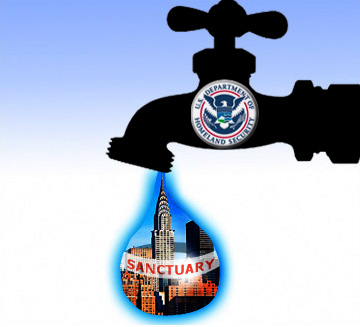

Al-Qaida‘s targets on 9/11 were in New York City and Washington. But if Tom Tancredo, R-Colo., and 233 other members of the U.S. House have their way, those cities and others at high risk of terrorist attacks, including some that have reportedly been the target of foiled plots, would be stripped of the federal funding intended to keep their citizens safe from attack.
At issue are so-called sanctuary cities. There is no single definition of a “sanctuary city,” but in essence it is one that takes a “don’t ask, don’t tell” stance toward the immigration status of its residents. For example, a sanctuary city might bar local police from inquiring about or disclosing the status of a victim or witness of a crime. A comprehensive list of sanctuary cities would have to include a huge swath of urban America. It would include the four biggest cities in the United States, the majority of the 25 biggest cities, and every one of the six urban areas the Department of Homeland Security says face the highest risk of terrorism — New York, Washington, Los Angeles, San Francisco, Chicago and Houston.
Spurred by the GOP base’s anger over illegal immigration, Republicans in the House have introduced several bills and amendments that would impose financial penalties on those sanctuary cities. Two measures, amendments to larger spending bills, have already passed. Such proposals have also become an issue in the race for the Republican presidential nomination, and several candidates have voiced their support.
But the proposals involve depriving the nation’s biggest and most vulnerable cities of their anti-terror funding. To fight the War on Illegal Immigration, the party is willing to defund the War on Terror. For residents of America’s major cities, it might therefore be reassuring to know that most of the measures, even as they’re approved by Congress, are written in such a way that they’ll be hard to enforce.
There are many overlapping lists of sanctuary, none of them definitive. The Congressional Research Service, a nonpartisan arm of the Library of Congress, counts 32 cities, towns and counties, as well as two states, Alaska and Oregon, as sanctuaries. Altogether, the jurisdictions in the CRS count — including, for example, New York City, Los Angeles, Houston, Detroit, Minneapolis, San Diego, San Francisco and Seattle — encompass roughly 25 million people, or more than 8 percent of the population of the United States. And the CRS list is fairly limited; it leaves off some large cities like Chicago, Boston and Washington, which have similar policies, or others, like Miami and Denver, that Tancredo has accused of having such policies. The National Immigration Law Center, a liberal advocacy group, has put together a preliminary list of “laws, resolutions and policies … limiting enforcement of immigration laws by state and local authorities.” (The NILC doesn’t like or use the “sanctuary city” term, but its list is a fair stand-in for a comprehensive account of the cities that opponents of sanctuary policies would describe as “sanctuary cities.”) That list includes nearly 70 jurisdictions, and even it doesn’t include some locales considered sanctuary cities by anti-illegal immigration activists.
At the moment, several proposals that would restrict funding to sanctuary cities are wending their way through Congress. Two, attached as amendments to spending bills, passed the House of Representatives this summer. One, proposed by Tancredo and attached to the appropriations bill that funds the Department of Homeland Security, provided that no funds from the bill — meaning no DHS anti-terror money — could go to a sanctuary city. That amendment passed by a vote of 234-189, and the bill to which it was attached later passed the House by a large margin. A version of the bill passed by the Senate does not include Tancredo’s amendment — T.Q. Houlton, Tancredo’s spokesman, described the chance it will be added to the final bill in committee as “slim.” A similar amendment, added to the Commerce, Justice, Science and Related Agencies Appropriations Act by Rep. Thelma Drake, R-Va., passed by voice vote. The House has passed that larger bill as well, but the Senate has yet to take it up.
Other bills that would punish sanctuary cities are on their way. Among them is H.R. 3549, The No Sanctuary for Illegals Act. Introduced by Rep. Dan Burton, R-Ind., the bill cuts all federal funding to sanctuary cities. Burton’s office did not respond to repeated messages seeking comment. Another recently introduced bill is H.R. 3531, the Accountability in Enforcing Immigration Laws Act of 2007, sponsored by Reps. Ginny Brown-Waite, R-Fla.; Brian Bilbray, R-Calif.; Jeff Miller, R-Fla.; Tancredo and Drake. That bill cuts 25 percent of “non-emergency” DHS funding from sanctuary cities and gives the head of DHS the discretion to cut an additional 25 percent.
Punishing sanctuary cities with legislation has a clear political upside. Such measures enjoy solid support among the anti-immigration segments of the Republican base. The issue has come up in the race for the 2008 Republican presidential nomination. Former Massachusetts Gov. Mitt Romney has used the subject in radio ads and debates, wielding it as a club with which to batter former New York City Mayor Rudy Giuliani, a rival candidate. While mayor, Giuliani was a staunch defender of the city’s policies, even filing an unsuccessful lawsuit to try to protect one part of the policy, since amended, from federal efforts to end it. In a 1996 speech at Harvard’s Kennedy School of Government, given the day before he filed the suit, Giuliani hit out at the federal government and anti-immigration forces generally, saying, “I believe the anti-immigration movement in America is one of our most serious public problems … I know that our executive order offends some people. They ask, ‘Why should we pay to provide services for illegal immigrants?’ The answer is, It’s not only to protect them, but to protect the rest of society as well.”
But opposition to sanctuary cities is not a purely Republican issue. A poll conducted by Rasmussen Reports in August put the proportion of likely voters in favor of cutting federal funding to sanctuary cities at 58 percent, with just 29 percent opposed. Up to 49 Democratic members of the House have supported some versions of the anti-sanctuary legislation.
Bilbray says he thinks public support will eventually force the passage of some anti-sanctuary measure. “I think the Democrats are going to realize, look, we have to take this one,” he said. “Because the areas where they’re demanding sanctuary for illegals, they’re not at-risk districts. They’re not the districts where they’re going to either hold, or lose the majority. It’s going to be those places where the illegal immigration is a real hot issue, and the sanctuary city thing will hurt them if they stand by it.”
But there’s more at work in the anti-sanctuary movement than just political considerations, proponents of anti-sanctuary measures say. They argue that sanctuary cities are a danger to local residents and the country as a whole. The cities, they allege, shield potential and actual criminals from deportation; could be allowing potential terrorists to go undetected; and are in violation of federal law simply by mandating noncompliance.
“When cities proclaim that they will not check immigration status, they essentially become a safe haven for not only out-of-status immigrants, but criminal aliens who have often committed violent atrocities in our country,” Brown-Waite, whose office did not respond to messages seeking comment, said in a statement at the time H.R. 3531 was introduced. “Imagine that Mohammed Atta or one of the other 9/11 hijackers, who were in the country illegally, had a city they could reside in to plot terrorist attacks with no fear of ever being checked or deported. We run the risk of inviting terror into these cities.”
In an interview with Salon, Bilbray echoed Brown-Waite’s sentiments. “Can you imagine anywhere else in the world where a city announces that it will not only not enforce or cooperate in enforcement of a federal law?” Bilbray asked. “The chutzpah of this is for a city to say we’re not going to cooperate with the federal government and then demand federal funds to fight terrorism. The two are linked and have been linked since 9/11.”
Defenders of sanctuary-city policies, however, assert that on balance the policies keep communities safer and healthier. Ed Koch, the former mayor of New York who, in 1989, became the first in a continuous line of the city’s mayors to promulgate a version of the executive order that controls the city’s policies on ascertaining and disclosing immigration status, says he’s still proud of his decision. In an interview, Koch provided examples of instances in which he said the city’s policies both applied and made sense.
“One, if you have children, send them to school. We do not ask where they came from. We don’t turn in children who are here illegally … We don’t want children, legal or illegal, walking the streets when they should be in school and either being victims of predators or predators … Number two, what we said was, if you’re sick and you can’t afford a doctor, come to our municipal hospitals. We don’t turn in illegal aliens. Why? Because if somebody is sick, particularly if they have a contagious disease, it affects all of us.”
When it comes to public safety, meanwhile, defenders of sanctuary cities say their policy deters crime. John Feinblatt, the criminal justice coordinator for the City of New York, says that the city’s policy regarding law enforcement involvement with immigration status isn’t protecting criminals but helping the NYPD catch them — and that it is one of the reasons New York City is the country’s safest big city. (It should be noted that, like officials in many other localities accused of being a sanctuary city, New York officials generally, and Feinblatt specifically in an interview with Salon, deny that the city is a sanctuary city. It does, however, have some of the policies that characterize a sanctuary. For example, New York prohibits the police from investigating a person’s immigration status unless there’s some other illegal activity suspected, and from looking into the immigration status of crime victims and witnesses.)
“We do smart law enforcement,” Feinblatt says. “The elements [of smart law enforcement] are being proactive, using data, being aggressive about putting your resources where the problems are, and maximizing information. How do you maximize information? You do it by having good intelligence, and part of good intelligence is the ability for victims and witnesses to come forward no matter who they are … We are a city of immigrants, and what we want to do is encourage people to come forward so that we can use their information to continue to fight crime.”
New York law enforcement isn’t alone in believing this. In 2006, an organization known as the Major Cities Chiefs, comprising the chiefs of police of the 64 largest police departments in the United States and Canada, put out a position paper that opposed any congressional efforts like the ones currently under consideration. In the position paper, the Major Cities Chiefs said local law enforcement did not have the budget or capability to become an enforcer of federal immigration law. Further, “immigration enforcement by local police would likely negatively effect [sic] and undermine the level of trust and cooperation between local police and immigrant communities. If the undocumented immigrant’s primary concern is that they will be deported or subjected to an immigration status investigation, then they will not come forward and provide needed assistance and cooperation. Distrust and fear of contacting or assisting the police would develop among legal immigrants as well … Such a divide between the local police and immigrant groups would result in increased crime against immigrants and in the broader community, create a class of silent victims and eliminate the potential for assistance from immigrants in solving crimes or preventing future terroristic acts.”
Perhaps the strongest argument made by opponents of sanctuary cities is that such policies could shield potential terrorists, using the 9/11 hijackers who were in the country illegally as an example of the danger. But that argument has its flaws, and not just because the remedies they’ve proposed involve, paradoxically, punishing such cities by cutting their terror funding. Though all nineteen 9/11 hijackers were in the country illegally, most had committed their violations in applying for their visa and thus could never have been detected by local law enforcement. As few as two or three of them had committed violations that would have been evident in the kind of check local law enforcement is capable of performing. And, says Susan Ginsburg, a staffer on the 9/11 Commission and the coauthor of a commission staff report titled “9/11 and Terrorist Travel,” it was unlikely that such a check could have been performed in the pre-9/11 era.
Ginsburg, now a visiting senior policy analyst at the Migration Policy Institute, a Washington think tank, opposes the proposals under consideration. “The larger point is that an immigration enforcement policy cannot substitute for a counterterrorism policy,” Ginsburg says. “It would be counterproductive to obstruct state and local counterterrorism programs in order to pressure them regarding immigration policy.”
Moreover, the actual extent to which local authorities are not cooperating with federal immigration officials appears to be greatly exaggerated. Earlier this year, the Department of Justice Office of Inspector General (OIG) released a report, mandated by Congress, that investigated whether any jurisdictions receiving funds intended to help them pay for the costs of incarcerating illegal aliens were not cooperating with the federal agency in charge of immigration, Immigration and Customs Enforcement. Included in the report’s executive summary was this note:
“Our review did not disclose any instances of outright failure to cooperate with ICE in the removal of criminal aliens from the United States. Instead, we found that local jurisdictions often set the enforcement of state and local law as a priority, while sometimes permitting or encouraging law enforcement agencies and officers to work with ICE to some degree on immigration matters.”
In interviews with Salon, New York City officials stressed that they always cooperate with ICE, and that though their policy may forbid the investigation of immigration status by itself, such an investigation is permitted if there’s any suspicion of any illegal activity, even something as simple as jaywalking.
“People who want to paint New York or other cities as not cooperating with immigration officials need to look at the facts,” Feinblatt said. “I mean, perhaps the most vivid example is in our city jail. ICE has its own office that we supply them. We do joint operations with them. For instance, ICE has estimated — conservatively, it says — that at least 200 new cases each month are identified through cooperative efforts of New York City.”
Because sanctuary-city opponents imagine the problem of non-cooperation as much bigger than it is, they may have inadvertently written their countermeasures so they apply to very few cities, if they apply to any at all.
The federal law that sanctuary cities are accused of breaking, the one that would trigger enforcement of the de-funding amendments proposed by Tancredo and Drake, is a specific section of the 1996 Illegal Immigration Reform and Immigrant Responsibility Act, which says local jurisdictions may not restrict their officials from exchanging information with federal immigration authorities about a person’s immigration status. On the floor of the House, Rep. David Price, D-N.C., challenged Tancredo to provide an example of a city with policies that contravene that section. Tancredo could not, and in conversations with Salon, neither could Tancredo’s spokesman.
Perhaps that’s because there aren’t any. The OIG was also asked to look into the question of what jurisdictions violated that section. In its report, it said, “Only the City and County of San Francisco gave a qualified ‘yes’ in response to our queries about the existence of a local ordinance or a departmental policy limiting the ability of local law enforcement officers or agencies to exchange information with ICE relating to immigration enforcement,” but noted that certain exceptions to the city’s policies meant that it might not truly be in violation of the section.
Even statutes written more broadly, like Burton’s, might not hit any of their intended targets. Burton’s bill cuts funding from “any State, or political subdivision of a State, that is determined by the Secretary of Homeland Security to be interfering with efforts to enforce Federal immigration laws.” But in a September hearing of the House Homeland Security Committee, DHS Secretary Michael Chertoff, under questioning from Brown-Waite about sanctuary cities and the potential effect of bills like hers, said flatly, “I’m not aware of any city, although I may be wrong, that actually interferes with our ability to enforce the law.”
