Bestsellers
Recipe for a bestselling book
One writer says he's figured out 12 basic ingredients for a blockbusting title. Can the puzzle really be that easy?
Remember the time you picked up a copy of that big bestseller and tore through the book in a couple of days, marveling at the bad writing, ridiculous plot twists and paper-thin characters? “Is drivel all it takes to sell a gazillion copies and retire to a sleekly spacious modern house in the woods?” you probably asked yourself. “I could crank out better crap than this! How hard can it be?”
The better question is: How easy? For if smart people who have spent their entire careers calculating how to write or publish bestsellers find it impossible to produce a surefire winner — and they do — chances are that you and the many, many, many other people who have had the thoughts described above are underestimating the task. Presumably aspiring authors will be the most avid readers of James Hall’s new book, “Hit Lit: Cracking the Code of the 20th Century’s Biggest Bestsellers,” and they may well learn from it. But does this title, the latest attempt to nail down the essential qualities of extremely popular books, actually wrap its fingers around the mystery?
Hall, a creative-writing professor and crime novelist, teaches a course on “megabestsellers,” books that have sold in the “multiple millions” and that have gone on selling for decades after they were originally published. He considers a list of 12: “Gone With the Wind,” “Peyton Place,” “To Kill a Mockingbird,” “Valley of the Dolls,” “The Godfather,” “The Exorcist,” “Jaws,” “The Dead Zone,” “The Hunt for Red October,” “The Firm,” “The Bridges of Madison County” and “The Da Vinci Code.” Though the list seems fairly diverse, Hall insists that they all share 12 common elements — to such a degree, in fact, that they are all “permutations of one book, written again and again for each new generation of readers.”
This is sorta true and sorta not, depending on what your needs are. It is indeed a fact that bestsellers often feature “fractured families,” spiritual quests or doubts, “didactic” interludes that assure the reader he or she is learning something, “hot button” issues of the day and — in my favorite of Hall’s coinages — a theme he dubs “Bumpkins vs. Slickers.” But so do a lot of other books, from truly great novels to justly forgotten flops, American and otherwise. How helpful is it to point out “universal” traits of bestselling books if they turn out to be universal traits of most books? “Vanity Fair” is every bit as much a rags-to-riches story as “The Godfather,” and nostalgic yearning for a lost pastoral idyll has been a major literary motif since Virgil’s Eclogues.
Is it any surprise that popular characters ranging from Scarlett O’Hara to Michael Corleone tend to show “a high level of emotional intensity that results in gutsy and surprising deeds”? Or that readers prefer characters who “act decisively” rather than engaging in “navel gazing”? A successful plot, Hall explains, is one that quickly establishes a conflict or dilemma so that readers are “drawn forward by the momentum of the unfolding story as one complication after another challenges the central character and the original dramatic question mutates into another question and another.”
Well, of course it does. Yet, in Hall’s defense, I would point out that he is a creative writing teacher. For some reason, it is often the very people who say they want to write novels who seem to have the least understanding of what other people want to read. So Hall has no doubt seen countless examples of would-be authors — including people determined to work in commercial genres — who simply don’t grasp the most elementary principles of storytelling. While “Hit Lit” may seem, to many readers, like the literary equivalent of instructions on how to boil water, the sad truth is that plenty of those who speak contemptuously of Dan Brown’s prose are writers who could not get a child interested in a fairy tale.
True, I, too, would never call Brown a “good writer” — yet many very successful novelists are not: Stieg Larsson, for example. A book doesn’t have to be especially well-written, plausible or original to be a bestseller (although it can be). The characters don’t have to be particularly interesting, as John Grisham proves again and again. In fact, if there is one trait that all of the bestsellers Hall considers absolutely share, it’s that a lot of people like them.
That statement isn’t as inanely tautological as it may sound. As Hall points out, the common belief that publishers deploy splashy, expensive promotional campaigns to snow the public into buying millions of copies of terrible books is quite mistaken; publishers do not have that kind of power. Hall quotes the fabled editor Michael Korda on the subject (and Korda, having launched Jacqueline Susann and Harold Robbins, ought to know): “At least half the books on any given week’s bestseller list are there to the immense surprise and puzzlement of their publishers.” Publishers can provide a book with the ideal conditions in which to catch on, but only the genuine enthusiasm of the reading public will make it an ongoing hit. Word of mouth — one reader raving to another about how much he or she enjoyed it — is the single determining factor. And you can’t buy that.
So why does that public fall in love with some crappy books but not others? Hall makes one of his strongest points almost in passing: The bestsellers he considers are, he notes, “unique and creative mash-ups of traditional genres.” “Unique” may be stretching it, but most of them do combine familiar elements in less familiar ways — the recipe for successful genre fiction. “Gone With the Wind” transported the career-woman melodramas of its time into a historical romance. “The Godfather” is a family saga grafted onto a gangster story. The sensational historical-religious conspiracy theory at the center of “The Da Vinci Code” had already appeared in a nonfiction bestseller; Brown’s brainstorm was to change the delivery mechanism to a fast-paced thriller.
And more often than you might think, luck and timing play a deciding role. Anyone in the romance-publishing industry will tell you that the current racy bestseller, E.L. James’ “Fifty Shades of Grey,” is fairly typical of the low-profile genre called erotic romance. Thousands of titles with more or less the same characters and themes — many of them better-written and arguably more interesting than “Fifty Shades of Grey” — were on the market long before James came along. But James emerged from the word-of-mouth factory that is Twilight fandom, and as a result her books introduced hundreds of thousands of readers to a genre they didn’t know existed, much as Stephenie Meyers had introduced them to the vampire romance novel a few years before.
Still, the essential quality separating most tentpole bestsellers from the rest of the genre pack remains an enigma. Why did “The Help,” among all the earnest, sentimental historical women’s fiction published in the past 20 years or so, sell 10 million copies? It’s easy, once the feat has been accomplished, to attribute a book’s success to this or that feature, but picking winners beforehand is another trick entirely. The one predictive factor that readers (and therefore publishers) consistently rely on is brand loyalty; an author who has done it once, they assume, is likely to do it again. That’s why the most consistent aspect of the bestseller lists is the reappearance of the same names, over and over.
Here’s something else you can count on: A person who can’t fathom why the public fell in love with Lisbeth Salander or Edward Cullen is probably not going to be able to write something they’ll like just as much. Whiling away a couple of summer afternoons reading a trashy novel is a harmless way of wasting time. But writing a book even you wouldn’t want to read? That’s just killing it.
Laura Miller is a senior writer for Salon. She is the author of "The Magician's Book: A Skeptic's Adventures in Narnia" and has a Web site, magiciansbook.com. More Laura Miller.
“Go the F**k to Sleep” and Tracy Morgan’s comedy battle
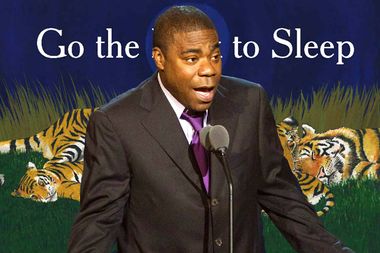
Tracy Morgan's latest gaffe, and an absurd CNN piece about "Go the F**k to Sleep," show how subjective humor can be
What’s more absurdly hilarious than an ersatz bedtime story called “Go the F**k to Sleep”? Funnier even than Werner Herzog or Samuel L. Jackson reading it? Answer: The uproariously hyperbolic opinion piece that ran Monday on CNN – CNN! – by author Karen Spears Zacharias, who claims, “The violent language of ‘Go the F*** to Sleep’ is not the least bit funny, when one considers how many neglected children fall asleep each night praying for a parent who’d care enough to hold them, nurture them and read to them.” Wah wah waaaaaaah.
Continue Reading Close
Mary Elizabeth Williams is a staff writer for Salon and the author of "Gimme Shelter: My Three Years Searching for the American Dream." Follow her on Twitter: @embeedub. More Mary Elizabeth Williams.
Moby Awards honor best, worst book trailers of 2011
From a grumpy Jonathan Franzen to a wacky Gary Shteyngart, a celebration of the viral videos of literary promotion
Trailer for Sloane Crosley's "How Did You Get This Number," which won a Moby for "Book Trailer As Stand Alone Art Object." On the surface, book trailers seem like a fairly ridiculous concept: trying to market literature to people who would rather wait until the movie version comes out. Most of the time, publishing houses create trailers that are visually arresting or entertaining, but have nothing whatsoever to do with the book they’re trying to sell. That’s where the Moby Awards come in.
Celebrating the best and the worst of book trailers with a statuette of a golden sperm whale, last night’s Second Annual Moby Awards were held at the Powerhouse Arena in Brooklyn. With categories like “Most Celebtastic Performance,” “Best Small House Press Trailer” and “What Are We Doing to Our Children? (good or bad, you decide),” the ceremony is more tongue-in-cheek McSweeney’s party than Paris Review gala.
Continue Reading CloseDrew Grant is a staff writer for Salon. Follow her on Twitter at @videodrew. More Drew Grant.
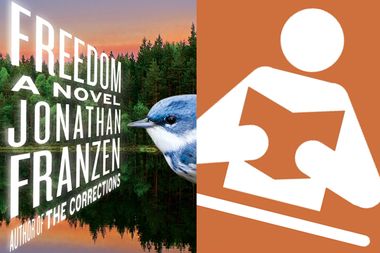
Jonathan Franzen’s “Freedom”: Brilliant portrait of our times
The author takes us on a dark, epic, funny tour of modern life with a family of conflicted idealists
Now that we know that the world is filled with opinionated, neurotic busybodies and compromised idealists just like us, our contempt springs to the surface so easily. We resent recognizing bits of ourselves in so many others, seeing how much more effectively (and photogenically!) these people put their ideals into action, through their daily yoga classes and lucrative yet admirable jobs as environmental lawyers, through the whimsical crafts and organic layer cakes they make with their creative, adorable children, through the two-week vacations they take in Maui or the Wakefield dressers they refinish for junior’s bedroom. Instead of bringing us together, the Internet shows us that we not only aren’t remotely unique, but everyone else out there is pursuing the same lifelong dreams and embracing the same hobbies with far more focus, style and energy than we could ever hope to muster.
Continue Reading CloseHeather Havrilesky is Salon's TV critic and author of the rabbit blog. Her memoir, "Disaster Preparedness," published in 2010. More Heather Havrilesky.
“Eat, Pray, Love”: A phenomenon goes bust
Julia Roberts finds grub, God and guys in a frequently frustrating adaptation of Elizabeth Gilbert's bestseller
Javier Bardem as "Felipe" and Julia Roberts as "Elizabeth Gilbert" in Indonesia in Columbia Pictures' EAT PRAY LOVE.(Credit: Photography By: François Duhamel) The enormous success of Elizabeth Gilbert’s travel memoir “Eat, Pray, Love” is one of those paradoxes that pretty much define modern life. There is nothing affluent Westerners of the information-economy class like better than being told that our lives lack soulfulness, sensuality and a sense of purpose — except, perhaps, for heaping derision on those who bring us this news. Every move in this dance is so well rehearsed that none of it can escape cliché: not the original complaint about our shallowness and materialism, not the presumptive moral high ground and false modesty of the evangelist-observer, not the exaggerated, Bill O’Reilly-style scorn of those who feel their iPhoned and Twitterized lifestyle is under attack.
Continue Reading Close“The Girl Who Played With Fire”: Out of the past
As Hollywood plans its own Stieg Larsson adaption, the second film in the Swedish series goes dark and gloomy
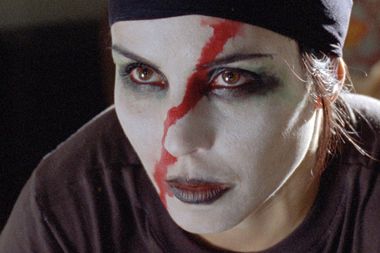
Noomi Rapace in "The Girl Who Played With Fire" Ordinarily, a film that was made in Sweden and is being released in the United States by a tiny indie distributor would barely merit a footnote on the overcrowded summer movie calendar. But “The Girl Who Played With Fire,” the second film in director Daniel Alfredson and screenwriter Jonas Frykberg’s Millennium trilogy (adapted, of course, from Stieg Larsson’s best-selling thrillers), is a peculiar exception. Like its predecessor, “The Girl With the Dragon Tattoo,” this is likely to be one of 2010′s top-grossing foreign-language films — and that’s without reaching anywhere near the total audience of Larsson’s novels.
Continue Reading ClosePage 1 of 2 in Bestsellers