It’s a growing trend: More and more adults are living with their parents. According to the Census Bureau, the number of 25- to 34-year-old adults in the U.S. living at home rose from 14 percent in 2005 to 19 percent in 2011. The trend is present in other developed countries across the globe too: In Italy, 37 percent of men 30 years of age and older have never left home; in Japan, men living under their parents’ care are pushing their 40s. Such individuals are easily disparaged as lazy, overgrown babies, content to mooch off their aging parents rather than strike it out on their own. (Remember all those biting jokes Archie Bunker would throw to his “meathead” of a son-in-law.) But are they really?
In “The Accordion Family,” Katherine Newman, a sociologist and dean of the school of arts and sciences at Johns Hopkins University, looks at the dynamics of the boomerang generation – a phenomenon she has dubbed the “accordion family.” Part economic analysis, part ethnography, Newman interviews hundreds of individuals in six different countries (in southern Europe, the Nordic states, Japan and the U.S.), to better understand the international dynamics at work. The major reasons driving adult children back to the nest are economic, she finds: Globalization and the recession are making it harder for new workers to enter the labor force, and the cost of housing is climbing. But other social and psychological factors are at play too. The result is a sometimes rocky, sometimes serendipitous experience for these families as they struggle to redefine adulthood and familial roles in the face of overwhelming global economic forces.
Salon spoke with Newman over the phone about the growing difficulty for young people to find work, how new the idea of being an independent young adult really is, and the surprising emotional benefits of the accordion family.
Is this current generation a bunch of lazy loafers? Your research doesn’t seem to indicate this.
No. They are a generation that has been caught by a series of unfortunate, overlapping trends that put them at a disadvantage for becoming independent the way their parents did. They’re entering a very unfriendly labor market that is particularly punishing to young workers. With the housing implosion in the United States, they’re still entering a housing system in which owner-occupied housing is very expensive. So, they have lower wages, if they have wages at all; they have high housing cost; and, in the advanced countries, there are ever more demanding credential races to qualify for professional employment. If they’re aspiring to be middle- or upper-middle class, the length of time it takes to pile up the education you need to qualify for the jobs to make that possible is getting longer and longer and more and more expensive. When you put all those things together, it’s not all that surprising that the accordion family has developed the way it has. It’s just a bunch of really bad circumstances that have coincided and affected this generation in ways that have not been the case before.
Money is (maybe obviously) a major reason for this trend. How so?
The recession we’re in has intensified a bunch of trends that were already gathering force, and already pushing people into accordion families. Those trends included a real downdraft in the capacity of young workers to find their way. That has really spread as downsizing has gathered force, as jobs have been outsourced. It’s become a much more competitive labor market, and an employer can be incredibly choosy. That leaves young workers at a disadvantage. And as much as they have a hard time qualifying for those jobs, the jobs themselves have increasingly become short-term, part-time or unpaid altogether. Now, to become a qualified professional, many middle-class American kids are going to have to spend many years in completely unpaid internships. So they finish college, or in the course of going to college, they spend years upon years working in jobs that used to pay money and don’t anymore because this market is so crowded. Well, if you’re going to spend years interning somewhere so that you get the kind of experience that will cause an employer to look at you seriously when there’s a paid position, how in the world are you going to manage if you have no income? You’ve got to live someplace. So, in households that can afford it, parents are making it possible for their kids to gather those credentials that will allow them someday – they hope – to launch at the level they’re expecting.
Is this phenomenon the same for lower classes or are there different reasons driving the accordion family trend in these rungs of society?
In poorer households, these accordion families have always been there. There’s nothing new there, because lower-income people have had to pool their incomes for generations, because to keep the household afloat you had to have everybody working and everybody contributing – and by the way, that was true for many middle-class households before the Second World War.
So this period of time which we come to see as normal – of young people leaving home; and spending time on their own before they marry; and their parents having an empty nest – that’s a phenomenon of the post-Second World War period of great affluence. It created a huge boom in wages, and burgeoning opportunities in the white-collar world. We’re not there anymore and we might not be again. We think of it as normal – and I think this is an important point – because the generations that experienced that “normal” are so huge. They dominate the social scene. They’re the baby-boom generation. That was their normal, but it wasn’t normal before them and it may not be after them.
So is this negative impression we have of boomerang children due to fickle memory?
What people think about, what they regard as normal, what they factor in as explanation for how they got where they are really differs from one country to another. In the United States, I came to find that people forget these huge investments that were made by the whole society in the form of, for example, the GI Bill, which really made a difference in the trajectory of those generations. It allowed them to become homeowners; it allowed them to get a college education – the first in their families ever to do so. They wouldn’t have been able to do either of those things if it were not for huge investments that we made, through government, in their well-being. Now, of course, this was seen as a tribute to soldiers – and it was, of course. But when you interview people [of that generation] and ask them, “How did you manage to become a homeowner?” they almost never mention the GI Bill. It’s not that they would deny it if you asked them, but if you just ask them, “Well, how did this happen?” the account is very much one of: “Well, I worked hard. I saved my money. I didn’t go out to eat. I had very modest tastes. The problem with the next generation is that they’re spending money freely and they have expectations that are too high, and they’re not as disciplined.” It’s all down to the personality of the generation rather than these huge economic structures that really do play a powerful role in determining where any individual or family ends up.
The same thing is true when you look at other countries. The Japanese, for example, tend to be very much like Americans: they think every person is the master of his own destiny. So if his destiny is not working out, then he really is to be despised. [These individuals] are the object of disdain. The Japanese tend to look at that next generation that’s living at home and say, “Well, they’re really lazy,” or, “They’ve lost their way,” or, “They don’t know how to be men like their fathers were,” and, “They’re a defective generation.” But you never hear the Spaniards say that because they have a different history and a different political culture, and they are looking for the ways in which government, or big business, or whatever, is to blame because they see themselves as recipients of those forces.
So these cultures, they subtract and they add pieces of their histories very differently, [even though] they’re all suffering from the same economic pressures.
Is there a place that you’ve studied where the self-perspective is healthier or more accurate?
When I started the project, I thought that Americans were sort of unrealistic in the way they thought about things, but when I started looking at these other countries, I decided maybe that wasn’t the case. That’s because now I can see the extremes on either side more easily. I can see how hysterical the Japanese are about [the accordion family trend]; and I can see how comfortable the Italians are with this, and how they don’t think it’s a problem.
So the United States turns out to be the moderate middle. There are some structural reasons why that is the case. We do have some housing that’s cheap – not homeownership, but we have dormitories on college campuses, we have rental housing that people can share with roommates. You’d think that that’s the way the whole world is organized, but it’s not true. In Spain, in Italy, there are no dormitories, there’s very little rental housing. In Japan there’s almost no rental housing. So, if you don’t have the money or the kind of job that you will need to have for a bank to lend you money for a mortgage, you’re not going to be able to move out because you’ve only got two options: You live at home or you buy a house.
You point out that there are very few accordion families in the Nordic countries. Why?
In Sweden, if you’re still at home after the age of 18, something is really wrong with you. I asked people in Nordic countries why they thought that in places like Portugal and Spain young people stayed with their parents for a long, long time, and I was really intrigued by their answers. Their answers had nothing to do with differences of the welfare state, at all. They said things like, “Well, we think maybe they love their children more than we do,” and, “There’s more attachment and affection in their families.” This led to one of the most surprising parts of the research project that underlies this book.
I thought the Nordic countries would look like paradise. These are the places where the problems that produce the accordion family don’t exist because the state has stepped in and cured them. I was amazed to hear the Nordic interviews talk about people being lonely, feeling separated, like maybe they didn’t love each other enough. It made me realize that the flip side of economic dependence, or need, across generations is a degree of commitment and affection and engagement that really isn’t alive in the Nordic countries in the same way. To them the emotional side is very evident and it causes them to be self-critical about whether they’ve gone too far and made it too easy for families not to care for one another across generations because the state cares for you.
Are you advocating for any social reform in the US?
Investment in higher education has always paid off for the United States as it does in the social democracies. Increasingly success in the world economy depends upon skill, training, flexibility, and all of the attributes we refer to in using the phrase “human capital.” Sadly, the U.S has been moving away from investing state resources in higher education at precisely the time when some of our competitors are pushing hard to increase their human capital. If we do not provide access to college for worthy students whose families cannot afford to pay the high cost of higher education, we will be wasting our talent base. So yes, I do think that we should be moving in the opposite direction, as we did with one of the greatest pieces of social legislation in the country’s history: the GI Bill.
How do these attitudes break down between ages?
I think what we’re going to see is that something that started out looking like an [age-specific] trend is going to engulf multiple generations. These labor market rules that introduced short-term and part-time jobs have affected one generation of young people when it began, basically in the mid ’80s. But 20 years later, it’s no longer just one generation [that is affected]. And if this keeps going – which I think it probably will – ultimately this will have engulfed the whole society because all the generations that come up from behind will be affected by the same labor laws. Right now, you’ve got two generations side by side with very different economic realities and very different definitions of a normal process of maturation: you’ve got the baby-boom generation [that] was able to be independent, and then you’ve got the generation coming behind them that inherited a completely different economic world. These two groups are now grappling for what is really normal. What should we be doing? Is it my reality or your reality that ought to count? But if you fast-forward another 20 years, when virtually everyone has been affected by this trend toward short-term employment and high housing costs, it’s going to become the new normal and there won’t be a contrast, and it won’t be age-graded because it’ll be everybody.
Some of the data you’ve collected on the accordion family phenomenon shows that there are more men staying with their parents than there are women doing so. Why do you think that is?
Women seem to be streaking ahead in educational attainment and occupational prestige. That may be one of the least recognized, but most important changes of our time. As they graduate high school and enroll in college at a higher frequency than men, women at the high end of the skill spectrum are starting to outstrip men in their earnings. This may well translate into earlier independence. Of course, in the past, women left home before men because they married at younger ages. Now, however, skill differences born of educational differences may mean men are less prepared than the women their age.
A number of college grads not having a really clear, defined career path are often returning home to “figure out what to do next.” Is this a privilege of class or reflective of a deeper social or cultural value?
Class has something to do with it, but there is something else going on. When I [used to] talk to my grandparents, they never thought that work was something that gave you meaning – it was just the way you put the roof over your head. But suddenly in the boomer generation, you have a very different way of thinking about work: It’s to be valuable, meaningful, honorable, enjoyable, a source of identity. That has now become a kind of standard for the way we think work should be. We have accepted the notion that our children ought to have jobs that are meaningful, not just a job that puts a roof over your head. It’s true that are all these powerful economic forces have set in motion the demand for the accordion family, but it isn’t all about necessity: it’s also about desire, values, what people find useful, what they’re proud of. And every one of these cultures has a different way of defining what kind of future is honorable.
How would you summarize parents’ and their adult children’s experiences living together?
There can be a lot of stress and a lot tension because the program isn’t working if the young people are not moving forward to a future [on which] everyone can agree. [There is], of course, a sacrifice of privacy. You do hear parents talk about how their golden empty nest years disappeared because the birds came back to the nest, or that they’re having to spend a lot of money that they would’ve otherwise saved for their own retirement to pay to take care of their kids for many years longer than they expected to. At the same – because nothing is ever simple – there can be a lot of joy in this.
So these parents who remember having to make sure Mary’s home at night, because it’s 12:30, are not thinking like that anymore now that Mary is 25. So they get their kids back in a different form than the way they had them when they were teenagers, and they’re introduced to the pleasure of getting to know your child again as an adult, [someone] with whom you might have a lot in common.
[Marriage has changed too.] I think we’re seeing a return, in some ways, to the way things were before the Second World War with the rising age of marriage and people staying home until they marry. The difference is they’re taking such a long time to get there – much longer than they did even before the war. In 1938 and thereabouts, you had people marrying in their mid-20s, and then it just plummeted. In the 1950s, the age of marriage in the U.S. for women was about 19 or 20. Now it’s gone way back up to 27 or 28.
What do you think future changes will look like?
I think the changes to come will have to do with what happens when this baby-boom generation is really elderly, because a lot of the resources they might have saved to care for themselves will have been spent on their children’s advanced education and on the preservation of the accordion family itself. And there are big changes that may be coming in 10 years or so, when we discover we can’t afford the nursing home solution such as it was for the earlier generation.
Demand for remedial instruction in colleges is on the rise. About 75 percent of New York City freshmen attending community college last year needed remedial math, reading or writing courses. The organization that administers the ACT found that only one in four of 2010 high school graduates who took the ACT exam were college-ready in four key subjects areas: English, math, reading and science. Statistics like these are startling, as they not only reveal serious flaws in our educational system, but also raise questions as to how these students will fare in the future if they are lacking the knowledge and critical skills needed to succeed in college and beyond.
In her new book, “The Republic of Noise,” New York City public school educator and curriculum advisor Diana Senechal argues that one reason for this problem is the students’ loss of solitude: the ability to think and reflect independently on a given topic. Schools have become more concerned with the business of keeping students busy in what Senechal deems is a flawed attempt to ensure student engagement. But as a result, students are not given the time and space to devote themselves completely to the study and understanding of one specific thing. It’s a need she finds reflected in our culture as a whole: We are a nation glued to smartphones and computer screens, checking email and Twitter feeds in our need to stay in some loop by reading and responding to rolling updates. Senechal is not advocating that we toss out our iPhones or unplug from social media, but rather that we think more slowly, give ourselves time for reflection — as such practice would only serve to enhance the very conversations new media and technology make possible.
Salon spoke to Senechal over the phone about the problems with our educational system, the meaning of solitude, and the dangers of immediacy.
What’s your definition of solitude?
The idea of solitude as an attribute of the mind goes back to antiquity. The Greek Stoic philosopher Epictetus distinguished between a negative sort of isolation (helplessness, removal from others) and the strength that comes from relying on one’s own mental resources. Quintilian wrote about the importance of overcoming distractions through mental concentration and separation. “In the midst of crowds, therefore, on a journey, and even at festive meetings,” he wrote, “let thought secure for herself privacy.”
Solitude is not about being in a hut out in the woods or being out in the desert or living without other people around. I define solitude as a certain apartness that we always have, whether we’re among others or not. It is something that can be practiced — maybe to think just on one’s own, even when in a meeting or in a group and so forth — but that also has been nurtured by time alone. So there’s an ongoing solitude that’s always there, and there’s also a shaped or practiced solitude, which requires both time alone with things, to be thinking about things and working on things, and time among others when you nonetheless think independently.
You’re critical of certain educational philosophies in practice in schools today, especially the workshop model. Why?
The workshop model has an emphasis on group work and a de-emphasis on teacher presentation. What happens is the teacher is supposed to give a mini-lesson which is about 10 minutes long. From there students are supposed to work in groups on something related to that mini-lesson, sometimes independently, but most of the time in groups. At the end they are supposed to share about what they learned. This was mandated across the board, across the grades and subjects, in many schools. Every lesson is supposed to follow a workshop model. (Of course some schools were a little bit more flexible about this than others.)
The problem with that is that the workshop model is very wonderful for certain lessons and topics, but when you apply it across the board, you are constraining the subject matter. You need a variety of approaches in order to deal with a topic. You may need a lesson where the teacher gives an extended presentation to give the students necessary background. Or an extended discussion. For instance, the students may have a project that they will have to do together, but they have to work on their own to build up to that point.
Also, schools have put an enormous emphasis on skills – or what are called skills – at the expense of content. This has been going on for decades. No one wants to specify what students should read, but they say that they should be analyzing and comparing and contrasting. Well, none of this has meaning unless you know what it is you’re comparing and contrasting or analyzing. What happens is, students write essays that show that they haven’t read very closely, and yet this passes because it meets the checks on the checklist: that it has the right number of paragraphs; it has an introduction, body, conclusion; it seems as though they’re comparing something with something. There is a contagious vagueness because we don’t specify what we’re talking about and what students should learn. We then encourage in them a certain vagueness and carelessness. The problem perpetuates itself, and it turns up much later when students enter college and don’t know how to write a coherent essay. Well, the reason this comes up is that they’re in courses where they’re expected to read on specific topics, and that’s where things fall apart and it’s no longer about the rubric.
So the problem lies in the idea of putting the model above the actual subject. You have to think about the subject and think about how you’re going to bring this to the students, and think about the type of lesson that will do that best. Often you’ll find that you need a combination of types of lessons.
Are you advocating for more teacher autonomy?
Yes, but not for just everyone to do whatever they want. I’m advocating for careful thought about the subject itself.
You write that we “mistake distraction for engagement”? How so? How does it affect even mental cognition?
I’m not a psychologist, but in the classroom and in many discussions on education, what I see is an emphasis on keeping the students busy from start to finish. Not letting a moment creep in where they don’t have something specific to do, something concrete where they are actually producing something. So if you keep them busy, busy, busy, and doing something at every moment, then supposedly they’re engaged. And when supervisors walk into classrooms and look and see the students writing and turning and talking, their conclusion is “Oh! What an engaged class!” The problem with that is then students don’t learn how to handle moments of doubt, or moments of silence, or moments where they have to struggle with a problem and they can’t produce something right on the spot. So, the students themselves come to expect to be put to work at every moment. If you want to give them something more difficult, you have to expect a little uncertainty. You have to expect a little bit of silence, a little bit of an awkward pause where they don’t know exactly what to do right away. What happens in this focus on visible engagement, we lose something that may go deeper, where students may have a chance to wrestle with something that’s a little bit above his or her head and where the answer is not immediately apparent.
This spreads outside the classroom too.
What I see is people having great difficulty sitting with a book for a long time, or with a pad of paper. They want to have the stimulus right nearby – they want access to their email, they want access to their text messages no matter what they’re doing. You see people walking down the street with their phones and just staring at their phones; and you see people holding their phones in all situations – at a concert or when having dinner with a friend – so they can check that they don’t miss anything. Yes, there is a loss of ability to just sit with something.
In trying to instill a greater habit of solitude in educational curricula, how do you see this working in an overcrowded classroom with limited resources?
That’s also a problem with the workshop lesson. Students won’t necessarily be engaged or be following along. Perhaps the biggest problem you’ll see is some students doing the work and others just following along. You’ll see some students using it as a time to socialize and others taking it seriously. So that problem is going to be there across the board. What students do respond to – and the workshop can be a part of it – is a lesson that makes sense, where they understand that you’re going from point A to point B. They understand that now that they have a grasp on this material, you’re going to take them here with it.
How do we then measure how well a student is learning and progressing, and do so as early as possible?
That’s where content-specific tests come in. Where we’ve gone astray is with tests that test quite general skills – you know, reading comprehension tests. There isn’t a good way to prepare for those tests, so we have a rather amorphous program of literacy where students learn all kinds of reading strategies but the emphasis is not on reading concrete things. You can test students on their reading of the subject matter, and not just factual knowledge, but their understanding. But then you have to have an actual course with actual subject matter taught, and you have to have a test that is about that course.
Math is a different case, and that’s why we see more progress with math than with English-language arts, because there is more of a math curriculum. But even with math, many districts have curricula that just jump from topic to topic so that students don’t go deep into any topic. [Students] learn how to do all sorts of different things, but they don’t know how to do them especially well. Tests have a role, but the curriculum has to come first.
Do you think we are overemphasizing the need to have a standardized method of teaching or testing?
Yes and no. There has to be a certain need for standardized tests to compare from state to state, and district to district, and get a measure of what’s going on across the board. And because it’s politically close to impossible to agree on a common curriculum, it probably would not be a good idea to have a very specific national curriculum. Those tests are going to be on the general side, but because of that, they should not be the be-all and end-all. Because they are so general, they should not match what the curriculum actually is. The curriculum should be much richer, and the tests that go along with that curriculum should be given more importance.
What has been found in many cases is when a school actually does not hold those tests so high, doesn’t put them on a pedestal but instead teaches a curriculum that is very considered, substantial and valuable, the students end up doing very well on the [standardized] tests. One must, in a sense, go beyond the test to do well on them.
You write about what you see as our obsession with the idea of success and our desire to do away with failure. What do we lose in the process of striving for success?
There is nothing wrong with striving for success at something meaningful. But if the emphasis is on the success and not on the thing being accomplished, the latter almost inevitably gets reduced. You can be successful if you make the task easy enough or lower the standards enough. You can feel good about it temporarily and get temporary approval or applause. But it is much more valuable, in the end, to accomplish something concrete, even if it doesn’t manifest itself as success for a long time.
For instance, a student is having difficulty with fractions. Well, that student should work on fractions until that student feels comfortable and fluent with them. But the talk emphasizes that “the student succeeds.” We hear about successful schools, successful students, successful people and so forth. Usually this means having some attainment of high stature, high score or high salary. The true accomplishments come often in the absence of these immediate, visible results; and if you sit and work with a subject, or you sit and struggle with a language, you may go for months without feeling you’re succeeding necessarily, but what you’re getting is something that won’t go away. Over time, after that constant practice and struggle, you find that you have attained something: You come to know that language. So the attention must go to the thing itself that you’re trying to do.
Continue Reading
Close
“Back to the Future,” “A Christmas Carol,” the “Terminator” series, “Star Trek,” “Rip Van Winkle,” “Hot Tub Time Machine,” “Terra Nova” — the list goes on. We, as a culture, have been mesmerized by the idea of traveling in time: going back to fix life-changing mistakes we regret; going forward to get a sneak preview at what we’ll become. Equally transfixing is the notion of traveling through space, exploring galaxies and unknown universes far beyond our sight’s reach.
In their new book, “Time Travel and Warp Drives,” Tufts physics professor Allen Everett and University of Central Connecticut math professor Thomas Roman explain the science behind the fiction of time travel, and tackle the question: Is it even possible? The authors delve into the lore of sci-fi shows and books to explain how wormholes, warp drives, and parallel universes work; and what Einstein’s theory of relativity is and its relevance to time travel. They also parse through all those pesky paradoxes that arise when one tries to go back in time.
Everett spoke with Salon over the phone to discuss how we perceive time, traveling at the speed of light, and why we can’t go back in time to kill Hitler.
I’m going to jump the gun and ask: In your opinion, is time travel possible?
There are ways in which it might be possible, but there are problems with all of those. I think it’s conceivable that time travel is possible. If someone put a gun to my head and made me make a yes or no prediction, I would predict no — with what we know now.
Twenty years ago, I think the answer would have been that it just wasn’t possible. We have learned some things about general relativity in the last 30 or 40 years or so, which make us take, at least for some of us in the profession, the idea of it being possible more seriously. But, still, one would have to say that the odds are against it. You might run into problems with time travel that you don’t run into with superluminal [faster than the speed of light] travel.
The correct statement is that backward time travel is not yet possible and may never be. We can travel forward in time.
How so, theoretically?
If you get into a space machine and travel from Earth to a nearby star and return, at a high speed (near the speed of light), when you get back to Earth, you will find that perhaps the trip took one year for you, as measured by your clock on the spaceship, but when you return to Earth, you will find that you returned to an Earth which is 10 years into the future, from the time when you left. So that’s exactly what we mean by traveling into the future. The possibility of doing that is well-established physics. As a practical matter it’s hard to do with people because the effect only becomes noticeable when the speed approaches the speed of light and it takes a prohibitive amount of energy to accelerate a people-carrying rocket ship to the speed of light and then slow it down again.
You can accelerate elementary particles (which decay radioactively to speeds very close to the speed of light). There are abundant observations to the fact that particles live longer when they are traveling at speeds close to the speed of light than they do when they are at rest. That is part of everyday observations in elementary particle laboratories. So you can certainly travel, in principle at least, into the future and return, but you can’t go back and listen to Mozart play a piano concerto. The chance of doing that is iffy at best.
You write that “it would be a bit tough to organize any kind of galactic federation” because of a phenomenon called “time dilation.” Can you explain what that is?
Suppose there’s a nearby galaxy which belongs to the emperor’s galactic empire. The emperor says, “I’m going to change the law in the empire. Henceforth, everyone on getting up in the morning must devote five minutes to praising the emperor.” So he sends one of his deputies off to a nearby star system with instructions to institute his new law, and in order to get there in a reasonable length of time, he’d have to be traveling at nearly the speed of light. He will get to the planet [in the nearby star system] in, let’s say, 100 years in the future, as far as the people on the planet are concerned. So they will say the law went into affect in the year [2111], but the Emperor’s deputy will take, say, only 10 years to travel to the planet, and another 10 years to travel back to Earth because of the time dilation effect. The law will be different at every point in the galactic empire because different observers will think the law went into effect at different times. I think that would make it difficult to run a reasonable empire.
Good point. So the person in the spaceship is experiencing time at a different rate?
Essentially, clocks in the spaceship are running more slowly than clocks that are at rest [outside the spaceship].
Does this have to do with our subjective experience of time?
No. If they don’t look outside, the people on the spaceship will not be aware that the time is moving slowly for them, but they will become aware of it when they return to Earth and find out that while 20 years has elapsed for them, 200 years has elapsed on Earth.
OK, if there are two different times, inside and outside time machine, then doesn’t time travel occur around us all the time? You mention in the book the idea of a bullet being fired. Theoretically, is the time inside the bullet slower than our time outside the bullet?
Yeah. If you imagine you had a tiny little watch in the bullet and you fired the bullet at a target, let’s say, 10 miles away. The bullet would take something like 10 seconds to get there, as seen by people on the Earth, but the little watch in the bullet, when it hits the target, will not read 10 seconds, but, say, 3 seconds. So the time as read by the clock in bullet will not be the same as the clock at the target, when the bullet get to the target — that’s provided you have synchronized the clocks.
[Going back to our previous example with the emperor], people on Earth and on the [other] planet think their clocks are running at the same rate, but then the clock on spaceship, when it arrives at the other planet, will not be synchronized with the clock on [that] planet because the clock in the spaceship (just as the clock in the bullet) has been traveling at high speed and has undergone time dilation.
A commonly repeated concern when speaking of time travel (to the past especially) is the danger of changing history. Is it possible to change the past? Can you get around the paradox of your travel being assumed (i.e., you are meant to go back but would you still be able to if your history is altered)? Is that when we run into problems?
Yes. That’s when you get into logical problems. You may go back in time trying to assassinate Hitler, but on the other hand you know that Hitler wasn’t assassinated. You cannot change the past. That past has already happened. Nothing you can do about it. If you travel back in time, the only possibility is if, somehow, you’re forced to do so in some way that doesn’t alter the past. Or, there is the other possibility that when you travel backward in time you wind up in a parallel universe. So in the universe we live in where Hitler wasn’t assassinated, we could, conceivably, travel backward in time into a different universe where you would assassinate Hitler and the subsequent time evolution in that second universe would then be quite different.
Can you explain what space-time is? We know time as the fourth dimension, but can we visualize it, spatially, like the three others?
In many ways, time is similar to the three dimensions of space but in other ways it is quite different. They are connected with one another, [but] there are important differences between them. A quantity in physics is defined by how you measure it. You measure the spatial difference between two points with a meter stick; you measure the temporal distance between them with a clock. That means, to a physicist, that they are fundamentally different quantities because the experiments that you did do to measure them are different.
Are there some fundamental truths or laws that must hold for time travel to be possible?
Among the most important laws of physics are the conservation laws, with things like energy and momentum, which must remain constant in time. As far as we know there is no way of producing or getting rid of the total amount of energy in the universe.
In Madeleine L’Engle’s “A Wrinkle in Time,” the characters travel by a method they call “tesseracting,” which involves folding space. Is time folding theoretically possible, in the way, say, we’re able to fold two- or three-dimensional objects?
Yes, if you can achieve the right distribution of matter and energy which would fold space in the manner you might like it to be folded. Whether you can really achieve that distribution of matter and energy is less clear. In particular, one of the things that is true is that if you want to fold space in such a way that time travel becomes possible, for example, you need a distribution of matter and energy with the property that there is a region of space and time where the energy density is negative—negative meaning that there is even less matter and energy present than the amount in empty space.
You talk about chaos or disorder in relation to backward time travel. Can you explain their relationship?
The question is: What is it that causes a difference between the two directions in time? The basic, classical laws of physics, which are Newton’s laws and their corresponding mechanical laws, make no distinction between the two directions in time—a process which can occur in one direction, can also occur in the opposite direction.
Why is backward time direction different than forward time direction? To me, the answer to that is something called the second law of thermodynamics, which says that the total entropy of the universe increases as time increases. Entropy is, essentially, the amount of confusion — mixing — in the universe. So, it’s that law which says it’s perfectly possible to see a diver dive off a diving board into a swimming pool. The laws of physics say that, if you arrange the system just right, in fact you can find that the diver will pop, spontaneously, out of the water and land on the diving board. It is possible, but the probability of the system having just the right conditions for that to happen is so small that we will never see it in the whole history of the universe. So when we talk about the difference between going forward and backward in time, what is it that defines that difference? Physicists say: What is it that produces an arrow of time? The answer is the second law of thermodynamics.
So this law explains cause and effect and why you can’t have an effect before its cause?
Yes.
Is it theoretically possible to get stuck in a time loop, like Bill Murray in “Groundhog Day”?
The answer is yes, but you have to assume the “many worlds” interpretation of quantum mechanics is the correct one, and then you’re not exactly stuck in a time loop — every time you go around the loop, you come back to the same starting point in a parallel universe.
So, even if time travel is not possible for humans (for now), what do you think of its future prospects? And what kind of social impact does this kind of research bear on daily life?
Well, it’s hard to say because you don’t know what the results of the research are going to be. Physicists have learned quite a bit about the consequences of relativity as the result of this kind of research, so we know a lot more than we did, say, maybe 30 years ago. A person on the street might say, “So what?”—and that’s not an unreasonable attitude to have. Will there be actual consequences on people’s lives? It’s hard to answer that question. I would hope that the evolution of human society is going to be a lot different if it turns out that in some way or other, one can travel faster than light, in which case we would probably expand into the galaxy. From the point of view of humanity, I think the question of whether superluminal travel is possible will have a lot more consequence than the question of whether time travel is possible.
Continue Reading
Close
In the past 30 years, post-traumatic stress disorder has gone from exotic rarity to omnipresent. Once chiefly applied to wartime veterans returning from combat, it is now a much more common diagnosis, still linked to traumatic events but now including those occurring outside the battle zone: the death of a loved one on a hospital bed, a car crash on the highway, an assault in the neighborhood park. Many would argue that this is a good thing: greater recognition of psychologically distressing events will lead to more people seeking treatment and a decrease in the preponderance of PTSD – a win-win.
Stephen Joseph disagrees. In his new book, “What Doesn’t Kill Us,” the professor of psychology, health and social care at the University of Nottingham (in the U.K.) warns that our culture’s acceptance of PTSD has become excessive and has led to an over-medicalization of experiences that should be considered part of ordinary, normal, human experience. This has kept us from proactively working through our grief and anxiety: We’ve become too quick to go to the shrink expecting him to fix us, rather than allowing ourselves the opportunity to grow and find new meaning in our lives as a result of painful, but common, events. Joseph advocates for a push toward post-traumatic growth as therapy to treat the stress of trauma, which he distinguishes as being different from the hokey, blue skies and rainbows, pop psychology that he claims has exploded in our culture in the past decade.
Joseph spoke to Salon over the phone to discuss our misunderstanding of the disorders, the meaning and usefulness of suffering, and if some cultures are more prone to PTSD than others.
How would you define a traumatic event? Is it subjective or are there some basic requirements that must be met?
I see trauma as a psychological rupturing. It’s when something happens to us that ruptures our psychological skin. Or, something which shatters our assumptions about ourselves in the world. That’s what I think of as traumatic, and in a way that can be many things. So, that can include a wider range of experience, and I can understand trauma in that broader way. There are lots of different experiences, such as being in a road traffic collision, or experiencing an illness – those sorts of things can be traumatic to people. It can be experienced as psychologically traumatic. But whether it’s necessary to create a psychiatric diagnostic category to capture those experiences is perhaps not necessary.
Do you believe that PTSD is over-diagnosed?
Well, that’s a really, really tricky question to answer because in a way it’s diagnosed pretty much exactly as it’s described in the Diagnostic and Statistical Manual (DSM). So whether the definition of PTSD is too broad is a different question, if you see what I mean. When PTSD was first introduced in 1980, it was defined much more tightly. The gatekeeper criterion to the diagnosis was: Have you experienced a traumatic event? In 1980, it was defined in such a way that only people who had experienced an event that was really outside the range of usual human experience, [like] Vietnam or the Holocaust, had experienced the sorts of experiences that were thought to elicit PTSD. So if you experienced something like a car accident or a traumatic birth, then you couldn’t get a diagnosis of PTSD, because, by definition, you hadn’t experienced a traumatic event.
In 1994, the definition changed in such a way as to include other, broader experiences. Equally persistent was the person’s subjective experiences of what they thought was traumatic. When that happened, people who had experienced car accidents, traumatic births, what we would have otherwise thought of as more ordinary life events, insofar as they are not statistically unusual, could then be diagnosed as a having PTSD. So now we are in a position where lots of people are able to receive the diagnosis of PTSD. So it’s not that it’s being over-diagnosed in that sense. The difficulty or problem, if there is one, is whether, generally speaking – PTSD would be part of this – the DSM over-medicalizes human experience. Things which are relatively common, relatively normal, are turned into psychiatric disorders.
Can you describe some of the typical symptoms of PTSD?
When people experience trauma, when their assumptions about themselves and the world come crashing down, there’s often a period of avoidance. People just try to block out what happened. Switch off. Turn their attention to other things. That’s quite understandable. Then, over time, that gives rise to memories and emotions that come flooding in as the person sort of begins to try to make sense of what happened, and that can become so powerful and distressing that they have to push that away again and go back into a period of avoidance. So sometimes people go through that, periods of avoidance and intrusion. That seems to me as a healthy and adaptive way of working through something painful, emotionally painful, that has happened to us. So those are the experiences. PTSD is when those experiences become so overwhelming that the person can’t function anymore – at work, or school, or in their social life. It takes over so much. But otherwise the symptoms of PTSD are fairly normal, natural ways of dealing with adaptation.
It’s important to see those experiences as quite normal and natural. They are not symptoms of a disorder by themselves. They’re just the way that people deal with an upsetting event in order to be able to make sense of things and to move on. It’s only when they become so overwhelmingly intense that they might be considered a disorder. I think that’s where we get into the problem with what PTSD is: when people are going through that normal experience, but they see it as having a disorder rather than a normal process of adaptation.
That will diminish over time?
Exactly.
Is the emotional pain overblown in such cases?
The suffering is very real. We’re not saying that people don’t have difficult emotional experiences and aren’t suffering. What we’re saying is this is not necessarily a disorder that people are experiencing, and if people think like that, it can be very disempowering to them.
What is the detrimental effect of over-medicalizing these more common human experiences of grief and pain?
When we think of ourselves as suffering from a disorder in a medical sense, well we go to the doctor and we expect the doctor to prescribe whatever the medical treatment is. We’re not in the driver’s seat. We go along – we tell them [our] symptoms, they listen to us, they diagnose what the problem is, and then they work out what the appropriate treatment is. That’s the mind-set when we’re working within a medical framework and we think of ourselves as suffering from a disorder. We sit down in front of the therapist and we expect the therapist to be like a doctor – to be looking out for what the symptoms are so that they can make the correct diagnosis and prescribe us the right treatment. The language of PTSD invokes those ideas, and I think it’s those ideas that can be quite unhelpful at times. For what we’re talking about here, if it’s a normal, natural process, what’s really important is for the person to be in the driver’s seat for themselves – to make their own choices, their own decisions, because we’re dealing not with a disorder, but a battle within the person to find new meanings and new ways of understanding the world. That’s what they have to do. Nobody else can do that for them.
What is “post-traumatic growth”?
Post-traumatic growth is when people come out of trauma having learned new things about themselves and about the world and about their relationship with the world. People develop new philosophies of life. They develop new priorities in life. People learn an awful lot about themselves: their strengths; what they’re good at; having new respect for themselves. They sort of see their lives as divided into two halves: before the event happened and after the event happened. There is a clear demarcation. And they recognize that something happened to them that sliced their world in half in that way, and things for them are now completely different. How they lead their lives has been transformed – their priorities about life, their relationships.
I think one of the things that captures that the most [starts with] the idea that, sometimes, people lead their lives in a way that is dictated by external forces of status and wealth, which are very much big drivers in our capitalist society. We often, in our everyday lives, forget about the small things that are quite important – our relationships: remembering to nurture them, to look after the people around us, to be giving, to be compassionate. When traumatic events happen, people are often shaken back to reality, and remember what really matters to them. Often it is those other things – remembering somebody’s birthday; nurturing our friendships; looking after our parents, the people around us; really embracing our relationships; and letting go of a more materialistic outlook. People often describe it as getting back to who they really are, or feeling more true to themselves, or being more genuine or more authentic. Somehow the idea of the false self that people create around them is shattered, like Humpty Dumpty falling off a wall. The essence of who they are emerges.
Yes, becoming truer to oneself captures the idea very well. Realizing that life is short and sometimes there isn’t as much time left as we thought to put up facades.
This kind of makes trauma sound like a blessing (you even mention people describing it as a “gift”). Is finding meaning the same thing as condoning the traumatic event? And doesn’t this talk of growth all sound very “kumbaya-ish” and unrealistic?
One of the reasons, sometimes, that post-traumatic growth can be seen unfavorably is that it seems like saying that trauma can lead to greater happiness; that for people who have been through trauma, it’s a good for them – they’re happier. That’s just so not the message. It’s not saying that trauma leads to happiness, in terms of smiling and feeling good and laughing and joy – not that type of happiness. What we’re talking about is how trauma can lead to a deeper, more existentially meaningful and fulfilling life, and that in turn may lead to greater happiness further down the road. But, post-traumatic growth is not about happiness in the sort of yellow, smiley face sense.
In essence, post-traumatic growth is a very simple idea, but it has been overshadowed by this mass of psychiatric literature over the past 30 or 40 years about the overwhelming destructive side of trauma, and about how these lead to medical problems. It’s a very simple idea, but [post-traumatic growth] sits, on the one hand, very uncomfortably within mainstream culture of the world of psychology and psychiatry, and on the other hand it seems to sit very comfortably with some other parts of Western culture, such as positive thinking, but it also clashes with some of that literature which is quite superficial, and not grounded in scientific research, and makes unsupported claims.
So, no, post-traumatic growth] doesn’t mean that [people] value or cherish the bad thing that has happened to them. They just accept that it has happened to them. People will often say they wish it hadn’t happened, or they wish they could go back, but there is a realism that they know they can’t. So it’s accepting that they can’t go back; they can’t change things. The only way forward is to go forward. It’s when people can’t accept that something has happened, and they [try] to go back to how they were before, is when they struggle. Acceptance is just being realistic – not seeing it as a good thing.
And someone not experiencing growth — or experiencing PTSD — is that person always trying to go back?
I think that often that’s what gets people stuck – trying to go back, trying to rebuild their lives exactly as it was before. That can lead people to get very stuck because it just isn’t possible when traumatic events happen and we’re presented with new information about the world, or with losses. It just isn’t possible to go back and make things as they were. We have to somehow accept what has happened to us and move on.
Is post-traumatic growth something completely in opposition to PTSD or post-traumatic stress? Either you have one or the other?
They can sit together. The way I see it, post-traumatic growth mostly arises out of post-traumatic stress. So it’s how people deal with the post-traumatic stress; how they manage to deal with the intrusive thoughts that are plaguing them; and the new sense they make of their experiences. So it’s through the post-traumatic stress, through the struggle of post-traumatic stress that post-traumatic growth arises. So often there’s a period of time in which people will begin to talk about post-traumatic growth but they will still be suffering from post-traumatic stress. They’re not in opposition. In a way, they are opposite sides of a coin.
You make a claim that true happiness is something that in and of itself cannot be pursued, and one is doomed to fail if one tries. How is that?
Well, that’s an idea that some philosophers have put forward. Some of the research seems to suggest that what’s really important to finding happiness is meaning and purpose in life. If we think our road to happiness is through seeking hedonistic pleasures night after night, then that’s not likely to lead to a deep, fulfilling level of happiness. But, if we find ways of finding meaning and purpose, wherever that might be, then we’re not setting out directly aiming for happiness but that’s what we’re going to get. We’re going to find a more fulfilling life. Happiness is a byproduct, but in a sense it’s more guaranteed.
When we think of psychological therapies, and the helping professions in general, they often have been about helping people feel better. [For] people with various problems of depression, anxiety or post-traumatic stress, therapy is about getting the person to have a more positive emotional state. That’s been, really, what the therapy world has been about for 50 years, and yet that’s only half the picture. The other half is about the meaning we put on things, our purpose in life, our sense of ourselves, our sense of autonomy, our relationships. Psychology can also be about those things. I’m not saying that therapists have ignored them altogether; for sure, they haven’t, but those more existential ideas have been overshadowed by trying to feel good. This is the idea between what psychologists call subjective well-being, which is about feeling good, and psychological well-being, which is what you could call “meaning-good,” and it’s just about getting the balance between those two things right.
Are there some cultures that are more prone to post-traumatic growth?
That’s a really good question. I don’t think the research has really documented that yet as to whether it may be more common. What the research has shown, however, is that post-traumatic growth is something observed in pretty much all cultures that have been investigated, though differently defined in slight ways. “Post-traumatic growth” sounds like a very Western idea, but [it’s one that] gets back into history and into all sorts of cultures. It’s an idea that’s very resonant with Buddhist and some Chinese philosophy ideas, as well as ideas in Western religion.
Continue Reading
Close
Remember the scene in “Reality Bites” where Wynona Ryder is asked to define irony? “Irony. Uh … Irony. It’s a noun. It’s when something is … ironic. It’s, uh … Well, I can’t really define irony but I know it when I see it!” Irony is one of those terms that can be hard to define, particularly since it is often used interchangeably with other related (but distinct) terms like satire, sarcasm, cynicism and snark. Why is irony such a difficult concept to grasp?
Philosophy professor Jonathan Lear sets out to answer this question in his new book, “A Case for Irony,” attempting to redefine and flesh out this term from the pat and the vague. In Lear’s view, irony is not just about humor: It’s meant to serve as a sobering mirror to our lives and actions, revealing and reaffirming to us our passions and beliefs. It shows how exactly we measure up to our professed ideals, all in an effort to strive for excellence – to become better at whatever it is we devote our lives to. Irony asks us, in a fundamental way, “Am I really who I say I am?”
Lear spoke with Salon over the phone to discuss this obscured meaning of irony, its connection with erotic impulse, its usefulness in the political arena, and Lincoln’s smarting humor.
You set out to define irony in this book and find that it has little to do with what is commonly understood by the term (i.e., wit and detachment). What do you understand irony to be?
I’m trying to go back to what I think is an old conception of irony. You can find it in Kierkegaard if you look hard, and he found it in Socrates. It’s almost the opposite of what irony is taken to be in contemporary culture, although if you start to look and think about it, one can see how they’re related.
How do they differ and what’s the connection?
I was just reading the paper the other day, and you begin to wonder: Is there any such thing as a euro anymore? Or when was the last time we had a president of the United States? Or among all our liberals, can we find a real liberal? One of the points of these questions that I think is very important in the central usage of irony is that it is not the opposite of earnestness. When you’re asking these questions, you’re not just being a smartass, or saying the opposite of what you mean in order to be recognized as saying the opposite of what you mean. These questions can be asked with intense seriousness, deep earnestness. You can be saying exactly what you mean and not the opposite of it. And unlike the contemporary culture’s understanding of it, it can be asked in the sense of “this really matters to me.”
It’s very complicated. When you say something like, “Is there a euro anymore?” or, “Is there a president anymore?” – on the one hand, you are, of course, somewhat detached from the current engagement, or that question wouldn’t even arise. But I think in its most important sense, it’s not meant to be a form of detachment. It’s because ultimately having a real president of the United States, or having a real liberal, or a having a solid currency matter to you that these questions arise. It’s not a question of, “Like, I’m not going to be attached to anything,” or, “I’m going to show how detached I am.” It’s actually quite the opposite. In its primary use, irony is a sign of how much things can matter and ought to matter and what they really ought to be like. So, I think that although there may be a moment of detachment in irony, it’s really, deeply in the service of trying to reattach to a more serious and committed way of living. And that, I think, is a complete 180-degree, just opposite view of contemporary culture’s understanding.
So if it’s not fundamentally about detachment, how is irony experienced? You write that it is linked with ignorance. How so?
Irony has to arise in the first person [i.e., has to be directed at oneself first]. There are a lot of derivative uses about how it’s about striking out at other people, or the world, or what you think about it. But, the really core issue of irony is when it hits you about yourself and the living of your life. Am I really succeeding as the kind of person I want to be? What outstrips what I’m now doing? Where do I stand with respect to that? What am I going to do with that? That, I think, is the key experience of irony.
In other words, irony is sort of like having an identity, or existential crisis where you question your ideals and purpose in life and whether or not you are actually living up to those, but this crisis moment doesn’t necessarily have to be a negative experience because it reveals or reaffirms the things/values we deem most important to life and who we are as individuals. Do you believe, then, that humans are always striving for excellence? That complacency is not inherent in us? Transcendence seems to be a running theme in your book.
I think there’s a tendency toward both. The thing that is more surprising is this kind of hopefulness and striving, which seems to me to be built into the kind of creatures we are. When you think about your own ambitions [and the steps you take to fulfill them], there’s a kind of excitement in that. That excitement, Plato thought of (and Freud picks up on this) is part of your erotic life. Your Eros has gotten into doing this thing, or being this kind of a person, and there’s something just exciting and alluring and fun about it. It’s that kind of erotic pull that, in a way, won’t let you rest content with being mediocre. Insofar as you fall into routines, that original love affair with what you might become makes you discontent with settling for the routine. That’s the moment of conscience.
On the other hand, we’re born helpless. It’s not just a psychological fact about us, I think it’s a structural fact. We’re very dependent for a long time. We get inducted by parents and teachers into a natural language and routines, everything from potty-training to eating food at a dinner table to not pushing to sharing, and all these things. It’s in our nature that we have to be inducted into society’s patterns and rituals and habits. There’s a tendency toward complacency – of fitting into the group, not questioning things too much. It’s an inherent part of who we are, and yet there’s also this countervailing tendency to disrupt that, to be discontent with it, to not settle for it. You can see this. Once you start looking for it, it’s everywhere. This [moment of discontent] is something important about being human.
You mentioned Socrates earlier; do you see any great ironists today?
That’s a really good question. No, I do not. I see situations I think of as ironic, but I have not seen public figures deploying it. In terms of statesmen and public figures, Abraham Lincoln was an ironist. He had a wonderful, self-deprecating humor, and some of his humor is ironic in my sense. At some point he says that people say that slavery is a good, but the strange thing about it is it’s a good that people only pursue for others – they never pursue it for themselves. Now that’s beautiful. That’s irony. That level of wit. But you see there’s something very deep in that. What I love about it is that anybody who heard it, if they could laugh at it, [then] it also stung them. It can get into your soul. “How is it that this could be a good if we’re always pursuing it for other people?” There you’ve got irony that’s earnestness. It’s got all the marks and features of it. But I don’t see this in the contemporary crop of political leaders.
[Irony] is being caught by something you already take yourself to believe in, and then the sudden sickening sense that the commitment is so much more demanding than you originally took it to be. You’re caught because the value matters to you, but then you come to see that your understanding up until now has been somewhat complacent. That’s the sting. “Whoa! What do I have to do now? Because on the one hand I’m already committed to it, and on the other I have a sudden glimpse that I don’t yet understand the it is that I’m already committed to but have a sense that it outstrips what I’m currently doing.” You start to get that anxious sense of “Holy mackerel!” That’s the sting.
And irony’s evil twin, snark, is just all sting?
Trying to be snarky, and above it all, and “nothing really matters,” and “it’s just naive to think that something matters” – this is the opposite of irony, as I understand it, and I think it’s an attempt to stay away from it. It’s too scary, too dangerous, too demanding.
To commit yourself to anything worthwhile?
Exactly. I think it’s a shallow attempt to isolate yourself from a recognition of commitment. You know, what is your life about? Do you want it to be about anything? I think it’s a fearful sense of “Well, maybe I can insulate myself from that question if I look at it as being naive.” I just think it’s a pretty thin defense. It doesn’t really work that well.
Was there ever a golden age of irony?
I don’t know and I’d be a pompous ass if I started to go on about the whole sweep of intellectual history. I assume there are other great ironists that have come along – Swift, Montaigne. There are, I’m sure, plenty others. The truth of the matter is is that I’ve lived in the company of Plato and Aristotle and Kierkegaard.
[However,] I think our time is ripe for irony around issues of what it would be to be a democracy. The recent Supreme Court decision where corporations get counted as persons and can contribute as much to campaigns as they want – is this what we mean by free speech? I’m not an expert on that ruling, but it seems a very poor ruling in terms of the free speech that a democracy needs.
Do you think that politicians are just fundamentally poor ironists?
How well does one do as a politician if you don’t fit into the demands of your political party? The demands of fundraising? How much of this is promoting a democracy and how much is interfering? My view is that there are tremendous social and political pressures against there being any ironist on the political scene. I think should one rise amongst us, he or she could be seen as a real leader.
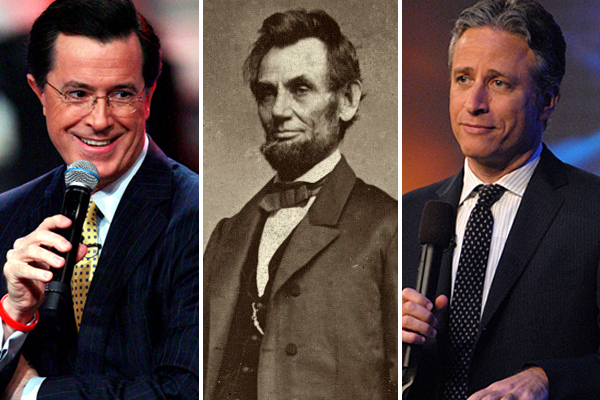
Do you consider satirists and comedians like Jon Stewart, Stephen Colbert or Bill Maher to be ironists?
I make a big difference between these three. I put Colbert and Stewart on one side, and Maher on the other. Maher is more snarky. He’s sort of preaching to the converted. He’s asking people who already agree with him to laugh at people who don’t agree with him, and, in itself, it’s a group activity. I think there’s less of that certainly in Colbert, and I think in Stewart too. There’s more of an attempt to play with ironic moments – especially the whole persona of Colbert, which is hilarious. But when [Colbert] looks straight into the camera and says, “Nation,” on the one hand it’s a very funny routine and it’s mimetic. He’s imitating others, and we recognize the imitation, and we enjoy the mimesis, and it’s pleasurable, but when he does that, is there ever a moment when one is stung by the thought: Well, what would it be to be a nation? What would it be for us to be a polity that could be addressed? Underneath the very real humor – and I’m not saying it’s always arising – but there’s a possibility of actually getting shaken up about this. I think Stewart does this as well, pointing out, in a hilarious way, the various ways our leaders can be hypocritical. Again, we laugh at the humor, and he’s very good at it, but I think that in laughing at the humor there’s a possibility for that kind of a sting – what would it be to either have a leader or to be one? Or to take responsibility for our elected officials? For Colbert and Stewart, there’s a possibility for irony that I don’t much see in Maher.
Continue Reading
Close
If you are still scratching your head trying to figure out Occupy Wall Street’s aim, you are not alone; the three-week-old movement has remained stubbornly resistant to stating clear demands. But one thing has become increasingly clear: It has managed to tap into a growing national frustration with the state of the American economy. And protesters are especially angry about our country’s increasing, outrageous income disparity. The numbers are astounding: As 2.6 million Americans fell under the poverty line last year, the top 1 percent continued to control more than 40 percent of the country’s wealth.
For anybody interested in understanding the reasons behind this economic travesty, economist Jeffrey Sachs’ new book, “The Price of Civilization,” is required reading. In the book, Sachs, who has focused much of his career on the developing world and eradicating global poverty, turns his eye homeward to examine the current economic crisis, tracing its roots not to the housing or financial bubbles of the ’00s, but to a shift in Washington toward smaller government that began in the early ’80s and has yet to be reversed.
Sachs talked to Salon over the phone to discuss the ills of small government and Reagan’s trickle-down economics, the Republicans’ and the Democrats’ culpability, and the need for more compassionate talk in politics.
You went to speak with the Occupy Wall Street protesters. What’s your opinion of the movement?
I’m very sympathetic to their message, and I’m glad that they’re protesting. I think that their key point — which is that the top 1 percent of society has run away with the income, the wealth and the power in this country — is correct. The income distribution in this country has gotten out of whack to a historically unprecedented extent and it has come with a very serious derangement of our political processes. A majority of Americans are feeling very disgruntled about both the economic squeeze and their lack of political representation.
You try to dissect the current economic crisis in your book. What do you think caused it?
This story goes back a long ways. It’s important to understand this because if we take this crisis to be something that started with the bankruptcy of Lehman Brothers in September 2008, or whatever recent event one might pick, we’re going to miss the big picture. The U.S. is facing a structural crisis that goes beyond the bursting of the financial bubble. The remedies, therefore, must also go beyond what I regard as gimmickry of a stimulus package, or a temporary tax cut – or, for that matter, even less relevant permanent tax cuts. So I try to peel back the story actually into the 1970s – from then until today.
Why the 1970s?
Beginning in the 1970s – this is crucial – the U.S. began to globalize, as did every other economy in the world. We felt it first with the competition from Japanese automobiles. But the dramatic story, of course, was the rise of China as a major world economic power when it changed its politics in 1978 [by opening its doors to foreign investors]. In the U.S., we were so focused on the Cold War and competition with a fourth- or fifth-rate economic power, the Soviet Union, that we didn’t understand that something far more consequential was occurring in the world economy.
The main effect of globalization, which is known but somehow weirdly separated from our politics, has been that those who have products, or services, or celebrity, or other things that they can sell to world markets, have found a boon in globalization. But for most of American society, and certainly for the majority of Americans who don’t have a bachelor’s degree, globalization has meant facing much lower-wage workers abroad and increasingly powerful competitive pressures. So our society began to separate between the “haves” and the “have-nots,” really in the early 1980s. And while this crucial dynamic was underway, American politics was going in almost the opposite direction.
How so?
Reagan came to office with a diagnosis, most famously put in his inaugural speech, that government is not the solution, but the problem. This was put forward as the reason why the 1970s were so shaky, why we were experiencing more instability. Reagan made a big and wrong diagnosis, with extraordinary consequences, and a lot of the country bought it.
He was playing to a lot of powerful interests [the rising Sun Belt, conservative businessmen, etc.], and the dismantling of government began, all in the service of cutting top tax rates as a theory of how to make the economy function properly. It’s a weird idea because there is plenty of evidence that government and markets are complementary parts of a healthy society – it’s not one of the other. The interests at the top benefited from globalization through market forces, tax avoidance and tax havens — and they absolutely grabbed hold of the federal government.
Each of the parties is constantly feeding at the trough of major interest groups. The Democrats, basically, were sold to Wall Street by [Bill] Clinton, and they’ve remained in Wall Street’s hands up until now. And that is one of the greatest failings of the Obama administration: the fact that he couldn’t find his way clear of the major interest group that helped bring him to office, and therefore he really couldn’t undertake deeper changes in the country.
Part of being in this straitjacket of fiscal or tax policy that Obama got himself into is that everything on the spending side has been short-term gimmicks rather than a long-term program, and it is exactly coherent with our incoherent nonstop campaign cycle. We don’t really have longer-term thinking in this country about our economic challenges.
You point to this political shift in the ’80s as a pivotal moment. What was public perception of government prior to Reagan?
When I was growing up, it was a commonly thought that America needed a mixed economy, that there were spheres of life where the market economy should prevail, and there were spheres of life where the government would be crucial. [The mixed economy] has had great history in all of the high-end democracies and there is a lot of economic reasoning behind it.
Basically, government has to be operating where the profit motive won’t suffice. The profit motive works where you have good economic competition, but if you just need one highway between city A and city B, that’s not going to be a competitive highway, so you’d better involve the government. If you want scientific knowledge in a society, for example, you don’t patent basic theorems, because everybody needs to use them, so you have to find a different way other than the profit motive to get science to develop.
I think Ronald Reagan really had a devastating effect on this. The idea that one would elect a president on the premise of demonizing government rather than making it work properly is really a shocking idea – “I’m here to dismantle the role of government.” No president since then has deviated from that line. Bill Clinton declared the end of big government. Rick Perry has been quoted as saying that he wants to make the federal government as inconsequential as possible to the American people. Well, maybe he should look for another job. That’s a lousy platform for a president of the United States.
You, in fact, call for a renewed emphasis on compassion and social responsibility.
What are our deeper economic objectives? Among these is a sense of well-being, of life satisfaction. Income can play a role in that, but so do things like social trust and honest government – and compassion for other people. This kind of discussion is considered odd and I think that is part of our problem right now. We don’t have effective ways to discuss these things in our society.
Instead, we have people who represent a cult of selfishness, what I would consider Ayn Rand libertarianism. They are political figures who say that the goal of America is to leave [people] alone, and that ideas like compassion and so on are dangerous. What the Republicans have on offer – which is based on this 30-year misdiagnosis – is cruel and deeply wrong, because they express disdain for the idea that people are suffering and they need help.
We’ve arrived at a crossroads about the real meaning of our civilization. I think that we will need to reflect on how to achieve a higher level of happiness in this country — [and think about] issues of social trust, social connectedness, decency, compassion.
And this isn’t in conflict with the American work ethic of “pulling yourself up by the bootstraps,” and everyone doing their fair share?
This [crisis] isn’t really about hard work and effort. It is about a society in which the options for a lot of people seem to be closed off right now. One of the great visions of America has been that this is a society where if you work hard, you can make it. But today we have the lowest social mobility of any high-income democracy. One of the most pertinent measures of social mobility is the correlation between parents’ and children’s educational attainment. If you’re lucky to grow up in [a middle- or upper-middle-class] household where your parents have a college degree, you have a very good chance of getting a college degree and gaining a good position in the economy. But if you grow up in a household where your parents’ highest educational attainment is a high school diploma [or less], the chance of you getting a bachelor’s degree, which is now the tollgate for middle-class success, is very, very small. That brings us back to globalization. There really were middle-class paths with a high school diploma before. Those don’t exist now.
You lay out an extensive plan for climbing out of this crisis. What are some of the steps you propose?
There is no quick fix right now. A quick fix would occur if we had hit a bump in the road of a normally functioning economy, but my point is that we had growing rot that was disguised by financial bubbles. Rebuilding the infrastructure, strengthening the scientific base, having an energy system that moves to a sustainable renewables, low-carbon economy, improving educational outcome so that more kids make it all the way through – those are 10-year projects, more or less. When the [national highway system] started in the mid-1950s it was understood that this was going to take a long time to do but that we were going to make the investment to build a whole national system.
How do you propose paying for this?
Americans have a pretty accurate picture of a lot of this [crisis]. They sense, first of all, the huge inequality that we have. They know that something is really wrong, that the top has really run away with the prize. About 60 percent of Americans wanted to repeal the Bush-era tax cuts at the top, and yet Obama ended up siding with the Republicans. I think that epitomizes the break between normal, American public opinion and policy. It reflects this remarkable, unprecedented since the period before 1929 swing toward the super-rich.
I’ve been pretty impressed by the core trilogy of what opinion surveys say America wants: tax the top, end the wars [in Iraq and Afghanistan], and protect social spending. We ought to be going after the corporations that have, basically, a deal with the IRS that keep abroad what they earn abroad and they don’t pay any taxes on it. We should be taxing worldwide income, not just U.S.-based income.
But what about the threat of job flight if we were to increase tax burdens on corporations?
There is a phenomenon called the race to the bottom. It says, what counts for me is whether my taxes are lower than your taxes so that I can attract capital from you. If everybody ends up racing to the bottom, so there’s a tax-cutting arms race, everyone ends up being a loser. We definitely have part of that happening right now.
Every country has an incentive not to have their tax base disappear into a Cayman Islands post office box. There has been talk of ways, through shared action, exchange of information, and so on, of possibly closing down these havens. But it has to do with the way the rules are written by our own governments. One of the arguments against the taxation is that if we tax the rich, they’ll move someplace else. It’s not so simple. We need to recognize that in a global, interconnected economy, with highly mobile capital, we need some cooperation to make sure that we don’t end up with all our governments in fiscal crisis simultaneously.
Continue Reading
Close