Alison Buckholtz

Once upon a time, Dad went to war

Books had always helped me in a crisis. But could I find one that explained to my kids why their father was in Iraq?

  • more
    • All Share Services

Once upon a time, Dad went to war

I don’t know which stretch of highway was sadder: our family’s drive to drop off my husband, Scott, an active-duty U.S. Navy pilot, to begin his seven-month deployment on an aircraft carrier or the drive back home without him. I sobbed quietly at the wheel, trying not to upset my two children, strapped in their car seats behind me, as we wound our way home on the gently curving roads of our rural county.

Glancing into the rearview mirror, I saw exactly what I expected. Four-year-old Ethan looked sullen and confused; he had been clingy and anxious during the big goodbye. Two-year-old Esther was too young to understand. She sang along with her “Sesame Street” CD, confident that I could provide for her health, happiness and well-being.

I didn’t feel nearly as certain.

This isn’t the first time I’ve taken care of the kids while my husband has been away for extended periods of time, but it’s our longest deployment yet. (We have been lucky — other military families have endured multiple 12-to-19-month deployment cycles since the Iraq war began.) Our Pacific Northwest town has a significant military population, and most of the people I have met here are women whose husbands are also service members. Because of the wars in Iraq and Afghanistan, a relentless schedule keeps many of the squadrons away from home. So we military moms talk often about ways to help our kids cope with their dads’ long absences. We trade names of psychologists. We exchange tips that may ease our kids’ nightmares, regressions and depression. But what I wanted, more than any of those things, was a book.

Kids’ books on deployment are becoming more prevalent as the war drags on; these stories, often self-published or from small publishing houses, try to explain to the 2-to-5-year-old set why Dad must help children overseas instead of staying home to play with them. I have always found comfort in literature, in the power of a shared experience to bring consolation during difficult times. So I prompted other military moms for authors’ names. I haunted the aisles of local shops and spent hours online. I borrowed other families’ deployment-related books and lent out my own. I amassed quite a children’s library — a heartbreak hotel of titles I wouldn’t wish on anyone. The books I found are well-meaning, almost painfully sincere in their effort to address a child’s fears and feelings. They end in joyful homecomings.

But talking to a kid about deployment is like talking to a kid about God: Every parent has his or her own approach. And I couldn’t find one single children’s book on deployment that I could read without cringing.

I knew exactly what I wanted: the military version of “Alexander and the Terrible, Horrible, No Good, Very Bad Day.” I envisioned a story that allowed kids to acknowledge their anger or sadness at Dad’s absence, even wallow in their bad mood if necessary — all while transmitting the assurance of a better day.

But even in the most sensitive and tender children’s books on deployment, I found jingoism (“Your daddy had to go to war because he said he would. A war is something that our nation believes is all good”), reflexive sloganeering (“‘You are Uncle Sam’s kids,’ said Daddy”) and a whiff of xenophobia (“Mom watched the news and she said, ‘That’s where Daddy is … Iraq.’ It didn’t look like a very nice place.”)

In others, politics intrude in a startling way. In a self-published title available on Amazon, the 11-year-old narrator says, “How can Uncle Sam be so unfair to the little people? Come on, isn’t it bad enough that my dad was ordered to fight in a controversial war, just to look for bad men who carry guns and wear dresses?” The section continues, “Where is justice for the little children all over America, who have to stand by and watch their mothers and fathers go off to war?”

Partisanship aside, the allusions to Iraq, or to combat, may be reasonable for older children who watch the news. But I found it totally unacceptable for the younger ones, kids who are developmentally unable to process anything but the basics: Dad’s gone, but he loves you very much, and he can’t wait to come back so we are all together again. And it’s OK to be mad about it.

That’s why I avoided talking to Ethan and Esther about the war. As the countdown to my husband’s deployment began, we described his “long trip for work.” The thought of transmitting any deployment-related details to my kids paralyzed me with fear. I didn’t want to be the one to shatter their innocence. I didn’t want their innocence shattered, period. I stuttered out vague explanations for the pro- and antiwar rallies we drove past on Sunday mornings when Ethan asked why people were holding up signs and shouting at one another.

I just prayed he didn’t hear about the war from anyone else. Though I understand the importance of telling children the truth, “Dad’s in a war” is among the ugliest truths there is, and I planned to shield him from it for as long as possible.

That turned out to be a month.

Ethan’s friend, a 5-year-old boy we adore, came over for a play date shortly after my husband deployed. As I made pizza in the kitchen, I watched the two boys swordfight, fit puzzles together, lounge against each other on the couch as they watched a video. The little boy got up, wandered around the room, and stopped in front of a photo of my husband in uniform.

“Is your Dad in the military?” he asked Ethan.

“He’s in the Navy,” Ethan said proudly. And I was proud, too — of him, for the dignified way he responded, and of myself, for transmitting the idea that he should be pleased with his dad’s service. My efforts were worth it, I thought. Those jagged explanations, awkward and unpracticed, actually worked.

“People in the Navy kill people,” the little boy said.

My scalp tingled with fear.

Ethan’s buddy was the child of civilian friends who, I discovered afterward, support the troops but openly discuss their antiwar feelings with their son. Every parent will choose what’s best for their kids, of course. But now our two boys stood face to face, arguing about whether or not Ethan’s father was a murderer.

Ethan’s nightmares began that night.

So I made an appointment with a civilian social worker on base. I wanted to ask if she could recommend a way through the crisis. I wanted book titles, too — I hadn’t abandoned that dream. Ever the diligent student, I uncapped my pen as soon as I sat on her couch. I jotted down tips, ideas, resources and her thoughts on our particular situation. None of it was very satisfying.

“I’m just not sure how to explain it all to him,” I finally confessed.

“Could you tell him his dad is fighting for freedom?” she suggested.

I put my pen down. Now I was truly alone.

“No,” I said.

I had come in search of a road forward, but instead I found myself on a brain-rattling gravel path that dead-ended in the middle of nowhere. There were no thoughtful answers. Even a trained social worker was offering slogans as a method — or a substitute — for coping. Maybe there was simply no good way to maintain a child’s emotional health during deployment, because sending a father off to war is an abnormal, traumatic experience that is rectified only when he returns. (Or perhaps never, for all I knew.) Maybe I hadn’t been able to find any satisfying children’s books on deployment because there just isn’t anything reasonable to say.

When I arrived back home, I reexamined the pile of books I’d rejected months before, wishing just one held the key. I knew nothing could lessen the kids’ yearning for their dad. I wasn’t looking for that. I just wanted the deployment to make sense to them, in the most personal way possible.

Normally, writing would have been my answer. But I write newspaper and magazine articles, not children’s books. Still, at my desk one morning, I started absent-mindedly drawing pictures of Ethan and his dad on a page in my notebook. I stuck a few happy-face stickers around the edges. I felt like I was in kindergarten. Then I wrote a few captions for the drawings, but I started running out of space, and my handwriting was sloppy, so I opened up my laptop.

When I looked up next, a few hours had passed. I printed out a dozen pages, and decorated them with stickers and stamps. I glued on photos that Ethan had never seen before. I stapled a makeshift binding along the side. I called my book “The Good Day: Having Fun While Dad’s Away.” It held between its two thin covers everything I wanted to say to the kids about Scott’s deployment. My credentials were tenuous. I was just a mom. But that qualified me as an expert in the small picture: the domestic sphere.

The next day, I asked Ethan and Esther to sit next to me on the couch. I reached for the book. Ethan was uncharacteristically withdrawn, but he oohed and aahed over the stickers. The kids turned each page together as we read. I wondered, yet again, if I was handling the separation the right way. After all, I had pored over volumes of pamphlets and fliers on getting kids through deployment. No one ever mentioned writing one’s own book.

As we reached the last page, Ethan looked up at me.

“Mommy?” His eyes were shining. Were those tears?

I felt I had totally blown it. Perhaps our military family in the making, still so emotionally fragile, could not withstand any further trauma. In that moment, I second-guessed myself on everything that had taken place since the day Ethan was born. Suddenly parading before my eyes were four years of bad decisions, missed opportunities and wrong turns that would surely land us on the “Dr. Phil” show.

“Mommy?” he repeated.

“Yes, my love?”

Ethan smiled the lopsided, closed-mouth grin that reminds me of my husband. It was the first moment in weeks I’d seen a spark of his old self.

“Read it again.”

The letter E is purple

My synesthesia made me feel like a freak. But if my son has inherited this neurological quirk, I hope he realizes what a gift it is.

  • more
    • All Share Services

The letter E is purple

It was a warm summer afternoon in our corner of the Pacific Northwest, and as I pushed my 4-year-old in the swing, we debated the color of the sun pulsing down on us. Is it yellow or gold, he wanted to know, or is it white, and if it is, why are the spots in front of your eyes pink if you stare at it too long?

“That’s a lot of colors,” I said, only half attentive to the conversation. “What other colors do you see?”

He thought for a second, as if deciding whether or not to tell me something. Then he said, “The letter E is purple.”

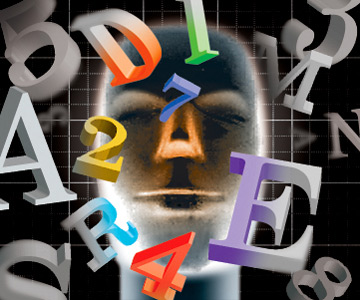
In that moment my whole world contracted. I knew exactly what “The letter E is purple” meant. Because, for me, numbers have always had their own color — not just the number itself (though that, too), but the very character of the number, its presence in the world, is a color. An obvious, intrinsic color. Five, for example, is orange. Two is yellow. Seven is green. It is as natural and unchangeable as the color of someone’s skin.

Speaking of skin, people had colors, too. Not everyone. But many people did, whether I liked them or not, whether I knew them well or not. I didn’t have to think about it; it was just so. As apparent to me as their eye color.

“The letter E is purple” meant that my son may have synesthesia. I’ve had it all my life, though I only found out a few years ago that it has a name, and that others have it, too.

Synesthesia is a neurological phenomenon in which activation of one sensory processing system (e.g., numbers or written language) leads to the automatic engagement of a second, distinct sensory processing system (e.g., color) to create a “crossed” sensory perception. For example, as in my case, numbers appear to have their own colors. Or, in other forms of synesthesia, sensory processing is “crossed” with emotion processing, imbuing letters, words, days of the week or months with their own personalities.

There have been many hypotheses about the cause of synesthesia since it was first studied with any rigor in the late 1800s, and a recent article in Nature Neuroscience posits that it is caused by an increased connectivity between relevant brain regions. Put another way, connections that have, over time, been “pruned” in others remain in place for synesthetes, though the reason for this is unknown.

Though there’s no one else in my immediate family with synesthesia, except for possibly my son, studies suggest a genetic basis; women and left-handers also tend to have it more. Other than being a possible distraction, synesthesia doesn’t interfere with daily functioning and isn’t considered a disorder — synesthetes perform normally on standard neurological exams.

But that’s where the certainties end. Estimates of prevalence are variable and shaky, from 1 in 200 to 1 in 100,000, though that same study in Nature Neuroscience suggests 2 in 100 people may have grapheme-color synesthesia, the version that causes my numbers to come alive. “Synesthesia is ‘abnormal’ only in being statistically rare,” according to the abstract from a scientific article in the journal Psyche. “It is, in fact, a normal brain process that is prematurely displayed to consciousness in a minority of individuals.”

“Minority” is the operative word here. In fact, the problem with statistics on synesthesia is that many people who have it don’t report what they’re seeing. The Victorian scientist Francis Galton, cousin of Charles Darwin, writes about this with great feeling in his charmingly titled article “The Visions of Sane Persons” (1881). As Galton and later generations of psychologists have emphasized, sometimes synesthetes who have grown up seeing colors don’t even realize that what they’re seeing is far from the norm. That’s how it was for me. For years I never realized what I saw was different, and so I didn’t mention my colors to anyone, including my parents.

There was no reason to, anyway. For much of my childhood, I enjoyed my synesthesia, playing with it as a kitten would bat around a ball of yarn. I’d mentally run through my numbers, one through 10, as if flipping through a paint deck that always landed on my favorite colors. I’d turn my eyes to a teacher halfway through class to bask in her lavender glow. I’d allow her color to soothe me for a few moments, then turn back to the assignment at hand.

As a teenager, it became apparent to me that what I was doing wasn’t quite normal. I wasn’t quite normal, either. No one else ever mentioned a lavender teacher. I’d heard about auras — radiant light surrounding a person, somehow revealing or reflecting his or her soul — and I figured the color I saw from certain people, or numbers, was an aura. Had I somehow gained access to a spiritual dimension?

But the only people I knew who believed in such things were hippies, New Age goofballs and other types who were decidedly marginal in my high-achieving Washington, D.C., suburb. There was no scientific basis, as far as I knew, for what was going on in my head. And in my family, as well as the families of my friends (whose parents worked at the National Institutes of Health, as my father did), science was practically a religion.

I decided I was a total freak. And my freakishness, however private, placed me in danger of serious social alienation. Though I was confused about what to do, one thing was very clear. I didn’t want supernatural powers.

In fact, I didn’t want to be special in any way. I was in high school, and I wanted to wear the clothes everyone else wore, do the things everyone else did, and see what everyone else saw — five qua five, in other words.

I couldn’t do anything about the fact that Guess jeans, the outrageously expensive fad of the moment, were out of my reach. I couldn’t do anything about the fact that I actually enjoyed eating lunch in the school library. But I could try to get all those damn colors out of my head, especially since the sensory overload was sometimes dizzying. I needed, once and for all, to clear some space in my brain. So I blocked my colors like any junior varsity football star would resist a surging offensive lineman. Sometimes, those colors tackled me instead. But I kept at it. And slowly, over the years, I began to close myself off from the barrage of perceptions I had lived with since I could remember.

Even then, I never talked to anyone about it. I figured if I had to be the only weirdo who saw colors where colors couldn’t logically exist, then I owed it to myself to keep the secret.

I didn’t worry about colors for many years, and though I retained all of my lifelong synesthetic associations, I only rarely generated new ones. Occasionally, I met a person whose color was obvious and unmistakable, and I couldn’t shake the connection. In fact, I named my daughter Esther, in part, because her color matched her name, which to me is pink. Even now it brings me deep aesthetic and emotional satisfaction to know that she and her name are so well-paired.

Finally, in my early 30s, I read a short piece on synesthesia in a scientific journal. Decades of tension I never knew I’d carried instantly lifted. My freakishness had a name. And actually, I wasn’t a freak at all. I wasn’t the only one perceiving my surroundings in technicolor. I recognized myself in sentence after sentence, paragraph after paragraph.

After the relief, though, I felt sadness and, ultimately, regret. The sadness grew out of a nostalgia for my childhood — the fun I once had with my colors, the deep comfort they brought me, and the way they mapped to specific points in my personal history. Before I became a self-conscious teenager, synesthesia facilitated some of my happiest quiet times. It was a way to soothe myself, to assuage my own anxieties. When I met people whose colors were obvious, the color often became a way to read them and their motivations. Those colors helped me manage and navigate an increasingly confusing world.

The regret came the moment I read the phrase “the gift of synesthesia” in that scientific article. Because, by then, I’d come to accept and even like my eccentricities; I seized on the well-documented link between synesthesia and artistic originality. (Some famous synesthetes include the writer Vladimir Nabokov, the artists Wassily Kandinsky and David Hockney, musician Franz Liszt and the physicist Richard Feynman.)

Synesthesia could have sprouted genius in me — or, at least, that’s what I told myself. Now that I can appreciate how full-throttle synesthesia could have energized my adult consciousness, I mourn the way I so casually excluded myself from its bounty.

I recently outed myself as a synesthete to my family, and they were astounded — especially my father and brother, who are both neuroscientists.

“Why didn’t you tell Dad?” my brother asked. “He’s spent his entire career researching the brain. Didn’t you think he’d be interested?”

In fact, many scientists are intensely interested in synesthesia right now. The revolution in cognitive science and the sophistication of new neuroimaging techniques like functional magnetic resonance imaging means that the study of cross-talk among the senses is white-hot.

As breakthroughs make it possible for scientists to look more precisely at connections and pathways in the brain, more evidence-based articles on synesthesia are being written than ever before, and in 2006 the brain research journal Cortex devoted an entire issue to synesthesia.

A University of Washington neuroscientist has even produced a Web page on synesthesia for kids. “Perhaps you are completely convinced that Wednesdays are light red,” it says. “If you have experiences like these, you might have synesthesia.”

But when I was a kid, I never would have guessed the rainbow that filled my head was a function of how many nerve cells were touching deep inside my brain. To me, those shades of light were as real as the bright sun that hovered over our swing set the day my 4-year-old announced that E is purple. I don’t know yet if his letters actually pulse with color. But, for his sake, I hope they do.

Continue Reading Close