Brendan Nyhan
Right still searching for “death panel” proof
Rationing is a reality of any plan to bring down healthcare costs
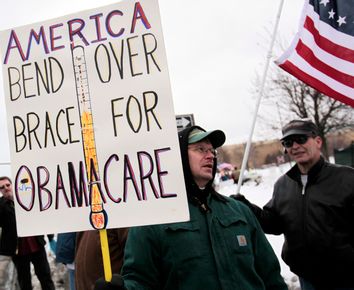
A Tea Party member carries a sign voicing his concern over "ObamaCare" during a rally marking the one-year anniversary of the movement in Troy, Michigan February 27, 2010. Some Tea Partiers say they can pinpoint the precise moment when they made it clear to the Republican Party they had no intention of being its lapdog. On a bright, brisk afternoon in mid-February, with snow still thick on the ground from storms that had battered Washington the week before, Republican National Committee Chairman Michael Steele met with more than 50 members of the Tea Party, the Twitter Age conservative movement that is reshaping the U.S. political landscape. Picture taken February 27, 2010. To match Special Report USA-POLITICS/TEAPARTY. REUTERS/Rebecca Cook (UNITED STATES - Tags: POLITICS CIVIL UNREST)(Credit: © Rebecca Cook / Reuters) This originally appeared at Brendan Nyhan’s blog.
One of the most frustrating aspects of the current debate over the healthcare reform is the way that conservative bloggers and pundits keep trying to find evidence to justify Sarah Palin’s false claims about a “death panel.”
The latest example comes from bloggers Ann Althouse, Jim Hoft, and Doug Ross, who claim that the decision by the Center for Medicare and Medicaid Services to conduct a National Coverage Determination for the prostate cancer treatment Provenge is evidence of a “death panel” (Althouse headline: “Death panel”; Hoft: “HERE COME THE DEATH PANELS”; Ross: “sounds like a death panel to me”).
This argument is absurd on a number of levels. First, in terms of the specific claims about Provenge, CMS hasn’t denied coverage and experts say it’s unlikely they will do so at the end of the year-long process (see also Media Matters). The entire claim is based on speculation.
More important, even if CMS had already decided to deny coverage, it would not justify Palin’s statement. Here is the relevant passage again:
The Democrats promise that a government health care system will reduce the cost of health care, but as the economist Thomas Sowell has pointed out, government health care will not reduce the cost; it will simply refuse to pay the cost. And who will suffer the most when they ration care? The sick, the elderly, and the disabled, of course. The America I know and love is not one in which my parents or my baby with Down Syndrome will have to stand in front of Obama’s “death panel” so his bureaucrats can decide, based on a subjective judgment of their “level of productivity in society,” whether they are worthy of health care. Such a system is downright evil.
Palin’s language suggests that a “death panel” would determine whether individual patients receive care based on their “level of productivity in society.” This was — and remains — false. Denying coverage at a system level for specific treatments or drugs is not equivalent to “decid[ing], based on a subjective judgment of their ‘level of productivity in society,’ whether [Palin's parents and baby with Down Syndrome] are worthy of health care” (see also Cato’s Michael Tanner). Those who try to redefine “death panels” in this way are attempting to move the goalposts in the debate. It’s the equivalent of pointing to buried Iraqi chemical shells from the 1980s as evidence for the Bush administration’s claims about WMD.
Finally, defining “death panels” as rationing of any sort is totally nonsensical. By that standard, there are government and private “death panels” throughout the healthcare system already. It’s true that Obama’s proposal is likely to increase rationing, but so would every other proposal to control the unsustainable trajectory of future healthcare spending. Under Rep. Paul Ryan’s Medicare voucher plan, for instance, CBO projects that “[b]eneficiaries would… be likely to purchase less comprehensive health plans or plans more heavily managed than traditional Medicare” (my emphasis). Unfortunately, hysteria over “death panels” is preventing a necessary debate over which approach would be most effective and fair.
The Fed is Obama and the Dems’ best bet for ’12
It's actually huge news that one of Obama's picks for the Federal Reserve Board was blocked this week
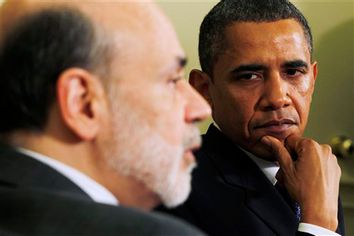
President Barack Obama meets with Federal Reserve Board Chairman Ben Bernanke in the Oval Office of the White House in Washington, Tuesday, June 29, 2010. (AP Photo/Charles Dharapak)(Credit: Charles Dharapak) It’s shocking to me how little attention is being given to the Federal Reserve by the Obama administration and its supporters. Consider the following list of statements:
Continue Reading Close1. The economic downturn has been severe. The history of financial crises suggests that recovery may be long and difficult, particularly if the U.S. enters a deflationary spiral.
2. A second stimulus can’t pass Congress now and certainly won’t pass after expected Republican gains in November.
3. The Federal Reserve plays the most important role in determining short-term macroeconomic outcomes.
4. While interest rates are at the so-called zero bound, the Fed could take other steps to try to stimulate the economy.
5. Some officials at the Fed are concerned about inflation; this appears to be limiting its aggressiveness.
6. Obama’s Fed appointees are likely to be inclined to try to stimulate the economy. Their confirmation could help tilt the balance toward more aggressive measures.
7. There are significant lags in macroeconomic policy, which make swift action by the Fed especially important.
8. If successful, these measures could help millions of Americans who are struggling to make ends meet during the deepest downturn of their lifetimes.
9. The economy plays the most important role in presidential approval and presidential election outcomes. If economic growth does not improve significantly, Obama’s approval ratings will decline and he is likely to be defeated in his re-election campaign.
The magical thinking of Fred Barnes
Economic growth, not spending cuts, will be the major factor in determining whether Obama gets another four years
This piece originally appeared at Brendan Nyhan’s blog:
I take it as a given that most journalists know very little about political science. But I still assumed that almost everyone has a basic understanding of the relationship between the state of the economy and presidential election outcomes. Apparently Fred Barnes missed the memo.
Continue Reading CloseThe disappearing Democratic brand advantage
Until recently, voters were more favorable to Democrats than the GOP. Now that advantage is eroding
Back in October, I noted that the GOP’s brand (as measured by its favorable/unfavorable ratings) was in much worse shape than any opposition party at that stage in the previous four midterm election cycles. That stigma, I suggested, might limit Republican gains in the November midterm elections relative to a 1994-style scenario.
Continue Reading CloseMaking Bush tell the truth about Iraq
The media has to be tougher on the president's tendency to dissemble about his policies, and then again when he's caught -- especially when it comes to war.
On Election Night, Republican candidates backed by President Bush won a resounding victory across the country. Facing a transformed political landscape, with a newly invigorated president and a war with Iraq looming, it’s time to ask a crucial question: Will the media finally hold the president and his staff accountable for their repeated evasions and dissembling?
In Washington, the maxim used to be that you get in trouble not by lying, but by trying to cover up the lie when you get caught. Bush has turned this tired piece of conventional wisdom on its head, running an administration that almost always tries to cover its tracks with misinformation rather than admit to an error or a lie — and often gets away with it.
Continue Reading CloseFools rush in
More false starts in the race to demonize Daschle.
In yet another example of the right’s ongoing campaign to manufacture attacks against Senate Majority Leader Tom Daschle, D-S.D., Rush Limbaugh recently helped promote an obviously suspect report from an ex-staffer about Daschle’s name appearing on an antiwar petition. The original story about Daschle and the petition was written by Joel C. Rosenberg, a former staff writer for the Limbaugh Letter who now serves as a contributor to Jewish World Review, a conservative Web site, and a columnist for the conservative World Magazine. Rosenberg called Daschle’s office to inquire about the senator’s listing as an online signer of the “Not in Our Name” (NION) petition, which appeared in the New York Times and Los Angeles Times in recent weeks. When the Daschle staffer that Rosenberg contacted did not immediately deny the charge, he rushed the story onto the JWR Web site, where it ran under the headline “Daschle now sides with president, but signed radical anti-war petition.” After noting Daschle’s recent support for the president’s policy toward Iraq, Rosenberg wrote that “Sen. Daschle is a co-signer of a defiant anti-war petition distributed nationwide in recent weeks.”
Continue Reading ClosePage 1 of 5 in Brendan Nyhan