Brent Hannon

Will Taiwan's president-elect defuse tension with China?

Chinese leaders say no to a proposal for peace talks as equals.

  • more
    • All Share Services

Will Taiwan's president-elect defuse tension with China?

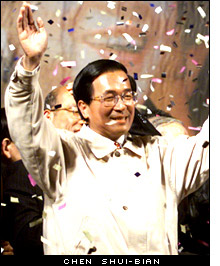
A proposal by Taiwan’s president-elect, Chen Shui-bian, for a peace summit with China seemed to run aground Monday despite toned-down rhetoric from both sides. Beijing is insistent that Chen accept its “one-China principle” before talks can begin; Chen, a native Taiwanese and the candidate most hated by the mainland, has long championed the island’s independence. His election Saturday came after weeks of bullying and threats from China.

The most immediate threat to peace in Taiwan was the reaction of Nationalist Party members, who rioted to protest President Lee Teng-hui’s failure to hold on to the presidency. A crowd of about 3,000 stormed the party headquarters in Taipei chanting “Step down president!” And indeed Lee promised to resign as party leader.

Chen’s supporters were exuberant after his unexpected victory. At a rally Saturday, deputy campaign manager Lee Yi-yang took the stage and taunted China. “The Taiwanese people have stood up,” he shouted. “The Taiwanese are taking back Taiwan.” Lee’s words, a play on the famous ‘Chinese people have stood up’ speech made by Mao Zedong after the Communists won the civil war, are a direct challenge to Beijing.

But if Lee can afford to taunt China — he was addressing a crowd of faithful supporters — president-elect Chen cannot. During the campaign, Chen toned down his rhetoric and stopped demanding a referendum on independence. In his victory address, he called repeatedly for peace, dialogue and talks between the two countries.

Still, it is clear where Chen’s sentiments lie. “We are unable to accept one country, two systems, or any such system,” he said at his post-election press conference. “We will not become a second Hong Kong or Macau.”

In Taiwan’s first-ever presidential election in 1996, China tried to influence the vote by firing missiles near Taiwan’s two main ports. The tactic backfired then, as Taiwan elected the candidate most disliked by Beijing, and now once again, the small island has defied its huge neighbor.

In the weeks preceding the election, China had escalated its threats against Taiwan, culminating in Prime Minister Zhu Rongji’s warning that China would shed blood to retake Taiwan, which it considers a renegade province.

Chen’s victory appears to have taken the United States by surprise — he trailed in the polls for much of the campaign — but the American Institute in Taiwan, the de facto U.S. Embassy, expressed cautious optimism. “Chen’s response to the threats from Zhu Rongji was very low-key,” said a senior U.S. official. “He has consistently downplayed all the threats, and we hope he will continue to do so.”

During the campaign, the ruling Nationalist Party warned of dire consequences if Chen were elected, including Chinese missiles falling in central Taiwan and the stock market dropping almost to zero. Now they must hope their predictions don’t come true. Taipei’s stock market index dropped 2.5 percent Monday, a sign that some investors are worried about the escalation in tension.

Few people here underestimate China’s desire to take back Taiwan. China is a nationalistic nation with a huge chip on its shoulder. It sees its present status in the world — a large, poor country with modest global clout — as a historical aberration. Taiwan’s very existence as a separate country — let alone an economic powerhouse and a bastion of democracy — is an ongoing humiliation to the mainland.

Chen’s Democratic Progressive Party (DPP) is unlikely to throw a match into the tinderbox, at least not on purpose. There is little to fear from the personalities in the party, who have matured considerably since the party was founded in 1986. In the years following its inception, the DPP was a firebrand opposition party, but as it gathered support among the people and in the local and national government, it softened its rhetoric.

When DPP leaders gathered for Chen’s post-victory press conference, the mood was serious and sober, and when party Chairman Lin I-hsiung addressed the media, he was calm and conciliatory.

Still, the party’s written platforms are sure to enrage China. In its China Policy White Paper, issued in November, the DPP declares that Taiwan is a sovereign and independent country, and not a part of China in any way. It further states that any change in relations between the two countries must have the consent of the people of Taiwan. It is a declaration of de facto independence.

Chen has distanced himself from the party platform, saying discussions are possible under any framework, but he adds two key caveats: Any changes to the status quo must be approved by the people of Taiwan, and Taiwan must be treated as an equal. But China has never regarded Taiwan’s government as legitimate, let alone equal, and thus the relationship begins in mutual suspicion.

On Monday, Chinese President Jiang Zemin dismissed the suggestion that the two governments are equal, and said that “negotiations across the Taiwan Strait should have a basis, namely, the one-China principle must first be recognized.”

Taiwan’s next move depends on China, said DPP legislator Shen Fu-hsiung. If China wants to talk, Taiwan will talk, but continued belligerence would force Taiwan to strengthen military alliances with Japan and the United States. “We are a small country between three giant neighbors,” he said. “To survive, we must use wisdom. We can either establish formal alliances with Japan and the U.S., or we can talk peace. We can either contain China, or push forward with diplomacy. But diplomacy must come from an attitude of peace on the part of China.”

In the first flush of victory, Chen supporters scoffed at the threats from China. As Lee taunted the mainland from the stage, the crowd took up the cause. “Just say no to China,” shouted one supporter, locking me in an embrace. Another, overseas Chinese Albert Shaw, said nothing will spoil his happiness, especially not China. “For 54 years I’ve been waiting for this day,” said Shaw. “There is nothing China can do.”

By the next morning the euphoria was gone, and the reality had set in: Taiwan has elected an independence-minded president and waved a red flag in front of a powerful enemy. Even so, on the streets of Taipei, China is not much talked about, and daily life remains the same regardless of the state of tensions. The situation resembles the United States during the Cold War: the presence of a vague threat that does little to dampen the good times and prosperity.

Are the people of Taiwan worried that China will make good on its threats? “Obviously not, or they wouldn’t have elected our candidate,” said the DPP’s Hsiao. “Chen’s promises in the final days of the campaign reassured them.”

Charles Chen, a middle manager at a company that deals regularly with the mainland, is also not worried. “There is nothing China can do that they haven’t done already,” he said. “They’ve already fired missiles off the coast of Taiwan. They’ve already threatened us. What more can they do?”

China and Taiwan have a tangled history. A neglected province under the Ching Dynasty, Taiwan was ceded to Japan in 1895, and returned to China in 1945, when the Nationalists took over after losing the civil war to the Chinese Communists. A period of harsh repression followed as the Nationalists subdued the native Taiwanese, whose ancestors had arrived a few centuries ago from Fujian province, on the southeastern coast of China.

Resistance to the Nationalists sowed the seeds of the opposition DPP, and was the start of a distinct Taiwanese identity. When Lee told Chen’s victory rally that Taiwanese had taken back Taiwan, he was referring to the Nationalist mainlanders as well as China. In its early days, the DPP called the mainlanders and their descendants “a foreign regime.”

The second step in forming a Taiwanese identity came in 1987, when the Taiwanese were first allowed to travel to China. They visited by the millions, and what they saw on the mainland shocked them: grinding poverty, harsh repression and systemic corruption. It was not what they had expected and it was much different from their lives in Taiwan.

The cross-strait relationship was not the only issue in the campaign, of course. Chen’s platform — against corruption, in favor of reform and in favor of ending 54 years of Nationalist Party rule — appealed to many voters. And his personality helped: The people see Chen as one of their own, a native Taiwanese from a poor family who rose to prominence.

But China is the wild card in the relationship. Its initial reaction was to restate its former position: China is one country, Taiwan is part of that country and we will retake Taiwan by force, if necessary. A belligerent, unpredictable power, China appears capable of drastic action.

Historically, countries often fight bloody wars to prevent territorial disintegration. The American Civil War and the current war in Chechnya are two examples. Thus the China/Taiwan relationship is a global flash point.

“Along with Israel and Palestine, and India and Pakistan, I have always said that Taiwan and China is one of the world’s most intractable issues,” said Chen Pi-chao, former national security advisor to President Lee Teng-hui, who has joined Chen’s staff. “There is no one-shot quick solution.”

Chen, 49, begins his four-year term May 20.

Robbed on Lombok

Bandits strike a group of travelers in the wilds of a remote Indonesian island.

  • more
    • All Share Services

Robbed on Lombok

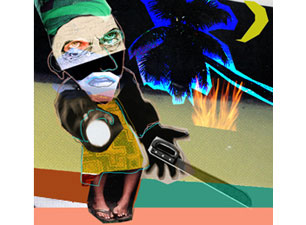
There may be a spot in Asia more remote than this lovely lake with the poetic name — it means Child of the Sea — but when six armed robbers raided our camp on the night of Sept. 9, we felt so isolated, so far from help, that we might as well have been on the moon.

Earlier that night, our group of three Americans and myself, a 40-year-old Canadian, had shared a campfire with the other trekkers in this distant corner of Indonesia — five Germans, a Belgian and another American. We drank a few beers, talked and retired early. We were a tired group. That morning, we had climbed to the top of magnificent Mount Rinjani, rising at 2:30 a.m. and reaching the 3,730-meter summit at sunrise. That was followed by a bone-crunching 2,000-meter descent to Segara Anak Lake. Exhausted and happy, we soon fell asleep.

A couple hours later I heard shouting — loud, threatening voices. I thought our porters were arguing, but it turned out to be six knife-wielding Sasaks (Lombok’s main ethnic group), warning our porters not to interfere with the impending robbery. The intimidation worked — all nine porters sat stone still for the next hour and a half.

The next few minutes were terrifying. I heard shouts from the tent of my hiking companions Chris Curran, 35, and his father, Bill, 61. “What the fuck is going on?” I heard Chris say, and then an alarming “Hey, hey, HEY!”

I heard a ripping sound, and a savage voice shouting, “Money! Money! Money!”

Robbery. Shit. I lunged for the tent door, filled with a sudden urge to be on my feet. “Brent, something’s going on,” said my traveling companion, 36-year-old photographer David Hartung, sitting up. His voice was quiet but alarmed.

At that moment a long machete slashed through our tent, inches from David’s face. Again and again it plunged through the thin fabric. I dived for the exit and scrambled to my feet. “David, get out of the tent!” I shouted. The robbers surrounded me, shining flashlights in my eyes and pointing their knives at my chest.

I yelled for our guide. “Jagat! Jagat! Get out here. Jagat!” As Wira Jagat came blinking out of his tent, I lost my temper. Filled with anger at the thieves, I stepped forward. The biggest robber — a mean, aggressive man of about 25 years — kicked me in the stomach. I retreated, but remained furious.

Jagat began to plead with me. “Please, please. I beg you. I beg you.” Bill, Chris and David joined the chorus, urging me to calm down. Finally some logic crept in: It’s only money and hiking gear. Better to be calm and avoid injury, especially in a spot like this, where any wound would remain untreated for many hours. I looked at the star-spangled sky, the bright lake and the surrounding deep forest. “Jagat, how long until daylight?” I asked. “About four more hours,” he said.

By now the robbers had all our gear on the grass, and were riffling through it. The four of us watched silently as they put our flashlights, cameras, watches and money into a plastic shopping bag.

Again and again they came over and searched us, pointing their knives. Twice I held my wallet in my left hand, over my head, while they checked my pockets, my crotch, my socks. Once I stood for a full 30 seconds, wallet in hand, while they shined a light in my face and we stared at each other. Finally, when they were absorbed in the looting, I stashed it under a rock.

Next the gang attacked two Germans, Andreas Spiegel, 32, and his girlfriend, Heike Schock, 30. Twice they stripped Heike naked, checking her bra and her panties, robbing her of earrings and necklace. There she stood, unclothed and shivering in the cold night, crying softly and filled with terror. This scene would later be repeated with the only other woman present, a 27-year-old German named Sylke Shirmer.

This was the darkest moment. The thieves found no money on Andreas and Heike, and they were in a bad mood. (Andreas wore a money belt, it turned out, which the bandits did not check.) Our group of four also had little money, having put it in a deposit box at the Senggigi Beach Hotel.

The angry robbers surrounded us and began to threaten us with their knives. The most aggressive one raised his machete over our heads, one by one, and yelled, “Dollars!” With Jagat translating, we explained: You already have all our money. The rest is at a hotel on Senggigi beach. We have no more money.

At long last, they stopped threatening us and attacked the tent of the other three Germans — Shirmer, Holyer Zullchner, 37, and Martin Jacob, 25. The same scene was repeated: knives stabbed through their tents, flashlights in their faces, pockets checked, gear dragged out and plundered. We heard Sylke pleading for the thieves not to take her shoes. “Please. Please. It’s the only pair I have.”

Last they robbed Gary Ford, a 26-year-old American, and David Blonde, a 25-year-old Belgian. Ford’s reaction was similar to mine: He was furious. As he argued with the desperate bandits, I could clearly see the foolishness of his actions (and mine).

Had the attack ended quickly, it would have been merely scary. But as it dragged on, the situation settled down somewhat. Bill, who has traveled widely in Mexico, South America, Asia and elsewhere, was the first to understand that their intentions were not violent. “I realized that like most criminals, they were young and dumb, and it was just a matter of doing what they wanted,” he said. “They didn’t make us kneel down, or line us up, or put knives to our throats, or any of that.”

As we began to observe our attackers, the robbery acquired a tone of tense black humor. One of the thieves yanked the comb from Bill’s pocket and held it up suspiciously. “What’s this?” he shouted, in English. “It’s a comb,” said Bill, providing a helpful hair-combing pantomime.

Another thief found time to deliver an anti-drug lecture. Ripping open a pack of Drum tobacco, he sniffed suspiciously. “Ganja!” he shouted. “No, no,” I said. “Tobacco. Tabac.” Brandishing his machete, he flung the tobacco on the ground and yelled, in English, “No ganja on Lombok!”

They were picky about their pilfered food. They liked the Taiwanese peanuts and the local bananas, but the raisins met with disapproval. Tearing the box open with his teeth, one of the robbers shoved a fistful into his mouth. Pah! He spat them out and threw the pack on the ground in utter disgust, glaring at David.

The littlest thief puzzled for a long time over Bill’s saccharine tablets. He held the container to his ear, shook it, looked at it, shook it again and looked again. In the end, the child-proof cap defeated him. He took the tablets anyway.

The meanest thief — the man who kicked me, and raised his machete over each of our heads — stalked about in white underwear, a filthy T-shirt and Bill’s wool socks. It’s true — we were robbed by a thug in underwear. At one point the man in underwear asked us if we had any checks. Sure, we joked later: Who should I make it out to?

Finally, after about an hour and a half, they melted into the forest and disappeared, carrying a sack full of cameras, lenses, cash, watches, flashlights, jewelry, socks, shorts, pills and even a bar of soap, which they sorely needed.

They left behind David’s exposed film, and Sylke’s only pair of shoes, and they left the passports and plane tickets belonging to the three Germans. Bill’s watch, a cheap Casio that he has owned for more than a decade, didn’t meet their standards.

We threw some wood on the fire and talked. The Belgian, David Blonde, had taped his money to the inside of his backpack, and Andreas had the money belt. The rest were not so lucky. Martin, Sylke and Holyer had lost all their cash: $200 U.S. and 300 deutsche mark. Jagat, his police radio gone, immediately sent four porters to the tiny village of Senaru to notify the police.

The next morning, as we hiked out of the crater and down the volcano to Senaru, a tough 12-hour slog, we had time to reflect. Was the robbery related to the rising tide of violence in Indonesia? Maybe. I had hiked this route in March 1998, when the country was ruled by Suharto, and there were no reports of violence. Our robbery, said Jagat, was already the third this summer.

Will the robbers be caught? Again, maybe. Jagat believes they are from southern Lombok. As they drift through the tiny mountain villages back to their homes, their accents will mark them as strangers. Every item they stole, from David’s $1,300 Canon camera body and $1,400 lens down to the flashlights, foreign watches and Swiss Army knives, will identify them as thieves.

When we reached Senaru after dark, the police were already mobilizing: 50 of them, mostly teenagers. The police chief, Lilik Putranto, was in a state of high excitement. He shook our hands, one by one. “I myself am going to the mountain tonight,” he said. “Tonight!”

If the criminals are caught, they’ll find themselves in a world of hurt. After the previous robbery, we were told, at least one suspect had been beaten to death.

Wira Jagat, our 23-year-old guide, was deeply affected by the robbery. On our way into the crater, he had been an energetic kid, full of life and busy learning new English swear words. On the way back out, he lagged far behind, limping and disillusioned. The robbery seemed to take away his spirit.

Certainly, it changed his career path. Never again, he said, will he guide visitors to Rinjani. Instead he will become an English teacher. He already has a good vocabulary. The day after the robbery, when I asked him how he was doing, he replied: “I am traumatized.”

The rest of us were not so despondent. Nobody had been hurt, and we even began to enjoy the freedom that accompanies temporary absolute poverty: It didn’t matter who handled our bags — porters, bellboys, taxi drivers, etc. — because they were completely worthless.

With the exception of David, who must replace $4,000 worth of photography gear, our losses were modest. “In the end, none of it matters,” said Bill. “It’s all just stuff.”

It matters more to the guides and porters and tour agencies, who make a tough but honest living leading trekkers up and down the rugged, beautiful volcano. While we return home, safely out of harm’s way, all they can do is hope that the robberies end, and peace returns to Lombok.

Continue Reading Close