Daniel Mangin

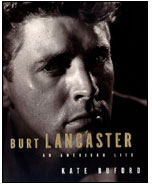
“Burt Lancaster: An American Life” by Kate Buford

This gorgeous hunk with a limited range became one of the finest and best-loved actors in Hollywood.

  • more
    • All Share Services

For an actor whose screen debut, the 1946 film noir classic “The Killers,” made him an instant star, Burt Lancaster’s first few seconds on celluloid are remarkably subdued. He lies motionless in bed, his face in shadow. The brightest light in the shot shines on his T-shirted chest as he learns that two hit men are on their way to rub him out. He’s nearly invisible as he passively accepts his fate, his face in shadow until just before he’s murdered.

Four decades later, in his last feature film, 1989′s “Field of Dreams,” Lancaster plays an elderly doctor who has always wanted a time at bat as a professional baseball player. His final scene concludes with him disappearing into a cornfield after achieving his dream. These two evanescent moments bookend a career in which box-office hits like “From Here to Eternity” and “Gunfight at the O.K. Corral” made possible the artistic risks he took in foreign and independent American films such as Luchino Visconti’s sumptuous epic “The Leopard” and the acerbic “Sweet Smell of Success.”


As Kate Buford points out in her absorbing new biography of the actor, Lancaster, who was born in 1913 and died in 1994, had the makings of a star: broad shoulders, a chiseled face, brilliant blue eyes, defiantly wayward hair and an iconic smile — much mimicked by impersonators during his heyday — that he called “The Grin.” Though he was a big man, he moved with grace on-screen, thanks to years of touring as a circus acrobat. David O. Selznick, the legendary producer of “Gone With the Wind,” had the chance to put him under contract in the mid-1940s but declined. Following the paradigm of Hollywood’s golden age, Selznick looked for personality types he could showcase in a series of similar roles, and he’d already signed one ravishing hunk, Guy Madison (a star remembered these days only by fey folk of a certain vintage). Who needed another?

Selznick’s rejection was actually a stroke of luck — one of many — for Lancaster. He hooked up with Harold Hecht, an agent who accurately gauged the social and economic forces transforming the motion-picture business after World War II. Within a few years, not only had Hecht helped engineer Lancaster’s superstardom (Lew Wasserman, the head of MCA, also played a key role), Hecht and Lancaster had become the producers of “Marty,” “Trapeze” (Lancaster’s homage to his circus days) and other hits. In the 1950s and early 1960s their company was the most successful independent outfit distributing through United Artists.

Lancaster, Buford writes, regarded his star persona, packaged in giddily overplayed roles like the hucksters in “The Rainmaker” and “Elmer Gantry,” as “one big commodity.” Because he produced many of his films, he could select parts that would expand his craft (he admitted he had a narrow range when he started) and allow him to examine personal and political issues. (He was a lifelong liberal.) Buford’s subtitle, “An American Life,” reflects her thesis that his best American films chart “the arc of postwar mainstream American life,” forming “a coherent story with chapters and themes.”

“Atlantic City,” one of the most memorable of these chapters, finds the star still growing as an actor late in his career. Lancaster plays Lou Pasco, an aging low-level gangster with delusions of grandeur who becomes infatuated with an oyster shucker (Susan Sarandon) with daydreams of her own. Sarandon, interviewed for the book, recalls Lancaster as at first seeing his character through a pre-feminist prism. It was, she says, “very, very difficult” for him to understand that her character gave herself to his; the actor “saw it as him pretty much taking her clothes off and taking her.” (His inability to comprehend the role reversal is surprising given a female friend’s reminiscence, earlier in the book, of women chasing after the youthful Lancaster “with mattresses on their backs.”) With coaxing from Sarandon, and presumably from the film’s director, Louis Malle, the actor turned in a supremely graceful performance — absent Sarandon’s anecdote, I might have called it instinctive — in which the woman set the tone for the lovemaking.

As for his real-life romantic exploits, Lancaster was generally discreet; the spiciest tidbits in Buford’s book, such as his passionate liaison with Shelley Winters, come from others who have written or contributed to tell-all accounts. The actor once said he couldn’t imagine anyone writing a biography of him because it might be too boring, and he would have been right had Buford not wisely chosen to focus on his work. The sections about his family life after he became a star border on the tedious — he philandered, his wife was an alcoholic and his kids had the typical problems of affluent children growing up in the 1950s and 1960s. But Buford keeps these discussions to a minimum.

This well-researched book’s only major flaws — and they’re by no means catastrophic — are the author’s tendency to repeat herself, particularly about her subject’s beauty, and to overstate her case. To drive home a point about Lancaster’s on-screen dynamism, for example, she describes him as never stopping “to lean against anything” in a film until the 1980 “Atlantic City.” It’s hard to imagine a late-1940s Hollywood director not taking advantage of Lancaster’s pinup potential by propping him against some scenery, which indeed happens in two of his first three pictures.

Buford nonetheless succeeds in her primary goal of tracing the relationship between Lancaster’s art and his life. Such a connection might seem like a given, but as Sidney Poitier tells her, “When you see substance in an actor’s work, it isn’t always necessarily there in the unfolding of his personality. In Burt’s case, what I saw on the screen … were the things I became familiar with off the screen.” If he’s right, Lancaster’s films may well constitute the actor’s best biography. But Buford’s admirable chronicle supplies the back story.

According to Buford, Lancaster probed the important personal and political themes of his life and era through his films. Sometimes he took the position he believed in; at other times he played his own devil’s advocate. The following movies, which contain some of his most important performances, also mark key points in his on- and off-camera biography:

The Killers (1946)

The “Citizen Kane” of film noir, which takes off from the story by Ernest Hemingway, recounts the circumstances leading up to the murder of Ole “Swede” Anderson (Lancaster), a lug double-crossed by Ava Gardner and a male confederate in a payroll heist. It was one of several early roles in which the actor played a fool for love.

Criss Cross (1949)

Yvonne De Carlo double-crosses Lancaster so many times he gets dizzy in this silly but effective noir with a bushel of atmospheric Los Angeles location shots. As an actor he’s still inexperienced, but when he flashes his dazzling teeth or gets in the clinch with De Carlo, he’s unmistakably a Hollywood star.

From Here to Eternity (1953)

Lancaster, as Sgt. Milton Warden, plays with fire in the form of Deborah Kerr, the wife of his commanding officer, in the film version of James Jones’ bestselling novel. It’s set on the eve of the Japanese invasion of Pearl Harbor, and foamy white waves bathe Kerr and Lancaster as they make love on the beach in one of 1950s cinema’s most torrid (and most famous) scenes.

Vera Cruz (1954)

A sneering, leering, swaggering Lancaster bonds with Gary Cooper as they attempt to highjack gold in Robert Aldrich’s wry western. The satire had disaster written all over it during production but turned out, deservedly, to be a hit.

Trapeze (1956)

Lancaster pays tribute to his days in the circus. As a broken-down trapeze artist, he trains Tony Curtis in a difficult routine. A ’50s-style misogyny infuses this film, in which a woman (Gina Lollobrigida) comes between the two male stars.

Sweet Smell of Success (1957)

They don’t come any meaner than J.J. Hunsecker, a gossip columnist who preys on publicist Tony Curtis’ lust for fame and money. Lancaster’s company produced “Sweet Smell,” a bomb when it was released but now considered a classic.

Elmer Gantry (1960)

Lancaster won a best-actor Oscar for his performance as Sinclair Lewis’ jive-talking religious revivalist. He’s a little over the top, but the film still packs a mild punch as a cautionary tale about cynics who manipulate people’s religious faith to make a buck.

Birdman of Alcatraz (1962)

This film about a convict who becomes an expert on birds, writes Buford, is “Lancaster’s great expression of hope and freedom of the spirit, his secular bow to the Christian idea of redemption he had been brought up with.”

The Leopard (Il Gattopardo, 1963)

Lancaster plays the aristocratic Prince Salina in Luchino Visconti’s pageant about the unification of Italy. Part history, part timeless visual poetry, this is one of the finest postwar Italian films. The actor and director got off to a rocky start as collaborators but eventually came to respect each other greatly.

The Swimmer (1968)

Middle-aged and conflicted, Lancaster swims home via his New England neighbors’ swimming pools in a de facto prequel to “The Ice Storm,” based on a John Cheever story. Cheever wrote of Lancaster, “He’s very sexy and commanding in the girl scenes but half the time he looks as if he were going to cry which is just right for the part.”

Ulzana’s Raid (1972)

Lancaster portrays an experienced scout who advises a greenhorn cavalry leader on a mission to capture a bloodthirsty Apache chief, in a western that contemplated America’s past to shed light on the Vietnam War, then still in progress.

Go Tell the Spartans (1978)

This subtle, troubling drama, set just before the mid-1960s troop buildup began, is among the best Vietnam War pictures ever made. The subject is how America got into Vietnam; this time Lancaster plays a world-weary military advisor. As in “Ulzana’s Raid,” blind imperialism and an inability to perceive the world on any but American terms doom a small, isolated combat force.

Atlantic City (1980)

Lancaster was never more endearing than in Malle’s film about an aging, two-bit gangster who gets involved in a drug caper and falls for Sarandon. He’s so superb as a man desperate to believe in a past he was too ineffectual to make happen that he’s convincing even when he recites lines as preposterous as “The Atlantic Ocean was something then. Yeah, you should have seen the Atlantic Ocean in those days.”

“The Big Tease”

Craig Ferguson of "The Drew Carey Show" is effervescent as a gay Scottish hairdresser in Lotusland, but Kevin Allen's hackneyed comedy is as light as a squirt of styling mousse.

  • more
    • All Share Services

It’s a Hollywood truism that if a film’s pitch doesn’t make sense in less than 10 seconds, the chances the picture will ever be made diminish considerably. With “‘Spinal Tap’ meets ‘Shampoo’” and “‘Rocky’ in curlers” as their rallying cry, the makers of the hairdressing mockumentary “The Big Tease” had seconds to spare. So it should come as no surprise that despite a modest pedigree — the script was co-written by and meant to star Craig Ferguson, the snarling Mr. Wick on ABC’s “The Drew Carey Show” — Warner Bros. signed a deal and rushed “The Big Tease” into production during Ferguson’s hiatus from his TV series.

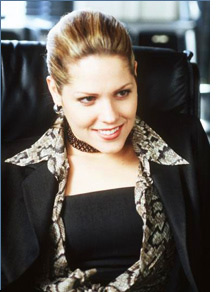
The plot, lighter than a swirl of John Paul Mitchell’s mousse, centers on Crawford Mackenzie (Ferguson), a gay Scottish hairstylist who thinks he’s been invited to an international competition in Los Angeles. The talented but naive newcomer treks across the Atlantic with a British television crew, only to discover that the form letter he received entitles him merely to be a “guest observer.” Oops. After he bestows an impromptu makeover on a loopy but powerful publicist (played by Frances Fisher), she vows to help him secure the requisite HAG (Hairdressers of America Guild) card. Thwarting the duo at every turn are the contest’s snooty organizer (Mary McCormack), who only traffics in superstar stylists, and the reigning champion (David Rasche), a pseudo-Nordic boor with the oafish name of Stig Ludwiggssen.

It’s hard to tell whether the bubbly spirit of “The Big Tease” derives more from the lead character or the blast Ferguson’s having in his first starring role in a feature. Either way, the giddy mood partially compensates for the forced and underdeveloped patches in the script he and Sacha Gervasi wrote. So, too, do the performances of cast members like Fisher, who makes her stereotypical publicist-to-the-stars vulnerable, even sweet. “The Big Tease” doesn’t adhere strictly to the mock-documentary format, but the posse of celebrities playing themselves — including models Kylie Bax and Veronica Webb and stylist John Paul DeJoria (aka, John Paul Mitchell) — adds an appropriate real-life touch. (And if only unwittingly, the appearance of “Baywatch” star David Hasselhoff presents the film’s deepest philosophical conundrum: Is a bad actor capable of acting poorly?)

Crawford, supremely confident in his tonsorial abilities, maintains a relentlessly upbeat perspective in the face of multiple catastrophes. In one of the few instances in which the script elevates the acting rather than vice versa, he faces the Century Plaza Hotel’s skittish manager, played by Larry Miller, who’s demanding payment Crawford can’t make. The manager vacillates between firmness and neurosis, slowly losing his cool, confessing no end of troubles that he finally blames on the time his “uncle inserted his finger into my anus when I was a kid.” (It’s all in the timing, which Miller pulls off superbly.)

Despite the manager’s meltdown, Crawford gets booted from his fancy digs. But with the title character of “Braveheart” as his model — it wasn’t clear to me if the filmmakers had picked up on that picture’s homo-unfriendly overtones, not that it matters — the intrepid haircutter carries on. And on and on. As with any life-of-the-party type who refuses to give it a rest, Crawford’s prattling produces fewer chuckles as “The Big Tease” unfolds. And like their protagonist, Ferguson and Gervasi spend too much time patting themselves on the back for being clever — time that would have been better spent honing the humor. Too often, they’re content to suggest a scene’s comic potential rather than actualize it.

The director, Kevin Allen (whose only previous directorial effort was “Twin Town”), doesn’t help much, either. He’s just as apt to punctuate a scene by having Ferguson toss an “Aren’t I cute?” look at the camera as to put it anywhere interesting. Allen does, though, love swish-pans and jump cuts, which if occasionally irrational add a certain vigor to the transitions.

Given its title, “The Big Tease” focuses less on the salon world than one might imagine. Los Angeles itself is the real joke — as if that hasn’t been done a million times. L.A. generates new fodder for satire almost daily, but the revelations in “The Big Tease” are strictly retreads: Limo drivers proffering head shots and pitching scripts. Power lunches (not one, but two). Snobby receptionists, P.R. hacks, agents, hairdressers. (OK, but just because it’s true doesn’t make it original.)

The climactic if clichi-riddled competition almost salvages “The Big Tease.” The dueling specialists — you get one guess whether Crawford wheedled his way into the event — concoct four outlandish coifs. But though the hair imagery is entertaining enough, even this sequence lumbers when it should be frolicking, and when it finally kicks into gear it’s more hyperactive than inspired.

As with the rest of the film, the scene’s enough of a lark to make one wish the filmmakers hadn’t been so sloppy — or, since ersatz viriti appears to have been the objective, that they’d been more calculatedly sloppy. As for the foolproof pitch, “This Is Spinal Tap,” “Shampoo” and “Rocky” may have been the theory, but — at the risk of getting too cute myself — “The Big Tease” ends up tasting like refried “Bean,” that other pale tale about a Brit out of water in L.A.

Continue Reading Close

“Sugar Town”

John Taylor, Michael Des Barres and Martin Kemp play -- what else? -- faded '80s rock titans in this slight L.A. music-biz satire.

  • more
    • All Share Services

During Hollywood’s golden age, Judy Garland and Mickey Rooney played exuberant kids who fought the odds to put on a show or get into one. Sentiment being the order of their day, the duo’s pluck and talent usually netted them fame and fortune. Behind the scenes they may have been popping pills, hitting the booze, wrecking happy homes and otherwise messing up, but audiences saw only the entertainment world’s wholesome side.

Something of the reverse has occurred with “Sugar Town,” a music-biz satire with the premise that nothing breeds desperation like a rock ‘n’ roll wannabe questing for stardom — except perhaps fallen stars maneuvering to regain their luster.

This story’s heartwarming side happened off-screen. Allison Anders and Kurt Voss, the co-writers and co-directors of “Sugar Town,” scripted it in less than two weeks, shot it in three and set up financing with relative ease. @ la Mickey and Judy, they persuaded friends to donate their houses as sets and contribute their talents for lower-than-usual fees. The film’s unvarnished look only adds to its charm.

Things on-screen go less swimmingly, as a cast headed by Ally Sheedy, Rosanna Arquette, Beverly D’Angelo and musicians John Taylor (Duran Duran), Michael Des Barres (Power Station) and Martin Kemp (Spandau Ballet) enacts scenarios worthy of the VH1 series “Behind the Music.” A talentless youngster steals, sleeps and steamrolls her way into the big time. To cut an album, a producer lies, strings people along and even turns to pimping. Faded ’80s rock titans go contempo with godawful “fusion soul.” A sexy vocalist attempts to seduce a session man away from his wife, who is eight months pregnant. And his newly reformed junkie of a brother … well, you get the idea. When it isn’t reconstituting tales of rock-world woe, “Sugar Town” samples from “All About Eve,” “Nashville” and a previous Anders-Voss collaboration, “Border Radio,” a grainy, low-budget, fictional snapshot of the late-1980s Los Angeles punk scene. (The co-directors apparently love mocking the notion of “seminal” all-male bands.)

The story’s so familiar and the clichis about Los Angeles so careworn, if merrily rendered, that after a short while only my admiration for Anders’ “Gas Food Lodging,” about a mother and her two daughters living in a trailer in New Mexico, kept me from squirming in my seat. (“Mi Vida Loca,” about Chicana gangs in Los Angeles, and “Grace of My Heart,” inspired by the songwriting career of Carole King, are two of Anders’ less fully realized, though still affecting, efforts.) Voss’ films, such as “Baja” (Molly Ringwald on the lam in Mexico) and “Amnesia” (adultery leads to amnesia and sex slavery), are the very things that give “edgy” a bad name. But despite the attention given Anders for her contributions to “Sugar Town,” Voss seems to have the upper hand here.

After its manic opening sequences, though, the film slips into an appealing groove. Anders blends her real-life observations into fictive action in a way no other American director — except perhaps Henry Jaglom — does. “Sugar Town” may be a lark and its characters essentially stereotypes, but they end up being more substantial than the material suggests they’ll be. An added bonus is that most of them are in their 30s and 40s. Unlike the inhabitants of many of this summer’s movies, their underlying dilemmas are more pressing than getting laid for the first time.

Not that they’re any more grown-up about handling said dilemmas. Sheedy’s character, a successful production designer, is a font of New Age psychobabble about relationships. Needless to say she’s got a miserable track record in dating. That one sympathizes at all with this airhead is a tribute to Sheedy’s earnest playing of the role and Anders’ skill at revealing the psychic nuances of women who aren’t necessarily deep or intellectual. Likewise with the male characters, even when they’re acting like dicks — or thinking with them — they invariably rise above caricature. Des Barres, for instance, plays a haggard-looking rocker who’s ever on the make for nubile flesh. He’s ridiculous, but in a nice twist his comeuppance winds up being his entree to more mature (and satisfying) sexual relations.

Anders and Voss keep the tone of “Sugar Town” mostly glib, but toward the end its satiric and serious sides surface simultaneously. A husband who has nearly succumbed to temptation — “Sugar Town” seems pretty clear that women are better at fidelity than men — congratulates himself for only kissing his seductress. His wife declares that kissing is worse than fucking because it’s more intimate. The statement’s at once hyperbolic and not without a grain of truth. The contradiction hangs nicely in the air, unresolved until the film’s closing shot.

“Sugar Town” isn’t profound, but it is perceptive, and despite its earthier take on show biz the film ends up being just as sweet on its protagonists as the scrappy Rooney-Garland vehicles of yore were on theirs. Maybe it’s because the film was made on the fly, in something of the spirit of those 1930s and 1940s shows within the show. In any case it’s a pile of fun — but don’t be surprised if you find yourself thinking about it a week later.

Continue Reading Close

The adventures of Sir Peter Ustinov

The actor, novelist, playwright and director talks about what it was like to follow in Mark Twain's footsteps -- literally.

  • more
    • All Share Services

As I sit down to chat with actor, writer and director Sir Peter Ustinov, someone whispers that he’s getting peeved because every interviewer on his current publicity junket — from Regis and Kathy Lee to the BBC — keeps asking the same two questions: What was it was like to be knighted? What was it like working with the late Stanley Kubrick on “Spartacus”?

To get on his good side I mention upfront that neither query is on the agenda. “Thank goodness,” he replies. But I press my luck when I inquire if there’s anything he’d like to discuss that no one’s asked him about. “Look, bub, I’m not here to do all the work,” he conveys with a stern expression. Then comes a devilish smile.

“The function of silence,” he intones with a chuckle, before pursing his lips, easing back in his plush chair and closing his eyes. Interview over.

Pause, two, three, four. Gotcha.

Such mischievous geniality accounts in large measure for the appeal of “On the Trail of Mark Twain with Peter Ustinov,” a four-hour documentary that airs on PBS beginning this week. Twain took a round-the-world trip in the late 1890s that he documented in his book “Following the Equator.” Sir Peter retraces Twain’s steps a century later and compares notes.

On its surface, “On the Trail,” a co-production of WNET in New York and Granada Television, is a lighthearted travelogue. Sir Peter bathes at a Maori communal spa, speaks about Mercedes-Benzes with a young Tibetan Buddhist who’s revered as the reincarnation of an 800-year-old deity and drops in on the personals department of a Bombay newspaper. Cumulatively, the episodes at once illustrate the lingering effects of colonialism and the tenacity of indigenous cultural conventions — India’s ancient caste system and marriage customs, for instance — in the face of both imperial domination and modernity.

In “On the Trail,” Ustinov, who for three decades has been a goodwill ambassador for the United Nations Children’s Fund (UNICEF), poses some larger philosophical and political questions about how we can best settle old squabbles and right past wrongs. He hints in “On the Trail” that the answer sometimes lies in accepting that the idealized precolonial past never existed — or at least that it has been irretrievably lost. And bucking the standard liberal line a bit, Ustinov suggests that a country’s attempt to “reclaim” its heritage as a way of casting off the psychological shackles of colonialism will in most cases be futile, if not also counterproductive.

Another Ustinov project in current U.S. release is “Stiff Upper Lips,” a lame parody of period British films of the Merchant-Ivory variety. He doesn’t have much to say about his featured turn as the libidinous owner of an Indian tea plantation. Fine with me, as he’s done better work — most notably in “Spartacus” and “Topkapi,” for which he won best supporting actor Oscars, and in “Billy Budd,” which he also directed and co-wrote.

Our chat at Manhattan’s Regency Hotel feels at times more like a private performance than mere conversation. Sir Peter’s never met an accent he didn’t want to tackle, and as he recounts his global journey, the opportunities for doing so are limitless.

What made Twain a great travel writer?

He was a very good journalist. He had an individual way of looking at things and he noticed everything. I don’t regard “Following the Equator” as a very good book — it’s meandering and it came out at a time when picturesque qualities were more important than the discussion of social issues. But he did say one remarkable thing, which is that there’s no square inch of the world that hasn’t been stolen. For the period, it seems to me to be the most extraordinary way of advancing a view of the world. It’s absolutely true, of course.

Twain warns an ascendant America not to follow Britain’s lead as an empire builder.

Yes, and with the U.S. the imperialism is more of an anomaly. The U.S. is by definition anticolonial, and it had every reason to be anticolonial given how it was established. But when you look at the way Hawaii was annexed or how Puerto Rico was acquired, there were so many tricks involved. And more recently with Grenada in the 1980s — they were a wonderful, innocent country and they had their adolescence taken away from them. They had to become adult overnight and they grew up in a different fashion than what they were expecting. What’s sad is that the American students [whose safety was the stated rationale for the invasion by U.S. troops] were in no possible danger.

What did you learn about the world making “On the Trail” that you didn’t already know?

One interesting thing, which I never knew, was that Fiji was never occupied by the British, but gave itself voluntarily because it had a big American debt at that time. Fiji saw what was happening to Hawaii and didn’t want to suffer the same thing. So, it gave itself to Queen Victoria, but on the condition that she pay the American debt. Years later, they wanted to remain a colony because they knew their own natural dignity didn’t make them victims of a colonial power. The British had to send a delegation out there to say, “We’re getting into trouble in the United Nations for not giving you your independence. For God’s sake, take it!” Emotionally, Fiji’s still a colony — people wearing English wigs in court and all that. They’re more royalist than the English could possibly ever be. It’s bewildering.

The attitude is somewhat different in New Zealand, where you follow a discussion among native peoples about reparation payments for fishing rights lost during the colonial period. And you drop in on a Maori man having his face tattooed in a traditional way. Did his action test your limits regarding people’s attempts to reclaim the past?

It was absolutely a nightmare watching it being done. I said to the man, “Does it hurt?” He says, “No, it’s rather like having a piece of broken glass dragged across your face.” (Laughs quizzically.) Horrifying. Then I asked him, “Why do you do this?” “It’s a statement.” “Yes, but a statement of what?” “Well, it proves that I am what I am, and in any case with this on my face I can’t get any work.” Huh? It was an eye-opener to me.

What are your philosophical reservations about the scheme whereby the government will provide land to people who can prove they’re at least 50 percent native Hawaiian?

That’s Bosnia. That’s Kosovo. “Is your mother Chinese?” “My mother was pure Chinese.” “Well it shows here she’s got Laotian blood.” It’s such an absurd way of doing things. Why should land be allocated in relation to the purity of your blood? This seems to me to be no different at all from ethnic cleansing.

You seem more mellow about this on camera.

One’s polite. The alarming thing is that, as usual, the quota system was a decision of Congress [in the 1920s].

What impressed you about South Africa’s establishment of
the Truth and Reconciliation Commission as an alternative to
conducting criminal trials of people who’d committed
atrocities during apartheid?

One feels in the courtroom how very different the proceeding
is when it’s done under the chairmanship of an archbishop
[Desmond Tutu] compared to what it would be under the
chairmanship of a judge. Tutu said, “Without the truth we
can’t make a fresh start.” And by doing it the way they did,
they probably got better mileage out of these idiots. That’s
why I put South Africa at the conclusion on the show. I
really believe that if the millennium is going to work, it’s
going to be due to the ratio between how much we are allowed
to forget and how much we are incited to remember. The whole
of Northern Ireland, Kosovo, the Middle East — all that is
based on incitement to remember.

Archbishop Tutu talks about it being pragmatic not to
seek retribution, but the approach was also a Christian one
– turn the other cheek, though in this case also seek some
accountability. Did you find it ironic how both sides
applied Christianity to such different ends?

When I met with Tutu I said, “I’m a little surprised that
both you and the Afrikaners took Christianity to be their
guiding light and yet your interpretation of it seems rather
different. Theirs seems to be a bit more pharisaical than
yours is in that they seem to be saying, ‘Thank you, God,
for making us different from them. But if there’s any way we
can help them, you only have to send us a signal.’ [Laughs.] Yet your form of worship is much more choreographic and symphonic.”

And he said, “You mustn’t be too hard on the Afrikaners.
They are in the position of a minority people surrounded by
a stronger majority. And because they have selfish needs,
they regard themselves as the chosen people. And after all,
it’s not the first time that this has happened,” he said
with the faintest grin. It was interesting comment because
it was taking a kind of risk and at the same time being very
perspicacious — and very generous.

Certainly more generous than Twain, who called their
forebears “profoundly ignorant, dull, obstinate,
bigoted.”

Indeed. Tutu’s a delightful character. He told me, “I never
saw a light. I never thought of the church as a vocation. I
went in because I thought it was the one place where a black
boy could be on equal terms with a white one. And it was
only once I was inside that I began to believe.”

Did your meeting with the 97-year-old widow of Hendrik Verwoerd, the architect of apartheid, feel as peculiar in person as it looked on camera?

I must say our visit to old Mrs. Verwoerd proved what Tutu
was saying. She came out of her house, and I put out my arm
and she searched for the arm and then the eagle had landed.
Ah, I was in such pain as these bony fingers dug into my
skin. Then she sits down. “No blacks, only whites.”

This is in Orania, the segregated area some Afrikaners are trying to develop
into a separate state?

Yes.

By contrast, Robben Island, once a notorious prison, has been so transformed that you see it as a positive metaphor for the new South Africa.
What fascinated you so much about the place?

One had doubts about the way things are going in the new
South Africa. Robben Island is a pretty island off the coast
with a wonderful view. It’s made for luxury, yet it had a
fearful penitentiary. But it’s no longer a prison; it’s a
place of pilgrimage. People go to cell No. 5, which
was Mandela’s, and they meditate and talk.

The extraordinary thing is that among the guides are people
that have settled on Robben Island for good — ex-political
prisoners, ex-criminals and ex-warders. This was a place
where savagery was encouraged. One of the punishments for
prisoners was to cover them up with sand until only their
heads were showing and then pee on them. But then political
prisoners like Mandela began cultivating little gardens and
beautifying the place. Suddenly everybody joined in,
mystified by this. Now, these disparate people are also
joining in together. Robben Island is growing into a
community based on this terrible place which by their
presence is somehow exorcised. There’s an example of
forgiving and forgetting.

Where has your work for UNICEF taken you?

The most recent mission was to Cambodia, which may be the
saddest place I’ve ever been. Cambodia, I think, is the
fault of the West, because Cambodia had more bombs dropped
on it than Vietnam. You feel like you’re flying over a
plucked chicken because the deforestation has been so
thorough. And when you get killing on that sort of scale it
brings on a habit of killing, so that in a way Pol Pot was
almost a logical follow-on to that.

The problems for children are enormous, and what makes you
furious is that you can live with acts of God, earthquakes
or natural disasters that seem inevitable. But that people
do terrible things, deliberately not foreseeing the
consequences, putting children at the age of 10 into
uniform when they enjoy playing soldiers and perverting
their natural tendencies, that’s unpardonable.

So, what makes you optimistic about the future?

I don’t think there’s any alternative to optimism. One
skeptical German journalist said to me, “Isn’t all you try
and do for UNICEF like just like a drop of water on a hot
stove?” That’s a German expression. I said I honestly think
it’s a little better than that: “It’s a drop of water in the
ocean: It doesn’t get lost.”

Continue Reading Close

“Head On”

Using rough sex and rougher drugs to escape the marriage-mortgage trap.

  • more
    • All Share Services

When a male director films a gritty, visceral look at life
– a “Mean Streets,” a “Reservoir Dogs” or a
“Trainspotting” — it’s usually taken at face value and
praised as “muscular” moviemaking. Let a woman try the same
thing and she’s apt to find herself being chided for trying
to “out-macho” her male counterparts, as has Ana
Kokkinos, the Australian director of “Head On.”
Sexism aside — “I thought the press here had matured past that kind of thing,”
was Kokkinos’ only comment about it during a conversation we had in June — with “Head On,” the insinuation seems all the
more misguided given that most of the film’s action also
takes place in its source, Christos Tsiolkas’ novel
“Loaded.” If anything, Kokkinos was in competition with the
book, in which a rebellious, drug-devouring 19-year-old
describes his fucked-up world. She reworks what was mostly a series of monologues in “Loaded” into vivid scenes, and trumps the book by supplying the techno-infused soundtrack it implies.

Ari, the nihilist protagonist, has two solutions for every quandary in his life: rough sex and even rougher drugs. He’s the type of self-indulgent lout
audiences either find captivating or exasperating –
particularly when the entire narrative unfolds from the lout’s point of view, as it does
here. What intrigued me about Ari was the way he, like many kids his age, uses
his body to thrash out his metaphysical conflicts. During
the slightly more than 24 hours in his life the film
depicts, he gets an inkling that an easier strategy might
exist, though he’s a ways off from shifting paradigms.

“Head On,”
which has begun to pop up in U.S. art houses, was a box-office hit
in Australia — something of a surprise given its modest budget and trippy style.
Heavy doses of hand-held, choppy and swooping camerawork give the film an
edgy feel, one that’s accentuated by the contributions of editor Jill
Bilcock, who cut the equally frenetic “Romeo + Juliet.”
Kokkinos goes overboard in spots and isn’t above hot-dogging
with the camera angles, but in general the cinematography
complements Ari’s emotional state.

Kokkinos puts a specifically Greek-Australian spin on a
familiar coming-of-age tale. Everyone around Ari, especially
his family, offers the same predictable advice: Get a job.
Get married. “Then you can do whatever you want,” his
friend’s mom tells him — a stance he finds too hypocritical.
As a “wog,” or foreigner, in a Melbourne suburb, Ari doesn’t
fit in with the white majority. “They look at us and all
they see is a hairy back,” he says of Anglo girls. But his
parents and their generation — many of them political
activists in Greece during the 1970s — seem not to notice
the psychic upheaval immigration has induced in their
offspring. Lacking imagination, most of the kids opt for
what Ari derides as the marriage-mortgage compromise.

Alex Dimitriades, an Australian TV star and teen heartthrob,
plays Ari with robust impetuosity. All his sex being
metaphorical, Ari lurches into some skanky episodes, not the
least of them an Oedipal back-alley tussle with a portly
fellow his father’s age. Ari’s at first debased when he’s
forced to give head — until now, he’s only been the top
– but afterward recoups a portion of his pride by forcing
the guy to jerk him off. When his partner momentarily gets
caught up in the act’s intensity and makes a slight move to
kiss him, Ari brutally twists the man’s head away and
maintains the hold until finally shooting. Kokkinos
choreographs the scene to mirror an earlier one in which
Ari’s father attempts to seduce his son back into the enveloping
comfort of patriarchal affection during an impromptu Greek
dance they share. Both scenes emphasize the grip Ari’s
family and heritage have on him, and from the dance it’s
apparent that the ties binding him aren’t entirely negative.

What’s telling about Ari’s tryst is that whatever
self-respect he’s regained at its conclusion is on the old
terms — namely, macho one-upmanship. But the older man is paradoxically the first person to
force Ari to accept his sexual vulnerability. Given his
chemical intake, however — Ari has already shot up, smoked,
snorted various drugs and had several drinks to boot — most
of this is lost on him in the short run.

Ari has so much homosex, and is so
trashily proficient at it from the get-go, that it took a while for it to
dawn on me that “Head On” is also his coming-out story. Ari
hasn’t yet accepted being queer — the sex for him is always
about something else. Early on, he meets a white Aussie,
Sean, who sees more of Ari’s potential than Ari does himself.
Sean’s projected too far into the future — it’s hard to
learn much in a day, and Ari is a slow learner in any case –
but in their interactions lies the nucleus of his
transformation.

The themes “Head On” juggles — sexual identity, cultural
alienation, conformity, individuality — lend themselves to
didacticism. For the first hour or so Kokkinos, who’s
Greek-Australian herself, merges her philosophical
observations into the action. Toward the end, though, she
falters. In a scene that’s not in the book, Ari and his
cross-dressing friend Toula (nee Johnny), who’s been
teaching him about standing up for one’s truth, get themselves arrested while tripping.
One of the cops is a textbook
white racist. The other’s a Greek guy who’s trying to
assimilate and becomes infuriated and embarrassed by what
Toula represents as a Greek. Only the sly performance of
Paul Capsis as the sassy Toula gives any bite to the
less-than-subtle confrontation.

Its missteps and excesses aside, “Head On” is a promising
feature film debut for Kokkinos, who previously directed the
hour-long drama “Only the Brave,” about a Greek-Australian
lesbian teen’s coming out. The director puts Ari through no
end of macho paces — though nothing anywhere near as gross
as the ear surgery in “Reservoir Dogs” or the toilet scene
in “Trainspotting” — but doesn’t revel in his bravado.
She’s clearly fond of the character, even moved by his
predicament. I’d almost say she nurtures him, for despite
his fatalistic ranting that closes the film, I think she sees
a future for a boy with this much fire in him. But then, that’d be
stereotyping her, wouldn’t it?

Continue Reading Close

“Fannie: The Talent for Success of Writer Fannie Hurst”

A life of one of the great trash novelists argues that (clunky metaphors aside) it's time for a revival.

  • more
    • All Share Services

When a character in F. Scott Fitzgerald’s “This Side of Paradise” blasts popular literature of the day, he cites “Fanny” Hurst among several authors “not producing among ‘em one story or novel that will last 10 years.” Harsh, yet not far off the mark: Fannie Hurst was one of America’s highest-paid writers, but few of her tales of shopgirls, boardinghouse dwellers and immigrants are still in print. These days, when she’s not being confused with entertainer Fanny Brice, she’s mostly remembered for the multiple film versions of her short story “Humoresque” and of her bestselling novels “Back Street” and “Imitation of Life.”

In “Fannie,” the first full-fledged biography of Hurst, Brooke Kroeger concedes her subject’s literary shortcomings. But she makes a convincing case that Hurst was a literary trendsetter who used her celebrity to promote an agenda that included racial equality and women’s rights. An early supporter of African-American writer Zora Neale Hurston (who worked briefly as her secretary) and a friend of Eleanor Roosevelt’s, Hurst saw beyond the jargon of the causes she championed. She encouraged men to support equal opportunity for women, for instance, but challenged her gender to live up to the bargain, mocking the “languid psychology” of women engaged in “the industry of gold digging.”

Hurst came into prominence before World War I with a string of heartwarming yet realistic short stories that led reviewers to dub her the female O. Henry. Literary types scorned her sappy plotting and “careless” writing, though some praised her intuitive rendering of women’s emotional lives. One superb example is “Hattie Turner versus Hattie Turner,” which ran in Cosmopolitan in 1935. The title character so fervently wishes her abusive husband would die that after he is killed she has trouble convincing herself she’s not the murderer.

Short stories were Hurst’s strong suit, but then as now, book publishers preferred novels, and her novels could be excruciating reads, full of corny metaphors and clunky prose. From “Anywoman”: “The days were transmission belts under her feet, moving her along.” From “Imitation of Life”: “Delilah might be said to have risen like a vast black sun over the troubled waters of the domestic scene, laying them and the hordes of fears, large and small, that had dogged her heels all day.” (No wonder Langston Hughes was moved to pen the theatrical parody “Limitations of Life.”)

Hurst described herself as “a ‘bleeder’ under criticism” but seems not to have heeded any of it, and despite Kroeger’s impressive research — her book is meticulously documented — “Fannie” never satisfactorily explains why not. The best the biographer can offer is the simplistic psychological speculation that “at some level [Hurst] seemed to invite the biennial opportunity to hemorrhage. Perhaps it was a way to bring back the verbal lashings of her St. Louis childhood.”

Hurst appears not to have inspired Kroeger as fully as did her previous subject, journalist Nellie Bly. This reduced affinity may explain such flaccid, Hurst-like similes as “Wednesday the telephone in Fannie’s apartment rang like a bell concert” and “Success for Fannie kept coming, like popcorn kernels exploding in hot oil.” Actually, Hurst herself provides some of the pithiest sequences in “Fannie” by way of the numerous citations from her autobiography, “Anatomy of Me.” She may shade (or delete) the truth, but she emerges more distinctly on her own pages than on Kroeger’s. Together, though, the two books provide a complete portrait.

Fitzgerald may have been too dismissive when he damned Hurst to obscurity, but by the time she died in 1968, interest in her had all but disappeared. Kroeger believes the time is ripe for a revival, and Hurst deserves one — though let’s hope, for the reading public’s sake, that it’s a selective one.

Continue Reading Close

Page 1 of 2 in Daniel Mangin