David Stringer

European nations, Australia expel Syrian diplomats

  • more
    • All Share Services

LONDON (AP) — British officials say the U.K. is expelling three Syrian diplomats in protest at the killing of civilians, including the deaths of 108 people shot in their homes last week.

Officials, who demanded anonymity to discuss the action ahead of a planned public statement from Foreign Secretary William Hague, said Tuesday that Britain was taking the step as part of a coordinated effort with other nations, including France, Germany and Australia.

Syria’s charge d’affaires, Ghassan Dalla, the country’s top ranking diplomat in London, is among those being expelled.

Ex-tabloid boss Brooks faces phone hacking charges

  • more
    • All Share Services

Ex-tabloid boss Brooks faces phone hacking chargesFILE This Friday, May 11, 2012 file photo shows Rebekah Brooks, former chief executive of News International and her husband Charlie Brooks leaving the High Court in London after giving evidence to the Leveson Inquiry. Brooks said Tuesday May 15, 2012 she and her husband will face charges over Britain's tabloid phone hacking scandal. Brooks, 43, said Tuesday in a statement that she will be prosecuted over allegations of obstruction of justice. (AP Photo/Sang Tan)(Credit: AP)

LONDON (AP) — Former U.K. tabloid editor Rebekah Brooks, her husband and four close aides were charged Tuesday over alleged attempts to conceal evidence in Britain’s phone hacking scandal — the first prosecutions since police reopened inquiries 18 months ago into wrongdoing by the country’s scandal-hungry press.

Brooks was one of Rupert Murdoch’s most trusted lieutenants for years and a close friend of the current Conservative prime minister, David Cameron. The prospect that courts will hear potentially explosive accusations against her and her husband could rock both Murdoch’s worldwide media empire and Cameron’s political career.

Cameron is a neighbor, friend and occasional horse riding companion of both the ex-editor and her husband, whom he has known since high school.

Brooks, 43, faces three separate allegations of conspiracy to pervert the course of justice — an offense that carries a maximum sentence of life imprisonment.

The law-breaking allegedly involved removing computers and files in the frantic days last summer when Murdoch shut down his tainted 168-year-old News of the World tabloid in an attempt to halt a tide of public disgust over the hacking furor.

Between July 6 and July 19 last year — the period covered in the charges — Brooks was struggling unsuccessfully to remain chief executive of News International, the British division of Murdoch’s News Corp. Murdoch announced his decision to close the News of The World on July 7 and Brooks, facing tremendous pressure, quit her high-profile role on July 15.

Alison Levitt, the legal adviser to Britain’s director of public prosecutions, said Brooks and the others are alleged to have concealed documents, computers and electronic equipment from police who were conducting inquiries into phone hacking and the alleged bribery of public officials.

With her former personal assistant Cheryl Carter, Brooks is also accused of removing seven boxes of materials from News International archives, Levitt said.

“All these matters relate to the ongoing police investigation into allegations of phone hacking and corruption of public officials in relation to the News of the World and The Sun newspapers,” Levitt said.

Brooks and her husband rejected the charges. Standing side-by-side in front of their lawyers’ office in London, Charlie Brooks slammed what he described as a “witch hunt” targeting his wife.

“I have no doubt that the lack of evidence against me will be borne out in court but I have grave doubts that my wife can ever get a fair trial, given the huge volume of biased commentary which she has been subjected to,” the 49-year-old racehorse trainer said.

Rebekah, looking grave, said she was baffled and furious at the charges.

“I cannot express my anger enough that those close to me have unfairly been dragged into this,” she said.

In testimony last week before Britain’s media ethics inquiry, Brooks acknowledged her close links to Cameron and detailed how their families mingled at dinners and Christmas parties. She said she had traded text messages with Cameron at least once a week and that he had offered a message of support after she stepped down amid the hacking scandal.

Daithi Mac Sithigh, a legal expert at the University of East Anglia who has given evidence to the ethics inquiry, said the decision to prosecute Brooks could have far-reaching consequences.

“It is safe to say that the relationship between the press, the public and the law will not be the same again,” he said.

Known for her striking red curls and storybook rise from a junior employee to chief executive at News International, Brooks also remains on police bail over separate allegations related to illegal eavesdropping, and will face more questions from detectives on that issue in the coming months.

Police said all six people charged Tuesday will appear for a hearing next month at a central London court.

Carter, 48, faces two charges of conspiracy to pervert the course of justice; so too does Charlie Brooks; the ex-head of security at News International Mark Hanna, 49; Brooks’ ex-chauffeur Paul Edwards, 47; and Daryl Jorsling, 39, a member of the firm’s security staff.

Henri Bradman, lawyer for Carter said in a statement that Brooks’ former assistant “vigorously denies” involvement in any offense. Hanna said in a statement he believed he would be “totally exonerated.”

Levitt confirmed that a seventh person, a 38-year-old man who was also a member of News International’s security staff, would not face any charges.

The criminal charges are the first to be filed since police launched a new inquiry into phone hacking in January 2011. Previously, two people were jailed briefly in 2007 for hacking into the phones of members of the royal household, and investigators initially accepted the company’s claims that malpractice was not widespread.

In other developments:

— Two more people were arrested in investigations into the alleged bribery of public officials by tabloid reporters seeking scoops. A 50-year-old man who works for Britain’s Revenue and Customs department was detained on suspicion of misconduct in a public office. A 43-year-old woman was arrested over an allegation of assisting misconduct in a public office and money laundering offenses.

Detectives said both arrests were the result of information supplied by News Corp.’s management standards committee, which has turned over evidence of alleged wrongdoing.

— Brian Leveson, the judge leading Britain’s media ethics inquiry, said News Corp. lobbyist Frederic Michel and Adam Smith, a former adviser to current Culture Secretary Jeremy Hunt, will give evidence later this month. Their appearances follow questions over Hunt’s handling of a decision on whether News Corp. could be allowed to take full control of British Sky Broadcasting, a satellite broadcaster in which Murdoch’s company already holds a 39-percent stake.

The ethics inquiry has previously published 163 emails sent by Michel that alleged either Hunt or his office had leaked sensitive information to Murdoch’s company and had indicated their support of the News Corp. takeover.

Smith quit following the disclosures, while Hunt denies any wrongdoing. Murdoch dropped the takeover bid for BSkyB in mid-2011.

— Cameron faced questions on a separate front, after Leveson called for more information on security clearances held by communications directors to the British prime minister. That came amid concern over the status of Andy Coulson, an ex-News of The World editor who also previously served as Cameron’s chief press aide.

Coulson wasn’t initially subjected to developed vetting, the highest form of security clearance. Critics suspect that Cameron may have kept Coulson from more stringent vetting amid worries it could expose his involvement in phone hacking. Coulson has been arrested by police but has not been charged with any offense.

Cameron’s office insists the decision was made amid efforts to reduce the number of aides with top security clearances.

Continue Reading Close

Ex-tabloid chief: Cameron sent message when I quit

  • more
    • All Share Services

Ex-tabloid chief: Cameron sent message when I quitFormer News of the World editor Rebekah Brooks gives evidence to Britain's media ethics inquiry in central London Friday May 11 2012 in this image from television. Brooks is a central figure in the scandal over tabloid phone hacking that has shaken both Rupert Murdoch's News Corp. and Britain's establishment. She resigned in July as chief executive of News International, Murdoch's British newspaper operation, and has twice been arrested and questioned by police about illegal eavesdropping and obstruction of justice. (AP Photo)(Credit: AP)

LONDON (AP) — Former News of the World editor Rebekah Brooks — a pivotal figure in Britain’s tabloid phone hacking saga — said Friday that Prime Minister David Cameron commiserated with her after she quit in the wake of the scandal.

The 43-year-old Brooks, who resigned in July as chief executive of News International, Rupert Murdoch’s British newspaper operation, told the country’s media ethics inquiry of her close ties to those in power.

Known for her striking red curls and meteoric rise from junior employee to editor at News of the World, Brooks acknowledged she had messages of support from politicians including Cameron and ex-Prime Minister Tony Blair when she stepped down.

In evidence offered so far in Friday’s hearing, Brooks has been questioned on the close ties between British politicians and the press, chiefly Murdoch’s media empire.

CLOSE TO CAMERON

Brooks said Cameron is a personal friend and neighbor in the picturesque Cotswolds area of southern England — and acknowledged she even had to offer him advice on text messaging.

After she stepped down amid the phone hacking scandal, Brooks said she had received “indirect messages” of support — text messages sent by the aides of politicians, but relaying their personal thoughts — including from Cameron.

“I received some indirect messages from No. 10, No. 11, the Home Office and Foreign Office,” Brooks said, referring to Cameron, Treasury chief George Osborne and other leading Cabinet members.

She agreed with inquiry lawyer Robert Jay that a message from Cameron had told her to “keep your head up” and expressed regret that he could not be more loyal because of the political pressure he was under over the hacking scandal.

The message was “along those lines, I don’t think they were the exact words,” Brooks said.

Brooks said she and Cameron would trade texts at least once a week, or twice a week during busier periods such as Britain’s 2010 national election.

“He would sign them off ‘DC’ in the main,” said Brooks, who showed composure, and frequent flashes of humor, as she testified.

“Occasionally he would sign them off LOL, ‘lots of love’, until I told him it meant ‘laugh out loud’,” she said.

Brooks confirmed that she had discussed tabloid phone hacking with Cameron, but “not very often, once or twice … it kept coming up, so we would bring it up.”

Conversations had taken place after the revelations that the News of the World had hacked murdered schoolgirl Milly Dowler’s phone when she disappeared in 2002.

Public revulsion at the tactics deployed to pursue the schoolgirl led Murdoch to shut down the 168-year-old News of the World in July, and saw Cameron set up the ethics inquiry, led by Lord Justice Brian Leveson.

Brooks also detailed about 20 formal meetings with Cameron between 2005 — when he became leader of the then-opposition Conservative Party — and 2011.

Cameron has previously acknowledged that he has known her husband for 30 years and that he had ridden on a retired police horse that had been loaned to Rebekah Brooks.

BUDDY OF THE BLAIRS

Blair, who quit as Prime Minister in 2007, also sent a message of support when she quit and was a longtime ally, Brooks disclosed.

In a written statement to the inquiry, Brooks said that “Tony Blair, his senior Cabinet, advisers and press secretaries were a constant presence in my life for many year.”

“I became close friends with his wife Cherie Blair … and also with the Blairs’ closest advisers, including Alistair Campbell and his partner Fiona Miller.”

In 2003, as editor of The Sun tabloid, she offered her newspaper’s support for Britain’s role in the U.S.-led invasion of Iraq.

“During the Iraq war, I spent more time than usual talking to Tony Blair and Downing Street,” she said. Public opinion was divided in Britain over the war, with large numbers opposed to Blair’s decision to join the conflict.

Brooks detailed at least 12 dinners — three when they ate alone — and drinks meetings with Blair between 2005 and 2007 and said he’d been among the political heavyweights who attended her 40th birthday party — hosted at Murdoch’s home.

BUT ANGER FROM GORDON BROWN

Murdoch’s newspapers turned their back on the Labour Party before Britain’s 2010 election, offering backing instead to Conservative Party leader Cameron.

Though Blair — who led Labour — remained friendly, his successor as prime minister and party chief, Gordon Brown was “incredibly aggressive and angry,” after The Sun tabloid switched political allegiance.

Brown hadn’t sent any message after she quit. “He was probably getting the bunting out,” Brooks joked, with a relaxed smile.

However, his wife Sarah Brown was “an amazing lady” and a friend who was part of a social circle that also included Brooks, Elisabeth Murdoch and Wendi Deng, Murdoch’s wife.

The ex-editor acknowledged she’d sided with Blair amid Brown’s maneuvering to oust his colleague as Britain’s leader.

AT THE HEART OF THE SCANDAL

Brooks, a former editor of both The Sun and the News of The World, has twice been arrested and questioned by police about illegal eavesdropping and obstruction of justice. She is currently on police bail pending further inquiries, but has not been charged with any offense.

Before stepping down, she was regarded as Murdoch’s key lieutenant in Britain.

As he arrived in London to handle the fallout from the hacking scandal last year — and before she quit — Murdoch told reporters his priority was “this one,” gesturing toward Brooks.

In a report earlier this month, legislators sharply criticized Brooks for overseeing a culture at the News of The World which permitted illegal acts at her newspaper, particularly in the Dowler case.

Continue Reading Close

Ex-tabloid chief: Cameron sent message when I quit

  • more
    • All Share Services

Ex-tabloid chief: Cameron sent message when I quitRebekah Brooks, former chief executive of News International, arrives at the High Court in London to give evidence to the Leveson Inquiry, Friday, May 11, 2012. The Leveson Inquiry is Britain's media ethics probe that was set up in the wake of the scandal over phone hacking at Rupert Murdoch's News of the World, which was shut in July 2011 after it became clear that the tabloid had systematically broken the law. (AP Photo/Sang Tan)(Credit: AP)

LONDON (AP) — Former News of the World editor Rebekah Brooks — a pivotal figure in Britain’s tabloid phone hacking saga — told the country’s media ethics inquiry Friday that Prime Minister David Cameron commiserated with her after she quit in the wake of the scandal.

Brooks, 43, resigned in July as chief executive of News International, Murdoch’s British newspaper operation, and has twice been arrested and questioned by police about illegal eavesdropping and obstruction of justice.

She told the inquiry of her close ties to those in power and acknowledged she received messages of support from politicians including Cameron and former Prime Minister Tony Blair when she stepped down.

Known for her striking red curls and meteoric rise from secretary to editor at News of the World, Brooks acknowledged that Blair had also attended her 40th birthday party — hosted at Murdoch’s home.

The ethics inquiry is focusing on links between British politicians and the press, chiefly Murdoch’s media empire.

British parties of all political persuasions had long tussled for support of the mogul’s best-selling tabloids, whose backing was credited with the power to swing elections.

As the phone hacking scandal unfolded, unease has grown about what favors the newspapers may have received in return for editorial support.

Brooks acknowledged Friday that she had received “indirect messages” — seemingly SMS messages sent by the aides of politicians, but relaying their personal thoughts — after she stepped down.

“I received some indirect messages from No. 10, No. 11, the Home Office and Foreign Office,” Brooks said, referring to Cameron, Treasury chief George Osborne, Home Secretary Theresa May and Foreign Secretary William Hague.

She agreed with inquiry lawyer Robert Jay that a message from Cameron had told her to “keep your head up” and expressed regret that he could not be more loyal because of the political pressure he was under over the hacking scandal.

The message was “along those lines, I don’t think they were the exact words,” Brooks said.

Blair, who quit as Prime Minister in 2007, had also sent a message, but few other Labour Party politicians had been in touch, she said. Murdoch turned his back on the Labour Party before Britain’s 2010 election, offering backing to Conservative Party leader Cameron.

Gordon Brown, Blair’s Labour Party successor ousted in the 2010 vote, had not contacted her, the former executive said.

“He was probably getting the bunting out,” Brooks said, with a relaxed smile.

She showed composure, and occasional flashes of humor, as she testified.

“You need better sources Mr. Jay,” she teased, as the inquiry’s lawyer asked her about rumors over her close friendship with Murdoch.

Brooks, who had a close relationship to Brown’s wife Sarah, is a neighbor and friend of Cameron in the picturesque Cotswolds town of Chipping Norton.

The prime minister acknowledged that he has known her husband, racehorse trainer Charlie Brooks, for 30 years and that he had recently ridden on a retired police horse that had been loaned to Rebekah Brooks.

As Brooks arrived for the hearing at London’s Royal Courts of Justice, she was confronted by protesters dressed as a horse.

Cameron set up the ethics inquiry, led by Lord Justice Brian Leveson, in July following revelations that the News of the World had hacked murdered schoolgirl Milly Dowler’s phone after she disappeared in 2002.

Murdoch shut down the newspaper amid widespread public revulsion over the hacking.

Leveson’s inquiry has already examined newspapers’ relations with the public and the police.

Continue Reading Close

UK govt to focus on economy, reform House of Lords

  • more
    • All Share Services

UK govt to focus on economy, reform House of LordsCORRECTS DATE TO 2012 Britain's Queen Elizabeth II reads the Queen's Speech to lawmakers in the House of Lords in London, Wednesday, May 9, 2012. Queen Elizabeth II said Wednesday that Britain's government plans to finally reform the centuries-old House of Lords and introduce direct elections for members. Announcing the government's new legislative program in an opulent pageant of pomp and politics, the queen said planned laws would introduce a smaller, mainly upper elected chamber. (AP Photo/Alastair Grant, Pool)(Credit: AP)

LONDON (AP) — Wearing a crown studded with glittering jewels, Queen Elizabeth II set out Britain’s new legislative agenda in opulent style Wednesday — but announced a frugal program aimed at boosting economic growth and overhauling the unelected House of Lords after decades of delays.

Though the queen read aloud the government’s plans in the traditional pageant of power, pomp and politics, she has no role in drafting the content. Each proposed law must also be debated and approved by lawmakers — with votes in Parliament if necessary — before it can hit the statute book.

REPAIRING THE ECONOMY

Britain’s economic woes continue to dominate the government’s work — two years after Prime Minister David Cameron and Deputy Prime Minister Nick Clegg formed a coalition government with a vow to clear the country’s debts.

A four-year austerity program of 81 billion pounds ($130 billion) in government spending cuts has angered the public, and seen economic growth stall.

Last month, Britain slumped back into recession for the first time since 2009.

New bills will seek to cut regulation for businesses and offer shareholders new powers to curb directors’ pay.

Seeking to safeguard Britain’s banks from any repeat of the global economic crisis, the government will demand that banks separate their high street retail operations from riskier investment divisions.

In a statement on their agenda, Cameron and Clegg vowed to “stretch every sinew to return growth to the economy,” but critics said they offered few practical steps.

Mark Littlewood, of the Institute of Economic Affairs, said the “meager measures simply tweak round the edges.”

LOSING THE LORDS

Cameron will take on a task that has frustrated his predecessors for decades, overhauling Britain’s 700-year-old upper chamber of Parliament, the House of Lords.

The government wants to gradually kick out unelected peers and replace them with fewer, mainly elected members who would serve a maximum term of 15 years.

Currently, Lords are appointed for life and cannot be expelled.

People who receive peerages in annual honors lists would no longer be entitled to a seat in the chamber.

Peers have long opposed any changes, and a new attempt to force through reforms will require lengthy — and rancorous — debates in Parliament.

Grass-roots members of Cameron’s Conservative Party warn that a focus on political reform sends out the wrong message in a time of austerity. They say the leader should instead focus on efforts to create new jobs.

EMAIL SNOOPING

Contentious plans to allow spy agencies to snoop on email traffic, Web browsing and social media sites won’t be given the go-ahead just yet.

After an outcry from civil liberties campaigners, the plans to allow new snooping on communications data have been published only in draft form.

That means there will be new debate about the balance between personal freedoms and the needs of law enforcement authorities — who insist they require wider powers as terrorists use increasingly sophisticated methods to communicate.

Cameron says the plan would plug “significant gaps in our defenses.” Human rights groups say it would create unnecessary intrusion.

A separate planned bill would introduce secret court hearings to protect intelligence shared by the United States and other allies and other sensitive national security material.

Other proposals will see TV cameras allowed into some British courts for the first time, while Britain also plans a new FBI-style crime fighting agency.

BRING OUT THE BLING

Bucking the gloomy tone of the government’s agenda, the queen showcased Britain’s love of elaborate pageantry as she arrived from Buckingham Palace for a ceremony featuring sparkling jewels and gleaming horse-drawn carriages.

After she donned the Imperial State Crown, studded with almost 3,000 diamonds, the queen delivered her speech from a gilded throne in the House of Lords, packed with peers wearing traditional red robes lined with gold and ermine.

The crown had arrived in its own carriage, ferried to Westminster with other priceless crown jewels — the Cap of Maintenance and the Sword of State.

Continue Reading Close

Pomp and poverty: UK sets out legislative agenda

  • more
    • All Share Services

LONDON (AP) — Queen Elizabeth II was scheduled Wednesday to set out the British government’s annual legislative program in traditionally opulent style — an agenda focused on kick-starting stalled economic growth amid painful austerity measures and a slide back into recession.

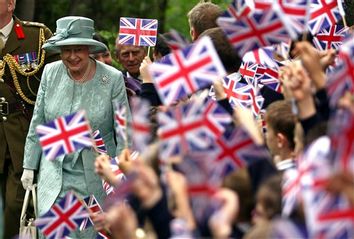
Hundreds of people are expected to crowd along the streets outside Parliament to see the monarch’s horse-drawn carriage parade from Buckingham Palace in a lavish ceremony featuring glittering carriages, sparkling diamonds and canon fire.

As the queen dons a crown studded with 2,000 diamonds for the annual pageant of power, pomp and politics, labor union members will march on the House of Commons to protest the government’s program of sharp spending cuts.

From a gilded throne in the House of Lords the queen will read aloud the new legislative package. But she has no role in drafting its content, which is written by Britain’s government.

Prime Minister David Cameron will prioritize new bills to cut regulation for businesses — which could make it harder for workers who allege unfair treatment — trim public sector pension payments and divide Britain’s banks to protect high street retail operations from riskier investment divisions.

The legislative slate is also expected to confirm a new attempt to modernize Parliament’s unelected upper chamber, the House of Lords, and may include contentious plans to snoop on emails and website use to combat terrorism.

Britain is carrying out a four-year program of about 81 billion pounds ($130 billion) of cuts to government spending, and Treasury chief George Osborne has already acknowledged a further two-year austerity package will likely be needed after a scheduled 2015 national election.

Last month, Britain’s economy slumped back into recession for the first time since 2009 amid stalled growth.

“We can’t let up on the difficult decisions we’ve made to cut public spending and to get the deficit and debt under control,” Cameron said Tuesday, addressing factory workers in Essex, southern England.

“I know it’s hard, I know it’s difficult, but when you’ve got a debt problem the one thing you mustn’t do is keep adding endlessly to that debt,” he said.

Continue Reading Close

Page 1 of 7 in David Stringer