Debra Ollivier
Whose crisis is this, anyway?
Teens are getting the blame for their parents' failures.
This summer, while their pals slept until noon, chilled at the beach or flipped burgers for extra cash, a growing number of teenagers were forcefully removed from their homes by “escorts,” flown several hundred miles away or, in some cases, overseas to be enrolled in “emotional growth boarding schools” or “wilderness therapy programs” for “defiant teens.” They are lost, troubled, self-destructive and underachieving, according to ads for teen “turnaround” programs, part of a bumper crop of particularly out-of-control teens who roam America’s cities and suburbs, tottering on the brink of an uncertain future.
Think Columbine. Think pot. Think mouthing off, broken curfews, lousy grades, pierced tongues.
Then think again.
Are we in the grips of a teen crisis, a developmental emergency that requires expensive intervention? Not exactly, say experts in adolescent psychology. Statistics show that teenagers aren’t really acting up or out more than they have in the past. Instead we are more likely in a crisis of parenthood that has created a lucrative new market for specialty schools and educational consultants. If there is a serious problem here, it may be one of parenting and perception, not bad kids.
“There is no evidence that risk taking among teens is any worse today, quite the contrary,” says Lynn Ponton, M.D., professor of adolescent psychology and author of “Romance of Risk” and “The Sex Lives of Teenagers.” “But there is a shift among parents. Baby boomer parents look at their own past risk taking, exaggerate it and project it onto their kids.
“There’s also a mistaken notion that peers create high-risk behavior,” adds Ponton. “In fact it’s parenting that creates high-risk behavior, and there are many studies to prove this. Some kids are seriously dysfunctional and some of these schools quite good. But what frequently happens is that kids are shipped off to these schools, come back better, but the parents are still pathological.”
Indeed, current statistics about teenage behavior reflect that American adolescents are much more wholesome than the rest of us give them credit for. Teen violence is down and test scores — for both genders — are up. In recent reports from the Centers for Disease Control and Prevention, researchers found that the teenage birth rate is at its lowest level in 60 years and that smoking among high school students has declined as well.
Nonetheless, a proliferation of dread-laden questions leaps out from school directory advertisements (“Troubled teen?” “Angry, defiant teen?” “Out of control?” “Self-destructive?” Low self-esteem?” “Underachiever?”), heralding an epidemic of insecurity among parents and an attendant boom in specialty schools. (A recent Sunset magazine had no fewer than 25 ads for specialty schools in its directory, once rife with weight loss camps and military academies.)
In this busy menagerie there are two distinct animals: emotional growth boarding schools and therapeutic wilderness programs. Therapeutic wilderness programs are short-term (usually six to eight weeks) expeditions that take kids into the wild and offer a blend of intensive counseling, discipline and coming to terms with Mother Nature in all her Spartan, unforgiving glory. Emotional growth boarding schools are the alternative to intensive therapy in the fir trees — private facilities offering (expensive) long-term therapy to stubbornly troubled teens.
Despite serious setbacks caused by the deaths of several young attendees several years ago, wilderness experience programs are growing. Of the estimated 500 such programs operating today, roughly 40 are therapy based, generating an average gross revenue of $143 million.
An official figure for the number of emotional growth boarding schools is hard to come by. However, for the past three years, Lon Woodbury — an educational consultant whose Web site and various publications have become a clearinghouse for the industry — has been circulating a survey among independent educational consultants. This spring, his list contained approximately 250 emotional growth schools, of which Woodbury included 89 in his directory (a personal “best-of” assessment based on “reputation for safety and effectiveness”). In 1998 these 89 schools represented $341 million in revenue. (In 1993, Woodbury’s directory contained only 31 such schools.) Had Woodbury included the total of 250 in his study, the annual revenue of specialty schools for 1998 would jump to $1 billion.
As lucrative as it has been for specialty schools, the perception that teen defiance is on the rise is less a matter of cultural disaster than a fluke of population. There are more teenagers alive today than ever before — approximately 30 million of them at the moment — and their numbers are expected to hit 40 million by 2008. With more teenagers out there — plus overcrowded schools, fewer treatment centers as a result of budget cuts and highly publicized white teen crime — there is the erroneous perception that pathologically bad teen behavior is increasing. The reality is that there are simply more teenagers and thus more bad apples falling from the tree.
Teens have been in a state of “crisis” ever since the first parenting handbook was written. Issues of immaturity, and the straightforward fallout of adolescence, are often at the root of teenagers’ inappropriate behavior. Says Woodbury of the original gestalt behind specialty schools, “The concept was that most of the children doing drugs, flunking out of school, rebelling against their parents, etc. were immature, not pathological. They needed help growing up. A typical child would be age 16, demanding adult privileges such as freedom to do what they want, sex, drink, etc., operating at the emotional age and sense of responsibility of a 4-year-old. Thus, the schools’ goal was to help the students grow up!”
This idea — that defiant behavior is not pathological but a reflection of immaturity — underscores the current consensus among adolescent specialists that teens have not changed much over the years, that, in short, it may be parents who need to “grow up” as much as their kids. While teen clinical pathologies do exist and require serious treatment, basic teen risk-taking behavior has not changed over the decades. Parenting, on the other hand, is a different story.
Says Lynn Hamilton, an educational consultant in Santa Barbara, Calif., who often “trails” teens throughout their intervention, “What I’m finding is that there are many parents out there who are overly child centered. Some of them are flower children parents, boomer parents. Many of these parents don’t set limits. Fathers are unavailable. Mothers are too enabling or overprotective, creating entitled children. As parents they’re relatively clueless. They want to be friends with their children.”
Ponton shares this view. “Many of these parents want to be their kid’s friend,” she says emphatically. “Well, you are not their friend. You are their parent.”
The fuzzy line between being a child’s parent and his or her peer is a common thread in the fabric of parental dysfunction among boomer parents and, according to many specialists, begins at the earliest stages in a child’s development. Patricia Doyle is executive director of the Southwest Region of CEDU, one of the country’s oldest and most well-established networks of emotional growth boarding schools and other programs. Pondering the proliferation of specialty schools, Doyle says: “There is clearly a cultural mandate that suggests that many parents have lost the key to parenting. Many of them are involved in delayed parenting; they want to treat their child as their friend, as someone they can reason with.
“Often it’s well-intentioned, but parents get too enmeshed in their children’s lives,” adds Doyle. “They become child advocates and don’t want their children to experience any struggle. But children grow through struggle. Struggles are what make us healthy. In the past, parents were more able to separate their needs from their kids’ needs. Now it’s the other way around. Parents have a hard time separating their own needs from their kids’ needs.”
Why parents in the past were better able to separate their needs from their kids’ needs is a source of debate. Some, like Woodbury, suggest that today’s parents are afraid of their teens. “I know of one guy — a therapist! — who had a seriously out-of-control 12-year-old,” says Woodbury. “He was unable to lay down the law because his child would threaten to report him to Child Protective Services.”
Woodbury, a father of four, also implies that well-intentioned but overly child-centered thinking has given too much benefit of the doubt to children, imbuing them with wisdom beyond their years and usurping parental authority. “I am against parent-bashing,” he says, “but our society has forgotten certain fundamental things about kids. For example, there are people who believe that children don’t lie. But of course children lie! Every child is capable of manipulation. If your philosophy is that a child won’t lie, where is a parent’s authority?”
Parents who give their child too much authority are only part of the problem. Smoking pot with your child, not setting boundaries or imposing structure, swapping designer clothes, passing off your platinum card to keep your kid busy, having too much family democracy (where everyone, and thus no one, is the decision maker) — the line between parent and child is progressively blurred, and a growing body of literature suggests that parents are increasingly removed from the realities of childhood and parenting.
Experts in education and adolescent psychology speculate that in the past 30 years our culture has put less emphasis on individual responsibility and too much on individual satisfaction, creating a culture of adult children who don’t know about delayed gratification.
Diane Ehrensaft — a developmental and clinical psychologist, psychotherapist, professor at the Wright Institute in Berkeley, Calif., and author of two books — was moved to write her second book when she realized “that something profound was occurring in our culture that needed explanation.” In “Spoiling Childhood: How Well-Meaning Parents Are Giving Their Children Too Much — But Not What They Need,” Ehrensaft explores the many contradictions that define today’s parents.
“How could this same group of parents be simultaneously accused of being the most self-centered and self-indulgent, and also the most child-centered and overly indulgent, generation of parents in modern history?” she asks. “Can it be both ways?”
The answer is affirmative. Describing times of rapid cultural flux, Ehrensaft posits that there have been dominant directives about raising children for many decades, from habit training in the 1930s to the more permissive approaches of Benjamin Spock in the 1940s and 1950s. No clear directives exist today. Limited time for “parenting,” overburdened two-income parents with fragile emotional ties, fear for our children’s future and a generation of “Peter Pan” parents are some of the factors that contribute to today’s “crisis in parenthood.”
“Consumed by their own stress and worries, feeling more afraid, alone, and professionally insecure than parents in the past, mothers and fathers attempt to bolster their own self-esteem by having precocious and high-achieving sons and daughters,” writes Ehrensaft. This confluence of stress and insecurities has created a sort of freakish adult-child, perhaps best typified by Jessica Dubroll, the cheerfully officious 7-year-old who lost her life while attempting to fly solo across the country.
As the trend toward being more grown-up starts at a younger age, a curious parenting permutation has emerged. Children are both pushed to progress and overcoddled, not by parents who are selfish or uncaring but, as Ehrensaft points out, “by confused parents who have no clear picture of what a child is and are unconscious of the vacillations between hurrying our children and holding them back. As a result, childhood is simultaneously contracting and expanding in some bizarre fashion.”
Equally bizarre is the phenomenon in which parents who push their children to grow up fast are often the same Peter Pan parents who never really wanted to grow up themselves, and thus have a paradoxically well-intentioned but myopic view of parenting that fetishizes, glorifies and commodifies childhood. Parenthood, which comes as a shock, becomes a high-investment, high-risk endeavor instead of a natural, evolving developmental process.
The best specialty schools function with a high awareness of dysfunctional parental dynamics and require parents to participate in a series of increasingly complex personal development programs for the duration of their child’s enrollment. Says Katie Brown, a CEDU alumni, “Parental involvement is crucial. Lots of parents send kids off to be fixed. These kids aren’t necessarily broken, but the parents are.”
Says Clif Drummond, who sent his son Dylan to CEDU when problems stemming from Dylan’s alcoholism got out of control: “You’re told that 90 percent of your kid’s success depends on what you do. You say, ‘Hey, I’m paying you guys 50 grand a year and you’re telling me that 90 percent of the work is about us?’ And they say, ‘Yes.’”
As for Dylan, he didn’t particularly enjoy CEDU at first (“My attitude toward everyone that first year was basically ‘Fuck off and die,’” he says), but he credits it with saving his life and attributes his parents’ work on themselves as an essential and crucial part of the process. “I was suspicious at first,” he says. “I never saw them being vulnerable, but over time I saw that this was for real. They were trying to share old, deep pain.
“It was the first time I was really touched by my parents — with them doing something for themselves with no burdens or expectations on me. That’s when I began to get over my anger and work actively on trying to heal, trying to mend our relationship.”
So are teens truly more defiant and troubled than ever before? Or are we experiencing a sort of cultural dij` vu that harks back to the ’50s, when the sexually and morally “degenerate” influences of rock ‘n’ roll, among other things, set off waves of parental panic throughout the nation?
“Absolutely,” says Ponton. “There are a number of parallels here.” The first similarity is statistical: There was a big boom in the teen population during the ’50s. Beyond that, there is a remarkable replay of old perceptions that the parents of today’s teens once rejected as irrational and unfair.
“These things are definitely culture based. Teens are once again perceived as risk takers, as dangerous,” says Ponton. “When society is doing well economically — as was also the case in the ’50s — people tend to dump on teens. You’d think economically good times would be good for teens, but they’re not.”
New education gurus
A booming market emerges for consultants to desperate parents.
The boom in specialty schools has created a cottage industry of educational consultants. Part psychologist, part educator, part guidance counselor and all-around coach, the educational consultant is hired by parents to select an appropriate specialty school for their teen based on his or her emotional/behavioral profile and family dynamic.
This is no small task in the booming market of specialty schools. The proliferation of programs, their high costs (tuitions as high as $58,000 a year) and the potential damage to a child from poorly run programs have made finding the right school a high-risk endeavor in and of itself. “Selecting a specialty school without an educational consultant is like picking a random name out of a public phone directory,” says Lynn Hamilton, an educational consultant in Santa Barbara, Calif.
Continue Reading CloseThe colorful dissenter of Benetton
Oliviero Toscani of Colors and Talk magazines talks about media hypocrisy, corporate responsibility and why fashion makes us stupid.
Oliviero Toscani is sitting in a rickety chair, hunched over a telephone, looking slightly weary. We’re at Studio Pin-up, a cavernous photo studio in Paris where Toscani — accompanied by his kids, a loyal band of colleagues and a coterie of hip, young models — is shooting the next Benetton catalog. Above us, an upstairs loft has been converted into a makeshift graphic design space where the entire catalog will be laid out over the course of a week. Toscani later banters with his models and hovers over his camera. At one point there is a discussion with a hairstylist about cutting his daughter’s hair in the style of a famous Italian personality to photograph in a spoof; his daughter, a wispy, refined preteen, is not so sure. There is laughter.
Continue Reading CloseAu revoir, les taxes
Will lingerie model Laetitia Casta, appointed symbol of the French Republic, decamp to England to flee taxes?
France has seen its share of traitors, but none as resplendent, contemporary and breasty as Laetitia Casta. The news that the recently appointed symbol of the French Republic (aka Marianne) was moving to London set off a wave of political protest and a trans-channel volley of old-time Franco-British rivalry.
French politicians and social pundits resoundingly went on record to denounce Casta’s move as a way of avoiding the country’s astronomically high taxes. (The debate around the virtues of socialism — or how to strike a balance between too many taxes and not enough social protection — is an old one here.) The minister of the interior publicly declared that once settled in London, Casta would be dismayed to find higher rents, an unreliable subway system and substandard hospital care, while another politician went so far as to suggest that Casta’s potential departure is a sign of the imminent failure of socialism.
Continue Reading CloseHomeopathy
It's not wizardry; in fact, it's based on the same principle as vaccination.
Genevihve Buot, a French microbiologist, is telling me about the time she used homeopathy instead of antibiotics to treat her son’s ear infection.
Says Buot: “He had what was essentially a messy mucus plug in his ear. It can be very painful and, when not treated, dangerous. I took my son to a conventional doctor who was adamant about treating him with antibiotics. I took the prescription but never filled it. Instead I used a combination of ferrum phosphoricum, aviaire and arsenicum album. When I went back to the same doctor to check on my son’s ear, the doctor was overjoyed. ‘Your son’s ear is perfect,’ he said. I never told him that I’d actually used homeopathy.”
Continue Reading CloseLiberti, Egaliti, 36C
Why was a pneumatic Victoria's Secret model chosen as the embodiment of the French Republic?
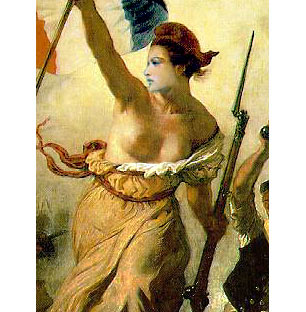
Laetitia Casta, widely known in America as the voluptuous, erotogenic model sporting lacy teddies and seamless satin bras in the Victoria’s Secret catalog, has been elected the new millennial Marianne, France’s embodiment of the Republic and symbol of the Revolution.
A multifarious figure unique to France (the only country in the industrialized world to revere a woman as its national effigy), Marianne originally emerged as an image representing France’s liberation from the shackles of monarchic dynasties and of its transformation into a republic. She has since come to represent justice, honor, patrimony, democracy, universal suffrage, religious piety, industry, agriculture, prosperity and patriotism, as well as various other virtues and ideals that have little if anything to do with Laetitia Casta.
Continue Reading ClosePage 2 of 4 in Debra Ollivier