Flore de Prineuf

“My son was killed because of the occupation”

Israel's Women in Black say the blood of their children is on Sharon's hands.

It’s cold and muddy. Israeli soldiers have just fired tear gas and percussion grenades at a large crowd of peace activists gathered at the entrance of Ramallah to protest Israel’s military operations in the West Bank. Aviva Weisgal, an Israeli mother of two, is doubled over, crouching between parked cars and trees, trying to escape the noxious cloud without giving in to panic.

“Now that’s real bravery,” she says between coughs, referring sarcastically to the soldiers’ show of force against unarmed demonstrators. Nearby, an old Palestinian woman, overcome with stinging fumes, falls hard to the ground. People scream for a doctor, men and women share water and onions to recover their breath. A little boy watches and visibly shakes with fear.

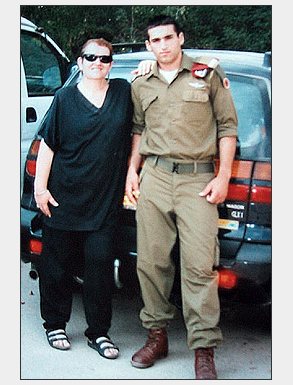
Days earlier, in her home on a kibbutz just west of the city, pacifist Malka Tezmach takes a quiet, but equally provocative stand against the violence. Her son, Tal, was killed in his sleep by a Palestinian commando on March 19 while serving in the Israeli-occupied Jordan Valley. Malka, her voice infused with terrible grief, refuses to call for revenge. Instead, she makes statements that infuriate those who demand retaliation.

“We saw pictures on television of the terrorists who came [to the Israeli training camp where Tal was serving],” says Tzemach, a 49-year-old nurse with short red hair and a weary expression that reflects strength and exhaustion. “I know people who saw them. Many curse them. But I was so angry and I’m so angry still that I can’t direct my anger at them specifically. I’m angry at the bad people on both sides. I’m angry at the situation.

“I don’t understand how for so many years we’ve allowed people to be killed without doing anything to stop it,” she goes on. “My fear now is that a friend of Tal’s will be killed. I can’t tolerate that even a friend of his friends will get killed. How will we keep on living through all the loss?”

Weisgal and Tzemach are members of Women in Black, a group of women who have held silent vigils for peace at major intersections around the country at the same hour every week for almost 15 years. In the past, the demonstrations have been uneventful, rarely marred by conflict more serious than name-calling. But in these chaotic times, marked by seemingly endless bloodshed on Israeli and Palestinian sides, women like Weisgal and Tzemach are coming out in greater — and louder — numbers, risking more than ever to voice opposition to what they see as a senseless war.

On Wednesday, Jewish and Israeli Arab women were supposed to march from Jerusalem to Kalandia, a checkpoint at the entrance of the West Bank city of Ramallah, to show solidarity with a Palestinian women’s group stuck on the other side. But a special army roadblock kept the women away from the Kalandia checkpoint, and the peace rally became confrontational when it was hijacked by more aggressive male demonstrators and politicians.

Despite the setbacks, turnout for the march was impressive (more than 2,000 people showed up), and it emboldened women trying to throw a wrench into the Israeli-Palestinian war machine. “There’s a growing number of women who are saying: ‘Enough, I don’t want to take part in this,’” says rally participant Magdalena Hefetz, a member of Women for Human Rights, an Israeli group founded last year that monitors the behavior of Israeli soldiers at checkpoints.

A growing number of Israeli pacifist women, many of them anxious mothers with draft-age children, are bringing their nonviolent message to bear on a bloody, testosterone-charged conflict. They are challenged by others, including Women in Green, a group based in a West Bank settlement that favors continued military response and retaliation. But as Israeli military and political figures have raised the volume on calls for more punitive strikes and wide-scale military actions, women against the war have responded with new vigor, publicly questioning the rationale of aggressive policies that carry a high cost in human lives.

It is difficult, at this point, to say exactly how many Israeli women are currently engaged in the fight for peace. Women in Black is not an organization of card-carrying members but rather a peace network that provides a framework for women wanting to express opposition to war and the occupation of the West Bank and Gaza. The group was inspired by Argentinian “mothers of the disappeared” who have gathered every Thursday in the Plaza de Mayo in Buenos Aires for more than two decades to demand news of their missing children. Women in Black now has chapters around the world — in the U.S., England, Italy and also in Serbia, where women bravely protested against Belgrade’s violent tactics.

Weisgal says she doesn’t know how many women participate in vigils in Israel these days. At her particular intersection, on a secondary road south of Jerusalem, about nine women show up every Friday. But Weisgal believes the movement is gaining momentum.

“After a gap of several years when we thought peace was on track, women are returning to the vigil [organized by Women in Black],” she says, in the minutes before tear gas breaks up the rally. “It’s hard because every five minutes you hear about a new suicide attack, and people who used to drive by our signs saying ‘Stupid women’ are now much more aggressive towards us.

“But every voice counts,” insists Weisgal. “I’m worried for my children. I have a 15-year-old boy and a 16-year-old girl, and I don’t want them to serve in the army.”

Weisgal says her son would rather do some sort of civilian social work than raid Palestinian houses or shoot tear gas at unarmed demonstrators. “He says it would be more brave to work with old people or disabled children than to be a soldier,” says Weisgal, a 47-year-old schoolteacher. “But I’m afraid that by draft age, peer pressure will take its toll.”

Many of the women’s organizations agitating for peace also lobby for alternatives to compulsory military service. They want a legal alternative to service for conscientious objectors, who now face three months in prison for refusal to join the army. The women’s proposal got a big boost recently, when hundreds of Israeli reservists announced publicly that they would no longer serve in the territories occupied by Israel since 1967.

“Sisters and mothers of the refuseniks [as the reservists are called] are becoming active, getting involved in various organizations. It’s great,” says Hefetz. “It’s just a little bit too late — 35 years too late.”

Too late, certainly, for Tal Tzemach.

“My son was killed because of the occupation,” says Malka Tzemach. Some Israelis would vow revenge and cultivate hatred for Tal’s assailants. Some would take pride in the fact that Tal, a second lieutenant promoted in his death to first lieutenant, was defending his country. But Malka says she will not let grief interfere with her beliefs — if anything, it strengthens them.

“For a long time I’ve believed that we treat Palestinians unfairly,” she says. “When my son was killed I couldn’t switch off those feelings and think suddenly about how terrible the Palestinians are and how virtuous we Israelis are. My impression is that life isn’t really important to us. I see it in our treatment of our enemies — if we can call them enemies. We’re contemptuous of them, and in the end we cheapen our own lives.”

It would be easier for Tzemach to believe her son did not die in vain. But Tzemach dismisses the argument that Israel must fight and maintain troops in the occupied territories in order to protect the Jewish heartland from terrorist attacks. “We believe our own propaganda,” she says. “Since the Gulf War [when Iraqi Scud missiles reached Tel Aviv], we know the Golan Heights and the Jordan Valley don’t really matter. Security is just an argument we cling to in order to justify ourselves. You can say the land is ours, we don’t want to give it back — that’s a different story. But it has nothing to do with security.”

Tzemach sees the occupation of the territories seized by Israel in the 1967 Six Day War as the root of all evil. For her, the occupation provides motivation for Palestinian terrorists and corrupts the behavior of Israelis. “Even traffic accidents are related to it,” she says. “It has turned us into aggressive macho people who don’t care about each other.”

Israel’s repeated conflicts with Palestinians and Arab neighbors also have created a suffocating narrative in which militaristic values are extolled and war is celebrated as the nation’s finest hour, says Tzemach. “Friends come into my house and speak about the army with pride, exulting in what the army did in the past. All the stories and boasting about the army is what keeps the conflict going,” she says, expressing a belief over which she and her husband, David, frequently butt heads.

Like other Israelis his age, Tal was deeply moved by the assassination of Prime Minister Yitzhak Rabin in 1995, says Malka. In fact, Tal and many of the soldiers fighting today were part of the “candle generation” that mourned Rabin’s death, and called for peace, at candle-lit memorials across the country. “We were at the peace demonstration where Rabin was killed,” says Tzemach. “After that, I took the kids to all the demonstrations I could. Tal told a pen pal in Canada that he was very happy when the Oslo accords were signed and very happy with the withdrawal from Gaza and Jericho.

“But when he joined the army,” says Tzemach, “we stopped talking politics. I would show him interesting articles from time to time, that’s it.”

Tzemach had mixed feelings about her son serving in the army. “All these years he was told that it’s important to serve, that it’s important to contribute to the security of your country. At a demonstration recently, I met women who taught their sons from age zero not to go in the army. It wasn’t our way.”

.”Now that [Tal] is dead I understand we really put these youths in a terrible situation,” continues Tzemach. “They’re bombarded with messages about protecting the homeland, messages sometimes of indifference and hatred. Without this mental preparation, soldiers couldn’t do what they’re doing. They stop asking questions and adopt a defensive position.”

“There are soldiers in my living room right now,” she says. “Friends of Tal’s come to pay their condolences. I keep quiet because I don’t want to create friction. But I believe Sharon hasn’t reached the point of orgasm yet, that’s why he’s continuing this war.”

One of Tzemach’s close friends, a woman who, like Tzemach, joined Women in Black during the Jerusalem riots of 1996, pipes in with the kind of feminist and pacifist opinion that is the group’s trademark.

“We’re holding Arafat. What’s next?” says Laurie Handel. “I think women would worry about the consequences. But here it’s like the Wild West, you draw guns first and think later. As a mother, we can say ‘OK, you win the fight, and then what?’” By ending the occupation and giving in to Palestinian demands, says Handel, “I get my son back, he’ll be safe at home. It’s not that we love Palestinians. But I’m not afraid of losing face. As women we know very well how to lose face — we do it several times a week.”

Weisgal believes that instant Israeli retaliations to Palestinian attacks come from a deep-rooted dread of being perceived as passive. “[Israeli men] are gung-ho for the war,” she says. “It’s how they demonstrate their bravery. Other ways are considered passive, and there’s the feeling that if we don’t answer with violence, Palestinians will think we’re willing to go to our deaths like sheep.”

The shadow of the Holocaust is difficult to shake, she says. So, too, is the feeling of revulsion caused by suicide attacks — whether carried out by men or, recently, by young women. “It’s horrific no matter who does it,” says Weisgal. “But it certainly doesn’t push women forward in Palestinian society. All it does is make Israel a little less confident in its ability to defend itself.”

Although Israel’s women’s groups rarely have an effect on government policy, there is a precedent that gives today’s pacifists some hope for success. When Israel pulled out of Southern Lebanon in May 2000, after nearly two decades of war, a women’s organization called Four Mothers was credited with helping rally Israeli public opinion behind the move.

Right-wing politicians like Prime Minister Ariel Sharon, then the leader of the opposition Likud Party, harshly criticized the army pullout as caving in to the guerrilla tactics of Hezbollah, a fundamentalist organization backed by Iran and Syria, and argued it would hurt Israel’s deterrence. But in countless interviews and opinion pieces, the Four Mothers — women who lost their sons in the Lebanon war — helped focus the debate not only on security issues but on the young lives that would be saved by putting an end to what was being labeled as Israel’s Vietnam — a war against guerrilla fighters on foreign land with victory nowhere in sight.

The Four Mothers spawned a group called the Fifth Mother, which is now agitating, like Women in Black and a half-dozen similar women’s organizations (Daughters of Peace, the Coalition of Women for Peace, and others), for an end to the occupation of the West Bank and Gaza. But the battle is much tougher now, says Hefetz, one of the peace activists braving the rain and tear gas at Wednesday’s rally. “Many people feel we’re not occupiers and that [the West Bank and Gaza] is our land. In Lebanon, it was much clearer. There was a border and it was a different state.”

The lack of national consensus over the facts of occupation and the tension created by repeated terrorist attacks cause many people to have little patience for female pacifists, who are easily dismissed as sissies and dreamers. At the Nahshon junction, the intersection where Tzemach, Handel and Weisgal stand vigil with a handful of other women every Friday afternoon, insults and even physical violence are more and more common.

According to Handel, most of the barbs are laced with sexual innuendo (“Why don’t you sleep with Arafat? You probably haven’t been properly laid in a long time”) or target the families of the demonstrators (“I hope your children all die”). They’ve been flashed and spat on, and a few months ago, four men came out of a van, pushed a woman to the ground and destroyed their signs. “They attacked us because we’re women,” says Handel. “They wouldn’t have dared if there were men with us.”

The trick is not to react, says Hefetz, who’s been pestered — including by right-wing women — during her work as a peace activist helping Palestinians cross Israeli army checkpoints around Jerusalem. “Soldiers tell us to go back to our kitchen, but it’s OK,” she says. “Women know how to ignore provocation. It’s men who always have to react.”

Meanwhile, the mere presence of women at the checkpoints, the scene of tense and often humiliating transactions between Israeli soldiers and Palestinian civilians, is beneficial, she says.

“It’s good for the soldiers. They have the feeling that their mothers are watching, so they behave better.”

Israel’s pivotal role

Palestinians celebrate World Trade Center attacks and Israel balks at truce talks. Will this threaten the U.S.'s global coalition?

When Palestinian leader Yasser Arafat donated blood this week to help the victims of terrorism in the United States, Israelis mocked the televised event as a propaganda ploy.

It seemed too little, too late: Thousands of Palestinians had already taken to the streets and spontaneously exulted in the United States’ misery despite official orders not to manifest joy. And his blood donation seemed particularly hollow on behalf of a man who practically founded modern terrorism as head of the PLO and, according to Israelis, continues to promote shooting attacks and suicide bombings in Israel, the West Bank and the Gaza Strip almost daily.

But it was a sign of Arafat’s determination to be counted as one of the “good guys” at a time when the United States is scanning the globe for friends and foes.

Israeli Prime Minister Ariel Sharon, for his part, jumped on the opportunity provided by Tuesday’s catastrophic events to equate Arafat with America’s prime suspect and arch-enemy Osama bin Laden and recommend that critics back off when Israel does what it can to crush local terrorists.

“Acts of terror against Israeli citizens are no different from bin Laden’s terror against American citizens. Terror is terror and murder is murder. There is no forgiveness for terror and no compromise with terror,” he said Sunday at a special parliamentary session. Earlier in the week, Sharon presented the Israeli-Palestinian conflict as part of the same global war on terrorism the United States has vowed to lead. “The fight against terror is an international struggle of the free world against the forces of darkness who seek to destroy our liberty and our way of life. I believe together we can defeat these forces of evil.”

Ironically, both Palestinians and Israelis have pledged their support for the United States’ war against terrorism, while continuing to trade barbs and bullets all week. But their quarrel, as petty as it may seem in the wake of Tuesday’s devastation, still has the power to derail American efforts to put together an international coalition ahead of likely military strikes on terrorist organizations.

The paradox brings to mind the situation during the Gulf War, with a twist. Israel, in theory America’s strongest ally in the Middle East, was already seen as a liability in 1990-1991 when the United States relied on Arab states for troops and bases in its war against Saddam Hussein’s Iraq. Israel was asked to “keep quiet,” stay out of the military confrontation and even refrain from responding to Iraqi missile attacks on its cities. Israel’s low profile was designed to keep Arab states such as Egypt and Syria on board with the American plan. (To reward Arabs for their support, the United States then pressured Israel into attending a conference in Madrid that began to address the question of Israel’s illegal occupation of the West Bank and Gaza and laid the groundwork for the Oslo peace process.)

The situation today is a little different. “The U.S. doesn’t need 500,000 troops in Saudi Arabia. It’s minimally dependent on a coalition. It doesn’t have to pay politically or financially for the support of Syria or Egypt,” said Gerald Steinberg, head of the program for conflict management and negotiation at Bar-Ilan University. “These regimes depend for their survival on the success of the fight against radical Islam.”

But the United States still desperately needs the political support of Muslim Arab states so that the war against Islamic terrorist organizations is not perceived as a war between the West and Islam — a “clash of civilizations” that would alienate about a fifth of the world’s population — but rather a war between the civilized world and savages.

Arab leaders, threatened by their own radical Islamic groups at home, have already vowed to help. But observers fear that anti-Americanism, which is rampant in the streets from Cairo to Damascus, will break that allegiance — particularly if Israel, America’s protigi in the region, continues to shell Palestinian cities with American-supplied weapons. In the past few days alone, the Israeli Defense Forces have kept a debilitating stranglehold on Jenin, a town in the northern West Bank that has been a breeding ground for suicide bombers in the past; driven tanks through Jericho; and attacked the city of Ramallah using a combination of undercover units, paratroopers, border police and air force. At least 15 Palestinians died in various Israeli military operations, two Israeli civilians were killed in drive-by shootings by Palestinian gunmen and an Israeli soldier died in the fighting near Ramallah.

A year into the Al-Aqsa Intifada, which has claimed about 800 lives, three-quarters of them Palestinian, “public opinion in the Muslim and Arab world is enraged,” said Khalil Shikaki, a Palestinian pollster and political analyst. The conflict, reported in bleak anti-Israeli terms by Arabic satellite TV organizations such as Al-Gezzira, the CNN of the Middle East, has done its share to radicalize Arab societies and explains in part the discrepancy between the condolences offered by Arab leaders and the sentiment of “just reward” expressed in the streets after the Twin Towers toppled and the Pentagon burned. “We’ve been seeing radical support in the streets for the intifada for months,” said Yossi Alpher, an Israeli strategic analyst. “And clearly anger for Israel overflows into anger for the United States.”

Not that Islamic radicals were happy with the peace process either. (The Islamic organization Hamas detonated bombs in Israel in 1996 to derail the talks, not to egg them forward.) But Islamic fundamentalists have always excelled at exploiting the Palestinian story of occupation, exile and suffering for their benefit. “The issue of the Palestinian-Israeli conflict is part of the whole baggage of Islamic fundamentalists versus the rest of the world. Fundamentalists use it to discredit the West and Western designs against the Arab world,” said Shikaki. “The ups and downs of the peace process provide a context [for terror]. It’s hard to cultivate hatred without scenes of Israeli atrocities.” Stabilizing the Israeli-Palestinian front would “deprive Islamic fundamentalists of that platform,” said Shikaki.

Israeli analysts, however, reject that linkage. Steinberg sees radical terrorism primarily as a function of fundamental hatred of the West. According to him, Israel, lower down on the list, rates as a target only because it represents Western penetration in the Middle East. “The Palestinians are largely irrelevant,” said Steinberg. “No state and few people are willing to confront Israel on this issue.”

Furthermore, Sharon has made clear that Israel is not willing to pay a diplomatic and security price for Arab participation in the American coalition. When President Bush called Sharon on Friday and exhorted him to allow Israeli Foreign Minister Shimon Peres to meet with Arafat to discuss the implementation of a truce, Sharon refused point-blank. On Sunday, he somewhat softened his position, saying the meeting could take place after 48 hours of absolute quiet but not while Arafat was making no effort to halt terror against Israel.

“A coalition against terrorism must fight every kind of terrorism, including Arafat’s,” said Sharon. “A meeting with Arafat at this time, while he is actively using terrorism at its fullest strength and has taken no preventive steps, will legitimize Arafat as a ‘good guy.’ This would be very dangerous as it would give Arafat a chance to continue terrorism without us being able to take action against him.”

Indeed, Tuesday’s terrorist attacks in the United States have all but destroyed the distinction in world public opinion between terrorists and “freedom fighters,” a distinction Arafat had succeeded in establishing for the Palestinian cause over the last decade. At the same time, diplomatic obstacles to an all-out Israeli war against the Palestinians have also given way to sympathy for the Israeli predicament. Sensing an important change in the diplomatic climate and fearing for his personal survival, Arafat has been desperate to please Americans this week. In his typically thuggish way, Arafat tried to suppress evidence of pro-bin Laden sentiment in the streets by having his minions threaten the lives of cameramen who would dare transmit the negative images. He has also ordered Palestinian terrorist groups such as Hamas and Islamic Jihad to halt their activities against Israel or face a brutal crackdown.

“The factions that support violence are willing to give Arafat a chance not to embarrass him given the catastrophe in Washington and New York,” said Shikaki. “But Arafat can enforce a cease-fire only if Israel shows flexibility.”

Sharon, whose unity government would probably collapse if peace talks were renewed, doesn’t want to let Arafat get off so lightly. “Sharon believes that now is indeed the time to wipe out Arafat and everything he represents,” wrote Shimon Shiffer, a political commentator in the Israeli daily Yedioth Ahronoth.

Other Israelis, particularly on the left, believe instead that the intense international pressure against terrorism offers a rare opportunity for Arafat to impose an unpopular cease-fire and put an end to a yearlong costly and fruitless intifada. “This is an opportunity for Yasser Arafat to change his ways and conduct,” said Yossi Sarid, a left-wing member of the Israeli parliament, interviewed on the Voice of Israel radio on Sunday. Just like the Gulf War 10 years ago helped end the first Palestinian uprising, the current crisis offers a ray of hope: The prospect of peace in the Middle East.

Continue Reading Close

Living with terrorism

In Israel, a day without an attack "is a miraculous day," and a public eager for escapism turns to soap operas.

Suddenly Israel, the scene of religious intolerance and repeated bloody explosions, has become a model country, a showcase for what perhaps awaits Americans as they learn to live in the shadow of terrorism.

Not that there’s much here to envy. In Israel, car trunks and handbags are systematically searched by security guards at the mall. People carrying large objects, wearing loose, baggy clothes or an Arab complexion are viewed suspiciously. And “single young woman, traveling alone” is an airport security profile not a personal ad.

Most of all, living in a country plagued by terrorism means sacrificing a degree of personal liberty for a greater sense of security and constantly calculating the risks involved in carrying out ordinary activities such as driving, shopping and eating out.

After a series of bombs blew up buses in Tel Aviv and Jerusalem in 1996, boarding a bus in Israel has seemed foolhardy. For the past year, since peaceful relations between Israelis and Palestinians disintegrated, the “Russian roulette” metaphor has extended to driving cars with Israeli license plates on roads in the West Bank (dozens have been ambushed) and strolling down the shopping areas of Israeli towns.

Each person has his own way of managing fear. Take Menashe Tsabag, 35, a lawyer in downtown Jerusalem, who works about 300 yards from Sbarro, the pizza parlor where a suicide bomber killed 15 and wounded 130 others on Aug. 9, and just a few blocks from Mahane Yehuda, the covered market that has also been a magnet for terrorists in the past. Tsabag went to the covered market recently to buy pineapple (much cheaper than if he had gone to a smaller, safer grocer), but stayed clear of the most crowded stalls. On his walks downtown, Tsabag usually avoids Jaffa Street, Jewish Jerusalem’s main artery, too crowded for comfort, but yesterday made an exception to his self-imposed rule to visit a friend. “I walked the street from one end to the other with the sensation of the edge of a knife in my back,” he said.

Many Israelis like Tsabag attempt to put order in the chaos wreaked by terrorism by taking what appear to be basic precautions, as sensible as respecting a road’s speed limit or driving sober. But that order rapidly crumbles in the face of the randomness of terrorist attacks. “Frankly, every day that doesn’t have a terrorist attack is a miraculous day,” said Tsabag. “If someone really wants to commit terror, he can’t be stopped. Jerusalem is a territorially unified city. The distances are so close between where we work and eat and the [predominantly Arab] Old City.”

“I’m not going to leave Jerusalem because of terror,” said Tsabag. “There are attacks in Tel Aviv and Netanya too. You live wherever you have to. It’s not fatalism, it’s real. Wherever you go, you could be hit.”

Yaron Ezrahi, a political analyst based in Jerusalem, believes terror attacks have different impacts on different sectors of Israeli society. “People who have a certain sense of the inherent fragility of human existence, people generally with a higher education, have more resources to deal with terror. They go to concerts, read books. They cope with resilience, with fatalism or with escapism,” he said.

Escapism, in particular, has become a dominant trait of Israeli society. People in Tel Aviv are famous for “partying on,” no matter what, and have earned the sprawling Mediterranean city a reputation for defiant debauch that presumably drives fundamentalists mad. Less flamboyantly, Israeli TV viewers have started to tune out the terror. Soap operas are up, news programs are down. On Sunday, when a rash of Palestinian attacks killed five Israelis and two suicide bombers in three separate incidents, Channel 2, a national TV channel, interrupted its normal programming to cover the bloodletting, only to see its ratings dramatically drop.

For a second group of people, however, escapism is not an option because they lack the necessary resources or cultural habits. “They live constantly with the mood in the street and with the TV news,” Ezrahi explained. “They are the most vulnerable to the process of disruption and routine imbalance. They channel their anxieties into powerful emotions of fear and hatred.”

These different reactions to terror, in turn, sharply color Israeli politics. The latter group is more “prone to encourage the massive use of force on the premise that it will end their anxieties,” said Ezrahi. They are the ones pressing the government for tough measures of retaliation after each terrorist strike and represent the core electorate of the Israeli right. The first group, by contrast, tends to believe that there is no military solution to the conflict, said Ezrahi, and that the injustice at the base of the enemy’s hatred must be somehow addressed. After months of bloodshed and grisly terrorist attacks, however, the left’s ranks have dwindled and its faith in the possibility of reaching an understanding based on rational discussion with the other side has been seriously shaken.

One idea each side can agree on: Isolate terrorist elements from Israel, be it through military closures imposed on entire Palestinian cities (like the sieges imposed on the West Bank towns of Jenin and Jericho this week) or through a unilateral withdrawal from the occupied territories. The concept of unilateral separation, which enjoyed only marginal support last year, is now supported by over 50 percent of the Israeli population, according to Yossi Alpher, an Israeli strategic analyst. This opinion shift, a result of repeated shooting attacks on settlements, can be seen as a victory for Palestinian militants and a sign that Israelis are “softening” in the face of unbearable casualties (at least 166 Israelis have been killed by Palestinians since last year). But terror has also made Israelis “more hostile and more angry at the Palestinians,” noted Alpher. “They don’t want to withdraw out of love for the Palestinians but to erect a large fence so that they never have to see them again. To get rid of them. It’s a very anti-Arab approach.”

Like the war in Lebanon, the conflict between Israelis and Palestinians, a mixture of guerrilla warfare and terrorism, has had brutalizing effects on Israeli society. Israeli proclivities toward domestic violence, rudeness in the streets or road rage seem somehow linked to what soldiers are taught to do in order to deal with regional and Palestinian threats. “It’s a long-term problem,” said Alpher. “It’s hard to prove the connection but many feel it is there. ” And ironically, toughness in the face of tough times has produced a vicious circle. “The first Intifada [1987-1993] broke out in part because of the brutal behavior of our soldiers at roadblocks and elsewhere,” noted Alpher.

But Israel’s grim scenario is not necessarily one the United States will follow. “American idealism will stand as a huge resource” for coping with Tuesday’s devastating blows on New York and Washington, said Ezrahi. “Once a sense of defending a civilization is established, it’s easier to withstand terror. It becomes a war.”

In dealing with their losses, Israelis have not always had the comforting feeling that they are waging a just and necessary battle. Apart from settlers who live in the West Bank and Gaza for ideological reasons and see their resistance to attacks by Palestinian gunmen as the heroic embodiment of a national and religious duty, many Israelis have been plagued in the past with moral uncertainties. Because of the curse of occupation, “There is no sense of idealism in defending Israeli values,” believes Ezrahi. Throughout the 1990s there was a lingering suspicion that if the West Bank and Gaza were turned over to the Palestinians and past grievances were addressed seriously, some of the anger and frustration fueling local terrorism would be defused. Those feelings were at the base of the Oslo negotiations that sought to exchange land for peace and security.

Palestinian leader Yasser Arafat’s rejection of a far-reaching Israeli peace plan last summer dealt a first blow to that theory. Tuesday’s shocking acts may have buried it entirely. When groups of Palestinians were caught on film cheering the devastating terrorist attacks against the United States, they were destined to be judged through guilt by association with a heinous crime, and many of the doubts and gray areas vanished from Israelis’ minds. “What are they going to call the pilots of those suicide planes? ‘Guerrilla fighters?’ No they’re terrorists,” said the lawyer Tsabag, usually sympathetic to the other side’s arguments. “It doesn’t matter if they did it for a good cause. Causes are relative, but death is death.”

Continue Reading Close

Where’s Arafat?

His intransigence helped elect Ariel Sharon, and violence rages on. Can Yasser Arafat lead the Palestinians out of crisis?

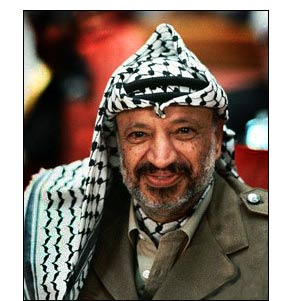
The first time I saw Yasser Arafat, I tracked his checkered head cloth as it moved down a double row of goose-stepping guards of honor to the stately oom-pah-pah tune played by a military band.

Arafat’s trademark black-and-white keffiyeh moved slowly and steadily, no more than 5 feet 4 inches above a red carpet stretching from a lavish VIP lounge to a freshly landed aircraft. It framed Arafat’s beaming, stubbly face as he personally greeted the first plane to touch down in Gaza. It was November 1998, the day of the inauguration of the Gaza International Airport, a perfect day for brass and pomp under the throbbing Middle Eastern sun.

The airport, the fruit of years of diplomacy, was a consecration of sorts for Arafat, the guerrilla commander turned jet-set dignitary, and a first step toward sovereignty for his embryonic Palestinian state. “Today the airport in Gaza, tomorrow the capital Jerusalem” promised a banner hung at the airport. Not far from the pageantry however, anarchy ruled.

A sea of ordinary Gazans in thongs and T-shirts, traditional embroidered dresses and jeans, had broken through the security lines separating the airport from Gaza’s dusty streets and taken over the tarmac. Scraps from Arafat’s dozen various security services celebrated in rowdy rings, carrying AK-47s over their heads as they chanted and danced. Women and children went for the sprinklers that had been laid down to breathe life into scraggly lawn patches and pierced the hoses to wash, drink and fill bottles with water — a precious commodity in the overcrowded and underdeveloped Gaza Strip. Most people in the crowd had never seen a plane up close and could never afford to fly.

That opening scene is repeated every day in the 40 percent of the West Bank and two-thirds of Gaza that fall under Arafat’s partial rule. There is not much authority in the Palestinian Authority. But there is plenty of misery and spontaneous combustion among Arafat’s 3.1 million subjects.

Throughout the fall, when riots degenerated into deadly clashes, and up to the present, when Palestinians are waging a low-intensity guerrilla war against Israel, the division of powers in Palestine has remained more or less the same. Arafat, military garb notwithstanding, does the flying but leaves the fighting and nitty-gritty task of economic survival to the people. (It’s against this backdrop that Ariel Sharon, the man whom many Palestinians blame for sparking the current wave of violence, assumes the mantle of Israeli prime minister this week.)

Among Western observers, Arafat’s wiles and decisions are the subject of careful study and consternation. How could the Palestinian leader allow the territories under his control to spiral into violence and chaos? Why hasn’t Arafat sought ways to put an end to an uprising that has already cost hundreds of lives? The widespread bafflement started after the collapse of the Camp David summit last summer, when Arafat walked away from generous Israeli peacemaking proposals without even making a counteroffer.

Thomas Friedman of the New York Times summed up the feeling of many in a column addressed to Arafat and written in the voice of then-President Bill Clinton last October: “You have an opportunity to deliver a Palestinian state, and to end the misery of hundreds of thousands of Palestinians, and you’re out there throwing stones and demanding an international investigation into the latest shootout. Are you nuts?”

“The Olso peace process was about a test,” wrote Friedman again in February. “It was about testing whether Israel had a Palestinian partner for a secure and final peace. It was a test that Israel could afford, it was a test that the vast majority of Israelis wanted and it was a test Mr. Barak [Israel's former prime minister] courageously took to the limits of the Israeli political consensus — and beyond. Mr. Arafat squandered that opportunity.”

Publicly ridiculed by Clinton for the failure of diplomatic efforts at Camp David, Arafat is also widely blamed for the upsurge of terrorism in Israel. The dovish image produced by Arafat’s historic handshake with Israeli Prime Minister Yitzhak Rabin on the White House lawn in 1993 has been eclipsed again in people’s minds by the image of Arafat as arch-terrorist. The Western media, however, could be giving too much credit to one man.

The demonization of Arafat is certainly at odds with the feeling on Palestinian streets, where Arafat’s name and authority are increasingly irrelevant.

In five months of unprecedented violence, in which more than 400 have died, Arafat has addressed precious few words of solace or encouragement to his people. A victory sign here, a sound bite there — but by and large the 71-year-old leader has distinguished himself by his absence from the battleground. Until Arafat met with U.S. Secretary of State Colin Powell in the West Bank city of Ramallah two weeks ago, he had made only one other trip to the West Bank, where two-thirds of his subjects live, since the intifada broke out at the end of September. (He attended Christmas mass in Bethlehem — hardly an electrifying moment in the life of embattled West Bankers.) At the same time, he has flown to dozens of capitals, relentlessly trying to rally support for Palestinian demands in a comatose Palestinian-Israeli peace process.

On the face of it, Arafat is in trouble. Arafat’s international image, never very positive, has taken a serious blow over the past months. Domestically, his name is associated with the discredited Oslo peace process and, as the president of the Palestinian Authority, he heads a vast structure of ministries, civil services and security services now severely crippled by a 5-month-old Israeli-enforced siege.

Each time Arafat lands in Gaza, he is greeted with full military honors, but each time his plane takes off he seems to become more irrelevant to the lives of struggling Palestinians. “The leadership is not prepared [to fight] but the people are prepared,” Marwan Barghouti, a 41-year old street activist who coordinates fighting on behalf of Arafat’s Fatah party in the West Bank, recently contended in an interview with Between the Lines, a Palestinian magazine. Could Arafat, P.R. man for a desperate cause, be losing his mystique and grip?

By forbidding the movement of Palestinian workers and goods and refusing to transfer customs and taxes that Israel collects on the Palestinians’ behalf, Israel has inflicted more than $1 billion in damage on the struggling Palestinian economy and virtually emptied the coffers of the Palestinian Authority. Funds for last month’s salaries were patched together from European donations, and doubts hang over civil servants’ next paychecks. United Nations Special Coordinator Terje Roed-Larsen warned recently that the fiscal crisis could lead to the collapse of key Palestinian institutions and Powell, during his visit to the region last month, urged Israel to ease its economic sanctions.

But Palestinian analysts dismiss as exceedingly alarmist scenarios in which thousands of Palestinian policemen, who have been ordered so far not to participate in the fighting, will go AWOL and use their guns as freelance fighters against Israel when Arafat’s money dries up. Nor is there any great risk that Palestinian society will give up its allegiance to Arafat and sink into tribalism and anarchy. “Palestinians survived Israeli occupation. If resources dry up, Palestinians will change their way of life and manage on a subsistence economy like they did during the first intifada,” says Ziad Abu Amr, an independent lawmaker in the Palestinian Authority’s legislative council and a political scientist at Birzeit University. “If there are economic difficulties, Arafat becomes like the rest of the Palestinians,” he says.

Although the Palestinian Authority is viewed as a spectacularly corrupt administration, Arafat is usually exempt from such criticism: His residence in Gaza is strikingly modest compared to the villas of some of his cronies, and he is known for his frugal lifestyle. If anything, Israel’s economic sanctions against the Palestinians hold the promise that Palestinian fat cats will shed some of their privileges and reinforce Palestinian unity. Economic pressure will “perhaps clean Palestinian society of corruption,” says Abu Amr. “It will also mobilize and radicalize Palestinians.”

Ehud Barak, Israel’s former prime minister and Arafat’s counterpart in peace negotiations, may have been voted out of office in special elections last month for failing to protect Israeli lives and continuing to negotiate under fire. But the intifada, in which hundreds of Palestinians have died and many thousands have been injured, has not eroded Arafat’s public standing. According to Ghassan Khatib, head of the Jerusalem Media and Communications Center, which regularly monitors Palestinian opinion, Arafat’s level of support has remained where it was before the intifada last summer.

What the intifada has done, however, is reshuffle the Palestinian territories’ informal class system. Five months of unending clashes have promoted the gunmen and teenagers who rule the streets with assault weapons, rocks and slingshots to hero status. The pictures of dead “martyrs” grace every shop and street corner and have become tragic role models for Palestinian boy fighters. The street fighters are usually disgruntled, downtrodden Palestinians whose living standards have deteriorated since the Oslo accords were signed in 1993 and third- or fourth-generation refugees who face no prospect of ever reclaiming the homes their forefathers fled in 1948. (The Oslo accords outlined a two-state solution to the Palestinian-Israeli conflict, in which Palestinians would get a state on land occupied by Israel since 1967 but would presumably refrain from returning to Israel proper).

At the same time, the intifada has sunk the political fortunes of the economically privileged “Oslo VIPs”– top Palestinian negotiators, security officials and aides to Arafat who prospered, while many Palestinians, stifled by checkpoints and borders, lost their freedom of movement and ability to make a living. But Arafat, who shared the 1994 Nobel Peace Prize with Rabin and Shimon Peres for making a historic choice against the armed struggle and in favor of negotiations, seems to be exempt from the fate of lesser Oslo dignitaries.

One reason may be that Arafat lacks any serious rivals. Barghouti, the charismatic Fatah militia leader in the West Bank, may command the attention of fighters in Ramallah, but he has no standing in Gaza and cannot match in Palestinian eyes Arafat’s lifelong commitment to the Palestinian cause. A second reason — and the key to understanding Arafat’s paradoxical political longevity according to Palestinian analysts — is that Arafat is both president of the Palestinian Authority and longstanding chairman of the Palestine Liberation Organization (PLO). “He can choose when to invoke the name and legitimacy of the Palestinian Authority and when to invoke the name and legitimacy of the PLO. He can transfer power from one pocket to another,” says Palestinian lawmaker Abu Amr.

On the one hand, Palestinians believe the president of the Palestinian Authority erred in the peace process. Arafat’s peace strategy did not work, says Khatib, the Jerusalem-based analyst. “He promised the peace process would bring an end to occupation and economic prosperity, but it failed,” Khtib says. “Now Hamas [the militant Islamic Resistance movement which acts as Arafat's opposition] is saying: ‘We told you so. Only by confrontation can we achieve our goals.’ And that’s what people are doing,” he says. The Palestinian Authority is a product of Oslo (it was established to implement interim agreements with Israel), “so it’s natural it should collapse with Oslo,” adds Khatib.

On the other hand, Arafat is indirectly part of the current struggle against Israel and has retained the people’s respect. As head of the PLO, an umbrella organization that includes his broad-based Fatah political party, he can capitalize on the participation of his party. “Fatah is in the lead of the intifada and hasn’t gone against public sentiment,” says Khatib. Fatah activists rally stone-throwers, put shooters in position and instruct people to fight on officially decreed “Days of Rage.” Although Arafat probably does not hand out detailed orders to Fatah militia leaders, neither has he acted to stop them. He also continues to supply them with funds and weapons. “His position is not weakened by Hamas because Arafat’s supporters and his party are the main force in the intifada,” concurs Abu Amr.

Arafat began to feel the need for street credibility as early as last spring when Palestinians, frustrated by the slow pace of prisoner releases and land transfers promised by Israel, clashed with Israeli security forces on the day of the Naqba (literally “the catastrophe” in Arabic — the day on which Palestinians commemorate the loss of their homeland in Israel’s 1948 war of independence). The clashes, the most violent in several years, were a wake-up call to those who thought Palestinians would wait calmly for the peace process to yield tangible benefits after years of disappointments and missed deadlines.

Barak used the violence as a pretext to delay handing over control of villages east of Jerusalem to the Palestinian Authority and temporarily save his disintegrating coalition in the Knesset, Israel’s parliament. The Israeli prime minister then pressured Arafat into accepting a summit at Camp David in July that would deal with the hottest issues on the table: the fate of borders, right of return for refugees and the division of Jerusalem and its holy sites. Analysts believe Arafat was reluctant to attend the summit and loath to accept Israeli proposals because he felt that “the street” was not ready. He allegedly told then-U.S. President Bill Clinton that he risked being killed if he returned with less than the full shopping list of Palestinian demands. By conceding nothing, Arafat was blamed internationally for the summit’s failure but returned to Gaza to a hero’s welcome.

“Arafat has accommodated himself with every Israeli prime minister since Oslo and accepted each prime minister’s particular interpretations of the accord. He accepted the constraints Israel imposed on the Palestinians on the basis of accepting what you have and with the understanding that it was all transitional,” says Mahdi Abdul Hadi, head of the Palestinian Academic Society for the Study of International Affairs. “But when the time came to deal with the end of the game, he came back to the doctrine of Oslo: the establishment of a Palestinian state based on the 1967 lines.” By offering less than 100 percent of the West Bank and Gaza, including East Jerusalem, Israel revealed its “deceptive intentions,” says Abdul Hadi. Arafat, then, did the right thing by walking out on the talks. “He shouldered his responsibilities and gained more legitimacy and recognition in the eyes of the people and the Arab states,” he says.

From the Israeli point of view, Arafat’s rejection of Barak’s offer, described in the Israeli press as the most far-reaching package of concessions ever put on the table by an Israeli prime minister, was an act of lunacy. It was read as the ultimate proof that Arafat does not really want to make peace with the Jewish state. Indeed, one of Arafat’s failings, in his many years of leadership, has been his inability to convince the Israeli public that he is no longer a terrorist but a statesman and a peacemaker. Unlike Jordan’s King Hussein, Arafat is not a charmer. King Hussein once flew to Israel to extend his personal condolences to the families of seven Israeli schoolgirls killed by a Jordanian soldier and managed to sway the country’s hostile opinion by doing so. By contrast, after a Palestinian intentionally drove his bus into a crowded bus stop and mowed down eight Israelis last month, for example, Arafat condemned violence in general but dismissed the event as “a car accident.” Arafat’s refusal to proffer excuses or make conciliatory gestures was typical.

Many Israelis view Arafat as a sort of Middle Eastern Hitler, who has chosen shrewdly to extract Israeli concessions with the blessing of Europe and the United States but will only be satisfied with the ultimate destruction of Israel.

Palestinians, of course, disagree. “I don’t see the Palestinian commitment to peace as a transient one,” says lawmaker Abu Amr. “Arafat is saying: When it’s time to struggle, I struggle. When Israel is ready for peace, I’m ready for peace.” Nonetheless, most analysts say it is a mistake to ascribe to Arafat some great scheme or try to uncover a pattern in his decision-making. “Arafat is the maestro of tactics. He abides by no specific holy strategy, jumps from one thing to another and reacts to events,” says Abdul Hadi. “He compromises between regional, international and domestic issues. This has given him the ability to survive.”

Arafat’s biography is studded with stories of close escapes and near-deaths. Arafat managed to survive repeated Israeli assassination attempts in Beirut, a plane crash in the Libyan desert that killed both his pilot and copilot and even a decade of political exile in Tunis. “From 1983 to 1993, he was in Tunisia far away from his people,” says Danny Rubinstein, the Israeli author of a political biography of Arafat. “His people were scattered under regimes that were hostile to him like Syria, Jordan and Israel. But despite his isolation, Palestinians were loyal to him because he knows how to read the wishes of the people.”

Arafat’s caution during this intifada fits that pattern: “Arafat behaves according to the consensus of the people,” says Rubinstein. “He’s a survivor. He’s riding the back of a tiger.”

Although Arafat has tried in the past to move the Palestinian consensus from a position of total rejection of Israel toward coexistence with the Jewish state, he will not risk defying the public mood. “Right now, he has no reason to ask people to stop fighting,” says pollster Khatib. “He could stop it if he had good reasons, if he proposed something in return.” But after months of blood and hundreds of funerals, the public is more demanding and Arafat is “required not to sell out after all the sacrifices,” he says. At the same time, the election of Israeli Prime Minister Ariel Sharon, a veteran right-winger who belongs to the same generation as Arafat, has reduced the likelihood that Israel will satisfy Palestinian demands and increased the prospect of all-out war.

As a result, no one should count on Arafat to lead his people out of the current chaos. As long as the street belongs not to frequent-flying diplomats but to desperate young men, Arafat will simply seek to sit astride the Palestinian tiger.

Continue Reading Close

Middle East meets Wild West

With the crisis simmering and the death toll mounting in Israel, vigilante movements are brewing among Israelis and Palestinians alike.

Twice a week since the beginning of the current Palestinian uprising, Shifra Hoffman, a grandmother in her 60s, has practiced firing her pistol at Combat, a shooting range in Jerusalem.

Wearing dangling Star of David earrings under a traditional Jewish headscarf, Hoffman seems frustrated on the range today. “I have a quarrel with my own government. It was put in power to protect and safeguard the people,” Hoffman says. Instead, “the politicians have stripped the army and tied its hands. What kind of government allows its citizens to be blown up in buses, stabbed and stoned, while continuing to talk about peace?”

So Hoffman, an admirer of the late right-wing extremist Rabbi Meir Kahane — known for his aggressive anti-Arab stances — has decided to take the protection of fellow Jews into her own hands. The founder of an organization called Victims of Arab Terror, Hoffman now regularly leads small groups to Combat to train in marksmanship.

Business at Combat has doubled since Palestinian violence erupted in the occupied territories two months ago, as Israeli settlers and concerned citizens have come to purchase high-caliber weapons and refresh their shooting skills. Likewise, the Interior Ministry’s Weapon Licensing Department has reported a 50 percent increase in the number of applications during the recent weeks of violence.

Israel is in many ways a nation of arms. In a country of 6 million, there are about 280,000 privately owned guns. In addition, most men under the age of 40 carry a weapon at all times during their one-month annual reserve duty. In the most recent clashes, Palestinians have repeatedly reported killings by trigger-happy settlers, in drive-by incidents and shoot-outs in olive groves, but few independent inquiries have confirmed the circumstances of those deaths.

More than a burgeoning vigilante movement, however, the newfound popularity of pistols reflects a growing sense of impotence and frustration with government policy toward the Palestinians.

“We feel very vulnerable. We have no recourse,” says Hoffman. “There will be shooting, we predict, in all neighborhoods.” Steve Averbach, Combat’s muscular and mustachioed shooting instructor, concurs: “We’re all moving targets.”

The Palestinian riots started on Sept. 29, a day after the controversial visit of right-wing leader Ariel Sharon to Temple Mount, a Jerusalem shrine held holy by both Muslims and Jews. They first pitted throngs of Palestinian stone-throwers against well-armed Israeli soldiers, but two months into the violence, the clashes have moved toward guerrilla-style warfare, involving bombs, ambushes and greater firepower on both sides. Roughly 280 people have been killed so far, including 33 Israeli Jews.

Wednesday, the day a remote-controlled car bomb blasted through the side of a bus during rush hour, killing two Israeli civilians north of Tel Aviv, about 100,000 people rallied in Jerusalem under the slogan “Let the Israeli Defense Forces win!” That sentiment is shared by many, but also puts the government in a difficult position.

For weeks now Israeli Prime Minister Ehud Barak has been casting about for ways to end the violence, without success. His policy of “restraint” has earned him the scorn of the right and a sharp popularity drop in national polls. At the same time, harsh retaliation to attacks — like last week’s bombardment of the Gaza Strip — has proven militarily ineffective and even counterproductive.

The dilemma is manifold. Consider just last week’s events. On Monday, a roadside bomb hit an Israeli schoolbus carrying the children of settlers in the Gaza Strip, killing two adults and maiming several children. That evening, Israel responded with a massive barrage of rockets on Gaza City fired from helicopters and gunboats. The three-hour bombardment terrorized the city, killed one person and injured dozens, but had no visible deterrent effect.

Indeed, Palestinian snipers shot and killed an Israeli settler in Gaza the very next day, and the rest of the week brought about the deaths of four Israeli soldiers and two Israeli civilians. In addition, Hezbollah, the Islamic guerrillas, detonated a roadside bomb in a contested area near the Lebanese border, killing an Israeli-Arab soldier Sunday. With the kidnapping of three soldiers in early October, it was Hezbollah’s second major provocative action along the northern border since Israel withdrew its troops from Southern Lebanon in May — and it represented a new blow to Israel’s deterrence power. Twenty-eight Palestinians were killed that week alone.

Rather than stopping Palestinian snipers and terrorists in their tracks, the Israeli tanks and missiles seem only to fan the flames of rage and revenge. Even worse, Israel’s international standing is damaged by the show of massive force.

On Oct. 7, near the beginning of the current clash, the United Nations’ Security Council passed a resolution lambasting Israel for its violence against the Palestinians, and dozens of non-governmental organizations have since slammed Israel for its heavy-handed anti-rioting techniques.

Physicians for Human Rights, a well-respected independent organization, sent a team of American forensic experts to Israel in October and concluded that “the Israel Defense Force (IDF) has used live ammunition and rubber bullets excessively and inappropriately to control demonstrators, and that based on the high number of documented injuries to the head and thighs, soldiers appear to be shooting to inflict harm, rather than solely in self-defense.” The Israeli army systematically refers to its use of guns as restrained and aimed at self-defense. The army has rejected blame even in the case of the televised killing of 12-year-old Mohammad al-Dirrah, who cowered helplessly behind his father during a gun battle in Gaza, claiming that Palestinian gunmen were most likely responsible for the death.

More devastating to Israeli diplomacy was the decision following last week’s bombardment by Egypt to recall its ambassador. A longtime ally of Israel, Egypt only recalled its ambassador on one other occasion during 20 years of Israeli-Egyptian diplomacy — when Israel invaded Lebanon in 1982. Jordan, Israel’s other closest Arab ally, announced it would delay sending its new envoy to Tel Aviv. And the United States condemned Israel for using excessive force.

In response to the criticism and the failure of Israel’s retaliation policy, Barak’s cabinet decided Thursday to change the focus of the strikes from massive bombardments to highly targeted operations against those responsible for the violence. Deputy Defense Minister Ephraim Sneh said the goal of these operations would be to prevent attacks or “punish terrorists for attacks they carried out, while causing us the least possible diplomatic damage.” In practice, this policy means fewer aerial raids and more assassinations.

A mid-ranking Palestinian militiaman, who was linked to shootings on the Israeli settlement of Gilo, was killed near Bethlehem three weeks ago by a helicopter missile. (The bomb also killed two Palestinian women on the sidewalk.) Last week, the Israelis wiped out a bomb-making terrorist who belonged to Hamas, the militant Islamic group, four members of the Tanzim militia, which belongs to Palestinian leader Yasser Arafat’s party, and five Palestinians whom the Israeli army identified as terrorists after they were killed in an ambush on Sunday night.

To the Palestinians who continue to suffer the brunt of the clashes’ casualties, live under tight military siege and sleep in fear of hovering helicopter gunships, the idea that Israel and “restraint” are even uttered in the same sentence seems surreal.

“Remember the whole thing started with Israeli violence,” says Ghassan Khatib, the head of a Palestinian think tank in Jerusalem. “On Sept. 29, when Palestinians protested Sharon’s visit to the Haram al-Sharif, the Israelis killed seven Palestinians. That initiated violence. On the second day, 13 were killed. And so on. So it’s funny to talk about restraint. Of course Israel is a powerful country and can show much more force,” he concedes.

But many Israelis feel the military strikes on Gaza and West Bank towns have not been harsh enough. They point to the fact that the strikes occur at night, usually after warnings from Israel to evacuate the targeted areas and produce mostly symbolic property damage. “There have been very few casualties — even in the so-called mass bombing in Gaza,” argues Gerald Steinberg, a specialist in security issues at the Begin-Sadat Center at Israel’s Bar-Ilan University. “There have been specific attacks on individuals associated with terrorism. But all in all, compared to NATO’s policy in Kosovo, for example, it has been a very limited response. That is why you see calls to increase the level of response.”

Hypothetically, Israel could respond to attacks with greater force. It could pummel Palestinian towns more intensively, seal off more effectively the Palestinian territories and cut off all fuel, water and electricity to those areas. “But very little can be done without risking escalation,” notes Steinberg. “Escalation could mean greater terrorism inside Israel but also the intervention of other countries and the beginning of a regional war. Israel is showing restraint to avoid that scenario,” he says.

Since Palestinian snipers and bomb makers take cover in Palestinian-controlled areas, some Israelis suggest reinvading the territory turned over to Arafat in the course of the Oslo peace process. But that would be “a very undesirable option,” according to Steinberg. “It turns the clock backwards. Israeli soldiers become easy targets and the rate of casualties increases.” The consensus these days, he says, is to “increase separation, reduce areas of friction and not to get more involved.”

Ironically, part of Israel’s difficulty in dealing with the Palestinians stems from the promise of peace. Despite having called for a “timeout” in the peace process, Barak is still eager to leave the door open for U.S.-brokered deals and bilateral negotiations.

And part of the difficulty comes from the strange nature of this war. Indeed, the clashes represent an awkward cross between a popular uprising — in which Palestinian teenagers man the barricades and die heroically in front of world cameras — and more professional guerrilla and terrorist attacks. Like Barak, Arafat is under pressure to increase the intensity of the conflict.

Analysts say Arafat does not have the power to squelch radical expressions of Palestinian discontent. He is counting instead on sympathetic international intervention to put an end to the bloodshed and deliver diplomatic gains. For this, the Palestinians must appear to be the victims as much as the perpetrators of the current violence. Despite popular calls for revenge and decisive action against Israel, the Palestinian leader has resisted deploying the 40,000 police and security men under his authority. Instead, he leaves the fighting to civilians, militia groups and terrorist cells — falling far short of an all-out war.

But, according to some Israeli and independent reports, Palestinian security men, frustrated by Arafat’s policy, frequently strip their uniforms and join the battles after hours, which mirrors the thirst for “real action” on the Israeli side.

“Most people wish it were a war by now, ” says Averbach, the shooting range instructor. “Wars end quickly.”

Continue Reading Close

Israel’s apartheid

Fed up with restrictions and discrimination, last month Israeli Arabs joined their Palestinian brethren in the battle against Israeli Jews.

Adel Kaadan wants out. The main street in Kaadan’s hometown 20 miles north of Tel Aviv is lined with neatly manicured flower beds and decorative palm trees. Off main street, however, the sidewalk ends, and the cracked asphalt and littered streets reveal the darker face of Arab life in Israel — one of poverty, discrimination, neglect and violent distress.

For six years now, Kaadan has tried to move his family out of the run-down, overcrowded Arab town of Baqa to the greener pastures of Katzir, a small Jewish village built on state-owned land, where open spaces, whitewashed houses and impeccably paved streets form a picture of suburban bliss. But the Katzir municipal council has barred Kaadan from building a home there for a simple reason: He’s an Arab.

Comprising roughly 18 percent of the country’s population, Israeli Arabs like Kaadan pay taxes, vote in Israeli elections and speak Hebrew. Tired of being treated as a second-class citizen, Kaadan sued the state in 1995. On paper, he won. But in practice, Kaadan and many other Arabs are still waiting for Israel to uphold their basic human rights.

Israel has treated its Arab minority — the descendants of the 150,000 Arabs who stayed put when Israel was established during the War of Independence in 1948 — as the enemy within for decades, as a fifth column with links to the greater Arab world, bent on undermining the Jewish state. (Other Palestinians became refugees in the West Bank, Gaza and neighboring Arab countries.) Until 1966, Israeli Arabs were subjected to curfews, administrative detentions, land confiscations and employment restrictions under a military regime. Israel even required its Arabs to carry “movement licenses” whenever they left their villages. Recently, however, the idea that Arabs should be treated as equal citizens has begun to take root in Israeli society.

Indeed, small signs of positive change are everywhere. In 1998, Israelis appointed the first Arab justice to the Supreme Court. In 1999, for the first time in the contest’s history, the country selected a long-lashed Arab beauty as Miss Israel. In March, the Supreme Court issued a landmark decision based on the Kaadan case, ruling that the government may not allocate state-owned land to communities like Katzir that bar Arab residents, and holding that “equality is among the fundamental principles of the state.”

And last month, Israeli Prime Minister Ehud Barak announced a plan to spend $1 billion over the next four years to improve roads, schools, work opportunities and housing in the Arab sector. Barak had promised during his campaign last year to narrow the gap between Arabs and Jews. That pledge — and Barak’s eagerness to make peace with Israel’s Arab neighbors — won him the support of 95 percent of Israeli Arab voters and accounted for his landslide victory in the last election. But support for Barak has crumbled among Arabs in the past weeks, and the plan was greeted with skepticism from Israeli Arab politicians. “The Arab sector has been discriminated against for 52 years. We need a development program, but it’s too little, too late,” Aded Dahamshe, one of 12 Arab members of the Israeli parliament, said in a telephone interview.

The plan, drafted over the past year, was unveiled soon after the worst unrest in Israeli Arab history. In early October, Israeli Arabs let their pent-up anger against the Jewish state explode in demonstrations of support for the Palestinians who live in the West Bank and Gaza. The demonstrations quickly turned to riots pitting disgruntled Arab youths against Israeli police. Thirteen Israeli Arabs were killed by the police, and hundreds more were wounded.

In response to the recent riots, the Israeli army announced plans this week to fortify Jewish towns like Katzir that are near Arab population centers. The extra precautionary measures will include stockpiling weapons, radio communications systems, fences, electric gates and providing alternative access routes to ensure that Jewish populations will not be vulnerable to attacks from their Arab neighbors.

The riots and the heavy-handed police crackdown confirmed deep-seated fears on both sides. In a survey conducted Oct. 6 for an Israeli newspaper, 74 percent of the Israeli Jews polled said they considered the behavior of Israeli Arabs “treacherous.” And 66 percent of Israeli Arabs said they would show allegiance to the Palestinians next door rather than to Israel in a conflict, adding substance to Israeli Jews’ security concerns. At the same time, when police opened fire against Arab rioters armed with stones, Arabs became convinced that Israel will always treat them as disposable enemies rather than as valuable citizens.

“Israel doesn’t realize it’s forcing us to become more nationalistic, more Palestinian than we ever wanted to be,” Kaadan says.

A 46-year-old staff nurse at an Israeli hospital and the father of four daughters, Kaadan considers himself a model citizen and a representative of “the moderate [Arab] stream that wants peace.” He teaches his daughters how to use a computer at home and has hired a Russian Jewish music instructor to teach them piano. The girls’ school in Baqa has neither a computer room nor music classes, and is lined with dangerous asbestos. One of the main reasons Kaadan would like to move to Katzir, the genteel Jewish village just a few miles from Baqa, is to improve his family’s standard of living. After the Supreme Court ruled in his favor this spring, Kaadan declared, “We know today that [Israel] is a state of all its citizens. The meaning of this is enough discrimination, enough racism — give coexistence a chance.”

Eight months later, however, Kaadan is singing a different tune. The Supreme Court verdict has had little effect on the discriminatory policies of the Israel Lands Authority, Kaadan still lives in Baqa and the recent outburst of violence has radicalized even the most conciliatory minds.

“If the Supreme Court had given the order to destroy my house, it would have happened the very next day. But since the order was to build a house for me, I probably won’t get it even if I wait another 20 years. That is racism,” says Kaadan.

“I feel like a prostitute. Israel used me to mount a PR campaign for the outside world so that the world would think it is democratic. But, in fact, it’s a racist, militaristic country that takes away people’s rights.” Later in the same interview, Kaadan refers to Israel as a “Nazi country” with an “apartheid system,” and drifts into an anti-Semitic diatribe against Jews who plague the world “like a cancer.”

But Kaadan says he would still like to live among the Jews in Katzir. “It’s my right, and I’m demanding my right. If I can’t [live there] my only outlet is religion, and we, as Arabs, have to declare jihad.” Kaadan, who is secular, says he prefers “the challenge of peace.”

In Katzir, Israeli Jews have also been more on edge lately. Dubbi Sandrov, the mayor of Katzir, believes the violence has vindicated his decision to exclude Kaadan from purchasing land in the village. “The places where there was tension were places that have a mixed community — places like Jaffa, Acco, Nazareth. It strengthens the conclusion we had already made that, when you plan residential neighborhoods, you shouldn’t plan conflict areas. You have to be smart and plan ahead. It would be ridiculous to now create new points of conflict,” the mayor says.

Sandrov also says that the majority of Katzir’s 2,200 Jewish residents aren’t racist. Instead, he argues, barring Arabs from the town is “a question of social suitability.”

In Sandrov’s worldview, Arabs are apparently suitable enough to bus Katzir’s children to school or fix leaks in Katzir’s tony homes, but they don’t share the same values as Israeli Jews. When asked to give examples of the culture clash, Sandrov accuses Israeli Arabs of lusting after Jewish women and disrespecting national holidays. “We work well with them. The problem is political. High walls make good neighbors,” says Sandrov, mangling the Robert Frost verse. “It’s the same in Bosnia, Serbia, the United States and Africa — wherever there is mixing there are problems.” But Kaadan finds great hypocrisy in the words of Sandrov and other Katzir residents. “It’s ironic, because some of the people sitting on the Katzir council were treated by me in hospital. They were embarrassed, but they told me up front: ‘We don’t want Arabs here,’” Kaadan says. “I said: ‘I took care of you through the night, but you can’t accept me as your neighbor?’ They had no answer.”

The plot of land Kaadan wants to buy stands in front of Katzir’s modern, landscaped school on a street that offers breathtaking views of the Mediterranean. Ayelet Sheiman, an English teacher at the school, pauses for a minute on her way home from work to explain her ambivalent feelings toward Arabs. She believes Kaadan should have the right to live wherever he wants “because Israel is a democratic country,” she says. “But part of me doesn’t want Arabs and Jews to mix. I want to preserve my religion. If [Kaadan] comes to live here, his daughter will marry his neighbor’s son, their children won’t be Jewish and their grandchildren won’t be Jewish at all.”

“We both live in this country,” says Sheiman, 26. “We have to live together — together, but separately.”

The problem, as the United States discovered in the 1950s, is that separate is usually inherently unequal. Israeli Arabs and Jews live essentially segregated lives — their paths crossing only briefly at university — with vastly differing opportunities. According to the New Israel Fund, an organization that promotes social justice, only 3.7 percent of Israel’s federal employees are Arabs; Arabs hold only 50 out of 5,000 university faculty positions; and of the country’s 61 poorest towns, 48 are Arab.

But the most glaring discrimination is the way in which the Jews strictly limit the Arabs from purchasing land.

Although Israel’s Arab population has grown from 150,000 in 1948 to almost 1 million today, Arab communities have been systematically denied the right to expand beyond their 1948 boundaries. At the same time, Israel has continued to confiscate private Arab land. Not surprisingly, the disproportionate amount of Arab land expropriated recently to build the Trans-Israel Highway was one of the major grievances that pushed Israeli Arabs to protest this month.

“It’s a Zionist plan to choke Arabs from within,” asserts Kaadan. In a scene typical of Arab overcrowding, Kaadan shares his narrow driveway with two other houses built seemingly without plan or permit. “They made us a part of their country, but Israel doesn’t really want us to be here. They didn’t develop Arab infrastructure or villages.”

The issue of land distribution is a reflection of the fundamental contradiction between Israel, the country set up after the Holocaust as a shelter for displaced Jews, and Israel as a liberal democracy. (Israel’s 1948 Declaration of Independence defined the country as a “Jewish state,” but simultaneously promised “full social and political equality of all its citizens, without distinction of religion, race or sex.”)

As with the hilltop around Katzir, most of Israel’s land has been designated for Jewish settlement through the Jewish Agency, a powerful quasi-governmental body that works solely on behalf of Jews. This means government resources go toward building new housing for Jews — even while Arabs continue to live in ghettoized pockets that suffer from gross neglect. This explains why Katzir, a village that has absorbed hundreds of new Jewish immigrants from the former Soviet Union in the past decade, felt it had the right to close its doors to Arabs. It also explains why the anger and bitterness among Israeli Arabs run so strong.

During the recent days of riots in Baqa, a town of 25,000 that has no pools, cinemas or shopping malls, “People looked for anything that represented Israel,” says Kaadan. “A border police jeep came into the village and was attacked. When the jeep left, they hit the Israel National Bank and burned down the post office.”

The attacks appalled Israeli Jews. Why should Israel improve the living conditions of Arabs if they burn Israeli flags and side with Israel’s Palestinian enemies? Beeri Holtzman, head of the governmental team that drafted the $1 billion plan for the Arab sector, says he was amazed Barak’s cabinet approved the package last week in such a climate of open hostility. “We are in the middle of a confrontation, and it’s quite a miracle for me to see that Israelis can accept this kind of program at a time like this. I can be more than proud. It seems that everyone feels that it’s time to improve the conditions of Arabs. It’s time to take some courageous steps.”

Shlomo Hasson, a professor of geography at Israel’s Hebrew University, puts the issue in different terms. He draws a parallel between Israeli Arabs who have feelings of sympathy for embattled Palestinians, and American Jews who identify with Israel in times of war but remain loyal American citizens. “The majority of Arabs are angry and upset,” Hasson says, “but they still regard themselves as Israeli citizens and should be treated that way.”

In many respects, this month’s Israeli Arab riots were a cry for attention, not a declaration of war. “The people are boiling here,” said Kaadan, speaking of Baqa. “Fifty percent are unemployed. Educated people can’t find suitable jobs. There are no activities after work. What do you want people to do? The government of Israel is responsible for this [outburst of violence].”

The Israeli government’s new plan for the Arab sector could help calm tempers by allowing Arab communities to gradually expand and develop. But Dan Yakir — a Jewish lawyer from the Israeli Association for Civil Rights who helped Kaadan win his suit and is now waiting, like Kaadan, for concrete results — expressed caution. “There have been many promises before. The real test will be in the implementation.”

Continue Reading Close

Page 1 of 2 in Flore de Prineuf

www.salon.com/writer/flore_de_prineuf/index.html