Gayle Brandeis

Cold fusion

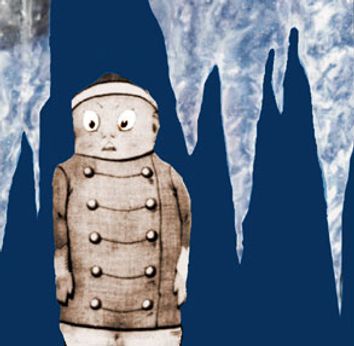
I don't let my children play with fire. So they play with ice instead.

  • more
    • All Share Services

Cold fusion

My freezer is full of cats.

Before you call the Society for the Prevention of Cruelty to Animals, let me assure you, these cats are not alive.

They’re not dead, either. These are stuffed animals, toys, drenched in water and left on their backs in the cold. Small icicles hang from their tails. The wire shelf racks score ribs into their synthetic fur. Soon my kids will take them out and squeeze them to see how crunchy they’ve become. They’ll marvel at the temperature. They might suck on a frozen paw.

Now 9 and 6, my kids have been freezing their toys for as long as I can remember. At any given moment, I can find a Tupperware container in the freezer, the water inside thickening into ice floes around a bunch of Legos or a Barbie head. Often, I’ll walk into the kitchen and see the kids madly stabbing at blocks of ice with butter knives, frozen shards flying like sparks as they excavate their playthings.

Toys are not the only things my kids freeze. Currently, the freezer sports an atomic fireball candy encased in a cup of ice. The kids will thaw the confection and drink the water, which they say tastes like cinnamon tea. They have frozen volcanoes made of vinegar and baking soda, socks, pencils, strange mixtures of juice and pretzels — pretty much anything that can be stuffed through the narrow door of our side-by-side Coldspot.

They like to see how things change. “Freezing stuff is cool,” my son said the other day as he pulled out of the freezer a cup filled with plastic spiders suspended in some sort of frozen pink solution. Then he laughed and corrected himself. “No,” he said. “It’s cold.”

In one of his “Sonnets to Orpheus,” German poet Rainer Maria Rilke reminds us to “be conversant with transformation.” My kids, it seems, have a nonstop gabfest with transformation. I won’t let them play with fire, so they play with ice, an element that they can touch, and can alter. They are tapping into a basic magic here: How amazing, really, that water can shape-shift itself into solid, liquid, gas. How amazing that our bodies are made almost entirely of water. My kids, in their ice play, know that transformation is our native language.

I remember being blown away by the first law of thermodynamics when I first learned about it in a high school physics class. My world was rocked by the notion that matter cannot be created or destroyed, only transformed. It made me wonder what my own personal matter had once been. Maybe my little toe was once the tooth of a tiger. Maybe my eyeball was once Einstein’s breath. Maybe a little bit of praying mantis was braided into my hair. It made me wonder what my body would one day become. Would my kneecaps turn into tulips? My aorta, stardust? The world suddenly seemed much more dynamic and interconnected than I had ever before imagined. Nothing was solid anymore. Everything was in rich, pregnant flux.

Being a mom keeps me conversant with transformation. I remember how, when pregnant, each day I would wake up with a new body — my nipples, my bellybutton, the stretch marks that girded my hips all charting previously unexplored territory.

Now I watch my kids’ bodies transform almost daily. It is incredible to me how they came out of nothingness, how they grew into somethingness under my skin, how they keep on growing and changing, changing and growing. My son, who started to measure his height against mine when his head was up to my thigh, now hits my shoulder. I spoke with him the other day about puberty (which he thought was called “peeverty,” an apt malapropism if ever there was one) and he seemed both terrified and thrilled by the prospect of so much impending change.

I watch my own transformation as I get older — the fine lines across my face, the softening of my various parts. Our bodies are verbs, not nouns. We don’t stay the same for very long. We dissipate, we gather. We freeze, we melt, we boil.

My kids seem to know this as they set about turning our kitchen into a cryogenics lab. They seem to understand that life is fluid, dynamic, constantly changing. Or maybe I’m just projecting — maybe they’re fueled by curiosity, pure and simple, as they explore their world, explore their own power, discover what changes they can effect with their own hands. Whatever their thoughts on the subject may be, I don’t mind finding frozen cats or candies or clothing in the freezer. It keeps me conversant with transformation. It keeps me conversant with my growing family, our strange and mutable selves.

Arin and Hannah’s cold fusion atomic fireball tea

This admixture of fire and ice will give you sticky fingers.

  • more
    • All Share Services

You will need, per person:

  • One plastic cup
  • Enough water to almost fill the cup, but not all the way
  • One atomic fireball candy

    Directions:

    1. Put the water in the cup.

    2. Suck the atomic fireball until it turns your fingers red when you take it out of your mouth.

    3. Put the candy in the water and wiggle it around until the atomic fireball gets white or the water gets really red.

    4. Put the cup in the freezer. You can keep the atomic fireball in, or you can take it out. If you keep it in, the tea will be sweeter.

    5. Freeze overnight.

    6. In the morning — or whenever your mom says it’s OK — take the cup out of the freezer and put it on the kitchen counter. While it’s still frozen, you can lick it, like a popsicle, or you can chop it up and eat it, like a Slurpee, but most people wait for it to melt and drink it, like tea. Sometimes it takes all day. You can cover it so flies won’t get in.

  • Contemplating hash browns

    A primordial nest of shredded spuds from which fond memories -- and life itself! -- have sprung.

    • more
      • All Share Services

    Contemplating hash browns

    hash \’hash\ vt (1590) 2: to talk about: REVIEW

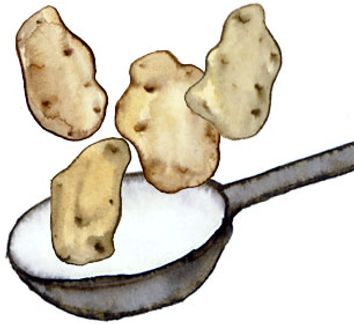
    I owe my life to hash browns.

    The first time my dad ever called my mom, he said, “I love hashed brown potatoes!” when she answered the phone. No “Hello.” No “Um, this is Buzz Brandeis — we met the other night at the Quadrangle Club?” Just a bright, enthusiastic “I love hashed brown potatoes!”

    Fortunately — for the sake of my own, and my descendants’, existence — my mom didn’t hang up. Fortunately, she laughed. Fortunately, she remembered the line, which came from a Eugene Ionesco play they had both seen the night they met.

    Neither of my parents can remember the name of the play: My dad thinks it may have been “The Woman With Three Noses”; my mom recalls it as something like “The Woman With One Eye.” I can’t find any proof that a play exists under either name. I thought maybe it could have been “The Rhinoceros” — the only Ionesco play I had ever heard of — but the closest reference I could find to hash browns in that script was a stage direction that called for an “edible cigarette” (a hash one, perhaps?).

    I hope to someday find the play about the woman with the unusual face, whoever she may be. It would be amazing to see, in black and white, the line that brought my parents together, the line that launched their relationship, a union that has been as tangled and nourishing as a wild mesh of potato shreds. I would love to trace my existence back to its absurdist, root-vegetable roots.

    hash n (1662) 3 b: a confused muddle

    My husband and I had an absurd hash brown connection of our own early in our relationship. A couple of months after we met, we had the chance to housesit for one of his mother’s friends. Our first morning there, I woke up early and thought about how nice it would be to make a romantic breakfast.

    Living in a dorm, I never had the chance to cook for Matt before. We were young and poor and hadn’t brought any groceries with us to the housesitting house, so I poked around the woman’s kitchen, looking for possibilities. Aside from a packet of stale pappadam, all I could find was a bag of potatoes, just starting to sprout. I discovered some garlic, rooted around for some oil and set about gouging out the pale eyes of the spuds.

    This was my first attempt at making hash browns, but I figured it would be fairly simple. How hard could it be to fry up some potatoes? I heated the oil in a cast-iron skillet, tossed in the garlic, then added the sliced potatoes just as the garlic began to burn.

    “Mmm, it smells good in here,” Matt said as he came down the stairs. He walked across the kitchen to kiss the back of my neck. I swiveled to give him access to my lips. When I turned back to the pan, the spatula had melted.

    It looked like the tip of a soft-serve ice-cream cone, its boxy edge liquefied into a dramatic swoop. In my limited kitchen experience, I had seen nothing wrong with using a rubber spatula in a hot frying pan. Now the potatoes were completely threaded with ribbons of rubber.

    Matt was very sweet about it, and insisted we eat the hash browns anyway. We spent most of the morning pulling chewy strands out of our mouths and spitting them into our napkins. Needless to say, I didn’t find Matt’s heart through his stomach.

    hash n (1662) 2: a restatement of something that is already known

    More than 12 years later, I had never even attempted to make hash browns again. Hash browns had become a going-out-to-breakfast treat for us, not something to eat at home. We are a family of diverse eaters — I’m a vegetarian, my omnivore husband has definite carnivorous tendencies, our son has been a “lacto-(except melted cheese-o)-ovo-baco vegetarian most of the year and our daughter vacillates between these camps. Hash browns are one thing we can always enjoy together.

    We’ve all become hash brown connoisseurs. We can rattle off the distinct charms of crispy golden hash browns, soft, pale hash browns, home fries, German fries, little fried fast-food hash brown coins, hash browns that look like hot potato chips, hash browns pressed into cakes, hash browns in chaotic shreds all over the plate.

    We can debate the additions of onions and green peppers. We can discuss the relative merits of ketchup and hot sauce (and whether you should pour the stuff over the top or goop it on the side for dipping). We just can’t tell you how to make the spuds at home.

    Recently I figured it was time for me to give cooking hash browns another go. The dish is part of my personal mythology, I reasoned; the least I could do is figure out how it’s made. As long as I could manage not to rubberize the potatoes, I was sure my experiment would be a success.

    It bears mentioning that in the past few years, I have become a lazy cook. I love to eat, I adore good food, but somehow the process of cooking has become something less than bliss for me. I think the creative energy I used to pour into soufflis is now being channeled into my writing. My writing gets the freshest, most savory part of me; the kitchen gets my leftovers, my dried-out scraps. I hope to someday reclaim my inner Wolfgang Puck, but for now we eat takeout burritos and pasta with jarred sauce far more often than I’d like to admit.

    hash \’hash\ vt 1 a: to chop into small pieces

    When I started to look for hash brown recipes, I anticipated only a few ingredients, only a few steps from start to finish. It appeared that I was fooling myself. “The Joy of Cooking” gals wanted me to pour a quarter-cup of cream over the hash browns while they cooked. Julia Child’s hash brown “flipping” instructions freaked me out. Even though she says she prefers a “slightly messy flip,” her description of a “daring flip” was a bit too intimidating for this cook. (Child also says she likes to use her hash browns as a bed for game hen, which, I’ve heard, can be slightly messy sleepers.)

    Many recipes wanted me to boil or bake the potatoes before I grated, diced or sliced them, which seemed like way too much work. If I’m going to boil or bake potatoes, I’m going to stop right there, grab the butter and salt and chow down, thank you very much.

    I found recipes that sounded more like latkes (something I do cook at least once a year, with varying degrees of success), recipes that sounded more like french fries, recipes that sounded more like brain surgery. By the time I happened upon the most simple recipe, from the Potato Board online (shred some potatoes, cook them in butter or oil), I was so exhausted that even that seemed too difficult. I wanted to have nothing whatsoever to do with a frying pan.

    hash n (1662) 3 a: hodgepodge, jumble

    That’s when I decided to hark back to the absurdist element of my parents’ first meeting, the absurdist element of the first meal I cooked for Matt. I went online again and looked at all the shudder-inducing hash brown casserole recipes I had avoided earlier. What could be more absurd, after all, than hash browns cooked with cornflakes and soup?

    I decided to blend a couple of the recipes I found into one gloriously mid-20th century casserole concoction, the kind of casserole that always embarrassed my friends when I was a kid but that I secretly pined for. Most of the steps involved simply opening packages and mushing the ingredients together — perfect for my lazy frame of mind. Plus, my daughter was more than happy to crush the cornflakes.

    The only “tricky” parts of the recipe required melting some butter and chopping a few scallions, which I ended up being glad for — their fresh green sting took away some of my guilt about cooking an otherwise completely processed-food meal for my family.

    Opening the soup can, I felt like the mutant child of Susie Homemaker and Andy Warhol.

    To my surprise, what started out pretty much as a joke ended up being a decadently satisfying dinner. The casserole was pure comfort food, so rich it made me gasp for air. With a Greek salad (from a bag — don’t give me too much credit) and some baby peas, this proved to be quite the square meal, maybe even a cubic one.

    The success was due, I’m sure, to the magic influence of the hash browns, which pretty much disappeared into the glop that made up the rest of the dish. Even hidden under cream of potato soup, even blanketed with sour cream, hash browns will forever taste like new beginnings to me — a taste I’ll always be grateful for.

    “I love hashed brown potatoes!” my dad told my mom the first time he called her, 36 years ago this week. I do, too. With a vengeance. Maybe next time I’ll even try to fry a batch — with a metal spatula, of course — myself.

    Continue Reading Close

    Hash browns

    Plain or absurd, they are always a hot item.

    • more
      • All Share Services

    Absurdly easy hash browns

    4 medium unpeeled potatoes
    1 cup grated onion
    4 teaspoons olive oil
    4 teaspoons butter
    2 teaspoons fresh or dried herbs, if desired (rosemary, oregano, etc.)
    Salt and pepper

    1. Grate potatoes coarsely; rinse with cold water and pat dry.
    2. Heat butter and oil in a large skillet.
    3. Add potatoes, onions, herbs.
    4. Cook over medium-high heat until tender and golden; toss occasionally, but not too often.

    5. Add salt and pepper to taste.

    Serves four.

    Hash brown casserole, ` la Ionesco

    1 2-pound bag of frozen hash browns
    1 can condensed cream of potato soup
    2 cups sour cream
    1/4 cup butter
    1 cup shredded cheddar cheese
    1/2 cup green onions, chopped
    2 cups cornflakes, crushed
    Salt and pepper to taste

    1. Preheat oven to 350 degrees.
    2. Melt butter over low heat.
    3. Mix 2 tablespoons of the melted butter with the crushed cornflakes; set aside.
    4. Mix soup and sour cream with remaining butter, and heat gently.
    5. In a large bowl, combine potatoes, green onion and cheese. Stir in heated soup mixture, then season with salt and pepper. Pour into a 9-by-13 casserole. Sprinkle cornflakes mixture evenly over the top.
    6. Bake 30 to 45 minutes, until bubbly and golden brown on the sides.

    Serve warm. Watch out for rhinoceros.

    Continue Reading Close

    O Tin-nenbaum

    This year, we welded our holiday totem; maybe next year we'll get it chromed.

    • more
      • All Share Services

    Before the metal Christmas tree, my husband used to think of the holidays the way he thought of traffic school. Sure, they may offer you a couple of free slices of pizza; sure, the instructor may be one hell of a funny guy; but the bottom line is this: You Are Required To Be There. It’s court-ordered. If you don’t show up, buster, you’re in for it.

    Matt was never a Grinch about the season, but he was never a Who down in Whoville, either. The holidays held no true joy for him. They felt like one big fat expensive obligation. Standing in line at the DMV, taxes, regular dental visits, holidays — all filled him with the same sense of duty and dread.

    I have always loved the holidays. I’ve always loved lighting the Chanukah candles, saying the blessing. I’ve always loved assembling the pieces of the small artificial Christmas tree from my assimilated Jewish childhood. Dust and old plastic smell more like Christmas to me than pine boughs and frankincense ever will.

    Now that the scent of spray paint and acetylene have become part of our holiday traditions, Matt appreciates the season much more, too.

    I don’t remember how the subject of a metal Christmas tree first came up. I suppose it was inevitable — Matt has always loved tinkering around with metal. When our son was little, he welded together a stroller loosely based on the shape of the running strollers that were just starting to become popular. If you tried to run with this stroller, though, you’d get much more of a workout than you’d bargained for. The thing was massive and angular, made of heavy rectangular steel bars. I could fit in the blue canvas seat, myself, with Arin in my lap. The bottom was fitted with sheet metal, which came in handy — I would wrestle the stroller to the grocery store down the street with Arin lounging in the hammock-y chair, and walk home with several bags of groceries resting under him on the metal shelf.

    Matt has also welded a bed frame strung with bungee cord, which was a bit more bouncy than he had anticipated; a push scooter fashioned with an engine that took it up to 35 mph; and some great metal-and-wood shelves for our house. He hasn’t yet crafted the mechanical chicken he dreams about, but I know he’ll make it a reality someday, in all its shiny poultry glory.

    However the idea for the Christmas tree first came about, it soon became a family affair. While Matt made the “trunk” out of 1-inch steel tubing and welded on several small sleeves of steel for the branches to plug into, I measured out lengths of quarter-inch steel rod for the branches, with smaller pieces to weld on as twigs. I cut them with huge bolt cutters, my whole body getting into the act — one foot holding down the bottom handle of the cutter, both hands pushing at the top. The deep clunk as the blades passed through metal was a strangely satisfying experience.

    The kids arranged the branches on the floor of the garage, sticking the twigs in different formations on the larger sticks, making each branch unique as a snowflake. Some of the branches had a diamond of twigs jutting out of the end, some looked feathered, others resembled arrows.

    After the branches were all laid out, we each put on goggles and welding masks and watched Matt burn the pieces together. It felt every bit as festive as gathering around a yule log, maybe even more so.

    If you’ve never seen metal being welded, you have missed what I think is one of the most gorgeous things available to the (shielded) human eye. Metal looks magical as it melts, alchemical, like some strange and luminous cellular process.

    When I took off my mask, I felt disoriented, as if I had been on a journey to the hot, oozy, center of the earth and had to adjust again to the thin light of the sun. The welding torch had chewed into the concrete floor of the garage, leaving strange scorch marks, footprints of fire, lasting mementos of our holiday creation.

    After the branches cooled, we fit them onto the trunk. The result was surprisingly lush looking, full and very tree-like. We debated about whether to keep the tree in its heat-streaked, almost iridescent, state, but Matt decided that it would rust too easily. We ended up spray-painting the whole thing two shades of blue. Our plan is to repaint the tree in a different color each year, or, maybe even have it chromed somewhere along the line.

    Once the paint dried and the fumes dissipated, we brought the tree into the house. I could see the holiday spirit finally ignite in Matt’s eyes as he placed a flashlight-shaped tool he had crafted on the very top of the tree.

    While we hope to some day make funky ornaments out of motherboards, the 1968 reindeer and elves from my first Christmas looked pretty groovy hanging from the metal branches. When we plugged in the string of lights, the whole tree, and the whole holiday season, came to sudden, dazzling life. We stood around it and sang.

    Continue Reading Close

    DYR MOM: WY R YOU SO LAVEABL?

    A nascent writer learns to cast spells.

    • more
      • All Share Services

    DYR MOM: WY R YOU SO LAVEABL?

    A few months ago, I bought some sugar cookies shaped like the letters of
    the alphabet. When Jewish children begin to study Torah, rabbis often give
    them a spoonful of honey so they will always associate learning with
    sweetness. I figured the cookies would provide a most delicious reading
    lesson for my 5-year-old daughter. I could picture us at the table
    together, spelling CAT and LOVE and APPLE on paper plates, our mouths full of shortbread and sugar and the lingering sweetness of words.

    When I got home, though, I discovered my daughter had already created her own movable feast. Hannah had been sent to her room for some minor infraction while I was out, and she was not happy about it. Did she whine? Maybe. Did she cry? Most likely. I wasn’t there to hear her protests. She did leave some evidence behind, though. She wrote.

    Hannah had never written anything all on her own before, other than her own name and the names of our family members. She had never constructed a sentence, never sat down with the intention of getting her thoughts on paper. In the hour that I was gone, though, she essentially figured out the whole writing process.

    As I walked through her door, Hannah handed me a piece of paper.

    “DYR MOM,” it said. “DED IS ALWYS MEYN.”

    Rough drafts of the letter were scattered around her room: “DRY MOM,” one began. “DYR MAM” read another.

    I was blown away. Not only had Hannah written a sentence for the first
    time, she had edited her own work! After years as a writer, I have only
    recently made friends with the revision process. Hannah shook hands with
    it her first time out. My heart filled to bursting — my little girl, a writer!

    My husband was amazed, too, although he was not completely thrilled to be the villain of her first literary undertaking. This gave us a little peek into what it must feel like to read a daughter’s tell-all memoir. Wait, the author’s parents must want to say, that’s not the whole story! We’re not bad people! We bought her a Sno-Cone from the ice cream truck just
    minutes before the alleged incident! And, you know, she never would have
    been sent to her room if she hadn’t thrown a stick at her brother’s head!

    Before we could get too worked up about her initial angry outpouring of
    words, though, Hannah began another series of letters, sweet as any sugar cookie.

    “DYR PYPIL,” she wrote. “I LAV AVRYWON.”

    “DYR IDAHO,” another said. “I WD LIK TO GO THAR.”

    It didn’t take long for her to return to her writergrrl roots, though. In
    a little heart-covered, pastel-papered notebook, she wrote more scathing
    critiques of her dad, and even more of her brother. So far, I’ve managed to
    escape her writerly wrath. ” MOM,” she wrote in her journal. “WY R YOU SO LAVEABL?” I know I won’t be immune to her poison pen forever, but for now, I enjoy being the subject of her little tributes. Who needs good reviews when your own daughter writes “THAT DANS WS GROOVY” and “MI MOM IS A POET. YOU CN TEL BCS OF HR BUKS”?

    Hannah often sits on the couch, one leg crossed over the other like a
    stenographer from a ’40s movie, pencil and notebook in hand. She loves to
    write lists — “LOBSDR, FISH, SHRIMP, SHRK”; “CHIKIN, TRKY, DAK,
    ROOSDR” — little inventories of the world she knows. She has her own
    “dictionary of bad words,” which right now reads “ASS ASS ASS HL.” She
    seems to know that writing is a safe place to explore the taboo, to delve
    into rage and joy and the enchantment of the ordinary.

    “I have my own way of spelling,” Hannah says excitedly, like she’s created
    her own civilization. When she asks me how to spell something correctly, I
    tell her, but I love the playful, fluid way she chooses to spell words. I
    want to give her some more time to swim around in her own language before she has to worry about spelling tests and red pencils marks and grammar and precision. That will come soon enough.

    I think of Margaret Atwood’s poem “Spelling,” which opens:

    My daughter plays on the floor

    with plastic letters,

    red, blue & hard yellow,

    learning how to spell,

    spelling,

    how to make spells

    Hannah is learning how to make spells. Her own spells. Her own magic.

    Hannah and I never did have our sugar-cookie spelling lesson. Our family
    polished off the container of treats like speed readers, spilling spelling
    crumbs everywhere, before we had a chance to act out my plan. Hannah
    taught herself more than those cookies ever could, though.

    The very last page of Hannah’s heart notebook reads, in large letters, “I
    AM JIST FYN.” Isn’t that, ultimately, what we all try to say when we
    write? Aren’t we all trying to convince our readers and, even more so,
    ourselves, that we are just fine? That our words are valid? That we
    deserve to be heard?

    Atwood writes later in the same poem, “A word after a word/
    after a word is power.” It is very cool for me, as a writer and a woman, to watch my daughter discover that power inside her. She helps me remember my own power as well: words sweet and biting, pungent and nourishing, in all of our fingers, on both of our tongues.

    Continue Reading Close